Decision comparison
Helicone vs OpenLIT
For LLM request logging and cost monitoring, Helicone is the focused fit when an OpenAI-compatible gateway, provider routing, automatic fallbacks, and unified billing are valuable. OpenLIT is the stronger fit when those request metrics must live inside broader OpenTelemetry-based agent harness engineering with evaluations, guardrails, prompts, and GPU monitoring. Helicone stops being the right answer when agent-level quality controls are the priority; OpenLIT stops being the right answer when gateway-based multi-provider routing and fallback execution are required.
Architecture choice. These take different approaches to the same problem. Read the table as a fit question rather than a feature race.
All 2 are LLM observability & evaluation.
Quick Comparison
| Decision factor | Helicone | OpenLIT |
|---|---|---|
| Best For | Teams needing low-friction LLM request logging, cost monitoring, provider routing, and fallback handling through an OpenAI-compatible gateway. | Teams instrumenting agent harnesses that need OpenTelemetry traces, evaluations, runtime guardrails, prompt management, and infrastructure cost visibility. |
| Architecture | OpenAI-compatible gateway captures requests in transit; optional asynchronous SDK supports teams unwilling to route production traffic externally. | OpenTelemetry-native agent harness platform covering tracing, evaluations, guardrails, prompts, context, model costs, and GPU monitoring. |
| Pricing Model | Hobby is free with 10,000 requests and 1 GB of storage. Pro is $79/month and Team is $799/month, both adding usage-based charges above the same 10,000 free requests and 1 GB. Enterprise is quoted and is the only tier with an on-prem deployment. The gateway is Apache 2.0 licensed, so self-hosting is free. | Open source under the Apache-2.0 license; source code at https://github.com/openlit/openlit. |
| Ease of Use | Point the OpenAI SDK at Helicone's endpoint to log requests with minimal application-code changes and no new tracing model. | Works with models, frameworks, and harnesses including Claude Code, Codex, OpenAI Agents SDK, LangGraph, and CrewAI. |
| Scalability | Gateway routes across more than 100 models with automatic provider fallbacks; Enterprise alone offers quoted on-premises deployment. | Self-hosted OpenTelemetry-based deployment supports observability across model, agent-harness, cost, and GPU monitoring workloads. |
| Community/Support | Apache-2.0 TypeScript repository with 6,274 GitHub stars; commercial Hobby, Pro, Team, and Enterprise service options. | Apache-2.0 TypeScript repository with 2,971 GitHub stars; documentation emphasizes self-hosting and broad framework compatibility. |
Helicone
- Best For:
- Teams needing low-friction LLM request logging, cost monitoring, provider routing, and fallback handling through an OpenAI-compatible gateway.
- Architecture:
- OpenAI-compatible gateway captures requests in transit; optional asynchronous SDK supports teams unwilling to route production traffic externally.
- Pricing Model:
- Hobby is free with 10,000 requests and 1 GB of storage. Pro is $79/month and Team is $799/month, both adding usage-based charges above the same 10,000 free requests and 1 GB. Enterprise is quoted and is the only tier with an on-prem deployment. The gateway is Apache 2.0 licensed, so self-hosting is free.
- Ease of Use:
- Point the OpenAI SDK at Helicone's endpoint to log requests with minimal application-code changes and no new tracing model.
- Scalability:
- Gateway routes across more than 100 models with automatic provider fallbacks; Enterprise alone offers quoted on-premises deployment.
- Community/Support:
- Apache-2.0 TypeScript repository with 6,274 GitHub stars; commercial Hobby, Pro, Team, and Enterprise service options.
OpenLIT
- Best For:
- Teams instrumenting agent harnesses that need OpenTelemetry traces, evaluations, runtime guardrails, prompt management, and infrastructure cost visibility.
- Architecture:
- OpenTelemetry-native agent harness platform covering tracing, evaluations, guardrails, prompts, context, model costs, and GPU monitoring.
- Pricing Model:
- Open source under the Apache-2.0 license; source code at https://github.com/openlit/openlit.
- Ease of Use:
- Works with models, frameworks, and harnesses including Claude Code, Codex, OpenAI Agents SDK, LangGraph, and CrewAI.
- Scalability:
- Self-hosted OpenTelemetry-based deployment supports observability across model, agent-harness, cost, and GPU monitoring workloads.
- Community/Support:
- Apache-2.0 TypeScript repository with 2,971 GitHub stars; documentation emphasizes self-hosting and broad framework compatibility.
Public signals
Verified factual signals only. Bars appear only for like-for-like metrics with five weekly assessments for every tool; missing evidence stays explicit. These signals do not establish enterprise adoption, product quality, or total cost.
| Metric | Helicone | OpenLIT |
|---|---|---|
| GitHub commits, 90d(Product adoption) | 16 | 138 |
| GitHub stars(Product adoption) | 6,000+ | 3,000+ |
| npm weekly downloads(Developer adoption) | 10.6k | Not available |
| Product Hunt comments(Community interest) | 163 | Not available |
| Product Hunt rating(Community interest) | 5.0/5 | Not available |
| Product Hunt reviews(Community interest) | 13 | Not available |
| Product Hunt votes(Community interest) | 790 | Not available |
| PyPI weekly downloads(Developer adoption) | 181 | 91.2k |
As of November 16, 2026 — updated weekly.
Health & risk evidence
Observed public-source checks for mapped package versions and repositories.
Helicone
November 16, 2026Package vulnerabilities
npm · @helicone/helpers@1.8.3 · PyPI · helicone@1.0.14
0 vulnerabilities
across 2 packages
Repository security score
Not available
OpenLIT
November 16, 2026Package vulnerabilities
PyPI · openlit@1.45.0
0 vulnerabilities
across 1 package
Repository security score
Not available
Interface Preview
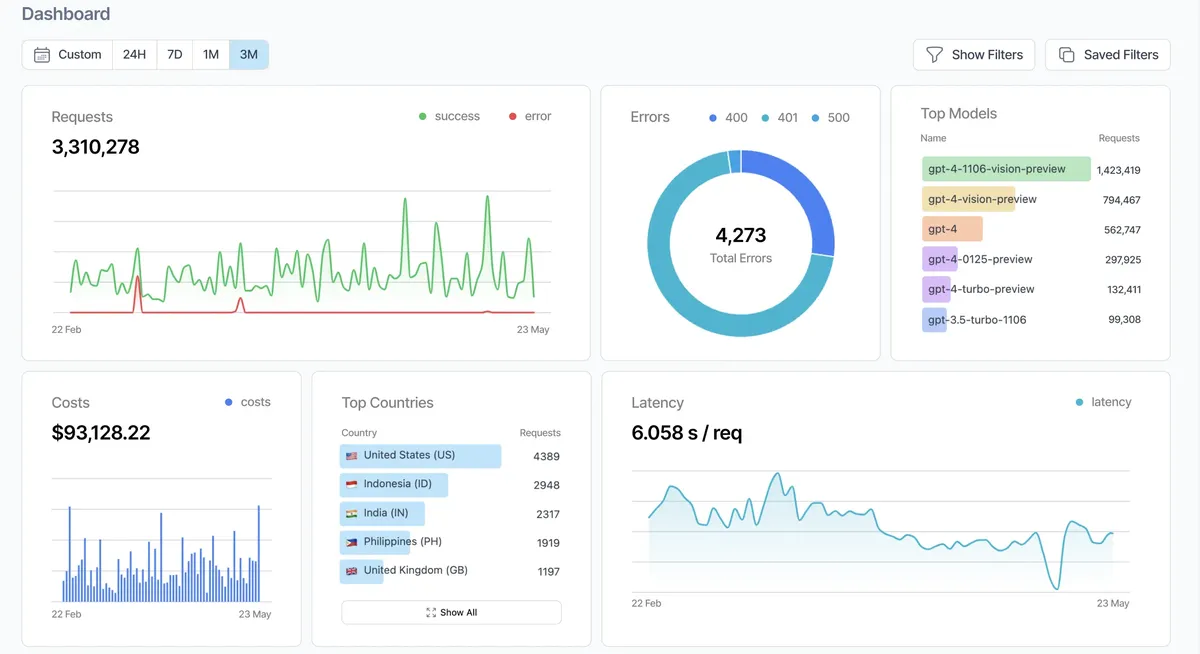
Helicone
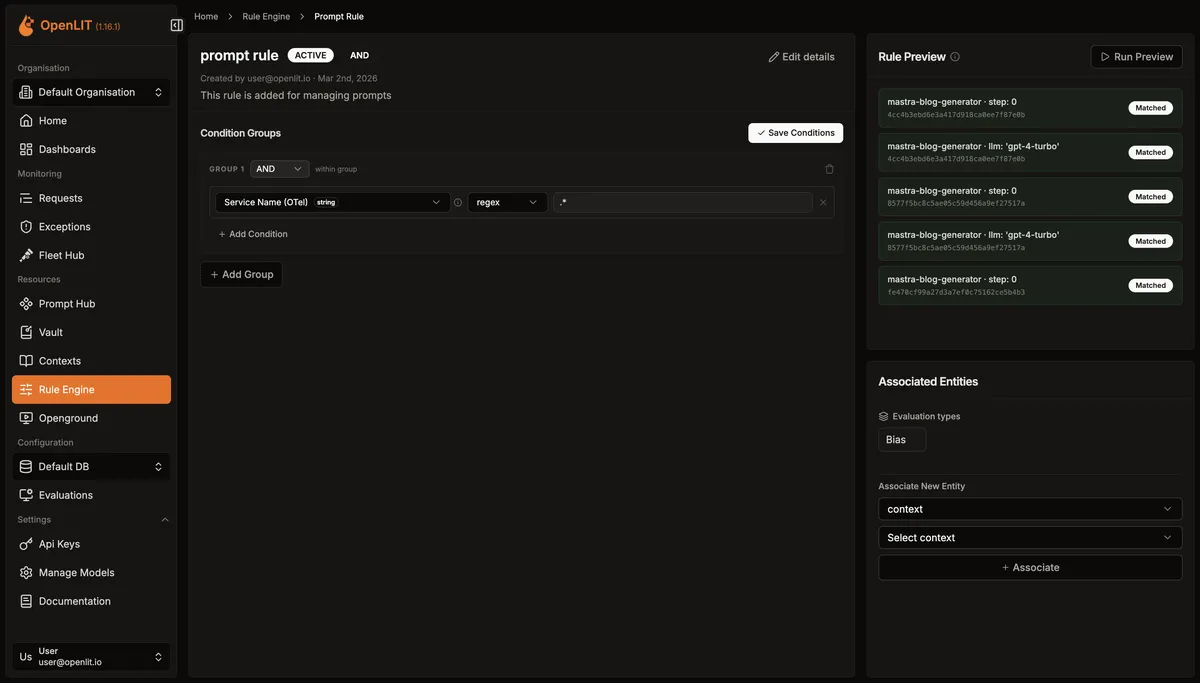
OpenLIT
Feature Comparison
| Feature | Helicone | OpenLIT |
|---|---|---|
| Instrumentation and request capture | ||
| Primary integration path | Redirect OpenAI SDK requests to a compatible gateway endpoint | Instrument agent harnesses through OpenTelemetry-native observability |
| Production traffic routing | Gateway sits in request path and records each model call | OTEL tracing captures harness behavior around model interactions |
| Alternative capture method | Async SDK logs activity without routing production traffic externally | Framework- and harness-compatible OpenTelemetry instrumentation captures telemetry |
| Model operations | ||
| Provider routing | Routes requests across more than one hundred available models | Works with any model through its agent-harness observability approach |
| Provider resilience | Automatically falls back between providers during routed requests | No provider-routing or automatic-fallback capability is provided |
| Billing model | Unifies provider billing with no stated markup on usage | Tracks model costs within OpenTelemetry-native agent observability |
| Observability and cost analysis | ||
| Request telemetry | Records individual request cost and latency through gateway logging | Traces agent failures across harness and model execution |
| Cost monitoring | Calculates request-level cost for logged LLM traffic | Monitors model costs alongside agent-harness telemetry |
| Infrastructure monitoring | Focuses provided capabilities on LLM request metrics and routing | Monitors GPU usage alongside agent and model costs |
| Quality and agent improvement | ||
| Evaluations | Supports monitoring, evaluation, and experimentation for logged applications | Uses LLM-as-a-judge evaluations to score agent behavior |
| Runtime guardrails | No runtime guardrail capability is provided in supplied data | Applies runtime guardrails around AI agent execution |
| Prompt management | No prompt hub or context-management capability is provided | Provides Prompt Hub plus prompt and context management |
| Deployment and ecosystem | ||
| Self-hosting | Apache-2.0 gateway can be self-hosted without license cost | Apache-2.0 platform is free to self-host |
| On-premises option | Quoted Enterprise tier is the only stated on-premises deployment | Self-hosted Apache-2.0 deployment is documented without stated tier restrictions |
| Developer ecosystem | OpenAI-compatible gateway minimizes changes for existing SDK clients | Supports Claude Code, Codex, LangGraph, CrewAI, and OpenAI Agents SDK |
Instrumentation and request capture
Primary integration path
Production traffic routing
Alternative capture method
Model operations
Provider routing
Provider resilience
Billing model
Observability and cost analysis
Request telemetry
Cost monitoring
Infrastructure monitoring
Quality and agent improvement
Evaluations
Runtime guardrails
Prompt management
Deployment and ecosystem
Self-hosting
On-premises option
Developer ecosystem
Which approach fits
For LLM request logging and cost monitoring, Helicone is the focused fit when an OpenAI-compatible gateway, provider routing, automatic fallbacks, and unified billing are valuable. OpenLIT is the stronger fit when those request metrics must live inside broader OpenTelemetry-based agent harness engineering with evaluations, guardrails, prompts, and GPU monitoring. Helicone stops being the right answer when agent-level quality controls are the priority; OpenLIT stops being the right answer when gateway-based multi-provider routing and fallback execution are required.
When each approach fits
Choose Helicone if:
Choose Helicone for OpenAI-SDK-based applications where you want immediate request-level cost and latency logging, gateway routing across models, automatic provider fallbacks, and optional paid managed service.
Choose OpenLIT if:
Choose OpenLIT for self-hosted agent systems needing OTEL-native traces, LLM-as-a-judge evaluations, runtime guardrails, Prompt Hub, API-key vaulting, and GPU monitoring.
These scenarios reflect the available product evidence. Your requirements, existing stack, and team expertise should guide the final decision.
Frequently Asked Questions
What is the main difference between Helicone and OpenLIT?
Helicone centers its integration on an OpenAI-compatible gateway: applications point the OpenAI SDK at Helicone, which logs request cost and latency while also enabling routing across more than 100 models and automatic provider fallbacks. OpenLIT centers on OpenTelemetry-native agent harness engineering. It traces agent behavior and adds evaluations, runtime guardrails, prompt and context management, Vault API-key management, cost tracking, and GPU monitoring. Both can support request observability, but their operational control planes are different.
Which is better for small teams?
A small team with an existing OpenAI SDK integration and a narrow need for LLM request logging and spend visibility will usually find Helicone the faster starting point, because redirecting requests to its gateway requires minimal code change. Its Hobby tier includes 10,000 requests and 1 GB of storage. A small team building agent workflows may instead prefer OpenLIT if it needs self-hosted OTEL traces, guardrails, evaluations, and prompt management from the outset; its Apache 2.0 source is free to self-host.
Can I migrate from Helicone to OpenLIT?
Yes, but this is an instrumentation and operating-model migration rather than a like-for-like gateway swap. Helicone observes calls by receiving them through an OpenAI-compatible gateway, whereas OpenLIT uses OpenTelemetry-native instrumentation around the agent harness. A team should identify every SDK call, framework integration, dashboard, alert, cost-reporting workflow, and any Helicone routing or fallback dependency. OpenLIT can replace the observability portion for supported workloads, but its supplied capabilities do not describe Helicone-style provider routing or automatic fallbacks.
What are the pricing differences?
Helicone has a managed freemium model: Hobby is free for 10,000 requests and 1 GB of storage, while Pro costs $79 per month and Team costs $799 per month. Pro and Team retain the same included 10,000 requests and 1 GB, then add usage-based charges; Enterprise is quoted and is the only stated on-premises tier. Its Apache-2.0 gateway is also free to self-host. OpenLIT is Apache 2.0 open source and free to self-host; the provided information publishes no paid tier, managed-cloud price, or usage limit.