Decision comparison
Langfuse vs OpenLIT
Langfuse is the stronger fit when a team needs a mature, integrated workflow from production traces through datasets, experiments, evaluations, and controlled prompt releases. OpenLIT is the clearer choice when the operating model centers on OpenTelemetry-native agent harnesses, runtime guardrails, GPU visibility, secret management, and framework-agnostic self-hosting.
Direct comparison. These are reviewed substitutes bought for the same job, so the differences below are the ones that decide between them.
All 2 are LLM observability & evaluation.
Quick Comparison
| Decision factor | Langfuse | OpenLIT |
|---|---|---|
| Best For | Teams needing a unified production-to-experiment loop for tracing, prompt deployment, datasets, evaluations, and agent quality improvement. | Teams standardizing agent harness observability, runtime guardrails, GPU monitoring, and model-agnostic OpenTelemetry instrumentation across agent frameworks. |
| Architecture | Open-source server deployable from one container image; Langfuse Cloud runs the same software for managed operation. | Apache-2.0 open-source platform built around OpenTelemetry, supporting self-hosted deployment across models, frameworks, and coding-agent harnesses. |
| Pricing Model | Hobby is free with 50,000 units a month and 2 users. Core is $29/month, Pro is $199/month and Enterprise is $2,499/month, each including 100,000 units a month with unlimited users. Extra usage is $8 per 100,000 units, falling to $7 above 1 million, $6.50 above 10 million and $6 above 50 million. A Teams add-on is $300/month. Self-hosting the open-source server costs nothing. | Open source under the Apache-2.0 license; source code at https://github.com/openlit/openlit. |
| Ease of Use | Combines tracing, prompt management, datasets, experiments, and evaluations in one platform, reducing workflow handoffs for LLM engineering teams. | Provides an integrated OTEL-native harness toolkit for tracing, evaluations, guardrails, prompts, costs, GPU monitoring, and secrets. |
| Scalability | Cloud plans include 100,000 monthly units; overages decline from $8 to $6 per 100,000 units at volume. | Self-hosted, OpenTelemetry-native architecture supports model- and framework-independent instrumentation; published data provides no hosted capacity limits. |
| Community/Support | Open-source platform with 37,197 GitHub stars; enterprise tier and optional $300/month Teams add-on support collaboration. | Apache-2.0 source project with 2,971 GitHub stars; documentation emphasizes compatibility with Codex, LangGraph, CrewAI, and OpenAI Agents SDK. |
Langfuse
- Best For:
- Teams needing a unified production-to-experiment loop for tracing, prompt deployment, datasets, evaluations, and agent quality improvement.
- Architecture:
- Open-source server deployable from one container image; Langfuse Cloud runs the same software for managed operation.
- Pricing Model:
- Hobby is free with 50,000 units a month and 2 users. Core is $29/month, Pro is $199/month and Enterprise is $2,499/month, each including 100,000 units a month with unlimited users. Extra usage is $8 per 100,000 units, falling to $7 above 1 million, $6.50 above 10 million and $6 above 50 million. A Teams add-on is $300/month. Self-hosting the open-source server costs nothing.
- Ease of Use:
- Combines tracing, prompt management, datasets, experiments, and evaluations in one platform, reducing workflow handoffs for LLM engineering teams.
- Scalability:
- Cloud plans include 100,000 monthly units; overages decline from $8 to $6 per 100,000 units at volume.
- Community/Support:
- Open-source platform with 37,197 GitHub stars; enterprise tier and optional $300/month Teams add-on support collaboration.
OpenLIT
- Best For:
- Teams standardizing agent harness observability, runtime guardrails, GPU monitoring, and model-agnostic OpenTelemetry instrumentation across agent frameworks.
- Architecture:
- Apache-2.0 open-source platform built around OpenTelemetry, supporting self-hosted deployment across models, frameworks, and coding-agent harnesses.
- Pricing Model:
- Open source under the Apache-2.0 license; source code at https://github.com/openlit/openlit.
- Ease of Use:
- Provides an integrated OTEL-native harness toolkit for tracing, evaluations, guardrails, prompts, costs, GPU monitoring, and secrets.
- Scalability:
- Self-hosted, OpenTelemetry-native architecture supports model- and framework-independent instrumentation; published data provides no hosted capacity limits.
- Community/Support:
- Apache-2.0 source project with 2,971 GitHub stars; documentation emphasizes compatibility with Codex, LangGraph, CrewAI, and OpenAI Agents SDK.
Public signals
Verified factual signals only. Bars appear only for like-for-like metrics with five weekly assessments for every tool; missing evidence stays explicit. These signals do not establish enterprise adoption, product quality, or total cost.
| Metric | Langfuse | OpenLIT |
|---|---|---|
| Docker Hub pulls(Product adoption) | 22.0M | Not available |
| GitHub commits, 90d(Product adoption) | 2.5k | 138 |
| GitHub stars(Product adoption) | 37,000+ | 3,000+ |
| npm weekly downloads(Developer adoption) | 2.5M | Not available |
| Product Hunt comments(Community interest) | 159 | Not available |
| Product Hunt rating(Community interest) | 5.0/5 | Not available |
| Product Hunt reviews(Community interest) | 49 | Not available |
| Product Hunt votes(Community interest) | 759 | Not available |
| PyPI weekly downloads(Developer adoption) | 7.5M | 91.2k |
As of November 16, 2026 — updated weekly.
Health & risk evidence
Observed public-source checks for mapped package versions and repositories.
Langfuse
November 16, 2026Package vulnerabilities
npm · langfuse@3.39.2 · PyPI · langfuse@5.2.0
0 vulnerabilities
across 2 packages
Repository security score
Not available
OpenLIT
November 16, 2026Package vulnerabilities
PyPI · openlit@1.45.0
0 vulnerabilities
across 1 package
Repository security score
Not available
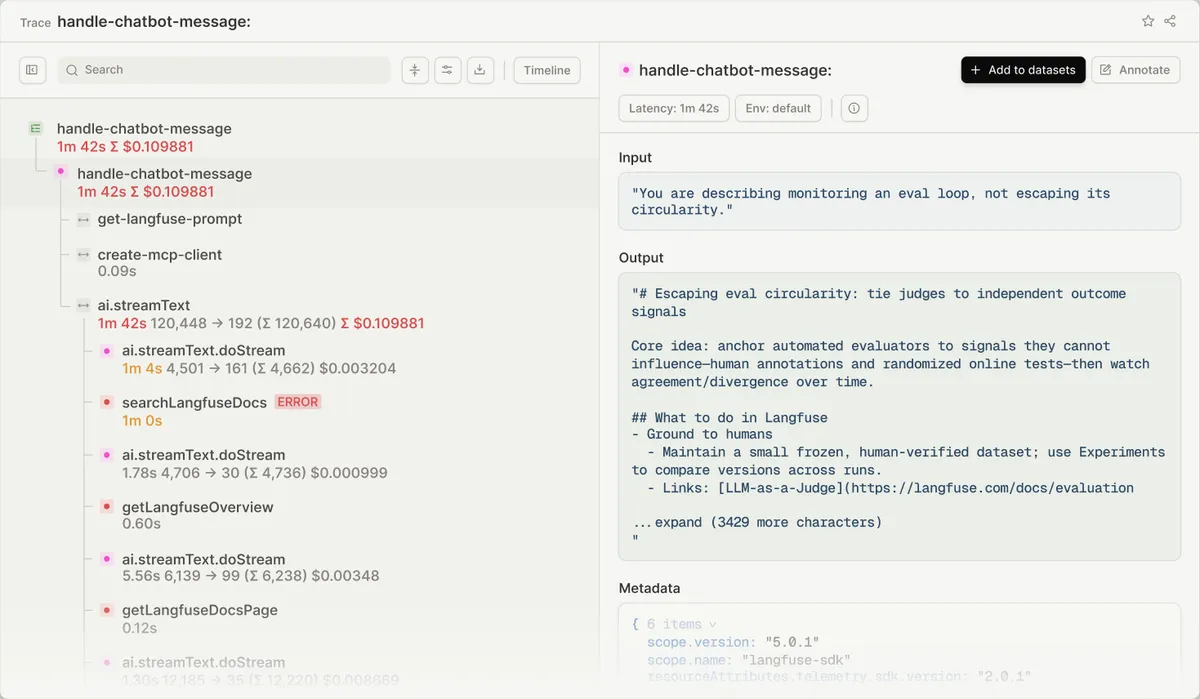
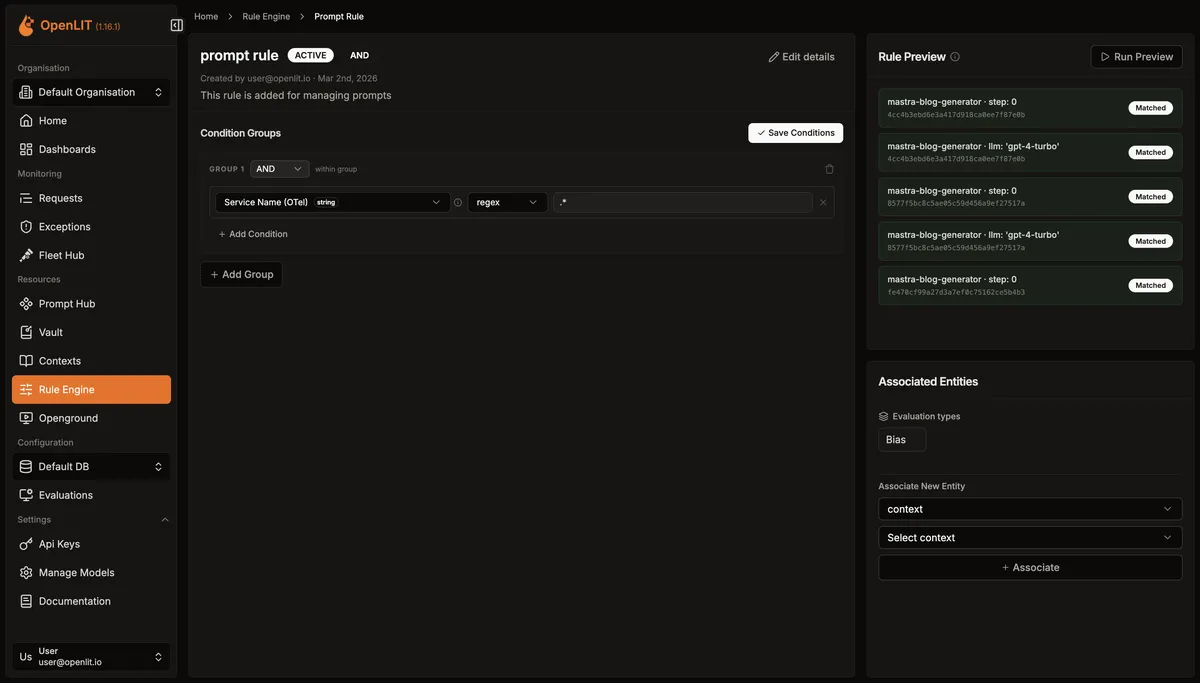
Interface Preview
Langfuse
OpenLIT
Feature Comparison
| Feature | Langfuse | OpenLIT |
|---|---|---|
| Observability and tracing | ||
| Trace capture | Hierarchical traces capture model calls, tools, and retrieval steps. | OpenTelemetry-native tracing captures behavior across agent harness components. |
| Production analysis | Uses production signals to understand behavior, cost, latency, and quality. | Traces agent failures so teams can turn them into harness fixes. |
| Cost visibility | Production loop uses observed application behavior to tune cost and latency. | Tracks AI-agent costs alongside traces and harness-level operational signals. |
| Evaluation workflow | ||
| Production evaluations | Runs evaluators against production data as well as test datasets. | Scores agent behavior with integrated LLM-as-a-judge evaluations. |
| Experimentation | Connects datasets and experiments directly to trace-based improvement workflows. | Uses evaluations to identify and improve agent harness behavior. |
| Quality feedback loop | Links tracing, testing, evaluation, and release improvements continuously. | Connects traced failures, scores, and fixes around agent harnesses. |
| Prompt and context operations | ||
| Prompt management | Deploys and rolls back prompts outside the application release cycle. | Provides Prompt Hub for managing prompts around agent harnesses. |
| Context management | Captures retrieval steps within hierarchical application traces. | Includes prompt and context management in the OpenTelemetry-native platform. |
| Prompt release control | Separates prompt deployment and rollback from code deployment workflows. | Provided data identifies Prompt Hub, without published rollback workflow details. |
| Agent runtime controls | ||
| Runtime guardrails | Provided product data emphasizes tracing and evaluation, not runtime guardrails. | Applies runtime guardrails as part of the agent harness platform. |
| Model comparison | Experiments evaluate application changes using datasets and production signals. | OpenGround supports model comparison within the agent engineering workflow. |
| API key management | Provided product data does not identify a dedicated API-key vault. | Vault manages API keys for agent harness and model integrations. |
| Deployment and ecosystem | ||
| Self-hosting | Runs the open-source server from one container image at no software cost. | Self-hosts free under Apache-2.0 for model-agnostic agent operations. |
| Framework coverage | Captures model, tool, and retrieval activity in production LLM applications. | Works with Claude Code, Codex, LangGraph, CrewAI, and OpenAI Agents SDK. |
| Infrastructure monitoring | Focuses published capabilities on LLM application traces, evaluations, and prompts. | Monitors GPU activity alongside agent cost and observability data. |
Observability and tracing
Trace capture
Production analysis
Cost visibility
Evaluation workflow
Production evaluations
Experimentation
Quality feedback loop
Prompt and context operations
Prompt management
Context management
Prompt release control
Agent runtime controls
Runtime guardrails
Model comparison
API key management
Deployment and ecosystem
Self-hosting
Framework coverage
Infrastructure monitoring
Which to choose
Langfuse is the stronger fit when a team needs a mature, integrated workflow from production traces through datasets, experiments, evaluations, and controlled prompt releases. OpenLIT is the clearer choice when the operating model centers on OpenTelemetry-native agent harnesses, runtime guardrails, GPU visibility, secret management, and framework-agnostic self-hosting.
Best-fit scenarios
Choose Langfuse if:
Choose Langfuse for self-hosted or managed LLM-agent tracing where product teams need production-data evaluation, dataset experiments, prompt rollback, and explicit cloud pricing that starts with a 50,000-unit free Hobby tier.
Choose OpenLIT if:
Choose OpenLIT for a fully self-hosted Apache-2.0 agent harness stack when OpenTelemetry standardization, runtime guardrails, GPU monitoring, Vault key management, and support for coding-agent frameworks are primary requirements.
These scenarios reflect the available product evidence. Your requirements, existing stack, and team expertise should guide the final decision.
Frequently Asked Questions
What is the main difference between Langfuse and OpenLIT?
Langfuse organizes LLM engineering around a continuous improvement loop: hierarchical traces feed datasets, experiments, evaluations, and prompt changes that can be deployed or rolled back independently of application releases. OpenLIT organizes around agent harness engineering on OpenTelemetry, combining tracing with LLM-as-a-judge evaluations, runtime guardrails, Prompt Hub, OpenGround model comparison, Vault API-key management, cost tracking, and GPU monitoring. Both support self-hosting, but their operational emphasis differs substantially.
Which is better for small teams?
For a small team building a conventional LLM application or agent product, Langfuse offers a particularly straightforward starting point: its Hobby tier includes 50,000 units per month for two users, while tracing, prompts, datasets, experiments, and evaluations share one workflow. For a small infrastructure-focused team that already standardizes on OpenTelemetry and needs guardrails or GPU visibility, OpenLIT can be compelling because it is free to self-host under Apache-2.0. The deciding factor is workflow scope, not team size alone.
Can I migrate from Langfuse to OpenLIT?
A migration is feasible at the application-instrumentation level, but the provided product information does not establish a built-in Langfuse-to-OpenLIT migration utility or direct data-import path. Plan to map existing Langfuse trace, evaluation, prompt, and dataset usage to OpenLIT's OpenTelemetry-native tracing, evaluation, and Prompt Hub workflows. Validate trace semantics, evaluator output, retention requirements, dashboards, and any prompt-release processes in a parallel environment before retiring Langfuse.
What are the pricing differences?
Langfuse publishes both free and paid cloud pricing. Hobby is free for 50,000 units per month and two users; Core costs $29 per month, Pro $199 per month, and Enterprise $2,499 per month, each including 100,000 units per month and unlimited users. Additional usage costs $8 per 100,000 units, declining to $7 above one million units, $6.50 above 10 million, and $6 above 50 million; Teams is a $300 monthly add-on. OpenLIT is Apache-2.0 open source and free to self-host; the supplied information lists no managed tiers, usage rates, or public dollar prices.