Decision comparison
Langfuse vs TruLens
For tracing and evaluating LLM applications across experiments and production, choose Langfuse when a team needs a managed or self-hosted platform that also governs prompts, datasets, and release-adjacent evaluation. Choose TruLens when OpenTelemetry-native instrumentation, RAG/agent feedback metrics, custom selectors, and version comparison are the core workflow; it stops being the complete answer when prompt lifecycle management and a published managed commercial platform are required.
Architecture choice. These take different approaches to the same problem. Read the table as a fit question rather than a feature race.
All 2 are LLM observability & evaluation.
Quick Comparison
| Decision factor | Langfuse | TruLens |
|---|---|---|
| Best For | Production LLM teams needing unified tracing, prompt management, datasets, experiments, evaluations, and controlled prompt deployment in one platform. | Teams evaluating RAG systems and AI agents with OpenTelemetry traces, agentic evaluations, custom metrics, and application-version comparisons. |
| Architecture | Open-source server deployable from one container image; Langfuse Cloud uses the same software for tracing and evaluation workflows. | MIT-licensed Python project built around OpenTelemetry-native tracing, selectors, inline or batch evaluation, MCP support, and custom metrics. |
| Pricing Model | Hobby is free with 50,000 units a month and 2 users. Core is $29/month, Pro is $199/month and Enterprise is $2,499/month, each including 100,000 units a month with unlimited users. Extra usage is $8 per 100,000 units, falling to $7 above 1 million, $6.50 above 10 million and $6 above 50 million. A Teams add-on is $300/month. Self-hosting the open-source server costs nothing. | Open source under the MIT license; source code at https://github.com/truera/trulens. |
| Ease of Use | Connects production traces, datasets, experiments, evaluators, and prompt changes in one continuous engineering loop, reducing tool-to-tool handoffs. | Selector API and inline or batch evaluations let developers attach targeted metrics to traces and compare application versions. |
| Scalability | Usage-metered cloud plans include 100,000 units, with declining overage rates from $8 to $6 per 100,000 units. | Uses OpenTelemetry-based tracing and supports batch evaluation; published data does not specify managed capacity limits or metered scaling. |
| Community/Support | Open-source platform with 37,197 GitHub stars; commercial plans, enterprise offering, and a $300/month Teams add-on support collaboration. | Actively maintained in open source by Snowflake after TruEra's acquisition; repository reports 3,633 GitHub stars. |
Langfuse
- Best For:
- Production LLM teams needing unified tracing, prompt management, datasets, experiments, evaluations, and controlled prompt deployment in one platform.
- Architecture:
- Open-source server deployable from one container image; Langfuse Cloud uses the same software for tracing and evaluation workflows.
- Pricing Model:
- Hobby is free with 50,000 units a month and 2 users. Core is $29/month, Pro is $199/month and Enterprise is $2,499/month, each including 100,000 units a month with unlimited users. Extra usage is $8 per 100,000 units, falling to $7 above 1 million, $6.50 above 10 million and $6 above 50 million. A Teams add-on is $300/month. Self-hosting the open-source server costs nothing.
- Ease of Use:
- Connects production traces, datasets, experiments, evaluators, and prompt changes in one continuous engineering loop, reducing tool-to-tool handoffs.
- Scalability:
- Usage-metered cloud plans include 100,000 units, with declining overage rates from $8 to $6 per 100,000 units.
- Community/Support:
- Open-source platform with 37,197 GitHub stars; commercial plans, enterprise offering, and a $300/month Teams add-on support collaboration.
TruLens
- Best For:
- Teams evaluating RAG systems and AI agents with OpenTelemetry traces, agentic evaluations, custom metrics, and application-version comparisons.
- Architecture:
- MIT-licensed Python project built around OpenTelemetry-native tracing, selectors, inline or batch evaluation, MCP support, and custom metrics.
- Pricing Model:
- Open source under the MIT license; source code at https://github.com/truera/trulens.
- Ease of Use:
- Selector API and inline or batch evaluations let developers attach targeted metrics to traces and compare application versions.
- Scalability:
- Uses OpenTelemetry-based tracing and supports batch evaluation; published data does not specify managed capacity limits or metered scaling.
- Community/Support:
- Actively maintained in open source by Snowflake after TruEra's acquisition; repository reports 3,633 GitHub stars.
Public signals
Verified factual signals only. Bars appear only for like-for-like metrics with five weekly assessments for every tool; missing evidence stays explicit. These signals do not establish enterprise adoption, product quality, or total cost.
| Metric | Langfuse | TruLens |
|---|---|---|
| Docker Hub pulls(Product adoption) | 22.0M | Not available |
| GitHub commits, 90d(Product adoption) | 2.5k | 168 |
| GitHub stars(Product adoption) | 37,000+ | 3,500+ |
| npm weekly downloads(Developer adoption) | 2.5M | Not available |
| Product Hunt comments(Community interest) | 159 | Not available |
| Product Hunt rating(Community interest) | 5.0/5 | Not available |
| Product Hunt reviews(Community interest) | 49 | Not available |
| Product Hunt votes(Community interest) | 759 | Not available |
| PyPI weekly downloads(Developer adoption) | 7.5M | 5.1k |
As of November 16, 2026 — updated weekly.
Health & risk evidence
Observed public-source checks for mapped package versions and repositories.
Langfuse
November 16, 2026Package vulnerabilities
npm · langfuse@3.39.2 · PyPI · langfuse@5.2.0
0 vulnerabilities
across 2 packages
Repository security score
Not available
TruLens
November 16, 2026Package vulnerabilities
PyPI · trulens@2.16.0
0 vulnerabilities
across 1 package
Repository security score
Not available
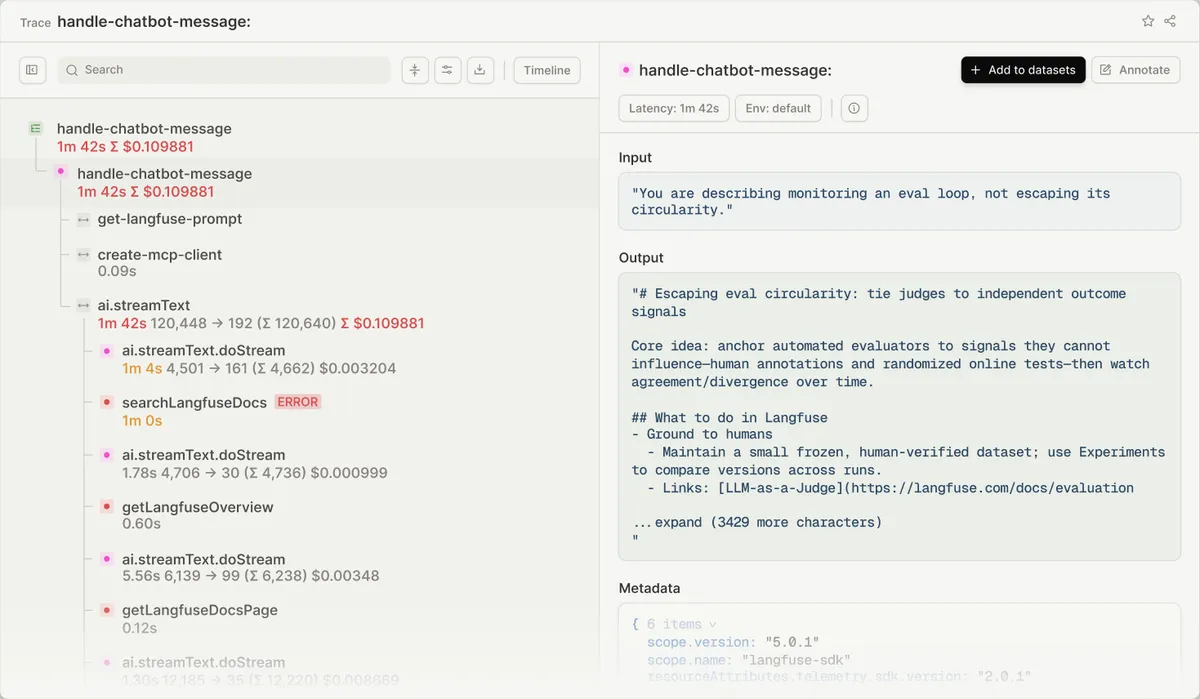
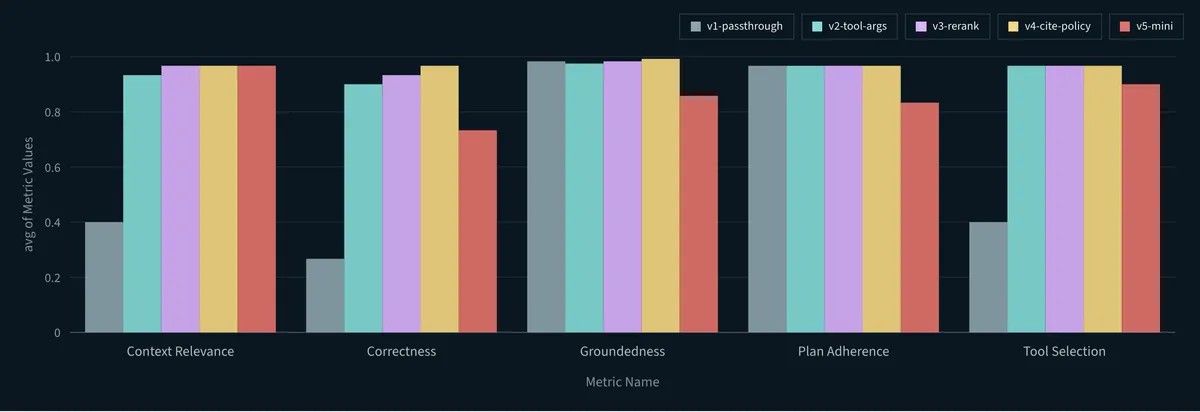
Interface Preview
Langfuse
TruLens
Feature Comparison
| Feature | Langfuse | TruLens |
|---|---|---|
| Tracing Architecture | ||
| Trace capture | Hierarchical traces capture model calls, tool invocations, and retrieval steps. | OpenTelemetry-based tracing records agent actions as spans. |
| Tracing standard | Platform documentation describes hierarchical application traces without naming a telemetry standard. | OpenTelemetry-native instrumentation centers tracing on interoperable spans. |
| Agent support | Traces agent workflows alongside model, tool, and retrieval activity. | Evaluates and traces AI agents, including MCP-enabled workflows. |
| Evaluation Workflow | ||
| Production evaluation | Runs evaluators against production observations and curated test sets. | Attaches inline evaluations to traced application or agent execution. |
| Batch evaluation | Uses datasets and experiments to evaluate changes outside production traffic. | Runs evaluations in batch or inline execution modes. |
| Custom metrics | Evaluators assess production behavior, quality, cost, and latency signals. | Custom metrics and Selector API target specific trace data. |
| LLM Application Improvement | ||
| Prompt operations | Deploys and rolls back prompts outside the application release cycle. | No prompt-management or prompt-deployment capability is specified. |
| Experiment management | Connects datasets, experiments, tracing, and evaluation in one loop. | Compares application versions using evaluation results and traces. |
| RAG evaluation | Captures retrieval steps within hierarchical LLM application traces. | Provides dedicated RAG evaluations, including relevance-oriented feedback metrics. |
| Deployment and Licensing | ||
| Self-hosting | Runs the open-source server from a single container image. | MIT-licensed source code is available for self-hosted use. |
| Managed offering | Langfuse Cloud runs the same software as the self-hosted server. | No managed commercial service is specified in the provided information. |
| License | Repository metadata reports license as NOASSERTION despite open-source positioning. | Source code is published under the MIT license. |
| Commercial Model and Ecosystem | ||
| Usage pricing | Cloud usage is priced per 100,000 units with volume discounts. | No usage-based rate card or vendor-paid tier is published. |
| Collaboration model | Unlimited users on paid plans; Teams add-on costs $300 monthly. | Open-source project maintenance is shepherded by Snowflake. |
| Repository activity | TypeScript repository latest release is v4.77.0 on 2026-11-09. | Python repository latest release is trulens-2.16.0 on 2026-10-19. |
Tracing Architecture
Trace capture
Tracing standard
Agent support
Evaluation Workflow
Production evaluation
Batch evaluation
Custom metrics
LLM Application Improvement
Prompt operations
Experiment management
RAG evaluation
Deployment and Licensing
Self-hosting
Managed offering
License
Commercial Model and Ecosystem
Usage pricing
Collaboration model
Repository activity
Which approach fits
For tracing and evaluating LLM applications across experiments and production, choose Langfuse when a team needs a managed or self-hosted platform that also governs prompts, datasets, and release-adjacent evaluation. Choose TruLens when OpenTelemetry-native instrumentation, RAG/agent feedback metrics, custom selectors, and version comparison are the core workflow; it stops being the complete answer when prompt lifecycle management and a published managed commercial platform are required.
When each approach fits
Choose Langfuse if:
Choose Langfuse for a production agent or LLM product where teams want one operational loop for hierarchical traces, production evaluators, datasets, experiments, prompt deployment, rollback, and either cloud or containerized self-hosting.
Choose TruLens if:
Choose TruLens for Python-oriented AI teams that want MIT-licensed, OpenTelemetry-native traces plus inline or batch RAG and agent evaluations, Selector API targeting, custom metrics, MCP support, and app-version comparisons.
These scenarios reflect the available product evidence. Your requirements, existing stack, and team expertise should guide the final decision.
Frequently Asked Questions
What is the main difference between Langfuse and TruLens?
Langfuse is an LLM engineering platform that combines hierarchical tracing, prompt management, datasets, experiments, and evaluations in a single loop. Its traces capture model calls, tools, and retrieval steps, while prompts can be deployed or rolled back outside a release cycle. TruLens focuses on OpenTelemetry-native tracing and evaluation of AI agents and LLM experiments, emphasizing inline or batch feedback, custom metrics, selectors, RAG evaluation, MCP support, and application-version comparison.
Which is better for small teams?
For a small team that needs an integrated production workflow, Langfuse's Hobby plan provides 50,000 units per month for two users at no charge, then Core starts at $29 per month. It is especially useful if prompt management and datasets matter immediately. TruLens is MIT-licensed open source and can be self-hosted without a published software charge, making it appealing for teams comfortable owning their Python instrumentation, evaluation setup, and operations.
Can I migrate from Langfuse to TruLens?
A migration is possible at the application level, but the supplied product information does not describe an automated Langfuse-to-TruLens migration utility or a compatibility guarantee. Plan to reinstrument application code around TruLens' OpenTelemetry-based tracing and recreate evaluation logic using its custom metrics, Selector API, and inline or batch modes. Langfuse-specific assets such as managed prompts, datasets, experiments, and prompt rollback workflows should be inventoried and rebuilt or replaced separately.
What are the pricing differences?
Langfuse publishes cloud pricing: Hobby is free for 50,000 units per month and two users; Core is $29 per month, Pro is $199 per month, and Enterprise is $2,499 per month, each including 100,000 units and unlimited users. Overage starts at $8 per 100,000 units and changes by volume tier, and Teams costs $300 per month. Langfuse self-hosting costs nothing. TruLens is MIT-licensed open source; no paid tier, usage meter, or public dollar rate is provided.