Snapshot
Scroll sideways to see all columns. With a keyboard, focus this table and use the arrow keys.
| Attribute | Detail |
|---|---|
License | MIT license |
Installation | Python package installed with pip |
Tracing | OpenTelemetry-based; traces can be exported to OTLP-compatible backends |
App integrations | LangChain/LangGraph and LlamaIndex packages are documented |
The repository documents provider packages for OpenAI/Azure OpenAI, LiteLLM, Google Gemini, AWS Bedrock, Snowflake Cortex, Hugging Face, and LangChain models.
Who it suits
TruLens is a strong fit when a Python-based AI application needs portable OpenTelemetry traces plus evaluation results attached to the same workflow. It can run evaluations inline as an application executes or in batch against a dataset, which supports both live investigation and repeatable regression checks.
Evaluate TruLens
Comparisons
Strengths
Captures structured spans for function calls, LLM generations, retrieval, and tool invocations; the documented OTLP export path can fit existing observability infrastructure.
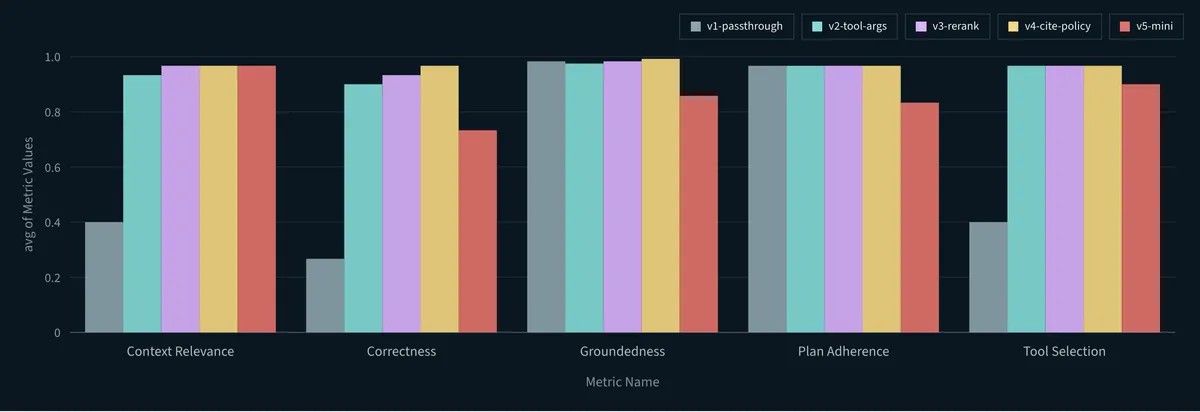
Includes seven documented agent-focused evaluators covering logical consistency, execution efficiency, plan adherence, plan quality, tool selection, tool calling, and tool quality.
Supports built-in and custom metrics, including Python functions, LLM-as-judge prompts, and evaluation of selected span attributes.
Documents MCP span instrumentation for recording a tool call's name, arguments, output, and latency.
Product screenshot
Trade-offs to consider
The documented workflow is Python-centric: installation, manual instrumentation, framework integrations, metrics, and runs are shown through Python packages and code. Teams should therefore assess how their application stack will supply the spans and evaluation inputs before standardizing on it. Evaluation also depends on choosing and configuring metrics or judges appropriate to the application and domain.
Public signals
About these signals
Verified factual signals from public sources. They indicate observable activity or interest, not total adoption, product quality, or cost.
168 GitHub commits 90d3.7k GitHub stars0 vulnerabilities across 1 package
See all signals from 3 sources
PyPI · trulens@2.16.0
Alternatives to TruLens
The reviewed substitutes for TruLens among the LLM observability & evaluation, and what would make each one the better answer.
Direct alternatives
Reviewed substitutes: products bought for the same job, where a team picks one.
- Arize Phoenix
- TruLens is an open-source Python library that scores LLM apps and agents with feedback functions, such as the RAG triad of groundedness, context relevance and answer relevance, and tracks experiment runs on a leaderboard. Arize Phoenix also traces on OpenTelemetry and runs evals from a notebook or container, but it adds annotation, datasets and an upgrade path to Arize's commercial platform. The choice comes down to whether a team wants a lightweight library of evaluation metrics or a fuller local-first observability app.Applies to: Evaluating RAG and agent quality during development
Other approaches
A different approach to the same problem. Each substitutes only for the workload named beside it.
- Langfuse
- TruLens focuses on scoring and comparing experiment versions of an LLM app with programmatic feedback functions. Langfuse is a broader engineering platform where tracing, prompt management, datasets and cost analytics share one self-hosted or cloud service, with evaluation as one part of it. Teams that mainly need to iterate on evaluations lean toward TruLens, and teams that also need to manage prompts and monitor production lean toward Langfuse.Applies to: Tracing and evaluating LLM apps across experiments and production
- Tolokaforge
- TruLens is an open-source library that instruments LLM apps and agents and scores their runs with feedback functions, which are mostly LLM-based judges of groundedness, relevance and similar qualities. Tolokaforge builds the test episodes itself, with user and agent loops in a sandbox, and grades the outcomes deterministically. The deciding factor is whether the buyer wants to score traces from their own application or run controlled, repeatable tool-use benchmarks across providers.Applies to: Open-source evaluation of tool-using agents
Sources
Official TruLens GitHub repository and README.
Official TruLens website.