Decision comparison
Tolokaforge vs TruLens
For open-source evaluation of tool-using agents, choose Tolokaforge when the central question is whether an agent can complete reproducible, isolated tasks across tools, coding CLIs, browsers, or multi-container environments. Choose TruLens when the central question is why an integrated agent or RAG application fails in practice, using OpenTelemetry traces, feedback metrics, and version comparisons. Tolokaforge stops being the right answer when application-level tracing and feedback analysis are the primary need; TruLens stops being the right answer when benchmark-grade sandboxed task execution and coding-harness trials are required.
Architecture choice. These take different approaches to the same problem. Read the table as a fit question rather than a feature race.
All 2 are LLM observability & evaluation.
Quick Comparison
| Decision factor | Tolokaforge | TruLens |
|---|---|---|
| Best For | Benchmarking tool-using, coding, browser, mobile, and long-horizon agents through repeatable multi-turn sandbox trials. | Tracing and evaluating deployed AI agents, especially RAG applications needing custom metrics and version comparisons. |
| Architecture | Python benchmarking harness using LiteLLM, agent/user loops, isolated containers, deterministic graders, and telemetry collection. | OpenTelemetry-native evaluation and tracing framework with selector-based feedback, inline or batch evaluation, and MCP support. |
| Pricing Model | Open source under the Apache-2.0 license; source code at https://github.com/toloka/tolokaforge. | Open source under the MIT license; source code at https://github.com/truera/trulens. |
| Ease of Use | Requires designing task packs, containerized environments, graders, and model or coding-CLI trial configuration. | Provides tracing, Selector API, feedback metrics, inline evaluation, and batch workflows for application-focused evaluation. |
| Scalability | Distributed runner and multi-container tasks support parallel evaluation workloads with configurable per-trial runtime. | Supports batch evaluations and OpenTelemetry tracing; distributed execution details are not provided in the supplied data. |
| Community/Support | GitHub-hosted Python project with 23 stars; latest listed release is image-v0.34.7-rc.1. | Open-source project actively maintained by Snowflake, with 3,633 GitHub stars and release trulens-2.16.0 listed. |
Tolokaforge
- Best For:
- Benchmarking tool-using, coding, browser, mobile, and long-horizon agents through repeatable multi-turn sandbox trials.
- Architecture:
- Python benchmarking harness using LiteLLM, agent/user loops, isolated containers, deterministic graders, and telemetry collection.
- Pricing Model:
- Open source under the Apache-2.0 license; source code at https://github.com/toloka/tolokaforge.
- Ease of Use:
- Requires designing task packs, containerized environments, graders, and model or coding-CLI trial configuration.
- Scalability:
- Distributed runner and multi-container tasks support parallel evaluation workloads with configurable per-trial runtime.
- Community/Support:
- GitHub-hosted Python project with 23 stars; latest listed release is image-v0.34.7-rc.1.
TruLens
- Best For:
- Tracing and evaluating deployed AI agents, especially RAG applications needing custom metrics and version comparisons.
- Architecture:
- OpenTelemetry-native evaluation and tracing framework with selector-based feedback, inline or batch evaluation, and MCP support.
- Pricing Model:
- Open source under the MIT license; source code at https://github.com/truera/trulens.
- Ease of Use:
- Provides tracing, Selector API, feedback metrics, inline evaluation, and batch workflows for application-focused evaluation.
- Scalability:
- Supports batch evaluations and OpenTelemetry tracing; distributed execution details are not provided in the supplied data.
- Community/Support:
- Open-source project actively maintained by Snowflake, with 3,633 GitHub stars and release trulens-2.16.0 listed.
Public signals
Verified factual signals only. Bars appear only for like-for-like metrics with five weekly assessments for every tool; missing evidence stays explicit. These signals do not establish enterprise adoption, product quality, or total cost.
| Metric | Tolokaforge | TruLens |
|---|---|---|
| GitHub commits, 90d(Product adoption) | 226 | 168 |
| GitHub stars(Product adoption) | 24 | 3,500+ |
| PyPI weekly downloads(Product adoption) | 1.7k | Not available |
| PyPI weekly downloads(Developer adoption) | Not available | 5.1k |
As of November 16, 2026 — updated weekly.
Health & risk evidence
Observed public-source checks for mapped package versions and repositories.
Tolokaforge
November 16, 2026Package vulnerabilities
PyPI · tolokaforge@0.34.8
0 vulnerabilities
across 1 package
Repository security score
Not available
TruLens
November 16, 2026Package vulnerabilities
PyPI · trulens@2.16.0
0 vulnerabilities
across 1 package
Repository security score
Not available
Interface Preview
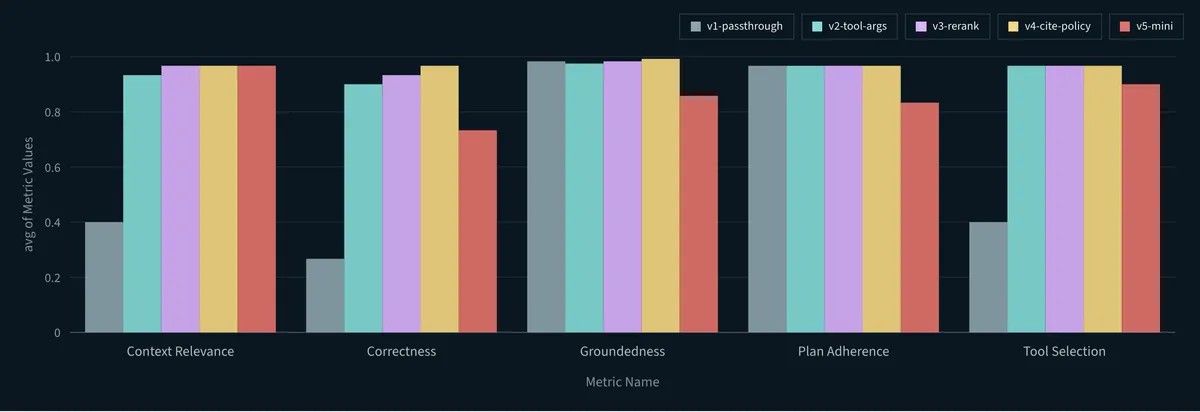
TruLens
Feature Comparison
| Feature | Tolokaforge | TruLens |
|---|---|---|
| Evaluation Workflow | ||
| Agent evaluation loop | Runs multi-turn conversations where agent and user models call tools. | Evaluates agent behavior through traces and agentic evaluation workflows. |
| Evaluation execution | Executes benchmark trials in isolated sandboxed task environments. | Runs evaluations inline during execution or in batch afterward. |
| Scoring approach | Uses deterministic grading for repeatable benchmark task outcomes. | Uses feedback results and custom metrics to assess application quality. |
| Agent and Tool Execution | ||
| Tool integration | Supplies MCP-compatible tooling within tool-using agent evaluation tasks. | Supports MCP alongside tracing and agent evaluation capabilities. |
| Coding-agent assessment | Runs seven vendor coding-agent CLIs inside each trial container. | No coding-harness CLI execution mode is described in provided data. |
| Task environment | Supports multi-container tasks and an interactive terminal for trials. | Focuses on instrumented AI applications rather than benchmark task containers. |
| Observability and Analysis | ||
| Tracing foundation | Captures rich telemetry from benchmark trials and agent execution. | Uses OpenTelemetry-native tracing for agent actions and application spans. |
| Metrics | Records rich metrics with configurable per-trial runtime measurement. | Calculates feedback metrics, including custom metrics and RAG evaluations. |
| Failure analysis | Uses trial telemetry and deterministic grades to inspect benchmark outcomes. | Uses traces and evaluations to identify failure and cost-quality tradeoffs. |
| Model and Application Coverage | ||
| Model-provider flexibility | Connects bring-your-own models across providers through LiteLLM. | Provider abstraction details are not specified in the provided data. |
| RAG evaluation | Can benchmark RAG agents through custom tool-using task packs. | Provides dedicated RAG evaluations and feedback-oriented quality assessment. |
| Version comparison | Compares repeatable trial results across benchmark configurations and models. | Compares application versions using evaluation results and tracing context. |
| Operations and Project Model | ||
| Parallel execution | Uses a distributed runner for scaling benchmark trial execution. | Batch evaluation support is documented; distributed runner is not specified. |
| Runtime isolation | Sandboxes execution inside trial containers with configurable runtime limits. | Instruments application runs through OpenTelemetry-based tracing rather than task sandboxes. |
| Open-source license | Ships as Apache-2.0 open source according to supplied pricing details. | Ships as MIT-licensed open source maintained under the TruLens project. |
Evaluation Workflow
Agent evaluation loop
Evaluation execution
Scoring approach
Agent and Tool Execution
Tool integration
Coding-agent assessment
Task environment
Observability and Analysis
Tracing foundation
Metrics
Failure analysis
Model and Application Coverage
Model-provider flexibility
RAG evaluation
Version comparison
Operations and Project Model
Parallel execution
Runtime isolation
Open-source license
Which approach fits
For open-source evaluation of tool-using agents, choose Tolokaforge when the central question is whether an agent can complete reproducible, isolated tasks across tools, coding CLIs, browsers, or multi-container environments. Choose TruLens when the central question is why an integrated agent or RAG application fails in practice, using OpenTelemetry traces, feedback metrics, and version comparisons. Tolokaforge stops being the right answer when application-level tracing and feedback analysis are the primary need; TruLens stops being the right answer when benchmark-grade sandboxed task execution and coding-harness trials are required.
When each approach fits
Choose Tolokaforge if:
Choose Tolokaforge for regression benchmarks of tool-using agents, coding-agent CLI evaluations, browser or mobile tasks, long-horizon workflows, and task packs requiring deterministic container-based grading.
Choose TruLens if:
Choose TruLens for instrumenting AI agents or RAG applications, reviewing OpenTelemetry traces, measuring custom feedback metrics, running inline or batch evaluations, and comparing application versions.
These scenarios reflect the available product evidence. Your requirements, existing stack, and team expertise should guide the final decision.
Frequently Asked Questions
What is the main difference between Tolokaforge and TruLens?
Tolokaforge is principally a benchmarking harness: it runs agents through repeatable, multi-turn tasks in sandboxed environments, grades outcomes deterministically, and gathers telemetry. Its coding-harness mode can execute supported vendor coding-agent CLIs inside trial containers. TruLens is principally an application evaluation and observability framework: it uses OpenTelemetry-based tracing, feedback metrics, selectors, inline or batch evaluation, and version comparison to understand behavior in AI agents and RAG systems. Both can support tool-using-agent evaluation, but their operational center of gravity differs.
Which is better for small teams?
For a small team validating a few agent workflows before release, TruLens is usually the more direct fit when the team already has an application to instrument. Its tracing, feedback results, custom metrics, RAG evaluations, and batch or inline workflows are oriented toward analyzing application behavior. Tolokaforge is a stronger fit for a small team whose immediate problem is building rigorous benchmark tasks, especially where sandboxed execution, deterministic graders, tool calls, or coding-agent CLI trials matter. The setup burden is higher because task environments and graders must be defined.
Can I migrate from Tolokaforge to TruLens?
There is no indicated one-click migration path because the tools retain different primary artifacts. Tolokaforge centers on task packs, trial containers, deterministic graders, agent and user loops, and benchmark telemetry. TruLens centers on instrumented application traces, selectors, feedback functions, custom metrics, and evaluation results. A practical transition is to preserve the behavioral criteria learned from Tolokaforge benchmarks, then recreate the relevant quality checks as TruLens feedback metrics and instrument the production agent with OpenTelemetry tracing. Keep Tolokaforge when isolated benchmark execution remains necessary.
What are the pricing differences?
Both products are presented as self-hostable open-source software without a published paid tier or dollar-denominated rate card in the supplied information. Tolokaforge is stated to be Apache-2.0 licensed and available from its GitHub source repository; the supplied GitHub metadata lists its license field as NOASSERTION, so organizations should verify the repository license files before procurement or redistribution. TruLens is MIT licensed and its source is available on GitHub. Neither provided dataset describes metering, seats, credits, managed-cloud charges, enterprise tiers, or a sales-quote trigger.