Decision comparison
Arize Phoenix vs Tolokaforge
For running experiments that compare agent models, choose Tolokaforge when the experiment must execute comparable sandboxed tasks, deterministic graders, or vendor coding-agent CLIs. Choose Arize Phoenix when model experiments must be grounded in traced production behavior, annotations, datasets, and ongoing quality improvement; it stops being the primary answer when you need a full benchmark harness for isolated task execution.
Architecture choice. These take different approaches to the same problem. Read the table as a fit question rather than a feature race.
All 2 are LLM observability & evaluation.
Quick Comparison
| Decision factor | Arize Phoenix | Tolokaforge |
|---|---|---|
| Best For | Production agent tracing, evaluation, annotation, and evidence-based iteration across any model, framework, or programming language. | Benchmarking tool-using, coding, browser, mobile, and long-horizon LLM agents through repeatable multi-turn, sandboxed trials. |
| Architecture | Local-first, self-hostable OpenTelemetry platform using OpenInference instrumentation, with optional free Phoenix Cloud and vendor-separated Arize AX. | Python benchmarking harness using LiteLLM across providers, sandboxed multi-container tasks, deterministic graders, MCP-compatible tools, and distributed runners. |
| Pricing Model | Phoenix costs nothing: the server is free to run yourself and the hosted Phoenix Cloud tier is free. Arize AX, the vendor's separate commercial platform, has a free tier with 25,000 spans a month and AX Pro at $50/month with 50,000 spans; AX Enterprise is quoted and offers self-hosted deployment. | Open source under the Apache-2.0 license; source code at https://github.com/toloka/tolokaforge. |
| Ease of Use | Starts locally with a single uvx command; coding-agent setup and trace conversations simplify investigation, annotations, experiments, and evaluation workflows. | Interactive terminal and per-trial runtime support hands-on evaluation, but task packs, containers, graders, and model-provider configuration require engineering setup. |
| Scalability | Uses OpenTelemetry-native tracing for interoperable production telemetry; Arize AX Enterprise offers custom spans, ingestion, retention, and self-hosted deployment. | Distributed runner executes isolated multi-container trials and supports bring-your-own models, enabling evaluation workloads beyond a single local harness. |
| Community/Support | ELv2-licensed project built in public, with 12,213 GitHub stars, Python as primary language, and an active November 2026 release. | Apache-2.0 project with 23 GitHub stars, Python as primary language, and a November 2026 release candidate for image-v0.34.7. |
Arize Phoenix
- Best For:
- Production agent tracing, evaluation, annotation, and evidence-based iteration across any model, framework, or programming language.
- Architecture:
- Local-first, self-hostable OpenTelemetry platform using OpenInference instrumentation, with optional free Phoenix Cloud and vendor-separated Arize AX.
- Pricing Model:
- Phoenix costs nothing: the server is free to run yourself and the hosted Phoenix Cloud tier is free. Arize AX, the vendor's separate commercial platform, has a free tier with 25,000 spans a month and AX Pro at $50/month with 50,000 spans; AX Enterprise is quoted and offers self-hosted deployment.
- Ease of Use:
- Starts locally with a single uvx command; coding-agent setup and trace conversations simplify investigation, annotations, experiments, and evaluation workflows.
- Scalability:
- Uses OpenTelemetry-native tracing for interoperable production telemetry; Arize AX Enterprise offers custom spans, ingestion, retention, and self-hosted deployment.
- Community/Support:
- ELv2-licensed project built in public, with 12,213 GitHub stars, Python as primary language, and an active November 2026 release.
Tolokaforge
- Best For:
- Benchmarking tool-using, coding, browser, mobile, and long-horizon LLM agents through repeatable multi-turn, sandboxed trials.
- Architecture:
- Python benchmarking harness using LiteLLM across providers, sandboxed multi-container tasks, deterministic graders, MCP-compatible tools, and distributed runners.
- Pricing Model:
- Open source under the Apache-2.0 license; source code at https://github.com/toloka/tolokaforge.
- Ease of Use:
- Interactive terminal and per-trial runtime support hands-on evaluation, but task packs, containers, graders, and model-provider configuration require engineering setup.
- Scalability:
- Distributed runner executes isolated multi-container trials and supports bring-your-own models, enabling evaluation workloads beyond a single local harness.
- Community/Support:
- Apache-2.0 project with 23 GitHub stars, Python as primary language, and a November 2026 release candidate for image-v0.34.7.
Public signals
Verified factual signals only. Bars appear only for like-for-like metrics with five weekly assessments for every tool; missing evidence stays explicit. These signals do not establish enterprise adoption, product quality, or total cost.
| Metric | Arize Phoenix | Tolokaforge |
|---|---|---|
| Docker Hub pulls(Product adoption) | 7.4M | Not available |
| GitHub commits, 90d(Product adoption) | 1.1k | 226 |
| GitHub stars(Product adoption) | 12,000+ | 24 |
| npm weekly downloads(Developer adoption) | 86.0k | Not available |
| PyPI weekly downloads(Product adoption) | 127.3k | 1.7k |
As of November 16, 2026 — updated weekly.
Health & risk evidence
Observed public-source checks for mapped package versions and repositories.
Arize Phoenix
November 16, 2026Package vulnerabilities
npm · @arizeai/phoenix-client@8.0.0 · PyPI · arize-phoenix@21.0.0
0 vulnerabilities
across 2 packages
Repository security score
Not available
Tolokaforge
November 16, 2026Package vulnerabilities
PyPI · tolokaforge@0.34.8
0 vulnerabilities
across 1 package
Repository security score
Not available
Interface Preview
Arize Phoenix
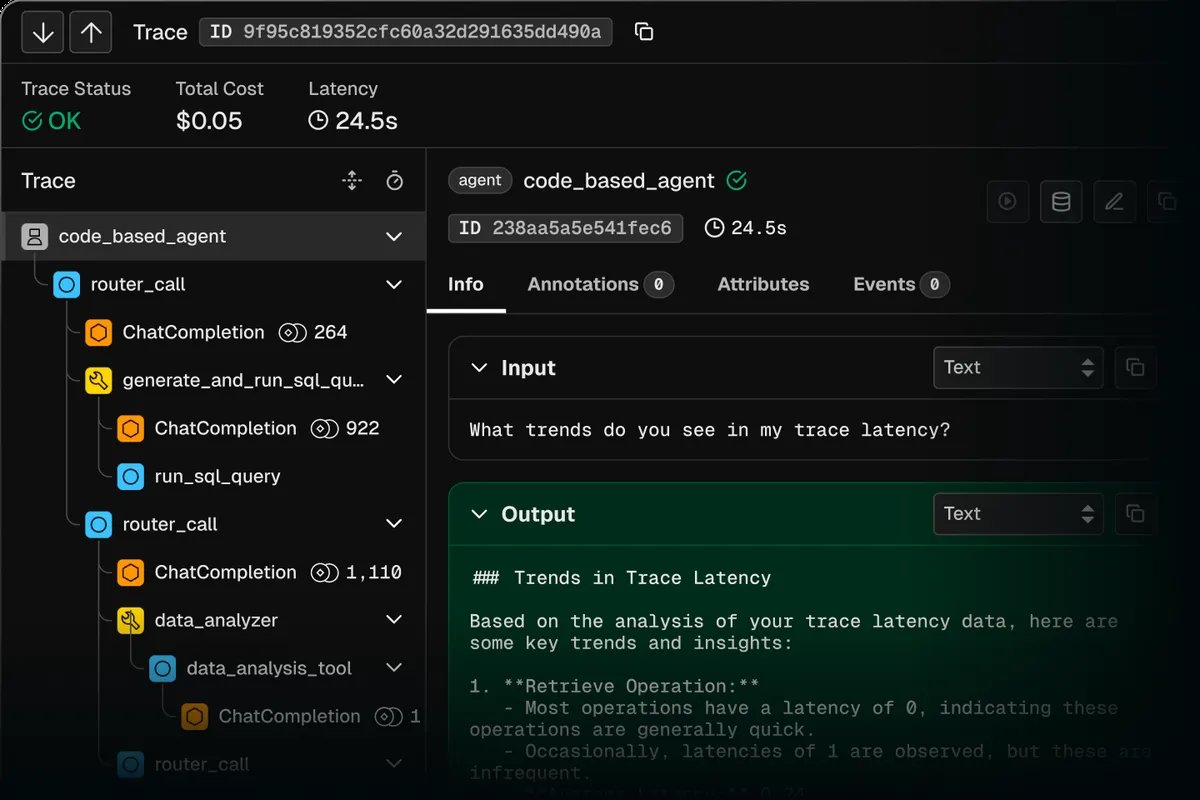
Feature Comparison
| Feature | Arize Phoenix | Tolokaforge |
|---|---|---|
| Observability and Telemetry | ||
| Trace visibility | Displays every agent step through OpenTelemetry-based tracing. | Captures rich telemetry for each benchmark trial. |
| Standards interoperability | Uses native OpenTelemetry support through OpenInference instrumentation. | Routes model-provider access through LiteLLM integrations. |
| Operational investigation | Supports trace conversations, annotations, issue investigation, and experiments. | Provides interactive terminal access during isolated trial execution. |
| Evaluation Workflow | ||
| Quality evaluation | Builds evals that score outputs and catch quality issues. | Uses deterministic grading for repeatable task outcome assessment. |
| Experiment inputs | Creates datasets from production traces for comparative experiments. | Runs benchmark task packs across selected models or CLIs. |
| Continuous improvement | Runs end-to-end experiments to validate agent changes. | Measures per-trial runtime and rich metrics across evaluations. |
| Agent Execution Model | ||
| Multi-turn interactions | Observes traced agent interactions and downstream execution steps. | Runs multi-turn loops where agents and users call tools. |
| Coding-agent evaluation | No dedicated coding-harness mode is described in provided data. | Executes seven vendor coding-agent CLIs inside trial containers. |
| Tool connectivity | Instruments any framework or language without proprietary lock-in. | Supplies MCP-compatible tooling for agent and user tool calls. |
| Isolation and Scale | ||
| Execution isolation | Supports local, self-hosted, or cloud observability deployment. | Executes trials in sandboxed containers with isolated environments. |
| Multi-container workloads | No multi-container task execution capability is described. | Runs tasks spanning multiple containers within each trial. |
| Parallel evaluation | Enterprise AX provides custom-scale spans and ingestion capacity. | Uses a distributed runner for benchmark execution workloads. |
| Deployment and Ecosystem | ||
| Deployment options | Runs locally, self-hosted, or through free Phoenix Cloud. | Ships as Apache-2.0 source for self-hosted execution. |
| Model portability | Works with any model, framework, or language. | Supports bring-your-own models across providers via LiteLLM. |
| Automation support | Offers coding-agent automations through the Phoenix skill. | Supports configurable trial runtimes and benchmark task packs. |
Observability and Telemetry
Trace visibility
Standards interoperability
Operational investigation
Evaluation Workflow
Quality evaluation
Experiment inputs
Continuous improvement
Agent Execution Model
Multi-turn interactions
Coding-agent evaluation
Tool connectivity
Isolation and Scale
Execution isolation
Multi-container workloads
Parallel evaluation
Deployment and Ecosystem
Deployment options
Model portability
Automation support
Which approach fits
For running experiments that compare agent models, choose Tolokaforge when the experiment must execute comparable sandboxed tasks, deterministic graders, or vendor coding-agent CLIs. Choose Arize Phoenix when model experiments must be grounded in traced production behavior, annotations, datasets, and ongoing quality improvement; it stops being the primary answer when you need a full benchmark harness for isolated task execution.
When each approach fits
Choose Arize Phoenix if:
Choose Phoenix for teams operating agents in production that need OpenTelemetry tracing, trace-driven datasets, output evals, annotations, and experiments tied to observed failures. It is especially suitable when models, frameworks, or languages vary and vendor-neutral instrumentation matters.
Choose Tolokaforge if:
Choose Tolokaforge for controlled agent-model comparisons involving tool use, browser or mobile tasks, code changes, multi-turn user loops, deterministic grading, and isolated containers. It is the better fit when benchmark reproducibility matters more than production trace analysis.
These scenarios reflect the available product evidence. Your requirements, existing stack, and team expertise should guide the final decision.
Frequently Asked Questions
What is the main difference between Arize Phoenix and Tolokaforge?
Arize Phoenix is an agent observability and evaluation platform centered on tracing real agent behavior, annotating traces, building evals, creating trace-derived datasets, and running improvement experiments. It uses OpenTelemetry through OpenInference and can run locally, self-hosted, or in Phoenix Cloud. Tolokaforge is instead a benchmarking harness: it executes tool-using agents in sandboxed trials, supports multi-turn agent/user loops, uses deterministic grading, and can evaluate coding-agent CLIs inside trial containers. Phoenix investigates and improves observed agent systems; Tolokaforge measures agents against controlled tasks.
Which is better for small teams?
For a small team already building or operating an LLM application, Phoenix is usually the easier starting point because it can start with a single local command, supports tracing across models and frameworks, and offers free self-hosted and Phoenix Cloud usage. Its workflow connects traces directly to annotations, evals, datasets, and experiments. A small research or platform team specifically comparing agent models on reproducible tasks may prefer Tolokaforge, but should budget engineering time for task packs, containers, graders, provider configuration, and benchmark execution infrastructure.
Can I migrate from Arize Phoenix to Tolokaforge?
There is not a direct product-for-product migration because the tools address different stages of an agent evaluation workflow. Phoenix traces operational behavior using OpenTelemetry/OpenInference and can turn traces into datasets for experiments. Tolokaforge runs benchmark trials with sandboxed execution, deterministic graders, and per-trial telemetry. A practical transition is to use Phoenix findings to define representative evaluation scenarios, then implement those scenarios as Tolokaforge task packs and grading logic. Keep Phoenix if production observability, trace annotations, and failure investigation remain requirements.
What are the pricing differences?
Phoenix itself costs nothing to run locally or self-host, and Phoenix Cloud is free. Its separate commercial Arize AX offering has AX Free with 25,000 trace spans per month and AX Pro at $50 per month with 50,000 spans per month; AX Enterprise is custom quoted with custom spans, ingestion volume, retention, and SaaS or self-hosted deployment. Tolokaforge is Apache-2.0 open-source software that can be self-hosted from GitHub. The provided information names no managed Tolokaforge service, public paid tier, usage cap, or commercial rate.