Decision comparison
Braintrust vs Tolokaforge
For scoring production-bound agent and model variants with continuous trace-driven improvement and release gates, Braintrust is the stronger fit. Tolokaforge is the right answer when the evaluation itself must execute realistic, sandboxed multi-turn or coding-CLI tasks under your own infrastructure; it stops being the direct answer when managed production observability, compliance controls, and online scoring are required.
Architecture choice. These take different approaches to the same problem. Read the table as a fit question rather than a feature race.
All 2 are LLM observability & evaluation.
Quick Comparison
| Decision factor | Braintrust | Tolokaforge |
|---|---|---|
| Best For | Product teams validating production-facing agents, comparing prompt or model variants, and converting observed failures into release-blocking evaluations before deployment. | Engineering teams benchmarking tool-using agents or coding-agent CLIs in repeatable multi-turn, sandboxed tasks before selecting a model or release candidate. |
| Architecture | Hosted evaluation-first platform combining versioned datasets, experiments, production trace collection, online scoring, and optional hybrid Brainstore data-plane deployment. | Open-source Python benchmarking harness using LiteLLM, sandboxed multi-container trials, deterministic graders, MCP-compatible tools, and distributed runners. |
| Pricing Model | Starter is $0/month with $10 of model credits, 1 GB of processed data, 10,000 scores and 14-day retention; past that it is $4/GB and $2.50 per 1,000 scores. Pro is $249/month with $100 of model credits, 5 GB, 50,000 scores and 30-day retention, then $3/GB, $1.50 per 1,000 scores and $0.50/GB/month to keep data longer. Enterprise is quoted and adds on-prem or hosted deployment. Qualifying startups get 6 to 12 months of Pro free. | Open source under the Apache-2.0 license; source code at https://github.com/toloka/tolokaforge. |
| Ease of Use | Managed workflows support side-by-side experiments, LLM/code/human scoring, searchable traces, and production scoring without assembling a separate benchmark harness. | Interactive terminal and bring-your-own-model configuration enable flexible trials, but task-pack design, environments, graders, and infrastructure remain engineering responsibilities. |
| Scalability | Searches millions of logs and tracks latency, cost, and quality; hybrid deployment supports customer-operated Brainstore data-plane infrastructure. | Distributed runner, multi-container tasks, per-trial runtime telemetry and provider-neutral LiteLLM integration for running benchmark suites across different execution environments. |
| Community/Support | Commercial platform with SOC 2 Type II, HIPAA, GDPR, granular permissions, sales-led Enterprise support, and MIT-licensed AutoEvals with 1,076 GitHub stars. | Source is available under Apache-2.0 according to project pricing information; GitHub reports 23 stars, Python primary language, and recent release activity. |
Braintrust
- Best For:
- Product teams validating production-facing agents, comparing prompt or model variants, and converting observed failures into release-blocking evaluations before deployment.
- Architecture:
- Hosted evaluation-first platform combining versioned datasets, experiments, production trace collection, online scoring, and optional hybrid Brainstore data-plane deployment.
- Pricing Model:
- Starter is $0/month with $10 of model credits, 1 GB of processed data, 10,000 scores and 14-day retention; past that it is $4/GB and $2.50 per 1,000 scores. Pro is $249/month with $100 of model credits, 5 GB, 50,000 scores and 30-day retention, then $3/GB, $1.50 per 1,000 scores and $0.50/GB/month to keep data longer. Enterprise is quoted and adds on-prem or hosted deployment. Qualifying startups get 6 to 12 months of Pro free.
- Ease of Use:
- Managed workflows support side-by-side experiments, LLM/code/human scoring, searchable traces, and production scoring without assembling a separate benchmark harness.
- Scalability:
- Searches millions of logs and tracks latency, cost, and quality; hybrid deployment supports customer-operated Brainstore data-plane infrastructure.
- Community/Support:
- Commercial platform with SOC 2 Type II, HIPAA, GDPR, granular permissions, sales-led Enterprise support, and MIT-licensed AutoEvals with 1,076 GitHub stars.
Tolokaforge
- Best For:
- Engineering teams benchmarking tool-using agents or coding-agent CLIs in repeatable multi-turn, sandboxed tasks before selecting a model or release candidate.
- Architecture:
- Open-source Python benchmarking harness using LiteLLM, sandboxed multi-container trials, deterministic graders, MCP-compatible tools, and distributed runners.
- Pricing Model:
- Open source under the Apache-2.0 license; source code at https://github.com/toloka/tolokaforge.
- Ease of Use:
- Interactive terminal and bring-your-own-model configuration enable flexible trials, but task-pack design, environments, graders, and infrastructure remain engineering responsibilities.
- Scalability:
- Distributed runner, multi-container tasks, per-trial runtime telemetry and provider-neutral LiteLLM integration for running benchmark suites across different execution environments.
- Community/Support:
- Source is available under Apache-2.0 according to project pricing information; GitHub reports 23 stars, Python primary language, and recent release activity.
Public signals
Verified factual signals only. Bars appear only for like-for-like metrics with five weekly assessments for every tool; missing evidence stays explicit. These signals do not establish enterprise adoption, product quality, or total cost.
| Metric | Braintrust | Tolokaforge |
|---|---|---|
| GitHub commits, 90d(Developer adoption) | 9 | Not available |
| GitHub stars(Developer adoption) | 1,000+ | Not available |
| npm weekly downloads(Developer adoption) | 3.3M | Not available |
| Product Hunt comments(Community interest) | 52 | Not available |
| Product Hunt rating(Community interest) | 5.0/5 | Not available |
| Product Hunt reviews(Community interest) | 5 | Not available |
| Product Hunt votes(Community interest) | 180 | Not available |
| PyPI weekly downloads(Developer adoption) | 2.1M | Not available |
| GitHub commits, 90d(Product adoption) | Not available | 226 |
| GitHub stars(Product adoption) | Not available | 24 |
| PyPI weekly downloads(Product adoption) | Not available | 1.7k |
As of November 16, 2026 — updated weekly.
Health & risk evidence
Observed public-source checks for mapped package versions and repositories.
Braintrust
November 16, 2026Package vulnerabilities
npm · braintrust@3.44.0 · PyPI · braintrust@0.50.0
0 vulnerabilities
across 2 packages
Repository security score
Not available
Tolokaforge
November 16, 2026Package vulnerabilities
PyPI · tolokaforge@0.34.8
0 vulnerabilities
across 1 package
Repository security score
Not available
Interface Preview
Braintrust
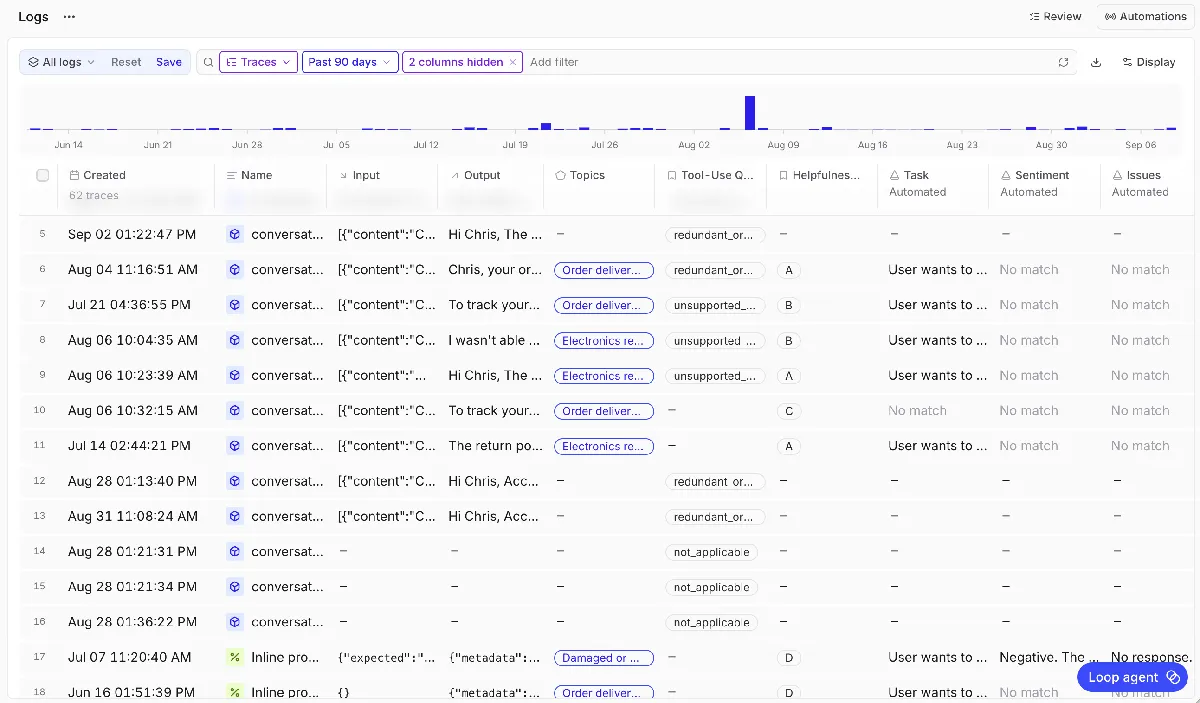
Feature Comparison
| Feature | Braintrust | Tolokaforge |
|---|---|---|
| Evaluation workflow | ||
| Experiment comparison | Versioned datasets compare prompts and models side by side | Benchmark task packs run repeatable agent trials across providers |
| Output scoring | Scores outputs with LLM judges, code, or human reviewers | Uses deterministic graders to assess trial outcomes |
| Release guardrails | Failing evaluation scores can block a production release | Benchmark results measure candidates before promotion decisions |
| Agent execution | ||
| Multi-turn interaction | Traces production agent prompts, responses, and tool calls | Runs agent and user models in multi-turn tool-calling loops |
| Coding-agent evaluation | Evaluates coding-agent outputs through configurable datasets and scorers | Runs seven vendor coding-agent CLIs inside trial containers |
| Execution isolation | Hybrid data plane can run on customer infrastructure | Sandboxed execution isolates benchmark trials and task environments |
| Observability and telemetry | ||
| Trace inspection | Inspects every agent trace and tool call in real time | Captures rich telemetry during benchmark trial execution |
| Production quality monitoring | Online scorers automatically score each production conversation | Per-trial metrics report benchmark execution behavior and outcomes |
| Operational analytics | Tracks latency, cost, and quality across searchable logs | Records per-trial runtime alongside rich benchmark metrics |
| Integration and deployment | ||
| Model-provider connectivity | Compares model variants within managed experiments and evaluations | Uses LiteLLM to run benchmarks across any supported provider |
| Tool interoperability | Records production tool calls inside agent traces | Exposes MCP-compatible tooling for agent task environments |
| Execution topology | Offers hosted service plus hybrid customer-operated data plane | Uses distributed runners for self-hosted benchmark execution |
| Governance and operating model | ||
| Access control | Provides fine-grained project and resource-level permissions | Not verified |
| Compliance posture | Publishes SOC 2 Type II, HIPAA, and GDPR compliance | Not verified |
| Source and extensibility | MIT-licensed AutoEvals library supplies reusable scoring components | Apache-2.0 source enables self-hosted harness modification and extension |
Evaluation workflow
Experiment comparison
Output scoring
Release guardrails
Agent execution
Multi-turn interaction
Coding-agent evaluation
Execution isolation
Observability and telemetry
Trace inspection
Production quality monitoring
Operational analytics
Integration and deployment
Model-provider connectivity
Tool interoperability
Execution topology
Governance and operating model
Access control
Compliance posture
Source and extensibility
Which approach fits
For scoring production-bound agent and model variants with continuous trace-driven improvement and release gates, Braintrust is the stronger fit. Tolokaforge is the right answer when the evaluation itself must execute realistic, sandboxed multi-turn or coding-CLI tasks under your own infrastructure; it stops being the direct answer when managed production observability, compliance controls, and online scoring are required.
When each approach fits
Choose Braintrust if:
Choose Braintrust when a product team needs versioned evaluation datasets, LLM/code/human scorers, online scoring of production traffic, searchable traces, and a release-blocking quality workflow. It is particularly suitable when observability findings must become the next regression-evaluation cases.
Choose Tolokaforge if:
Choose Tolokaforge when you need to benchmark tool-using agents, browser/mobile/coding workflows, or vendor coding-agent CLIs in sandboxed and deterministic multi-turn trials. It is best for teams comfortable operating task containers, graders, runners, and their own model-provider accounts.
These scenarios reflect the available product evidence. Your requirements, existing stack, and team expertise should guide the final decision.
Frequently Asked Questions
What is the main difference between Braintrust and Tolokaforge?
Braintrust is an evaluation-first managed platform that connects offline experiments with production observability. It captures agent traces and tool calls, lets teams score outputs with LLM judges, code, or humans, and can use failing scores as release gates. Tolokaforge is a self-hosted benchmarking harness focused on executing realistic agent trials: multi-turn agent/user loops, sandboxed execution, deterministic grading, multi-container tasks, and coding-harness support for seven coding-agent CLIs. They overlap for pre-release scoring, but Braintrust emphasizes the production feedback loop while Tolokaforge emphasizes controlled benchmark execution.
Which is better for small teams?
A small product team shipping an application-facing agent will usually find Braintrust faster to adopt because its managed workflow combines datasets, experiments, scoring, traces, and production monitoring. Its Starter tier is $0/month and includes $10 of model credits, 1 GB of processed data, 10,000 scores, and 14-day retention. A small engineering-heavy team may instead prefer Tolokaforge when it needs free self-hosted benchmarking and can operate the required sandboxes, task definitions, deterministic graders, and model access. That flexibility comes with more setup and operational ownership.
Can I migrate from Braintrust to Tolokaforge?
You can move the evaluation intent, such as prompts, test cases, expected behaviors, and scoring criteria, but this is not a like-for-like platform migration. Tolokaforge can represent agent tasks as sandboxed, multi-turn benchmark trials with deterministic graders, whereas Braintrust organizes versioned datasets, experiments, production traces, and online scores. Braintrust-specific production trace history, project permissions, hosted retention, and release-gate workflow would need separate replacement processes. Before migrating, identify whether the requirement is controlled pre-release benchmarking or ongoing production observability, because Tolokaforge does not provide the supplied evidence for Braintrust-style managed trace search and online production scoring.
What are the pricing differences?
Braintrust publishes usage-based freemium pricing. Starter costs $0/month and includes $10 in model credits, 1 GB of processed data, 10,000 scores, and 14-day retention; overages are $4 per GB and $2.50 per 1,000 scores. Pro costs $249/month with $100 of model credits, 5 GB, 50,000 scores, and 30-day retention; overages are $3 per GB, $1.50 per 1,000 scores, and $0.50 per GB per month for longer retention. Enterprise is quoted. Tolokaforge is Apache-2.0 open source and free to self-host; no managed pricing or usage rate card is provided, though teams still pay their own infrastructure and model-provider costs.