Decision comparison
Arize Phoenix vs TruLens
Choose Arize Phoenix when your RAG or agent-quality workflow needs a cohesive trace-to-dataset-to-experiment loop, conversational trace investigation, and a free local or Cloud entry point. Choose TruLens when MIT licensing, custom metric construction, Selector API targeting, inline or batch evaluation, and explicit app-version comparison are the deciding requirements.
Direct comparison. These are reviewed substitutes bought for the same job, so the differences below are the ones that decide between them.
All 2 are LLM observability & evaluation.
Quick Comparison
| Decision factor | Arize Phoenix | TruLens |
|---|---|---|
| Best For | Teams needing a local-first observe, annotate, experiment, and measure loop for production agents and development-time RAG quality evaluation. | Developers who want MIT-licensed, metric-centric tracing and evaluation for RAG applications, experiments, and AI-agent version comparisons. |
| Architecture | Local-first, open-source platform using OpenTelemetry and OpenInference instrumentation; runs locally, self-hosted, or through free Phoenix Cloud. | Open-source, OpenTelemetry-native evaluation and tracing toolkit with inline and batch evaluations, selector-based metrics, and MCP support. |
| Pricing Model | Phoenix costs nothing: the server is free to run yourself and the hosted Phoenix Cloud tier is free. Arize AX, the vendor's separate commercial platform, has a free tier with 25,000 spans a month and AX Pro at $50/month with 50,000 spans; AX Enterprise is quoted and offers self-hosted deployment. | Open source under the MIT license; source code at https://github.com/truera/trulens. |
| Ease of Use | Starts with a single uvx command and supports coding-agent setup; trace conversations, annotations, datasets, and experiments are integrated. | Provides custom metrics, RAG evaluations, batch or inline execution, and app-version comparison for structured evaluation workflows. |
| Scalability | Free Phoenix supports local or self-hosted workflows; separate AX Enterprise offers custom limits, SaaS or self-hosted deployment, and quoted pricing. | Batch and inline evaluation support different execution workflows; the provided information does not publish hosted capacity or enterprise deployment limits. |
| Community/Support | ELv2 open project with 12,213 GitHub stars, open contributions, and Arize commercial AX tiers for production-oriented support. | MIT open-source project with 3,633 GitHub stars; Snowflake actively maintains it after TruEra's acquisition. |
Arize Phoenix
- Best For:
- Teams needing a local-first observe, annotate, experiment, and measure loop for production agents and development-time RAG quality evaluation.
- Architecture:
- Local-first, open-source platform using OpenTelemetry and OpenInference instrumentation; runs locally, self-hosted, or through free Phoenix Cloud.
- Pricing Model:
- Phoenix costs nothing: the server is free to run yourself and the hosted Phoenix Cloud tier is free. Arize AX, the vendor's separate commercial platform, has a free tier with 25,000 spans a month and AX Pro at $50/month with 50,000 spans; AX Enterprise is quoted and offers self-hosted deployment.
- Ease of Use:
- Starts with a single uvx command and supports coding-agent setup; trace conversations, annotations, datasets, and experiments are integrated.
- Scalability:
- Free Phoenix supports local or self-hosted workflows; separate AX Enterprise offers custom limits, SaaS or self-hosted deployment, and quoted pricing.
- Community/Support:
- ELv2 open project with 12,213 GitHub stars, open contributions, and Arize commercial AX tiers for production-oriented support.
TruLens
- Best For:
- Developers who want MIT-licensed, metric-centric tracing and evaluation for RAG applications, experiments, and AI-agent version comparisons.
- Architecture:
- Open-source, OpenTelemetry-native evaluation and tracing toolkit with inline and batch evaluations, selector-based metrics, and MCP support.
- Pricing Model:
- Open source under the MIT license; source code at https://github.com/truera/trulens.
- Ease of Use:
- Provides custom metrics, RAG evaluations, batch or inline execution, and app-version comparison for structured evaluation workflows.
- Scalability:
- Batch and inline evaluation support different execution workflows; the provided information does not publish hosted capacity or enterprise deployment limits.
- Community/Support:
- MIT open-source project with 3,633 GitHub stars; Snowflake actively maintains it after TruEra's acquisition.
Public signals
Verified factual signals only. Bars appear only for like-for-like metrics with five weekly assessments for every tool; missing evidence stays explicit. These signals do not establish enterprise adoption, product quality, or total cost.
| Metric | Arize Phoenix | TruLens |
|---|---|---|
| Docker Hub pulls(Product adoption) | 7.4M | Not available |
| GitHub commits, 90d(Product adoption) | 1.1k | 168 |
| GitHub stars(Product adoption) | 12,000+ | 3,500+ |
| npm weekly downloads(Developer adoption) | 86.0k | Not available |
| PyPI weekly downloads(Product adoption) | 127.3k | Not available |
| PyPI weekly downloads(Developer adoption) | Not available | 5.1k |
As of November 16, 2026 — updated weekly.
Health & risk evidence
Observed public-source checks for mapped package versions and repositories.
Arize Phoenix
November 16, 2026Package vulnerabilities
npm · @arizeai/phoenix-client@8.0.0 · PyPI · arize-phoenix@21.0.0
0 vulnerabilities
across 2 packages
Repository security score
Not available
TruLens
November 16, 2026Package vulnerabilities
PyPI · trulens@2.16.0
0 vulnerabilities
across 1 package
Repository security score
Not available
Interface Preview
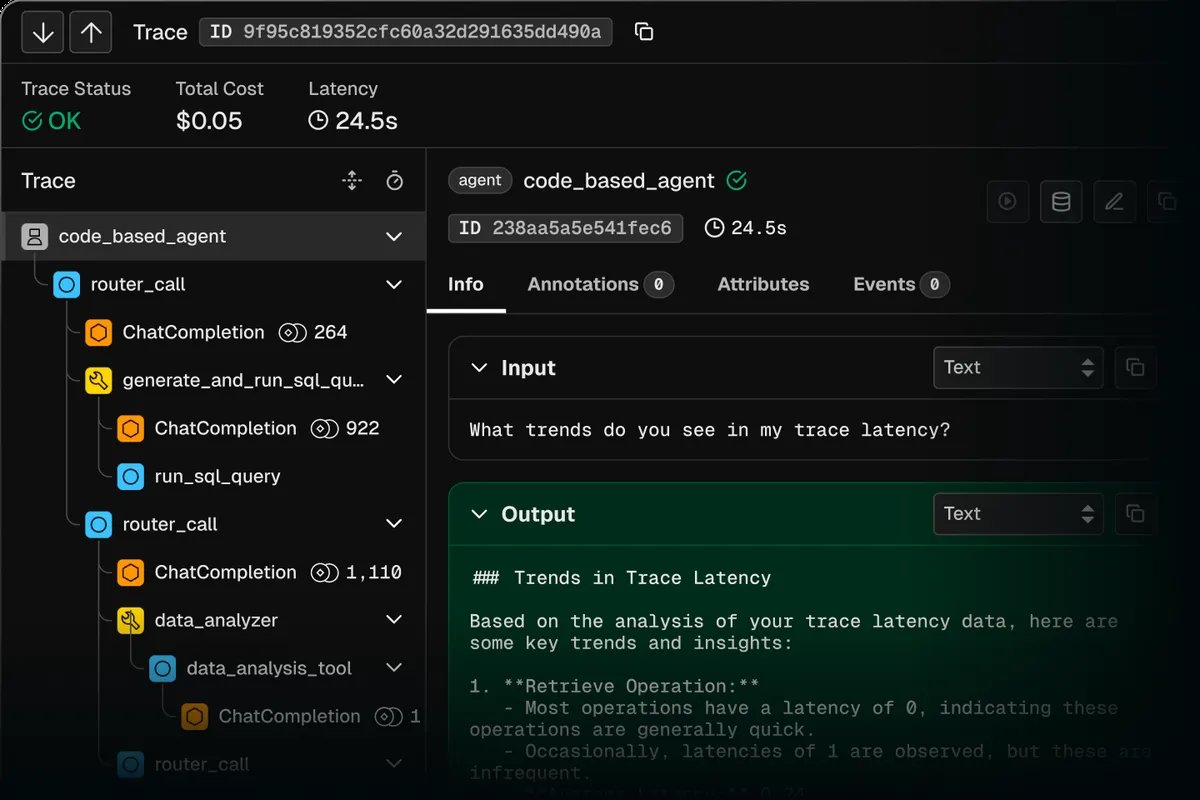
Arize Phoenix
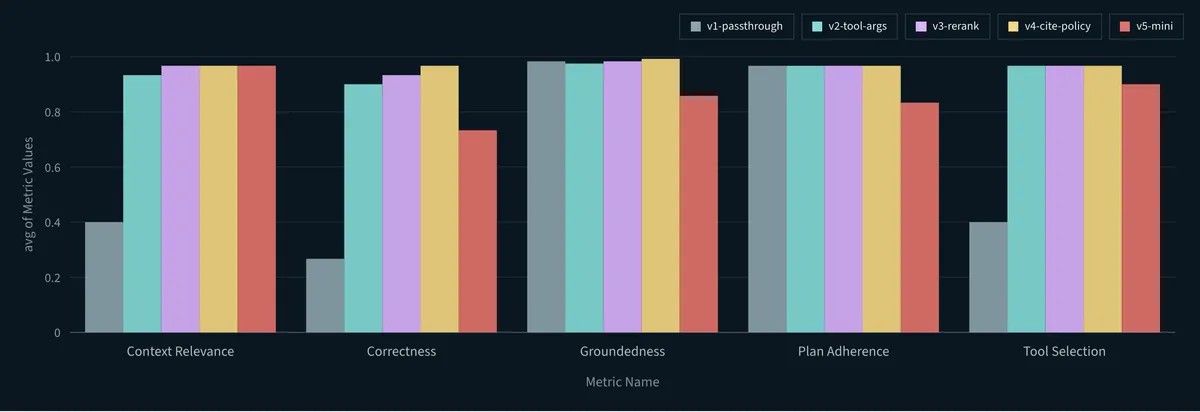
TruLens
Feature Comparison
| Feature | Arize Phoenix | TruLens |
|---|---|---|
| Tracing and observability | ||
| Agent execution visibility | Shows every agent step to diagnose what went wrong. | Traces agent actions and captures every span. |
| Tracing standard | Uses native OpenTelemetry instrumentation through OpenInference conventions. | Uses OpenTelemetry-native tracing for AI-agent experiments. |
| Trace investigation | Supports conversational trace investigation and adding annotations. | Uses feedback results and selector-based metric inspection. |
| Evaluation workflow | ||
| Quality metrics | Builds evals that score outputs and catch issues. | Defines custom metrics and agentic evaluation workflows. |
| Evaluation execution | Runs experiments against datasets created from traces. | Runs evaluations inline during execution or in batches. |
| Agent evaluation | Agent-as-a-Judge learns from telemetry to surface failures. | Provides agentic evaluations for AI-agent behavior. |
| Iteration and experimentation | ||
| Dataset-driven testing | Creates datasets from traces for evidence-based experiments. | Evaluates RAG applications using configurable quality metrics. |
| Version comparison | Tests changes through experiments before shipping improvements. | Compares application versions using evaluation results. |
| Issue discovery | Signal surfaces root causes and review-ready fixes. | Finds agent failures and cost-cutting opportunities through metrics. |
| Developer integrations | ||
| Framework and model portability | Works with any model, framework, or language. | OpenTelemetry-native design supports instrumented AI-agent applications. |
| Coding-agent automation | Offers Agent Native automations through coding agents. | Provides MCP support for model-context-protocol integrations. |
| Metric targeting | Uses annotations and evals to investigate trace outcomes. | Uses Selector API to target data for custom metrics. |
| Deployment and project model | ||
| License | Phoenix is published under the Elastic License 2.0. | Source code is published under the MIT license. |
| Deployment options | Runs locally, self-hosted, or on free Phoenix Cloud. | Open-source deployment model; hosted options are not stated. |
| Commercial expansion | Separate AX Enterprise offers custom limits and self-hosting. | No commercial tier or public enterprise offering is provided. |
Tracing and observability
Agent execution visibility
Tracing standard
Trace investigation
Evaluation workflow
Quality metrics
Evaluation execution
Agent evaluation
Iteration and experimentation
Dataset-driven testing
Version comparison
Issue discovery
Developer integrations
Framework and model portability
Coding-agent automation
Metric targeting
Deployment and project model
License
Deployment options
Commercial expansion
Which to choose
Choose Arize Phoenix when your RAG or agent-quality workflow needs a cohesive trace-to-dataset-to-experiment loop, conversational trace investigation, and a free local or Cloud entry point. Choose TruLens when MIT licensing, custom metric construction, Selector API targeting, inline or batch evaluation, and explicit app-version comparison are the deciding requirements.
Best-fit scenarios
Choose Arize Phoenix if:
Choose Phoenix for teams instrumenting diverse models, frameworks, or languages with OpenInference; creating evaluation datasets from production traces; and iterating through annotated traces and experiments. It is also the fit when a free local deployment or free Phoenix Cloud is required, with an eventual AX path for custom enterprise scale.
Choose TruLens if:
Choose TruLens for teams that require permissive MIT-licensed source code, want to define custom RAG and agent metrics through its Selector API, or need to run the same evaluation logic inline and in batch. It is particularly suited to evaluation-heavy development workflows that compare app versions before release.
These scenarios reflect the available product evidence. Your requirements, existing stack, and team expertise should guide the final decision.
Frequently Asked Questions
What is the main difference between Arize Phoenix and TruLens?
Phoenix is organized around an end-to-end improvement loop: observe agent traces, annotate them, create datasets, run experiments, and measure results. Its OpenInference-based OpenTelemetry instrumentation, conversational trace investigation, and free local or Cloud usage make it a broad agent-development platform. TruLens is more explicitly metric-centric: it combines OpenTelemetry tracing with custom metrics, Selector API targeting, inline and batch evaluation, RAG evaluation, and app-version comparison. Both address agent and RAG quality, but their evaluation workflows emphasize different operating models.
Which is better for small teams?
For a small team that wants to begin quickly with trace visibility and a unified experimentation workflow, Phoenix has a particularly low-friction starting point: it can run with a single uvx command, is free to self-host, and Phoenix Cloud is free. For a small team with a strict permissive-license requirement or an evaluation-first RAG workflow, TruLens is compelling because it is MIT licensed and provides custom metrics, Selector API targeting, and inline or batch evaluation. The deciding factor is workflow preference, not a general quality ranking.
Can I migrate from Arize Phoenix to TruLens?
Migration is possible at the application-instrumentation level when your tracing is based on OpenTelemetry, because both products are OpenTelemetry-oriented. However, it should be planned as a workflow migration rather than assumed to be a one-click export. Phoenix-specific assets such as annotations, trace-derived datasets, experiments, and its conversational investigation workflow do not have documented TruLens portability in the provided information. TruLens-specific custom metrics, Selector API definitions, and version-comparison workflows should likewise be recreated and validated in the destination tool.
What are the pricing differences?
Phoenix itself costs nothing to run locally or self-host, and Phoenix Cloud is also free. Its separate commercial Arize AX product has AX Free with 25,000 trace spans per month, 1 GB monthly ingestion, 15-day retention, and 10 Signal issues per month. AX Pro costs $50 per month for 50,000 spans, 10 GB ingestion, 30-day retention, and 25 issues; AX Enterprise is quoted. TruLens is MIT-licensed open source and free to use or self-host, while the supplied data lists no managed-service plans, paid tiers, or public usage-based rates.