Decision comparison
AgentsDock vs capsul
For wrapping an existing Claude Code or Codex subscription to reduce task context, capsul is the direct fit: it budgets selected context, previews what is sent, and tracks local savings. AgentsDock is the better fit when the work instead requires a remote, multi-agent research workspace with persistent sessions and mobile access; it stops being the direct answer when token-level context minimization is the primary need.
Architecture choice. These take different approaches to the same problem. Read the table as a fit question rather than a feature race.
All 2 are claude code tooling.
Quick Comparison
| Decision factor | AgentsDock | capsul |
|---|---|---|
| Best For | Researchers coordinating Claude Code, Codex, OpenCode, or Cursor jobs across personal machines and remotely accessed servers. | Developers extending existing Claude Code or Codex CLI subscriptions by selecting task-specific repository context under token budgets. |
| Architecture | Open-source cross-platform desktop and mobile IDE using persistent tmux sessions, remote server connections, and inline agent-job results. | Commercial npm CLI that analyzes repository context locally, invokes signed-in Claude or Codex CLIs, and stores savings ledgers locally. |
| Pricing Model | Open source under the Apache-2.0 license; source code at https://github.com/zhengyiluo/agentsdock. | Free: 10 trial prompts, no card. Pro: €5.99 per month, a launch offer (list price €9.99), unlimited prompts. Team: from €20.99 per month with 15 seats included, then €3.50 per extra seat, up to 30 seats. All prices in euros, no VAT charged. The terms let the publisher change prices at any time; a rate stays until the subscription expires. Official pricing and terms pages checked November 8, 2026. |
| Ease of Use | Provides one workspace for supported agent CLIs, syntax-highlighted remote files, and desktop-to-mobile access from any device. | Install @penra/capsul from npm, retain existing CLI sign-in, preview context, and run offline diagnostics. |
| Scalability | Supports multiple server connections and persistent tmux sessions, fitting workflows distributed across several researcher-managed machines. | Team plan includes 15 seats, adds €3.50 per seat up to 30, and supports cross-machine savings history. |
| Community/Support | Apache-2.0 GitHub project with 113 stars, Python as primary language, and latest release v1.0.11. | Commercial product sold by PENRA; published plans include individual and email-invited team subscriptions. |
AgentsDock
- Best For:
- Researchers coordinating Claude Code, Codex, OpenCode, or Cursor jobs across personal machines and remotely accessed servers.
- Architecture:
- Open-source cross-platform desktop and mobile IDE using persistent tmux sessions, remote server connections, and inline agent-job results.
- Pricing Model:
- Open source under the Apache-2.0 license; source code at https://github.com/zhengyiluo/agentsdock.
- Ease of Use:
- Provides one workspace for supported agent CLIs, syntax-highlighted remote files, and desktop-to-mobile access from any device.
- Scalability:
- Supports multiple server connections and persistent tmux sessions, fitting workflows distributed across several researcher-managed machines.
- Community/Support:
- Apache-2.0 GitHub project with 113 stars, Python as primary language, and latest release v1.0.11.
capsul
- Best For:
- Developers extending existing Claude Code or Codex CLI subscriptions by selecting task-specific repository context under token budgets.
- Architecture:
- Commercial npm CLI that analyzes repository context locally, invokes signed-in Claude or Codex CLIs, and stores savings ledgers locally.
- Pricing Model:
- Free: 10 trial prompts, no card. Pro: €5.99 per month, a launch offer (list price €9.99), unlimited prompts. Team: from €20.99 per month with 15 seats included, then €3.50 per extra seat, up to 30 seats. All prices in euros, no VAT charged. The terms let the publisher change prices at any time; a rate stays until the subscription expires. Official pricing and terms pages checked November 8, 2026.
- Ease of Use:
- Install @penra/capsul from npm, retain existing CLI sign-in, preview context, and run offline diagnostics.
- Scalability:
- Team plan includes 15 seats, adds €3.50 per seat up to 30, and supports cross-machine savings history.
- Community/Support:
- Commercial product sold by PENRA; published plans include individual and email-invited team subscriptions.
Public signals
Verified factual signals only. Bars appear only for like-for-like metrics with five weekly assessments for every tool; missing evidence stays explicit. These signals do not establish enterprise adoption, product quality, or total cost.
| Metric | AgentsDock | capsul |
|---|---|---|
| GitHub commits, 90d(Product adoption) | 1.3k | Not available |
| GitHub stars(Product adoption) | 119 | Not available |
| npm weekly downloads(Developer adoption) | Not available | 16 |
As of November 23, 2026 — updated weekly.
Health & risk evidence
Observed public-source checks for mapped package versions and repositories.
AgentsDock
Package vulnerabilities
Not available
Repository security score
Not available
capsul
November 23, 2026Package vulnerabilities
npm · @penra/capsul@1.4.8
0 vulnerabilities
across 1 package
Repository security score
Not available
Interface Preview
AgentsDock
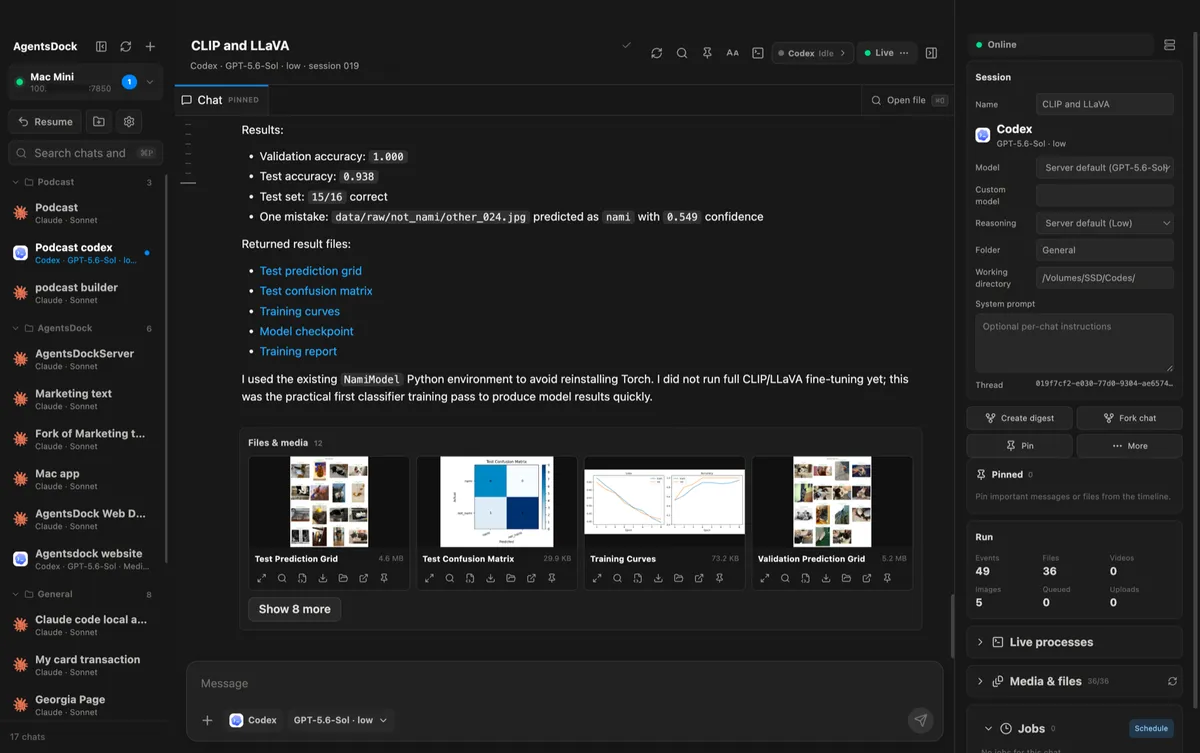
Feature Comparison
| Feature | AgentsDock | capsul |
|---|---|---|
| Agent Workspace and Execution | ||
| Multi-agent workspace | Runs supported agent tools in one desktop and mobile workspace | Wraps one signed-in Claude or Codex CLI request path |
| Persistent execution sessions | Keeps agent work alive through persistent tmux sessions | Runs CLI requests without a published persistent-session workspace |
| Job-result visibility | Displays inline results from agent jobs in the workspace | Reports selected context and local savings through command output |
| Context and Code Handling | ||
| Context selection | Provides remote code editing rather than published token-budget context selection | Selects task-needed files and context within a user-set token budget |
| Excluded-context explanation | No published feature listing omitted files or token-budget exclusions | Lists what is sent and what the token budget left out |
| Language precision | Offers syntax-highlighted files across remotely edited code | Reads JavaScript and TypeScript most precisely for context matching |
| Remote Access and Privacy | ||
| Remote machine access | Connects to multiple servers and switches between them remotely | Operates locally against the repository and installed agent CLIs |
| Mobile workflow | Provides desktop and mobile workspaces, including iPhone, iPad, and Android | Published as an npm command-line tool without a mobile workspace |
| Prompt and ledger handling | No published prompt-routing or local-ledger privacy specification provided | Keeps savings ledger locally and sends no prompt, repository, or reply |
| Model and CLI Integration | ||
| Claude Code support | Runs Claude Code inside its unified agentic research workspace | Uses an already signed-in Claude CLI without a capsul relay |
| Codex support | Runs Codex alongside other supported agent development tools | Uses an already signed-in Codex CLI with selected context |
| Additional agent tools | Also supports OpenCode and Cursor in the same workspace | Published integration scope names Claude and Codex only |
| Operations and Commercial Model | ||
| Cost monitoring | No published local spend-ledger feature in the supplied product data | Records local spend by agent, model, and project |
| Installation and licensing | Apache-2.0 source project distributed from its GitHub repository | Commercial CLI installed globally from npm as @penra/capsul |
| Team access | Coordinates multiple servers but publishes no paid seat-based team plan | Team subscription includes 15 seats with email-based invitations |
Agent Workspace and Execution
Multi-agent workspace
Persistent execution sessions
Job-result visibility
Context and Code Handling
Context selection
Excluded-context explanation
Language precision
Remote Access and Privacy
Remote machine access
Mobile workflow
Prompt and ledger handling
Model and CLI Integration
Claude Code support
Codex support
Additional agent tools
Operations and Commercial Model
Cost monitoring
Installation and licensing
Team access
Which approach fits
For wrapping an existing Claude Code or Codex subscription to reduce task context, capsul is the direct fit: it budgets selected context, previews what is sent, and tracks local savings. AgentsDock is the better fit when the work instead requires a remote, multi-agent research workspace with persistent sessions and mobile access; it stops being the direct answer when token-level context minimization is the primary need.
When each approach fits
Choose AgentsDock if:
Choose AgentsDock when you run agentic research across several servers, need persistent tmux-backed jobs, edit remote files, or check Claude Code, Codex, OpenCode, and Cursor work from mobile devices.
Choose capsul if:
Choose capsul when your team already pays for and signs into Claude Code or Codex CLI, and wants smaller task-specific prompts, explicit token budgets, local savings records, and a seat-based team plan.
These scenarios reflect the available product evidence. Your requirements, existing stack, and team expertise should guide the final decision.
Frequently Asked Questions
What is the main difference between AgentsDock and capsul?
AgentsDock is an Apache-2.0, cross-platform IDE for operating agentic coding and research work. It unifies Claude Code, Codex, OpenCode, and Cursor, supports multiple remote servers, keeps tmux sessions persistent, and exposes results in desktop and mobile workspaces. capsul is a commercial npm CLI that sits around existing signed-in Claude or Codex CLIs. Its purpose is to identify task-relevant repository context, enforce a token budget, show what will be sent, and record savings locally.
Which is better for small teams?
For a small team trying to make existing Claude Code or Codex subscriptions go further, capsul is the more directly aligned option. Its Team plan starts at €20.99 per month with 15 seats included, then costs €3.50 per additional seat up to 30; it also provides email invitations and cross-machine savings history. AgentsDock can suit a research-oriented small team that needs shared operational patterns across remote servers, but the supplied information does not publish a seat-based team plan or centralized team administration.
Can I migrate from AgentsDock to capsul?
There is no published data migration described between them, because they address different layers of the workflow rather than store the same project data. You can continue using the same repository and existing signed-in Claude Code or Codex CLI while adopting capsul, then invoke capsul for tasks where context selection matters. Moving away from AgentsDock means replacing its workspace conveniences—remote server switching, persistent tmux sessions, mobile access, inline results, and support for OpenCode and Cursor—with other tooling as needed.
What are the pricing differences?
AgentsDock is open source under the Apache-2.0 license, with source code hosted on GitHub; the supplied information lists no subscription tiers, usage limits, or hosted-service price. capsul offers 10 free trial prompts without a card. Its Pro plan is €5.99 per month as a launch offer, with a €9.99 list price, and includes unlimited prompts. Team starts at €20.99 per month for 15 seats, then €3.50 per extra seat up to 30. Prices are in euros and no VAT is charged.