Decision comparison
Apache Airflow vs AWS Kinesis
Choose Apache Airflow when the central problem is reliably coordinating scheduled, dependency-heavy workflows across warehouses, cloud services, ML jobs, and operational tasks. Choose AWS Kinesis when the central problem is low-latency ingestion and processing of continuous event or video streams; it can feed downstream systems that Airflow later orchestrates.
Used together. These are normally used together rather than chosen between. The comparison explains what each one does in the stack.
Applies to: Whether work belongs on a continuous stream or in a scheduled batch pipeline.
These are different kinds of product — Workflow Orchestrator and Event Streaming Platform.
Quick Comparison
| Decision factor | Apache Airflow | AWS Kinesis |
|---|---|---|
| Best For | Scheduling, coordinating, and monitoring complex batch-oriented data, ML, infrastructure, and cross-system workflows using Python DAGs. | Ingesting, buffering, and processing high-volume real-time data or video streams for monitoring, fraud detection, and live analytics. |
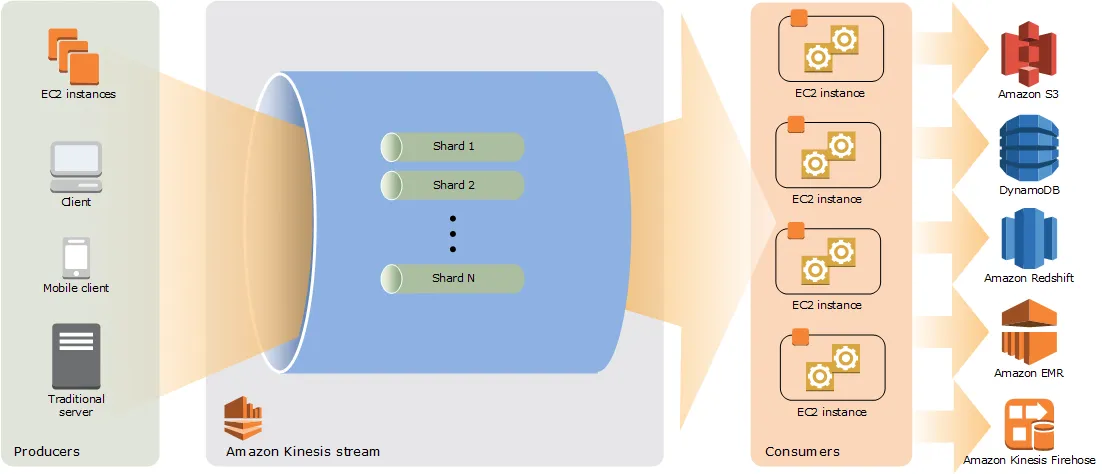
| Architecture | Modular Python workflow orchestrator using DAGs, operators, a scheduler, web UI, message queue, and distributed workers. | Fully managed AWS streaming platform using streams, records, shards or on-demand capacity, consumers, and CloudWatch monitoring. |
| Pricing Model | Free and open-source under the Apache License 2.0 | Usage-based pricing starting at $0.08 per GB of data ingested, with example monthly charges of $593.04 for 7,413.12 GB of data ingested. Additional pricing tiers include $0.04, $0.03, and $0.01 per GB/month as shown in the sources. |
| Ease of Use | Python-based authoring and modern UI simplify workflow development, but users report a steep learning curve for operations. | Managed serverless infrastructure removes cluster management, while producers still require partitioning, throughput, and consumer design decisions. |
| Scalability | Message-queue architecture can orchestrate arbitrary numbers of workers; dynamic Python DAG generation supports large workflow estates. | Processes streaming data from thousands of sources with low latency; capacity scales through shards or on-demand stream mode. |
| Community/Support | Active open-source community and 46,764 GitHub stars; users identify it as an industry standard with broad integrations. | AWS-managed service with Kinesis client libraries; the cited Java client repository has 667 GitHub stars and Apache-2.0 licensing. |
Apache Airflow
- Best For:
- Scheduling, coordinating, and monitoring complex batch-oriented data, ML, infrastructure, and cross-system workflows using Python DAGs.
- Architecture:
- Modular Python workflow orchestrator using DAGs, operators, a scheduler, web UI, message queue, and distributed workers.
- Pricing Model:
- Free and open-source under the Apache License 2.0
- Ease of Use:
- Python-based authoring and modern UI simplify workflow development, but users report a steep learning curve for operations.
- Scalability:
- Message-queue architecture can orchestrate arbitrary numbers of workers; dynamic Python DAG generation supports large workflow estates.
- Community/Support:
- Active open-source community and 46,764 GitHub stars; users identify it as an industry standard with broad integrations.
AWS Kinesis
- Best For:
- Ingesting, buffering, and processing high-volume real-time data or video streams for monitoring, fraud detection, and live analytics.
- Architecture:
- Fully managed AWS streaming platform using streams, records, shards or on-demand capacity, consumers, and CloudWatch monitoring.
- Pricing Model:
- Usage-based pricing starting at $0.08 per GB of data ingested, with example monthly charges of $593.04 for 7,413.12 GB of data ingested. Additional pricing tiers include $0.04, $0.03, and $0.01 per GB/month as shown in the sources.
- Ease of Use:
- Managed serverless infrastructure removes cluster management, while producers still require partitioning, throughput, and consumer design decisions.
- Scalability:
- Processes streaming data from thousands of sources with low latency; capacity scales through shards or on-demand stream mode.
- Community/Support:
- AWS-managed service with Kinesis client libraries; the cited Java client repository has 667 GitHub stars and Apache-2.0 licensing.
Public signals
Verified factual signals only. Bars appear only for like-for-like metrics with five weekly assessments for every tool; missing evidence stays explicit. These signals do not establish enterprise adoption, product quality, or total cost.
| Metric | Apache Airflow | AWS Kinesis |
|---|---|---|
| Docker Hub pulls(Product adoption) | 1.6B | Not available |
| GitHub commits, 90d(Product adoption) | 2.0k | Not available |
| GitHub stars(Product adoption) | 46,000+ | Not available |
| Search interest(Market interest) | 2 | 1 |
| Hacker News mentions, 90d(Community interest) | 1 | 0 |
| PyPI weekly downloads(Product adoption) | 1.8M | Not available |
| Stack Overflow questions(Community interest) | 10.6k | 1.8k |
| GitHub commits, 90d(Developer adoption) | Not available | 19 |
| GitHub stars(Developer adoption) | Not available | 667 |
| npm weekly downloads(Developer adoption) | Not available | 1.9M |
As of September 14, 2026 — updated weekly.
Health & risk evidence
Observed public-source checks for mapped package versions and repositories.
Apache Airflow
September 14, 2026Package vulnerabilities
PyPI · apache-airflow@3.3.1
0 vulnerabilities
across 1 package
Repository security score
github.com/apache/airflow
7.3/10
AWS Kinesis
September 14, 2026Package vulnerabilities
npm · @aws-sdk/client-kinesis@3.1131.0
0 vulnerabilities
across 1 package
Repository security score
Not available
Interface Preview
Apache Airflow
AWS Kinesis
Feature Comparison
| Feature | Apache Airflow | AWS Kinesis |
|---|---|---|
| Primary Workload Model | ||
| Workflow definition | Python DAGs define ordered, parameterized tasks and dependencies. | Records flow through real-time streams using partition keys and consumers. |
| Scheduling and execution | Scheduler runs time-based workflows across distributed task workers. | Continuously ingests and serves streaming records with low latency. |
| Typical outcomes | Coordinates ETL, ML models, transfers, and infrastructure operations. | Supports monitoring, fraud detection, live leaderboards, and streaming analytics. |
| Operations and Management | ||
| Operational interface | Modern web application monitors schedules, task status, and logs. | AWS service metrics integrate with CloudWatch for stream monitoring. |
| Compute management | Operators deploy and manage schedulers, metadata, queues, and workers. | Fully managed serverless infrastructure runs streaming service capacity. |
| Failure handling | Task states and logs expose failed workflow execution for remediation. | KPL provides automatic exponential-backoff retries for failed records. |
| Scale and Throughput | ||
| Horizontal scaling | Message queue orchestrates an arbitrary number of workers. | Shards provide stream throughput units; on-demand mode handles variable ingestion. |
| Dynamic workload handling | Python code dynamically generates pipelines and task structures. | Thousands of sources can send records for low-latency processing. |
| Producer optimization | Operators execute external tasks rather than batch streaming records. | KPL batches records in memory before Kinesis API submission. |
| Integration and Extensibility | ||
| Cloud integrations | Plug-and-play operators connect AWS, Google Cloud, Azure, and third parties. | AWS-native streams emit processed results to data stores or applications. |
| Customization model | Custom operators and libraries extend workflow abstraction levels. | Producer behavior is configured through KPL batching and retry settings. |
| Implementation language | Workflows use standard Python features, loops, and datetime scheduling. | Cited client library is Java; AWS SDKs support stream producers. |
| Data Controls and Economics | ||
| Data retention | Workflow metadata and task logs support execution traceability. | One-day stream retention is included in data-ingested charges. |
| Reliability state | DAG task states preserve visibility into completed and failed runs. | KPL checkpointing can persist batch state across producer restarts. |
| Cost basis | Apache-2.0 software is free; users fund their hosting and operations. | Charges meter data ingested, beginning at $0.08 per GB in US-East. |
Primary Workload Model
Workflow definition
Scheduling and execution
Typical outcomes
Operations and Management
Operational interface
Compute management
Failure handling
Scale and Throughput
Horizontal scaling
Dynamic workload handling
Producer optimization
Integration and Extensibility
Cloud integrations
Customization model
Implementation language
Data Controls and Economics
Data retention
Reliability state
Cost basis
How they fit together
Choose Apache Airflow when the central problem is reliably coordinating scheduled, dependency-heavy workflows across warehouses, cloud services, ML jobs, and operational tasks. Choose AWS Kinesis when the central problem is low-latency ingestion and processing of continuous event or video streams; it can feed downstream systems that Airflow later orchestrates.
What each one handles
Use Apache Airflow for:
Choose it for Python-defined batch pipelines, multi-step ETL dependencies, scheduled ML workflows, backfills, cross-cloud task orchestration, and teams willing to operate or use a managed Airflow deployment.
Use AWS Kinesis for:
Choose it for AWS-centric, real-time telemetry, clickstream, IoT, transaction, fraud-detection, or live-dashboard workloads where low-latency ingestion and managed streaming infrastructure are priorities.
These roles reflect the available product evidence. Most teams run both; which one owns a given job depends on your stack and team.
Frequently Asked Questions
What is the main difference between Apache Airflow and AWS Kinesis?
Apache Airflow is a workflow orchestrator: it defines task dependencies as Python DAGs, schedules runs, dispatches work to operators and workers, and exposes task status and logs in a web UI. AWS Kinesis is a managed real-time streaming platform: it ingests, buffers, and delivers continuous records or video with low latency. Airflow coordinates jobs; Kinesis moves and processes streaming data. They are often complementary rather than direct replacements.
Which is better for small teams?
For a small team building scheduled ETL, reporting refreshes, or dependency-heavy Python workflows, Apache Airflow can be attractive because its Apache-2.0 software is free to self-host and it has broad plug-and-play integrations. The tradeoff is its reported steep learning curve and the operational responsibility for its scheduler, workers, metadata, and monitoring. For a small AWS-focused team with continuous event ingestion needs, Kinesis reduces infrastructure management through its fully managed model, but usage charges grow with data volume.
Can I migrate from Apache Airflow to AWS Kinesis?
Not as a direct one-for-one migration, because the products solve different layers of a data platform. An Airflow DAG with scheduled dependencies, retries, and external operators would need to be redesigned as streaming producers, consumers, and downstream processing around Kinesis. You can migrate a continuous ingestion portion of an Airflow-managed pipeline to Kinesis, while retaining Airflow for scheduled backfills, warehouse transformations, quality checks, and orchestration of systems consuming Kinesis data.
What are the pricing differences?
Apache Airflow is free and open-source software under the Apache License 2.0, so there is no software subscription price in the supplied data; costs come from the infrastructure and operations required to run it. AWS Kinesis uses consumption pricing. Its official US-East on-demand example prices ingestion at $0.08 per GB: 1,000 records per second at 3 KB each equals 7,413.12 GB per month and $593.04 in data-ingestion charges, before applicable additional usage.