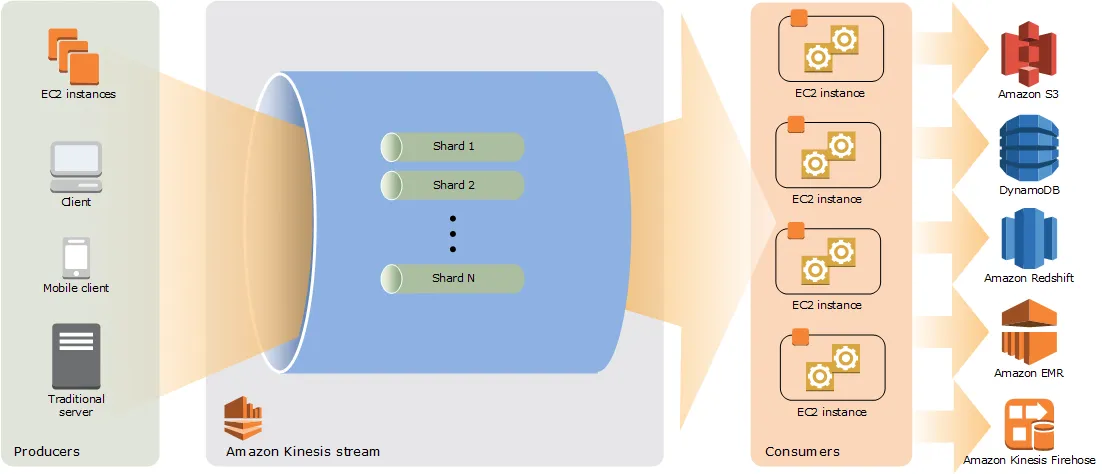
AWS Kinesis: product and architecture
AWS Kinesis review is essential for data engineers and analytics leaders evaluating real-time data pipeline solutions. As a fully managed service, AWS Kinesis provides stream ingestion, low-latency processing, and integration with AWS services. However, its pricing structure and architectural limitations demand careful consideration. For example, a single shard can handle up to 1MB/sec or 500 records/sec for writes, and the cost for ingesting 7,413.12 GB of data is $593.04 per month at the $0.08/GB rate. This makes Kinesis relevant to high-throughput use cases, while teams with modest volumes or strict cost targets should model their workload before choosing it. We recommend this tool for organizations requiring integration with AWS services and willing to accept its pricing and complexity trade-offs. Below, we dissect Kinesis’s capabilities, pricing, and alternatives in detail.
Overview
AWS Kinesis is designed to collect, process, and analyze real-time data streams from thousands of sources. Its core value proposition lies in its ability to deliver insights in minutes through a fully managed, serverless architecture. The service supports a wide range of use cases, including IoT analytics, log aggregation, and fraud detection. For example, a financial institution might use Kinesis to monitor transactions in real time, flagging suspicious activity as it occurs. The service’s low-latency processing and ability to handle petabytes of data make it a compelling choice for enterprises with complex data pipelines. However, Kinesis’s pricing model and dependency on AWS infrastructure can be limiting factors. For instance, the $0.08/GB ingestion rate for 7,413.12 GB of data equates to $593.04 per month in one scenario, which could be prohibitive for focused teams. We recommend Kinesis for organizations already invested in AWS and requiring a tightly integrated, managed solution, but caution against it for those prioritizing cost efficiency or multi-cloud flexibility.
Key Features and Architecture
AWS Kinesis’s architecture is built around shards, which are the fundamental units of throughput. One shard provides an ingest capacity of 1 MB/second or 1,000 records/second. and 2MB/sec for reads. This design allows Kinesis to scale horizontally by adding shards, but it also introduces complexity in managing capacity. The service uses a producer-consumer model, where data is ingested via producers (e.g., applications, sensors) and processed by consumers (e.g., analytics tools, data lakes). Key features include:
- Batching and Batching Optimization: The Amazon Kinesis Producer Library (KPL) automatically batches records in memory before sending them to Kinesis, reducing API call overhead. This can lower costs by minimizing the number of requests. For example, batching 500 records at a time can reduce ingestion costs by up to 20% compared to sending individual records.
- Automatic Retries and Error Handling: KPL includes exponential backoff for failed records, reducing the need for manual error handling. This is critical for high-throughput scenarios where network issues or throttling can occur frequently.
- Metrics and Monitoring: Kinesis integrates with Amazon CloudWatch, exposing metrics like
BytesSent,RecordsSent,FailedRecords, andBatchLatency. These metrics enable real-time debugging of performance bottlenecks, such as identifying shards that are consistently underperforming. - Checkpointing for Stateful Producers: KPL can persist batch state to disk, ensuring data integrity if a producer restarts. This feature is particularly valuable for applications that require stateful processing, such as fraud detection systems that must track user behavior across sessions.
- Shard Management and Scaling: Kinesis allows dynamic scaling of shards based on workload, but this requires careful planning. For example, increasing the number of shards from 10 to 100 can improve write throughput but may also increase costs by a factor of 10.
These features collectively make Kinesis a robust platform for real-time data processing, but they also demand expertise in managing shards, monitoring metrics, and configuring producers. Organizations must weigh these complexities against the benefits of a fully managed, scalable service.
Ideal Use Cases
AWS Kinesis excels in scenarios requiring high-throughput, low-latency data processing with tight integration to AWS services. Three specific use cases include:
- IoT Analytics for Large-Scale Sensor Networks: A manufacturing company with 10,000 IoT sensors generating 100 MB of data per hour could use Kinesis to aggregate and analyze sensor data in real time. For example, monitoring equipment health to predict maintenance needs. However, this use case requires careful shard provisioning to handle the data volume, and the $0.08/GB rate could become expensive if the data volume exceeds 10,000 GB/month.
- Real-Time Fraud Detection in Fintech: A fintech firm processing 10 million transactions per day might use Kinesis to detect fraudulent activity as transactions occur. By integrating Kinesis with AWS Lambda and Amazon S3, the firm can analyze transaction patterns and store results for audit purposes. However, this use case is not ideal for teams with limited AWS expertise, as setting up the pipeline requires configuring shards, producers, and consumers.
- Log Aggregation for SaaS Platforms: A SaaS company with 50,000 customers might use Kinesis to centralize logs from microservices and perform real-time analytics. For example, detecting anomalies in user behavior or system performance. However, this use case is not suitable for organizations with low data volumes, as the $0.08/GB rate may be cost-prohibitive for smaller teams.
Don’t use Kinesis if your workload requires sub-millisecond latency or if you need to avoid AWS lock-in. For example, a startup with limited data volume and a multi-cloud strategy might find Kinesis’s pricing and vendor dependency less appealing.
Pros and Cons
Pros:
- Scalable Sharding Model: Kinesis’s shard-based architecture allows horizontal scaling to handle petabytes of data. For example, a shard can process up to 1MB/sec of writes, enabling teams to add shards as needed without overprovisioning.
- Deep Integration with AWS Ecosystem: Kinesis seamlessly integrates with services like Lambda, S3, and DynamoDB, reducing latency and complexity in data pipelines. For instance, data can be processed in Lambda and stored in S3 with minimal configuration.
- Managed Service with Low Latency: As a fully managed service, Kinesis eliminates the need for infrastructure management. It also supports low-latency processing, with sub-100ms response times in many scenarios.
- Robust Monitoring and Metrics: CloudWatch integration provides detailed metrics like
BatchLatencyandFailedRecords, enabling teams to optimize performance and troubleshoot issues in real time.
Cons:
- Cost Exposure for High-Volume Workloads: At the stored Basic-tier rate, ingestion cost rises directly with volume. Model payload size, record rate, retention, reads, and regional charges together rather than comparing only the headline ingestion rate.
- Complexity in Shard Management: While shards enable scalability, managing them requires expertise. Teams must monitor shard utilization and adjust capacity dynamically, which can be time-consuming.
- Vendor Lock-In: Kinesis’s deep integration with AWS services makes it difficult to migrate to other platforms. For example, moving data to a non-AWS ecosystem would require rearchitecting pipelines and potentially incurring migration costs.
These trade-offs highlight that Kinesis is best suited for organizations with existing AWS investments and high-throughput needs, but less ideal for those prioritizing cost efficiency or multi-cloud flexibility.