Decision comparison
AWS Kinesis vs Confluent
Choose AWS Kinesis when an AWS-native team wants a fully managed, serverless stream service and accepts GB-based ingestion billing. Choose Confluent when Kafka compatibility, reusable connectors, schema governance, deployment flexibility, and explicitly tiered throughput are central to the platform strategy.
Architecture choice. These take different approaches to the same problem. Read the table as a fit question rather than a feature race.
Applies to: managed Kafka-based streaming and connector-heavy data integration workloads
All 2 are event streaming platforms.
Quick Comparison
| Decision factor | AWS Kinesis | Confluent |
|---|---|---|
| Best For | AWS-native real-time ingestion, application monitoring, fraud detection, live leaderboards, and low-latency processing from thousands of streaming sources. | Organizations standardizing on Kafka for governed, cross-system event streaming, real-time integration, and AI or ML applications needing fresh data. |
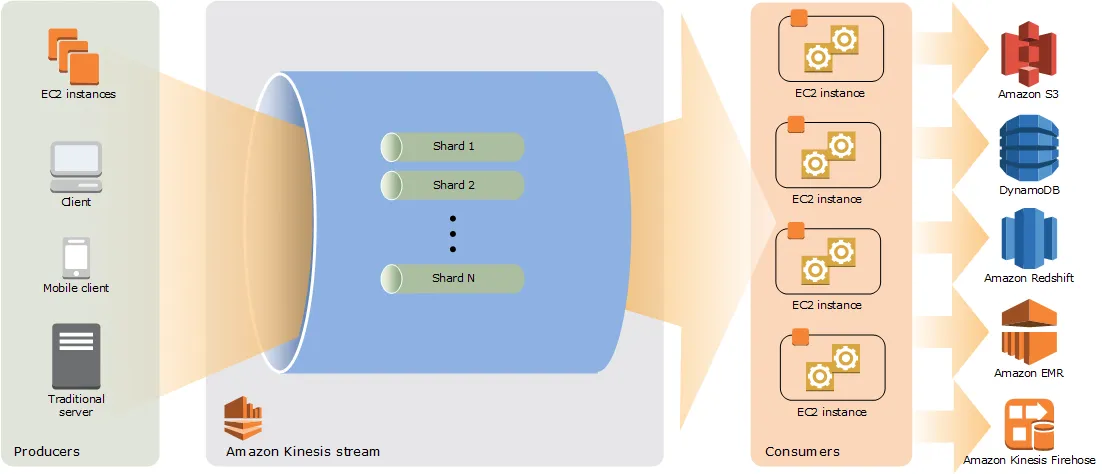
| Architecture | Fully managed, serverless AWS streaming service using streams, shards, records, retention settings, checkpointing, encryption, and CloudWatch monitoring. | Kafka-based data streaming platform offering managed Confluent Cloud, self-managed Kafka deployments, connectors, Schema Registry, tiered storage, and Kubernetes operations. |
| Pricing Model | Usage-based pricing starting at $0.08 per GB of data ingested, with example monthly charges of $593.04 for 7,413.12 GB of data ingested. Additional pricing tiers include $0.04, $0.03, and $0.01 per GB/month as shown in the sources. | Basic $0/mo, Standard $385/mo, Enterprise $895/mo, Freight $2,300/mo with usage-based rates starting at $0.01 |
| Ease of Use | Managed AWS infrastructure reduces operational work, while shard configuration, partition keys, producer batching, and consumer checkpointing still require engineering decisions. | Pre-built 120+ connectors, Control Center, Schema Registry, and managed cloud reduce Kafka operations, though users report some complexity and slowness. |
| Scalability | Scales streaming capacity through shard count or on-demand operation; warm throughput and shard-level limits govern sustained ingestion and consumption. | Autoscaling clusters range from 250/750 MBps Basic throughput to 9,120/27,360 MBps Freight ingress/egress, with tier-specific partition limits. |
| Community/Support | Backed by AWS managed-service support and ecosystem tooling; the cited Java client library has 667 GitHub stars and Apache-2.0 licensing. | Founded by Apache Kafka co-creators, with vendor support; cited user feedback is 9.2/10 across 27 reviews and Python client has 504 stars. |
AWS Kinesis
- Best For:
- AWS-native real-time ingestion, application monitoring, fraud detection, live leaderboards, and low-latency processing from thousands of streaming sources.
- Architecture:
- Fully managed, serverless AWS streaming service using streams, shards, records, retention settings, checkpointing, encryption, and CloudWatch monitoring.
- Pricing Model:
- Usage-based pricing starting at $0.08 per GB of data ingested, with example monthly charges of $593.04 for 7,413.12 GB of data ingested. Additional pricing tiers include $0.04, $0.03, and $0.01 per GB/month as shown in the sources.
- Ease of Use:
- Managed AWS infrastructure reduces operational work, while shard configuration, partition keys, producer batching, and consumer checkpointing still require engineering decisions.
- Scalability:
- Scales streaming capacity through shard count or on-demand operation; warm throughput and shard-level limits govern sustained ingestion and consumption.
- Community/Support:
- Backed by AWS managed-service support and ecosystem tooling; the cited Java client library has 667 GitHub stars and Apache-2.0 licensing.
Confluent
- Best For:
- Organizations standardizing on Kafka for governed, cross-system event streaming, real-time integration, and AI or ML applications needing fresh data.
- Architecture:
- Kafka-based data streaming platform offering managed Confluent Cloud, self-managed Kafka deployments, connectors, Schema Registry, tiered storage, and Kubernetes operations.
- Pricing Model:
- Basic $0/mo, Standard $385/mo, Enterprise $895/mo, Freight $2,300/mo with usage-based rates starting at $0.01
- Ease of Use:
- Pre-built 120+ connectors, Control Center, Schema Registry, and managed cloud reduce Kafka operations, though users report some complexity and slowness.
- Scalability:
- Autoscaling clusters range from 250/750 MBps Basic throughput to 9,120/27,360 MBps Freight ingress/egress, with tier-specific partition limits.
- Community/Support:
- Founded by Apache Kafka co-creators, with vendor support; cited user feedback is 9.2/10 across 27 reviews and Python client has 504 stars.
Public signals
Verified factual signals only. Bars appear only for like-for-like metrics with five weekly assessments for every tool; missing evidence stays explicit. These signals do not establish enterprise adoption, product quality, or total cost.
| Metric | AWS Kinesis | Confluent |
|---|---|---|
| GitHub commits, 90d(Developer adoption) | 19 | 44 |
| GitHub stars(Developer adoption) | 667 | 504 |
| Search interest(Market interest) | 1 | 1 |
| Hacker News mentions, 90d(Community interest) | 0 | Not available |
| npm weekly downloads(Developer adoption) | 1.9M | Not available |
| Stack Overflow questions(Community interest) | 1.8k | 2.1k |
| Docker Hub pulls(Product adoption) | Not available | 22.0M |
| npm weekly downloads(Ecosystem adoption) | Not available | 2.6M |
| Product Hunt comments(Community interest) | Not available | 1 |
| Product Hunt rating(Community interest) | Not available | 5.0/5 |
| Product Hunt reviews(Community interest) | Not available | 3 |
| Product Hunt votes(Community interest) | Not available | 6 |
| PyPI weekly downloads(Developer adoption) | Not available | 9.6M |
As of September 14, 2026 — updated weekly.
Health & risk evidence
Observed public-source checks for mapped package versions and repositories.
AWS Kinesis
September 14, 2026Package vulnerabilities
npm · @aws-sdk/client-kinesis@3.1131.0
0 vulnerabilities
across 1 package
Repository security score
Not available
Confluent
September 14, 2026Package vulnerabilities
PyPI · confluent-kafka@2.15.0 · npm · kafkajs@2.2.4
0 vulnerabilities
across 2 packages
Repository security score
Not available
Interface Preview
AWS Kinesis
Feature Comparison
| Feature | AWS Kinesis | Confluent |
|---|---|---|
| Streaming architecture | ||
| Core streaming model | AWS-managed streams organize records across configurable shards. | Kafka-based platform organizes event streams for managed or self-managed deployment. |
| Infrastructure operation | Serverless managed infrastructure runs streaming applications without operating brokers. | Confluent Cloud manages Kafka, while self-managed Kafka deployments remain supported. |
| Low-latency processing | Ingests, buffers, and processes streaming data with low latency. | Basic through Enterprise target sub-100ms latency; Freight can reach one to two seconds. |
| Scale and performance controls | ||
| Capacity scaling | Shard count and warm throughput settings control stream capacity. | Autoscaling applies across Basic, Standard, Enterprise, and Freight cluster tiers. |
| Throughput model | Shard-level write and read throughput determine stream throughput planning. | Tier throughput ranges from 250/750 to 9,120/27,360 MBps ingress/egress. |
| Payload handling | Max record size in KiB is an explicit stream configuration capability. | Kafka clients publish records through Kafka protocol-based producers and consumers. |
| Data durability and governance | ||
| Retention and storage | Retention period is configured in hours; one-day retention is included in cited ingestion pricing. | Tiered storage optimizes resource use for Kafka data retention. |
| Encryption and security | Stream encryption is a listed Kinesis stream capability. | Platform provides robust security features for streaming deployments. |
| Schema governance | Records use partition keys, payloads, and sequence numbers for stream ordering. | Schema Registry provides centralized data governance for Kafka event schemas. |
| Integration and operations | ||
| Monitoring | CloudWatch exposes BytesSent, RecordsSent, FailedRecords, and batch-latency metrics. | Control Center streamlines monitoring for Kafka clusters and streaming workloads. |
| Producer reliability | Kinesis Producer Library batches records and retries failures using exponential backoff. | Kafka Python client supports Kafka protocol connectivity through librdkafka. |
| Ecosystem connectivity | AWS streaming applications can emit analysis results to data stores or applications. | More than 120 pre-built Kafka connectors support real-time data integration. |
| Commercial and deployment choices | ||
| Consumption billing | Charges data ingestion by GB; cited US-East example uses $0.08 per GB. | Publishes Basic through Freight tiers plus usage-based rates starting at $0.01. |
| Service levels | AWS provides a fully managed streaming service with configurable stream controls. | Published SLAs span 99.5% Basic through 99.99% higher-capacity tier configurations. |
| Kubernetes operations | No Kubernetes day-two operations product is described in the provided Kinesis data. | Confluent for Kubernetes supports day-two operations for Kafka deployments. |
Streaming architecture
Core streaming model
Infrastructure operation
Low-latency processing
Scale and performance controls
Capacity scaling
Throughput model
Payload handling
Data durability and governance
Retention and storage
Encryption and security
Schema governance
Integration and operations
Monitoring
Producer reliability
Ecosystem connectivity
Commercial and deployment choices
Consumption billing
Service levels
Kubernetes operations
Which approach fits
Choose AWS Kinesis when an AWS-native team wants a fully managed, serverless stream service and accepts GB-based ingestion billing. Choose Confluent when Kafka compatibility, reusable connectors, schema governance, deployment flexibility, and explicitly tiered throughput are central to the platform strategy.
When each approach fits
Choose AWS Kinesis if:
Choose Kinesis for AWS-centric telemetry, clickstream, fraud, monitoring, or leaderboard pipelines where managed stream operations, encryption, CloudWatch metrics, and shard or on-demand scaling fit the workload.
Choose Confluent if:
Choose Confluent for Kafka-standardized event architectures spanning many systems, especially when 120+ connectors, Schema Registry, tiered storage, Control Center, or self-managed and Kubernetes deployment options are required.
These scenarios reflect the available product evidence. Your requirements, existing stack, and team expertise should guide the final decision.
Frequently Asked Questions
What is the main difference between AWS Kinesis and Confluent?
AWS Kinesis is an AWS-managed streaming service built around streams, records, shards, retention, encryption, and AWS monitoring. Confluent is a Kafka-based data streaming platform founded by Apache Kafka co-creators, offering managed Confluent Cloud as well as self-managed Kafka options. Confluent adds platform capabilities such as Schema Registry, 120+ connectors, tiered storage, Control Center, and Kubernetes-focused operations.
Which is better for small teams?
For a small team already operating primarily in AWS, Kinesis is often the simpler operational fit because it is presented as a fully managed, serverless service and integrates monitoring through CloudWatch. Confluent Basic starts at $0 per month, which can make experimentation accessible, but teams still need to understand Kafka concepts. Confluent is more compelling when connector breadth and Kafka portability outweigh that additional conceptual overhead.
Can I migrate from AWS Kinesis to Confluent?
Yes, but it should be treated as an application and data-contract migration rather than a direct infrastructure conversion. Kinesis producers use records, partition keys, shards, and Kinesis consumer checkpointing; Confluent workloads use Kafka-compatible clients, topics, partitions, and optionally Schema Registry. Inventory producers, consumers, ordering assumptions, retention needs, schemas, replay requirements, and downstream integrations before running both pipelines in parallel and cutting consumers over.
What are the pricing differences?
Kinesis is consumption-priced in the supplied example: $0.08 per GB of data ingested in US-East, where 7,413.12 GB per month produces a $593.04 ingestion charge; other listed rates include $0.04, $0.03, and $0.01. Confluent publishes Basic at $0 per month, Standard at $385 per month, Enterprise at $895 per month, and Freight at $2,300 per month, alongside usage-based rates starting at $0.01. Compare projected data volume, throughput tier, retention, and consumption before choosing.