Decision comparison
Google BigQuery vs StarRocks
Google BigQuery and StarRocks target different points on the analytics spectrum. BigQuery delivers a zero-ops, serverless experience that excels when your team lives inside the Google Cloud ecosystem and needs scalable batch and ad-hoc analytics without managing infrastructure. StarRocks is the stronger choice when your workloads demand sub-second query latency on rapidly changing data, and your team has the operational capacity to run (or the budget for managed) a high-performance MPP cluster.
Architecture choice. These take different approaches to the same problem. Read the table as a fit question rather than a feature race.
These are different kinds of product — Cloud Data Warehouse and OLAP Database.
Quick Comparison
| Decision factor | Google BigQuery | StarRocks |
|---|---|---|
| Best For | Serverless analytics on GCP with pay-per-query simplicity | Sub-second OLAP queries on mutable, real-time data |
| Deployment Model | Fully managed SaaS on Google Cloud | Self-hosted (open source) or CelerData managed cloud |
| Pricing Model | BigQuery offers two compute pricing models. On-demand pricing charges for bytes processed by each query, billed per TiB, with the first 1 TiB of query data per month free. Capacity pricing charges for compute capacity per slot-hour instead. Storage is billed separately, and BigQuery also has a free usage tier and free operations. | StarRocks is free and open source, and the project publishes no pricing. Managed StarRocks is sold by third parties under their own brands, and their rates are published there rather than by the project, so treat any managed price as a vendor quote and not as a StarRocks price. |
| Query Latency | Seconds-range for most analytical queries; optimized for throughput over latency | Sub-second latency on complex multi-table joins via vectorized MPP engine |
| Real-Time Ingestion | Streaming inserts and Pub/Sub subscriptions; CDC via Datastream | Primary Key tables with streaming and CDC ingestion from Flink and Kafka; sub-ten-second freshness |
| Open Source | No; proprietary Google Cloud service | Yes; Apache 2.0 license, 11,000+ GitHub stars |
Google BigQuery
- Best For:
- Serverless analytics on GCP with pay-per-query simplicity
- Deployment Model:
- Fully managed SaaS on Google Cloud
- Pricing Model:
- BigQuery offers two compute pricing models. On-demand pricing charges for bytes processed by each query, billed per TiB, with the first 1 TiB of query data per month free. Capacity pricing charges for compute capacity per slot-hour instead. Storage is billed separately, and BigQuery also has a free usage tier and free operations.
- Query Latency:
- Seconds-range for most analytical queries; optimized for throughput over latency
- Real-Time Ingestion:
- Streaming inserts and Pub/Sub subscriptions; CDC via Datastream
- Open Source:
- No; proprietary Google Cloud service
StarRocks
- Best For:
- Sub-second OLAP queries on mutable, real-time data
- Deployment Model:
- Self-hosted (open source) or CelerData managed cloud
- Pricing Model:
- StarRocks is free and open source, and the project publishes no pricing. Managed StarRocks is sold by third parties under their own brands, and their rates are published there rather than by the project, so treat any managed price as a vendor quote and not as a StarRocks price.
- Query Latency:
- Sub-second latency on complex multi-table joins via vectorized MPP engine
- Real-Time Ingestion:
- Primary Key tables with streaming and CDC ingestion from Flink and Kafka; sub-ten-second freshness
- Open Source:
- Yes; Apache 2.0 license, 11,000+ GitHub stars
Public signals
Verified factual signals only. Bars appear only for like-for-like metrics with five weekly assessments for every tool; missing evidence stays explicit. These signals do not establish enterprise adoption, product quality, or total cost.
| Metric | Google BigQuery | StarRocks |
|---|---|---|
| Search interest(Market interest) | 11 | 1 |
| Hacker News mentions, 90d(Community interest) | 7 | 0 |
| npm weekly downloads(Developer adoption) | 3.3M | Not available |
| PyPI weekly downloads(Developer adoption) | 33.5M | 131.3k |
| Stack Overflow questions(Community interest) | 26.2k | 11 |
| Docker Hub pulls(Product adoption) | Not available | 906.6k |
| GitHub commits, 90d(Product adoption) | Not available | 1.3k |
| GitHub stars(Product adoption) | Not available | 12,000+ |
| Product Hunt comments(Community interest) | Not available | 0 |
| Product Hunt reviews(Community interest) | Not available | 0 |
| Product Hunt votes(Community interest) | Not available | 2 |
As of September 21, 2026 — updated weekly.
Health & risk evidence
Observed public-source checks for mapped package versions and repositories.
Google BigQuery
Package vulnerabilities
npm · @google-cloud/bigquery@9.0.3 · PyPI · google-cloud-bigquery@3.45.2
0 vulnerabilities
across 2 packages
Repository security score
Not available
StarRocks
September 21, 2026Package vulnerabilities
PyPI · starrocks@1.3.4
0 vulnerabilities
across 1 package
Repository security score
Not available
Interface Preview
StarRocks
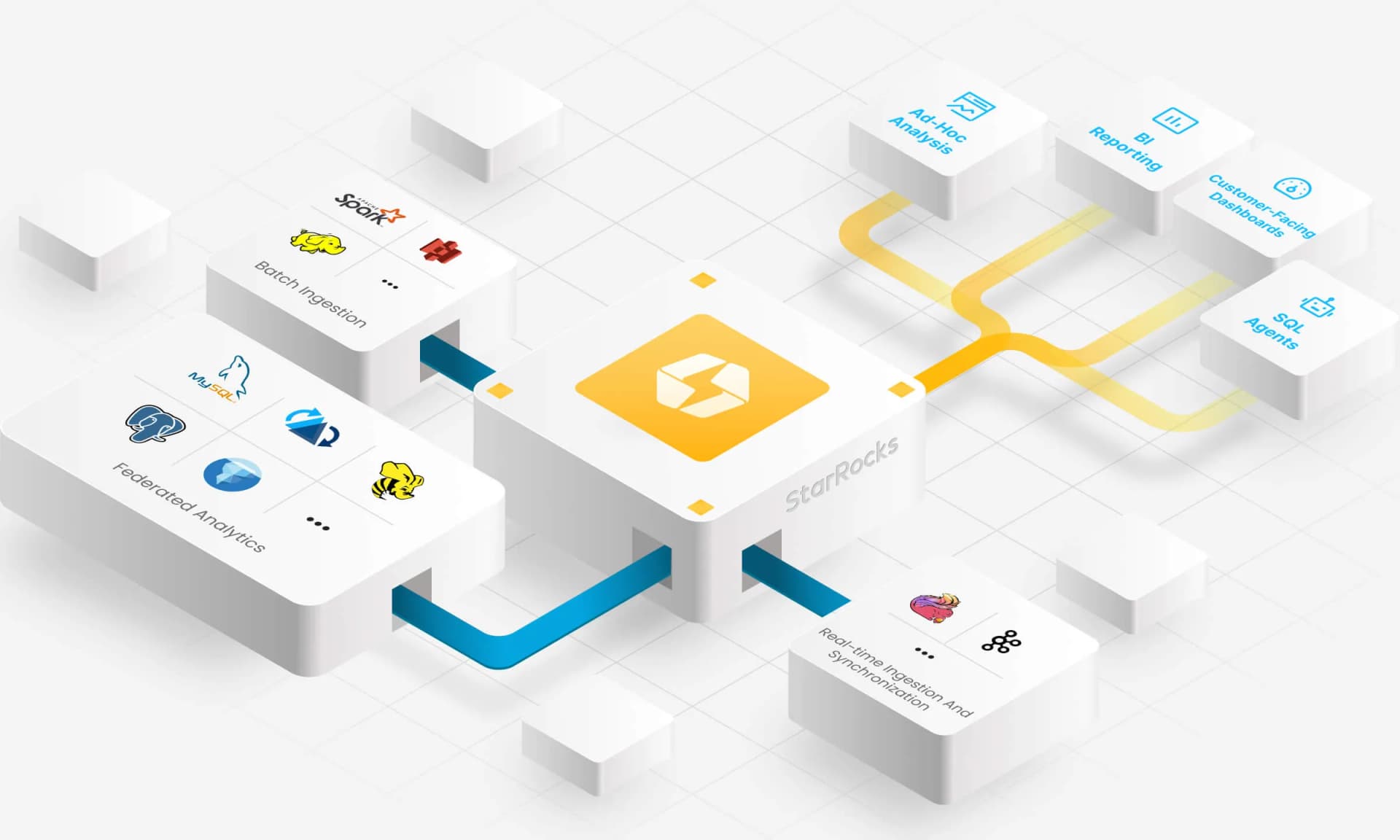
Feature Comparison
| Feature | Google BigQuery | StarRocks |
|---|---|---|
| Architecture & Deployment | ||
| Serverless / Fully Managed | Yes — no clusters to provision or manage | Self-hosted requires cluster management; managed option via CelerData |
| Storage-Compute Separation | Yes — decoupled storage and compute with automatic scaling | Yes — shared-data architecture persists data on S3 or compatible object storage |
| Open Source | Not verified | Yes — Apache 2.0 license |
| Query Performance | ||
| Vectorized Execution Engine | Dremel-based execution with columnar processing | SIMD-optimized fully vectorized engine built in C++ |
| Cost-Based Optimizer | Yes — internal optimizer handles join ordering and pruning | Yes — uses table and column statistics for join order, pruning, and pushdown |
| MPP Parallel Execution | Yes — distributed execution across slots | Yes — massively parallel joins and aggregations on normalized schemas |
| Sub-Second Query Latency | Not typical — seconds-range latency for most workloads | Yes — designed for sub-second response on complex queries |
| Data Ingestion & Freshness | ||
| Streaming Ingestion | Streaming inserts at $0.05/GB; Pub/Sub subscriptions for real-time loads | Streaming and CDC ingestion from Flink and Kafka with real-time updates |
| CDC Support | Via Datastream for non-intrusive change data capture | Native CDC ingestion with Primary Key table for efficient upserts |
| Data Freshness | Near real-time with streaming; batch loads for bulk data | Sub-ten-second freshness with mutable Primary Key tables |
| Ecosystem & Integration | ||
| Open Table Format Support | Managed Apache Iceberg tables via BigLake | Direct queries on Apache Iceberg, Delta Lake, and Apache Hudi |
| SQL Compatibility | ANSI SQL with extensions for nested and repeated fields | ANSI SQL, MySQL protocol, and Trino/Presto dialect support |
| Built-In ML | BigQuery ML — train and deploy models directly in SQL | No native ML; integrates with external ML tools |
| AI Agent Support | Gemini-powered agents for data engineering and analytics | MCP server for LLM agents; built-in vector index for embedding lookups |
| Materialized Views | Available in Enterprise and Enterprise Plus editions | Asynchronous materialized views with automatic query rewrite |
Architecture & Deployment
Serverless / Fully Managed
Storage-Compute Separation
Open Source
Query Performance
Vectorized Execution Engine
Cost-Based Optimizer
MPP Parallel Execution
Sub-Second Query Latency
Data Ingestion & Freshness
Streaming Ingestion
CDC Support
Data Freshness
Ecosystem & Integration
Open Table Format Support
SQL Compatibility
Built-In ML
AI Agent Support
Materialized Views
Which approach fits
Google BigQuery and StarRocks target different points on the analytics spectrum. BigQuery delivers a zero-ops, serverless experience that excels when your team lives inside the Google Cloud ecosystem and needs scalable batch and ad-hoc analytics without managing infrastructure. StarRocks is the stronger choice when your workloads demand sub-second query latency on rapidly changing data, and your team has the operational capacity to run (or the budget for managed) a high-performance MPP cluster.
When each approach fits
Choose Google BigQuery if:
Choose Google BigQuery if your organization is already invested in Google Cloud and you need a fully managed, serverless warehouse that scales from a generous free tier to petabyte-level analytics. BigQuery is the better fit for teams that want zero infrastructure management, built-in ML via BigQuery ML, and tight integration with Looker Studio, Vertex AI, and other GCP services. Its on-demand pricing at $6.25 per TiB scanned works well for bursty or exploratory workloads, while capacity-based Editions with slot commitments offer predictable costs for steady production workloads.
Choose StarRocks if:
Choose StarRocks if your analytics require sub-second query latency on mutable, real-time data and you need an open-source engine that avoids vendor lock-in. StarRocks excels at serving interactive dashboards, powering AI agent queries, and handling CDC ingestion from Kafka and Flink with sub-ten-second data freshness. Its Apache 2.0 license, shared-data architecture on S3, and native support for Iceberg, Delta Lake, and Hudi make it a strong lakehouse query engine. Teams that need predictable p95/p99 latency under high concurrency will find StarRocks' resource-group isolation and vectorized MPP engine well suited to production-grade real-time analytics.
These scenarios reflect the available product evidence. Your requirements, existing stack, and team expertise should guide the final decision.
Frequently Asked Questions
Is StarRocks a direct replacement for Google BigQuery?
Not exactly. StarRocks and BigQuery serve different primary use cases. BigQuery is a fully managed serverless warehouse best suited for batch and ad-hoc analytics on GCP, while StarRocks is an open-source MPP engine optimized for sub-second latency on real-time data. Organizations sometimes run both: BigQuery for large-scale batch processing and StarRocks for low-latency dashboards and agent-serving workloads.
How do the pricing models compare between BigQuery and StarRocks?
BigQuery charges either on-demand at $6.25 per TiB scanned (with 1 TiB free per month) or through capacity-based Editions starting at $0.04 per slot-hour. StarRocks is free and open source under the Apache 2.0 license when self-hosted, so costs come from your own infrastructure (compute, storage, ops). CelerData offers a managed StarRocks cloud service with its own pricing based on compute and storage consumption.
Which tool handles real-time data ingestion better?
StarRocks has a stronger real-time story. Its Primary Key table model resolves data changes at ingestion time and supports streaming plus CDC ingestion from Flink and Kafka with sub-ten-second freshness. BigQuery supports streaming inserts and Pub/Sub-based ingestion, but its architecture is optimized for throughput rather than ultra-low-latency data freshness.
Can BigQuery and StarRocks query open table formats like Iceberg?
Yes. BigQuery supports managed Apache Iceberg tables through BigLake, enabling analytics on open formats within the GCP ecosystem. StarRocks queries Apache Iceberg, Delta Lake, and Apache Hudi tables directly without ingest pipelines or data copies, making it a flexible lakehouse query engine that works across cloud providers.