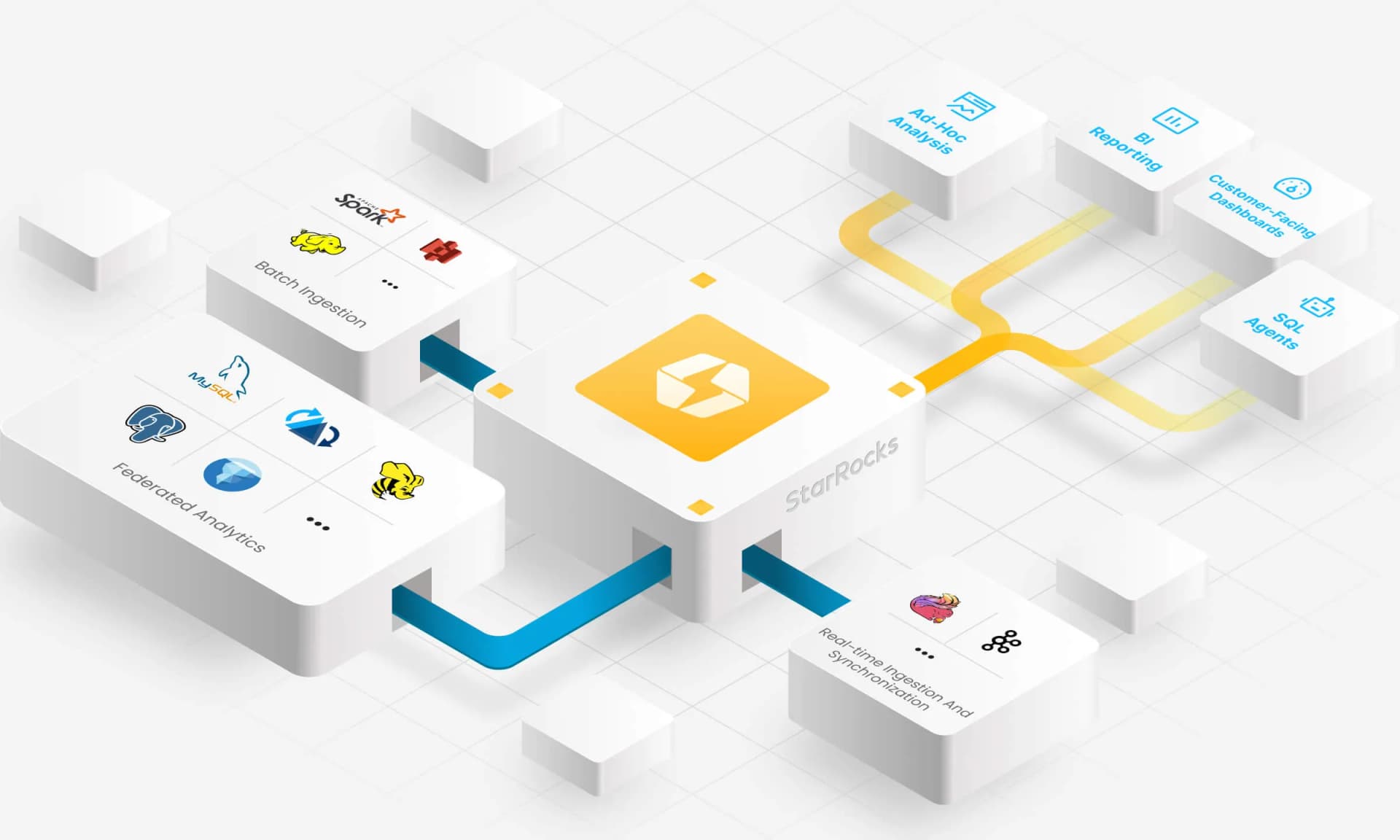
StarRocks: product and architecture
This StarRocks review reaches a clear verdict: we recommend StarRocks for teams that need a single SQL analytics engine for mutable real-time data and open-lakehouse queries, and that can accept the operational and design discipline of an MPP OLAP database. Its strongest case is not generic warehouse replacement; it is delivering fresh, low-latency analytics without forcing every workload through denormalized copies or batch-only pipelines.
StarRocks positions itself as a next-generation, sub-second MPP OLAP database for multidimensional analytics, real-time analytics, ad hoc queries, and lakehouse scenarios. The project is Apache-2.0 licensed, its GitHub repository has 11,987 stars, and version 4.0.13 was released on July 21, 2026. Those are useful public adoption and maintenance signals, but they are not proof that the product fits every enterprise operating model.
Overview
StarRocks is an open-source high-performance data warehouse built around sub-second analytics for end users and AI agents. Its stated product scope combines real-time data, lakehouse querying, and AI-oriented query serving in one engine. That breadth matters because many analytics teams otherwise maintain separate systems for streaming updates, BI queries, and data-lake access.
The central value proposition is consistent: query fresh data in real time or query directly from the lakehouse, while maintaining performance at scale. StarRocks explicitly supports complex multi-table SQL and presents itself as a system that can run analytics on normalized schemas rather than requiring pre-aggregation or denormalization. For data teams, that can reduce the number of duplicated analytic models and the delay between a source update and a usable query result.
Its technical identity is MPP OLAP rather than a general-purpose transactional database. That distinction should guide evaluation. StarRocks is designed around analytical scans, joins, aggregations, concurrency, and data freshness; teams looking primarily for row-by-row application transactions should look elsewhere.
The project also has credible open-source signals. It received InfoWorld’s 2023 BOSSIE Award for best open source software, its primary repository language is Java, and its repository topics include analytics, big-data, cloudnative, datalake, Delta Lake, and Hudi. The latest repository push listed in the supplied data was August 13, 2026, which indicates current public development activity but does not by itself establish support quality or deployment maturity for a particular organization.
Key Features and Architecture
StarRocks combines real-time ingestion, MPP SQL execution, and lakehouse access in a unified architecture. Its primary-key table design resolves data changes during ingestion, which is intended to keep updates immediately queryable while preserving read performance. The product describes this capability as supporting sub-ten-second freshness on mutable data, a meaningful design point for operational analytics where records change after initial arrival.
Streaming and CDC ingestion are another core feature. StarRocks can stream inserts and updates directly from Flink and Kafka, then apply those changes in real time rather than waiting for a batch job. This is particularly relevant when analysts need current customer, order, inventory, or event records and cannot tolerate stale replicas created by periodic transformations.
The execution engine is columnar, fully vectorized, SIMD-optimized, and built in C++. Vectorized operators and columnar storage are designed to make scans and aggregations use modern CPU instructions efficiently. The cost is that teams must still model and distribute analytical data sensibly; vectorization does not remove the need to understand workload shape, data skew, or join behavior.
For SQL planning, StarRocks uses a cost-based optimizer that relies on table and column statistics to select join order, pruning, and pushdown. Its stated aim is stable plans for complex queries without manual tuning. That is valuable for analytics engineers maintaining evolving models, although reliable optimizer behavior still depends on having useful statistics and query patterns.
The MPP layer supports large fact-to-fact joins and high-cardinality aggregations. StarRocks states that it can query normalized schemas directly without pre-aggregation or denormalization, which can shorten delivery cycles and reduce redundant derived datasets. The trade-off is that normalized, multi-table workloads make query planning and physical data layout more consequential than in a deliberately simplified serving model.
For multi-tenant workloads, StarRocks provides resource-group isolation and skew-aware data layouts. These capabilities are intended to stabilize p95 and p99 latency by spreading hotspots and reducing wasted scans under load. This is a practical feature for shared analytics platforms, though it introduces resource-governance work that smaller teams may prefer to avoid.
Lakehouse delivery is another differentiator. StarRocks can query Apache Iceberg, Delta Lake, and Apache Hudi directly, using open table formats rather than mandatory data copies and ingestion pipelines. Its shared-data architecture persists data on object storage such as S3 and separates compute from storage, giving teams elasticity and potentially lower long-term storage cost while retaining open-format governance.
Finally, StarRocks explicitly targets AI-agent query serving. The product states that it can serve agents with low latency and high concurrency, including unoptimized SQL. That is strategically useful for teams exposing governed analytical data to agent workflows, but the supplied data does not provide benchmark figures, concurrency limits, or security-control details for this use case. Evaluate those requirements directly before treating agent support as a production guarantee.
Ideal Use Cases
StarRocks is best for a data platform team supporting a real-time analytical product where updates and deletes matter as much as initial event ingestion. Consider a retail, marketplace, logistics, or customer-operations team that receives mutable order, inventory, shipment, or account records through Kafka and Flink. Primary-key tables and real-time application of changes provide a direct fit when the organization needs queryable updates within sub-ten-second freshness rather than a delayed batch reconciliation.
A second strong scenario is an analytics engineering team with a lakehouse built on Apache Iceberg, Delta Lake, or Apache Hudi. If that team wants SQL analytics on open tables without creating another copied serving layer, StarRocks’ direct open-table-format querying is compelling. We recommend StarRocks for teams that value retaining their lakehouse governance model and can benefit from separating compute from object storage such as S3.
A third fit is a shared data product with many analytical consumers and uneven demand. Resource-group isolation and skew-aware layouts address a common platform problem: one heavy workload can destabilize interactive queries for everyone else. Organizations building internal dashboards, embedded analytics, or AI-agent access can evaluate StarRocks when predictable tail latency matters alongside high concurrency.
StarRocks is also a credible option for teams whose SQL workloads involve complex multi-table joins and high-cardinality aggregations. Its MPP engine, cost-based optimizer, and vectorized execution are explicitly oriented toward that workload. This is not merely a faster extract-and-load destination; it is a system designed to execute analytical SQL at scale.
Do not use StarRocks if the main requirement is general-purpose transactional processing rather than OLAP. Avoid it as well if your team cannot operate an MPP database, maintain relevant statistics and data layouts, or validate performance on representative workloads. The supplied data supports strong feature claims, but it does not provide deployment staffing requirements, managed-service operational details, security certifications, or workload benchmark results; those missing decision inputs should be resolved in a proof of concept.
Strengths & Trade-offs
StarRocks has a focused set of strengths that matter for modern analytical systems:
-
Mutable-data analytics is a first-class design point. Primary-key tables resolve changes during ingestion, and the product states that updates become immediately queryable without impacting query performance. That is more relevant than append-only ingestion when records are corrected, deleted, or updated after arrival.
-
It integrates streaming changes directly from Flink and Kafka. Teams can stream inserts and updates into StarRocks without designing every freshness requirement around batch jobs. The benefit is current analytical records; the trade-off is that streaming and CDC pipelines still require careful operational ownership.
-
The SQL engine is built for demanding analytical queries. Columnar storage, fully vectorized operators, SIMD optimization, and an MPP architecture target fast scans, complex joins, and high-cardinality aggregations. This is a concrete technical advantage for analytical SQL, not a generic usability claim.
-
It can query Iceberg, Delta Lake, and Hudi directly. That supports open-format analytics without mandatory ingestion pipelines, data copies, or denormalized serving models. For teams committed to a lakehouse, this can reduce duplication and preserve existing governance patterns.
-
It includes workload-stability mechanisms. Resource-group isolation and skew-aware data layouts are intended to protect p95 and p99 latency in multi-tenant environments. This is valuable when interactive dashboards and heavier analytical users share a platform.
-
Its public project evidence is substantive. StarRocks is Apache-2.0 licensed, has 11,987 GitHub stars, received the 2023 BOSSIE Award, and released version 4.0.13 on July 21, 2026. These are positive public signals of activity and interest, though they should not replace a technical evaluation.
The limitations are equally important:
-
StarRocks is weak as a fit for transactional application workloads. Its stated identity is an MPP OLAP database for analytics, not a general-purpose transaction database. Teams should not select it simply because they need a database with SQL.
-
The advertised performance claims are not accompanied by supplied benchmark detail. StarRocks states sub-second latency, stable p95/p99 behavior, and performance at scale, but the available data does not include workload definitions, dataset sizes, cluster sizes, or comparative benchmark results. Require proof on your own joins, concurrency, and update patterns.
-
Self-hosting is the only path the project prices, and it prices it at zero. There is no ingestion ceiling to plan around, and no paid tier to grow into; what scales is the cluster you run. A managed offering is a separate purchase from a separate vendor.
-
The architecture creates operational responsibility. Primary-key ingestion, statistics-driven optimization, resource groups, skew-aware layouts, streaming changes, and shared data all offer leverage, but they also require capable platform ownership. A small team seeking a minimal-configuration analytics service may find the operational surface area disproportionate.