Decision comparison
Databricks vs StarRocks
Choose Databricks when one managed platform must cover Spark engineering, collaborative notebooks, governed Delta Lake pipelines, and the ML lifecycle. Choose StarRocks when the central requirement is sub-second, high-concurrency SQL analytics on fresh mutable data or open lakehouse tables, with an open-source self-hosting option.
Architecture choice. These take different approaches to the same problem. Read the table as a fit question rather than a feature race.
These are different kinds of product — Lakehouse Platform and OLAP Database.
Quick Comparison
| Decision factor | Databricks | StarRocks |
|---|---|---|
| Best For | Enterprise data engineering, collaborative data science, machine learning, and lakehouse analytics across AWS, Azure, or GCP. | Low-latency real-time OLAP, high-concurrency dashboards, mutable-data analytics, and direct SQL queries across open lakehouse tables. |
| Architecture | Managed lakehouse platform combining Apache Spark, Delta Lake, cloud object storage, SQL endpoints, notebooks, and ML services. | MPP analytical database with vectorized C++ execution, primary-key tables, shared object storage, and separated compute scaling. |
| Pricing Model | Consumption-based: billed per Databricks Unit (DBU) per second on top of your own cloud compute and storage charges, with no up-front cost and committed-use discounts available. Published per-DBU rates are not machine-readable from the vendor pricing page. Free Edition is available at no cost for non-commercial use only; a 14-day trial with free credits covers paid-platform evaluation. | StarRocks is free and open source, and the project publishes no pricing. Managed StarRocks is sold by third parties under their own brands, and their rates are published there rather than by the project, so treat any managed price as a vendor quote and not as a StarRocks price. |
| Ease of Use | Collaborative notebooks and managed services simplify workflows, though users report the interface and access controls can initially confuse. | SQL-focused design supports direct queries on Iceberg, Delta Lake, and Hudi without denormalization or copied data pipelines. |
| Scalability | Managed Spark processes large-scale engineering workloads, while Delta Lake provides transactional storage over independently scalable cloud object storage. | MPP joins, resource-group isolation, skew-aware layouts, and shared-data object storage support elastic compute and predictable tail latency. |
| Community/Support | Mature enterprise platform with collaborative workspaces; user feedback reports an 8.8/10 rating across 109 reviews. | Open-source project under Apache-2.0; its repository reports 12,076 stars and a Java-based codebase. |
Databricks
- Best For:
- Enterprise data engineering, collaborative data science, machine learning, and lakehouse analytics across AWS, Azure, or GCP.
- Architecture:
- Managed lakehouse platform combining Apache Spark, Delta Lake, cloud object storage, SQL endpoints, notebooks, and ML services.
- Pricing Model:
- Consumption-based: billed per Databricks Unit (DBU) per second on top of your own cloud compute and storage charges, with no up-front cost and committed-use discounts available. Published per-DBU rates are not machine-readable from the vendor pricing page. Free Edition is available at no cost for non-commercial use only; a 14-day trial with free credits covers paid-platform evaluation.
- Ease of Use:
- Collaborative notebooks and managed services simplify workflows, though users report the interface and access controls can initially confuse.
- Scalability:
- Managed Spark processes large-scale engineering workloads, while Delta Lake provides transactional storage over independently scalable cloud object storage.
- Community/Support:
- Mature enterprise platform with collaborative workspaces; user feedback reports an 8.8/10 rating across 109 reviews.
StarRocks
- Best For:
- Low-latency real-time OLAP, high-concurrency dashboards, mutable-data analytics, and direct SQL queries across open lakehouse tables.
- Architecture:
- MPP analytical database with vectorized C++ execution, primary-key tables, shared object storage, and separated compute scaling.
- Pricing Model:
- StarRocks is free and open source, and the project publishes no pricing. Managed StarRocks is sold by third parties under their own brands, and their rates are published there rather than by the project, so treat any managed price as a vendor quote and not as a StarRocks price.
- Ease of Use:
- SQL-focused design supports direct queries on Iceberg, Delta Lake, and Hudi without denormalization or copied data pipelines.
- Scalability:
- MPP joins, resource-group isolation, skew-aware layouts, and shared-data object storage support elastic compute and predictable tail latency.
- Community/Support:
- Open-source project under Apache-2.0; its repository reports 12,076 stars and a Java-based codebase.
Public signals
Verified factual signals only. Bars appear only for like-for-like metrics with five weekly assessments for every tool; missing evidence stays explicit. These signals do not establish enterprise adoption, product quality, or total cost.
| Metric | Databricks | StarRocks |
|---|---|---|
| GitHub commits, 90d(Ecosystem adoption) | 1.5k | Not available |
| GitHub stars(Ecosystem adoption) | 44,000+ | Not available |
| Search interest(Market interest) | 33 | 1 |
| Hacker News mentions, 90d(Community interest) | 63 | 0 |
| npm weekly downloads(Developer adoption) | 406.0k | Not available |
| Product Hunt comments(Community interest) | 5 | 0 |
| Product Hunt rating(Community interest) | 5.0/5 | Unavailable |
| Product Hunt reviews(Community interest) | 5 | 0 |
| Product Hunt votes(Community interest) | 86 | 2 |
| PyPI weekly downloads(Developer adoption) | 18.6M | 131.3k |
| Stack Overflow questions(Community interest) | 8.4k | 11 |
| Docker Hub pulls(Product adoption) | Not available | 906.6k |
| GitHub commits, 90d(Product adoption) | Not available | 1.3k |
| GitHub stars(Product adoption) | Not available | 12,000+ |
As of September 21, 2026 — updated weekly.
Health & risk evidence
Observed public-source checks for mapped package versions and repositories.
Databricks
September 21, 2026Package vulnerabilities
npm · @databricks/sql@2.1.0 · PyPI · databricks-sdk@0.140.0
0 vulnerabilities
across 2 packages
Repository security score
github.com/apache/spark
5.6/10
StarRocks
September 21, 2026Package vulnerabilities
PyPI · starrocks@1.3.4
0 vulnerabilities
across 1 package
Repository security score
Not available
Interface Preview
StarRocks
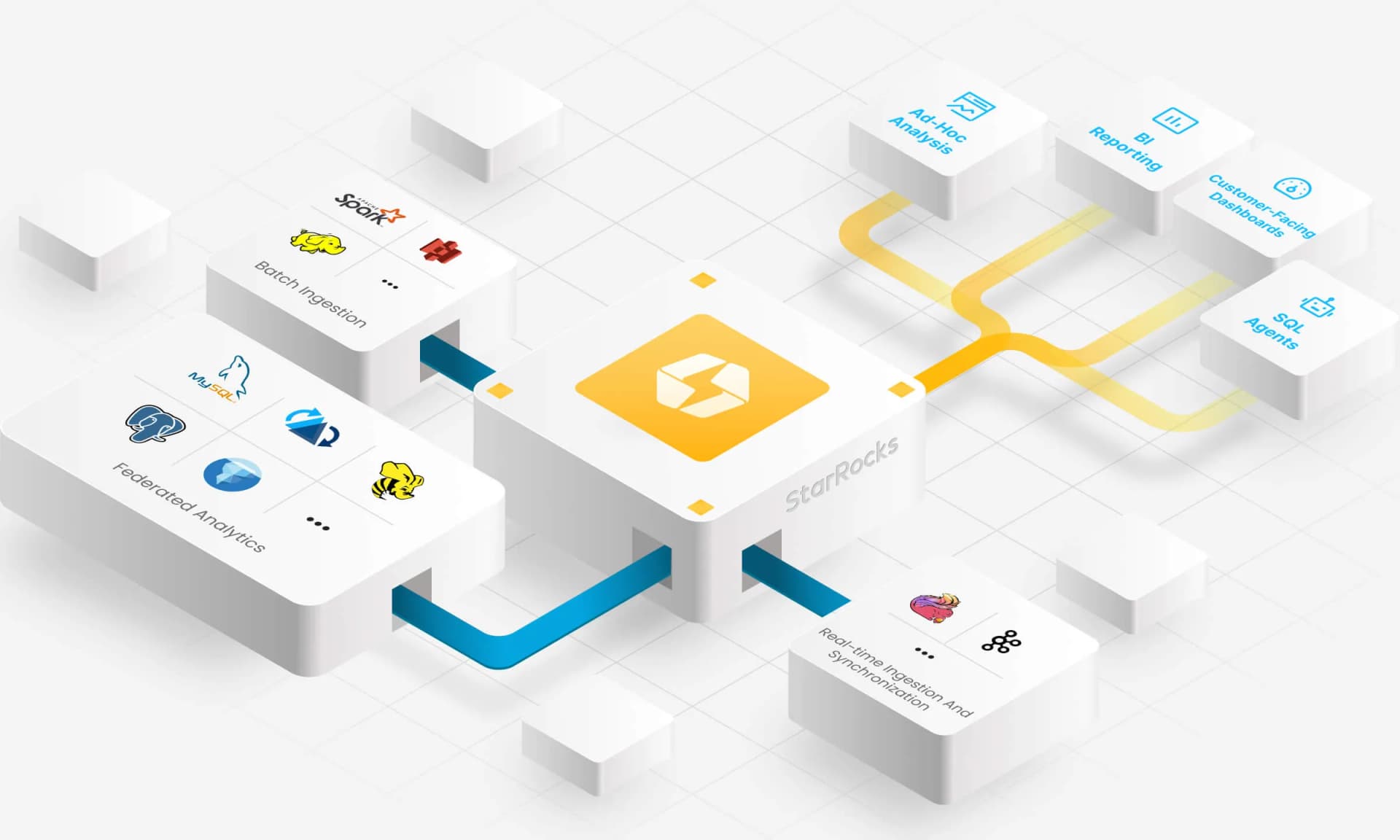
Feature Comparison
| Feature | Databricks | StarRocks |
|---|---|---|
| Data Storage and Lakehouse | ||
| Transactional lake storage | Delta Lake adds ACID transactions over Parquet files in cloud storage. | Queries Delta Lake tables directly alongside other open lakehouse formats. |
| Schema and data change handling | Delta Lake supports schema evolution and historical time-travel queries. | Primary-key indexes resolve updates and deletes during ingestion. |
| Object-storage architecture | Lakehouse services operate on underlying cloud object storage. | Shared-data design persists data on S3-compatible object storage. |
| Query Performance and Serving | ||
| SQL analytics execution | Databricks SQL endpoints apply Delta Engine optimizations for BI workloads. | Vectorized MPP engine targets sub-second complex SQL analytics. |
| Complex joins and aggregations | Apache Spark executes distributed transformations and analytical workloads. | Massively parallel engine runs fact joins and high-cardinality aggregations. |
| Latency consistency | SQL endpoint layer is optimized for business-intelligence query workloads. | Resource groups and skew-aware layouts stabilize p95 and p99 latency. |
| Data Ingestion and Transformation | ||
| Pipeline development | Delta Live Tables provides declarative ETL pipeline development. | Streaming ingestion applies incoming changes directly during data loading. |
| Streaming and CDC | Managed Spark supports scalable data engineering and raw-data processing. | Flink and Kafka streams deliver inserts and updates in real time. |
| Fresh mutable data | Delta transactions provide governed, reliable lakehouse data updates. | Ingest-time change resolution keeps updates queryable within seconds. |
| Development and AI | ||
| Programming environments | Shared notebooks and jobs support SQL, Python, Scala, and R. | SQL database engine supports analytical queries and agent-serving workloads. |
| Machine learning lifecycle | Managed MLflow supports experiment tracking, model serving, and ML workflows. | Serves AI-agent queries with low latency and high concurrency. |
| AI application platform | Mosaic AI services support generative AI applications on governed data. | Analytics engine handles unoptimized AI-agent SQL at scale. |
| Operations and Governance | ||
| Collaboration controls | Workspace shares notebooks, repositories, dashboards, and role-based access controls. | Open-format access avoids copied datasets and preserves existing governance. |
| Cloud deployment model | Managed service deploys across AWS, Azure, and Google Cloud. | Self-hosted open-source database separates storage from elastic compute. |
| Open-format interoperability | Delta Lake stores transactional tables as Parquet in cloud storage. | Directly queries Apache Iceberg, Delta Lake, and Apache Hudi. |
Data Storage and Lakehouse
Transactional lake storage
Schema and data change handling
Object-storage architecture
Query Performance and Serving
SQL analytics execution
Complex joins and aggregations
Latency consistency
Data Ingestion and Transformation
Pipeline development
Streaming and CDC
Fresh mutable data
Development and AI
Programming environments
Machine learning lifecycle
AI application platform
Operations and Governance
Collaboration controls
Cloud deployment model
Open-format interoperability
Which approach fits
Choose Databricks when one managed platform must cover Spark engineering, collaborative notebooks, governed Delta Lake pipelines, and the ML lifecycle. Choose StarRocks when the central requirement is sub-second, high-concurrency SQL analytics on fresh mutable data or open lakehouse tables, with an open-source self-hosting option.
When each approach fits
Choose Databricks if:
Choose Databricks for cross-functional data engineering and data science teams that need managed Spark, Delta Live Tables, SQL BI endpoints, MLflow, model serving, and multi-cloud deployment.
Choose StarRocks if:
Choose StarRocks for product analytics, operational dashboards, streaming CDC workloads, or AI-agent query serving where sub-second SQL latency and predictable performance under load are primary requirements.
These scenarios reflect the available product evidence. Your requirements, existing stack, and team expertise should guide the final decision.
Frequently Asked Questions
What is the main difference between Databricks and StarRocks?
Databricks is a managed lakehouse platform that unifies Apache Spark data engineering, Delta Lake storage, SQL analytics, collaborative notebooks, and machine-learning services such as MLflow and model serving. StarRocks is an MPP OLAP database optimized for low-latency analytical SQL. Its distinguishing capabilities include vectorized execution, primary-key tables for mutable data, Kafka and Flink ingestion, and direct querying of Iceberg, Delta Lake, and Hudi tables.
Which is better for small teams?
StarRocks can be attractive for a small team focused primarily on SQL analytics because it is Apache-2.0 open source and can be self-hosted without license cost; it publishes no pricing of its own, and managed offerings are sold separately. Databricks is often better for a small team that needs an integrated managed environment for Python, SQL, Spark pipelines, notebooks, and machine learning, but its listed Standard plan is per-DBU consumption with no fixed monthly plan.
Can I migrate from Databricks to StarRocks?
Yes, particularly for analytical serving workloads. StarRocks can query Delta Lake tables directly, so a team may keep Delta Lake data in object storage while moving selected dashboard, ad-hoc SQL, or low-latency serving workloads to StarRocks. This is not necessarily a replacement for Databricks notebooks, managed Spark jobs, Delta Live Tables, MLflow, or Mosaic AI services; those workloads require separate migration or replacement planning.
What are the pricing differences?
Databricks has a free trial and published plan figures in the supplied data: Standard is per-DBU consumption with no fixed monthly plan and Premium is per-DBU consumption at higher volumes. StarRocks publishes no pricing of its own; managed StarRocks is sold separately by third parties. The StarRocks open-source project is licensed under Apache-2.0, enabling free self-hosting, while operational infrastructure and support still require budgeting.