Decision comparison
Amazon SageMaker vs Databricks
Amazon SageMaker and Databricks serve overlapping but distinct roles in the ML and data platform landscape. SageMaker excels as a purpose-built ML platform within the AWS ecosystem, offering superior model deployment, edge computing, and deep AWS service integration. Databricks dominates as a unified data and AI platform with its lakehouse architecture, multi-cloud flexibility, and stronger data engineering capabilities built on Apache Spark. The right choice depends on whether your primary workflow centers on ML model lifecycle management or unified data analytics and engineering.
Architecture choice. These take different approaches to the same problem. Read the table as a fit question rather than a feature race.
These are different kinds of product — ML Platform and Lakehouse Platform.
Quick Comparison
| Decision factor | Amazon SageMaker | Databricks |
|---|---|---|
| Best For | Enterprise ML teams deeply invested in AWS who need end-to-end model training, deployment, and MLOps governance with managed infrastructure | Data engineering and data science teams needing a unified lakehouse platform combining analytics, ETL pipelines, and ML on Apache Spark |
| Architecture | Fully managed AWS service wrapping EC2 compute, S3 storage, and container orchestration with proprietary APIs for the complete ML lifecycle | Lakehouse architecture built on Apache Spark with Delta Lake ACID storage, separating compute from cloud object storage across AWS, Azure, and GCP |
| Pricing Model | Pay-as-you-go by component. SageMaker Unified Studio has a free tier: the first 2 months of 250 hours of sc.t3.medium notebook instances, plus 20 MB of metadata storage, 4,000 API requests and 0.2 compute units a month. Beyond that, notebooks bill by instance type and storage duration, the Data Agent is $0.04 per credit, and SageMaker Catalog is $10 per 100,000 requests, $0.40 per GB of metadata storage and $1.776 per compute unit. SageMaker AI GPU training and hosting instances cost well over $10 per hour; for example ml.p4de is $23.42 per hour and ml.p5.48xlarge $54.92 per hour (prices effective October 7, 2026, in all available AWS Regions). Verified 2026-10-05 against https://aws.amazon.com/sagemaker/ai/pricing/. | Consumption-based: billed per Databricks Unit (DBU) per second on top of your own cloud compute and storage charges, with no up-front cost and committed-use discounts available. Published per-DBU rates are not machine-readable from the vendor pricing page. Free Edition is available at no cost for non-commercial use only; a 14-day trial with free credits covers paid-platform evaluation. |
| Ease of Use | Rated 8.8/10 across 59 reviews; users praise seamless deployment and Jupyter notebooks but cite steep learning curves for non-AWS-native teams | Rated 8.8/10 across 109 reviews; users praise the collaborative notebook environment but note access control complexity and a confusing initial learning curve |
| Scalability | Auto-scaling inference endpoints with HyperPod distributed training clusters that auto-detect and replace faulty GPU nodes during long-running jobs | Multi-cloud deployment across AWS, Azure, and GCP with workload-specific autoscaling, serverless SQL warehouses, and automatic compute optimization for performance |
| Community/Support | Rated 3.9/5 on Gartner Peer Insights across 39 reviews; backed by AWS documentation, forums, tutorials, and certified third-party providers | Rated 4.7/5 on Gartner with 168 ratings; strong Apache Spark open-source community, extensive training resources, and annual Data+AI Summit conference |
Amazon SageMaker
- Best For:
- Enterprise ML teams deeply invested in AWS who need end-to-end model training, deployment, and MLOps governance with managed infrastructure
- Architecture:
- Fully managed AWS service wrapping EC2 compute, S3 storage, and container orchestration with proprietary APIs for the complete ML lifecycle
- Pricing Model:
- Pay-as-you-go by component. SageMaker Unified Studio has a free tier: the first 2 months of 250 hours of sc.t3.medium notebook instances, plus 20 MB of metadata storage, 4,000 API requests and 0.2 compute units a month. Beyond that, notebooks bill by instance type and storage duration, the Data Agent is $0.04 per credit, and SageMaker Catalog is $10 per 100,000 requests, $0.40 per GB of metadata storage and $1.776 per compute unit. SageMaker AI GPU training and hosting instances cost well over $10 per hour; for example ml.p4de is $23.42 per hour and ml.p5.48xlarge $54.92 per hour (prices effective October 7, 2026, in all available AWS Regions). Verified 2026-10-05 against https://aws.amazon.com/sagemaker/ai/pricing/.
- Ease of Use:
- Rated 8.8/10 across 59 reviews; users praise seamless deployment and Jupyter notebooks but cite steep learning curves for non-AWS-native teams
- Scalability:
- Auto-scaling inference endpoints with HyperPod distributed training clusters that auto-detect and replace faulty GPU nodes during long-running jobs
- Community/Support:
- Rated 3.9/5 on Gartner Peer Insights across 39 reviews; backed by AWS documentation, forums, tutorials, and certified third-party providers
Databricks
- Best For:
- Data engineering and data science teams needing a unified lakehouse platform combining analytics, ETL pipelines, and ML on Apache Spark
- Architecture:
- Lakehouse architecture built on Apache Spark with Delta Lake ACID storage, separating compute from cloud object storage across AWS, Azure, and GCP
- Pricing Model:
- Consumption-based: billed per Databricks Unit (DBU) per second on top of your own cloud compute and storage charges, with no up-front cost and committed-use discounts available. Published per-DBU rates are not machine-readable from the vendor pricing page. Free Edition is available at no cost for non-commercial use only; a 14-day trial with free credits covers paid-platform evaluation.
- Ease of Use:
- Rated 8.8/10 across 109 reviews; users praise the collaborative notebook environment but note access control complexity and a confusing initial learning curve
- Scalability:
- Multi-cloud deployment across AWS, Azure, and GCP with workload-specific autoscaling, serverless SQL warehouses, and automatic compute optimization for performance
- Community/Support:
- Rated 4.7/5 on Gartner with 168 ratings; strong Apache Spark open-source community, extensive training resources, and annual Data+AI Summit conference
Public signals
Verified factual signals only. Bars appear only for like-for-like metrics with five weekly assessments for every tool; missing evidence stays explicit. These signals do not establish enterprise adoption, product quality, or total cost.
| Metric | Amazon SageMaker | Databricks |
|---|---|---|
| GitHub commits, 90d(Developer adoption) | 199 | Not available |
| GitHub stars(Developer adoption) | 2,000+ | Not available |
| Search interest(Market interest) | 1 | 33 |
| Hacker News mentions, 90d(Community interest) | 2 | 55 |
| npm weekly downloads(Developer adoption) | 365.6k | 247.3k |
| Product Hunt comments(Community interest) | 1 | 5 |
| Product Hunt rating(Community interest) | 4.6/5 | 5.0/5 |
| Product Hunt reviews(Community interest) | 17 | 5 |
| Product Hunt votes(Community interest) | 10 | 86 |
| PyPI weekly downloads(Developer adoption) | 3.4M | 19.1M |
| Stack Overflow questions(Community interest) | 3.0k | 8.4k |
| GitHub commits, 90d(Ecosystem adoption) | Not available | 1.4k |
| GitHub stars(Ecosystem adoption) | Not available | 44,000+ |
As of October 19, 2026 — updated weekly.
Health & risk evidence
Observed public-source checks for mapped package versions and repositories.
Amazon SageMaker
October 19, 2026Package vulnerabilities
npm · @aws-sdk/client-sagemaker@3.1152.0 · PyPI · sagemaker@3.25.0
0 vulnerabilities
across 2 packages
Repository security score
github.com/aws/sagemaker-python-sdk
5.5/10
Databricks
October 19, 2026Package vulnerabilities
npm · @databricks/sql@2.2.0 · PyPI · databricks-sdk@0.154.0
0 vulnerabilities
across 2 packages
Repository security score
github.com/apache/spark
5.6/10
Interface Preview
Amazon SageMaker
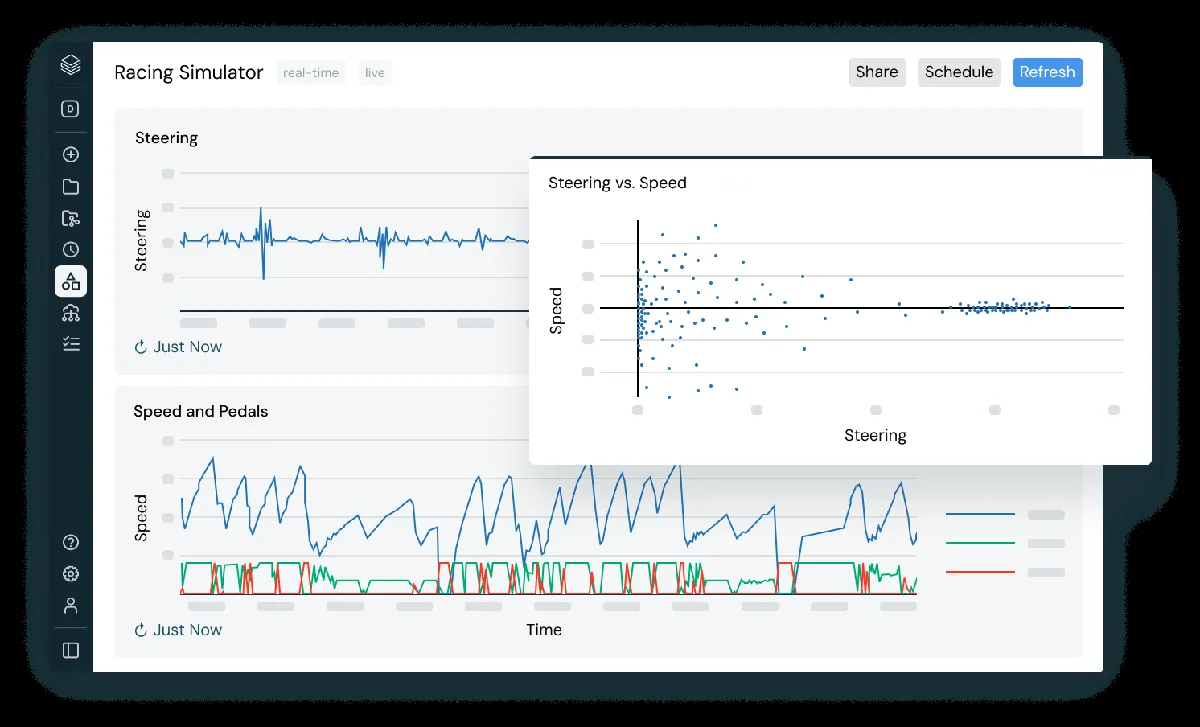
Databricks
Feature Comparison
| Feature | Amazon SageMaker | Databricks |
|---|---|---|
| Data Management & Storage | ||
| Data Lake Integration | Lakehouse architecture unifying S3 data lakes and Redshift warehouses with Apache Iceberg-compatible tooling and zero-ETL integrations | Delta Lake with ACID transactions, schema evolution, and time travel on Parquet files stored in cloud object storage across all major providers |
| Feature Store | SageMaker Feature Store for storing, sharing, and managing ML features with both online and offline store configurations | Unity Catalog-based feature management integrated with MLflow experiment tracking and Delta Lake table versioning |
| Data Processing | SageMaker Data Wrangler for visual data prep, Processing Jobs for script-based transforms, and integration with AWS Glue and Athena | Native Apache Spark engine supporting Python, SQL, Scala, and R with Lakeflow pipelines for declarative batch and streaming ETL pipelines |
| Model Development & Training | ||
| Development Environment | SageMaker Studio IDE with JupyterLab, SageMaker Canvas for no-code visual ML, and Studio Lab for browser-based experimentation | Collaborative workspace with shared notebooks supporting SQL, Python, Scala, and R, plus Git repos integration and role-based access control |
| AutoML Capabilities | SageMaker Autopilot iterates through algorithms automatically to find optimal models with full visibility into generated code and training metrics | AutoML through Mosaic AI services with experiment tracking, automatic hyperparameter tuning, and integration with managed MLflow for model registry |
| Distributed Training | HyperPod clusters with automatic fault detection and node replacement during long-running LLM training on P4/P5 GPU instances | Apache Spark-based distributed training across configurable clusters with spot instance support providing 60-80% cost savings on GPU workloads |
| Deployment & Serving | ||
| Real-Time Inference | Persistent REST endpoints with auto-scaling, shadow testing for A/B validation, and multi-model serving on managed EC2 infrastructure | Model serving endpoints through Mosaic AI with pay-per-token foundation model APIs and serverless deployment options across cloud providers |
| Batch & Serverless Inference | Serverless inference with cold starts of 5-10 seconds for intermittent traffic, plus async batch processing for large-scale predictions | Serverless SQL warehouses with sub-second startup for BI queries and batch inference through scheduled Spark jobs on auto-terminating clusters |
| Edge Deployment | SageMaker Edge for deploying and operating ML models on edge devices with device fleet management and S3-based output configuration | No native edge deployment capability; models must be exported and deployed through third-party edge runtime frameworks |
| MLOps & Governance | ||
| Pipeline Orchestration | SageMaker Pipelines providing CI/CD workflows with step-based DAGs, model registry integration, and AWS CodePipeline compatibility | Lakeflow pipelines for declarative ETL pipelines with automatic error remediation, plus Databricks Workflows for scheduling and orchestration |
| Model Monitoring | Model Monitor with data quality checks, model quality tracking, bias detection via SageMaker Clarify, and drift detection on real-time endpoints | AI-powered monitoring and observability through Unity Catalog with data lineage tracking, quality monitoring, and sensitive data detection |
| Access Control & Governance | IAM-based fine-grained permissions with VPC isolation, KMS encryption, SageMaker Catalog for data discovery, and ML lineage tracking | Unity Catalog providing a single permission model for data and AI assets with RBAC, audit logging, and table-level access controls in Premium tier |
| Analytics & BI Integration | ||
| SQL Analytics | Amazon Redshift integration through SageMaker Unified Studio for SQL analytics with Amazon Q Developer AI-assisted query generation | Databricks SQL warehouse layer with Photon engine optimizations; Databricks reports up to 12x better price-performance than legacy warehouses for BI workloads |
| Generative AI Development | Amazon Bedrock integration through Unified Studio for building generative AI applications with foundation models and proprietary data | Mosaic AI services for creating, tuning, and deploying custom generative AI models with Lakebase serverless Postgres for AI agent applications |
| Multi-Cloud Support | AWS-only deployment with deep integration into the AWS ecosystem including Lambda, API Gateway, Redshift, Glue, and Athena services | Full multi-cloud deployment on AWS, Azure, and GCP with Delta Sharing for cross-platform data collaboration without proprietary format lock-in |
Data Management & Storage
Data Lake Integration
Feature Store
Data Processing
Model Development & Training
Development Environment
AutoML Capabilities
Distributed Training
Deployment & Serving
Real-Time Inference
Batch & Serverless Inference
Edge Deployment
MLOps & Governance
Pipeline Orchestration
Model Monitoring
Access Control & Governance
Analytics & BI Integration
SQL Analytics
Generative AI Development
Multi-Cloud Support
Which approach fits
Amazon SageMaker and Databricks serve overlapping but distinct roles in the ML and data platform landscape. SageMaker excels as a purpose-built ML platform within the AWS ecosystem, offering superior model deployment, edge computing, and deep AWS service integration. Databricks dominates as a unified data and AI platform with its lakehouse architecture, multi-cloud flexibility, and stronger data engineering capabilities built on Apache Spark. The right choice depends on whether your primary workflow centers on ML model lifecycle management or unified data analytics and engineering.
When each approach fits
Choose Amazon SageMaker if:
Choose Amazon SageMaker when your organization is deeply invested in AWS and your primary need is end-to-end machine learning model development, training, and deployment. SageMaker is the stronger choice for teams focused on MLOps governance with features like Model Monitor, Clarify for bias detection, and Pipelines for CI/CD automation. It stands out for edge deployment scenarios through SageMaker Edge and for teams needing HyperPod resilient distributed training on expensive GPU clusters. The trade-off is AWS vendor lock-in and higher complexity for data engineering workflows that Databricks handles more naturally with Spark.
Choose Databricks if:
Choose Databricks when your team needs a unified platform spanning data engineering, analytics, and ML across multiple cloud providers. Databricks is the better fit for organizations running large-scale ETL pipelines, SQL analytics workloads, and collaborative data science in a single lakehouse environment. Its Delta Lake foundation provides ACID transactions and time travel capabilities that simplify data management. The multi-cloud support across AWS, Azure, and GCP avoids vendor lock-in. The trade-off is that dedicated ML deployment features like edge serving and advanced MLOps tooling are less mature compared to SageMaker's purpose-built capabilities.
These scenarios reflect the available product evidence. Your requirements, existing stack, and team expertise should guide the final decision.
Frequently Asked Questions
Can Amazon SageMaker and Databricks be used together?
Yes, many enterprise teams use both platforms in complementary roles. A common pattern involves using Databricks for data engineering, ETL pipelines, and feature preparation with its Apache Spark engine and Delta Lake storage, then passing processed data to SageMaker for model training, deployment, and inference serving within the AWS ecosystem. Databricks runs natively on AWS, making integration through S3 straightforward. This approach leverages Databricks' strengths in data processing and SageMaker's purpose-built ML deployment infrastructure, though it does increase operational complexity and requires teams to maintain expertise across both platforms.
How do Amazon SageMaker and Databricks pricing compare for typical ML workloads?
SageMaker uses per-second usage-based billing with on-demand rates by instance type, plus a free tier covering 250 hours of notebook usage. Savings plans offer up to 64% off. Databricks charges through DBUs (Databricks Units) billed per second, plus underlying cloud infrastructure costs that typically add 50-200% on top. Both platforms require careful cost management, as charges scale with compute intensity and cluster runtime.
Which platform is better for teams with multi-cloud requirements?
Databricks is the clear choice for multi-cloud strategies. It deploys natively across AWS, Azure, and GCP, allowing organizations to run workloads on their preferred cloud provider without platform changes. Delta Sharing enables cross-platform data collaboration without proprietary formats. Amazon SageMaker is exclusively an AWS service with deep integration into the AWS ecosystem including Lambda, Redshift, Glue, and API Gateway. Teams locked into SageMaker face significant migration effort if they need to expand beyond AWS. For organizations committed to a multi-cloud or cloud-agnostic approach, Databricks provides flexibility that SageMaker fundamentally cannot match.
What are the key differences in ML model monitoring between the two platforms?
Amazon SageMaker provides dedicated ML monitoring through Model Monitor, which tracks data quality, model quality, and feature drift on real-time inference endpoints. SageMaker Clarify adds bias detection and model explainability with automated reports. These are purpose-built for production ML workflows. Databricks approaches monitoring through Unity Catalog with AI-powered observability, data lineage tracking, and quality automation across the entire data estate. Databricks monitoring is broader, covering data pipelines and analytics alongside ML models, while SageMaker's monitoring goes deeper on ML-specific metrics like prediction drift and feature attribution. Teams needing granular ML model governance tend to favor SageMaker, while those wanting unified data and model observability prefer Databricks.