Decision comparison
Snowflake vs StarRocks
Snowflake and StarRocks serve different segments of the modern data stack. Snowflake is the stronger choice for teams that want a fully managed, enterprise-grade data warehouse with deep governance, multi-cloud portability, and built-in AI capabilities. StarRocks is the better fit when sub-second query latency on mutable, real-time data is the primary requirement and your team has the operational capacity to manage an open-source deployment or is willing to use CelerData's managed offering. Both platforms separate compute from storage, but they optimize for different workload profiles.
Architecture choice. These take different approaches to the same problem. Read the table as a fit question rather than a feature race.
These are different kinds of product — Cloud Data Warehouse and OLAP Database.
Quick Comparison
| Decision factor | Snowflake | StarRocks |
|---|---|---|
| Best For | Enterprise analytics teams needing a fully managed cloud data warehouse with broad BI and AI workloads | Data teams requiring sub-second OLAP queries on mutable, real-time data at high concurrency |
| Architecture | Fully managed SaaS with separated compute and storage across AWS, Azure, and GCP | Open-source MPP engine with shared-data architecture; self-hosted or CelerData managed cloud |
| Pricing Model | Snowflake prices on consumption, not a subscription: its pricing page states "We keep pricing simple with a consumption-based pricing model" and publishes no monthly or per-user price. Editions are Standard, Enterprise, Business Critical and Virtual Private Snowflake. Per-credit rates are scoped by edition, cloud and region: the Service Consumption Table effective 2026-09-09 lists on-demand AWS US East at $2.00 (Standard), $3.00 (Enterprise), $4.00 (Business Critical) and $6.00 (VPS), rising to $2.60/$3.90/$5.20 in AWS EU Dublin, so no single platform-wide credit price exists. Storage is billed separately at $23.00 per TB per month on demand in US East, less under capacity commitments. A 30-day free trial ends when the period or the included credit balance runs out; that is a trial, not a free tier. Verified 2026-09-16. | StarRocks is free and open source, and the project publishes no pricing. Managed StarRocks is sold by third parties under their own brands, and their rates are published there rather than by the project, so treat any managed price as a vendor quote and not as a StarRocks price. |
| Ease of Use | Low learning curve with familiar SQL interface, web UI, and zero infrastructure management | MySQL-compatible SQL and broad BI tool support; requires more operational expertise for self-hosting |
| Scalability | Automatic elastic scaling with multi-cluster warehouses for concurrent workloads | Horizontal MPP scaling with resource-group isolation and separate compute/storage on object storage |
| Real-Time Analytics | Near-real-time via Snowpipe continuous loading; optimized for batch and scheduled workloads | Sub-second analytics on mutable data via primary key tables, streaming CDC from Flink and Kafka |
Snowflake
- Best For:
- Enterprise analytics teams needing a fully managed cloud data warehouse with broad BI and AI workloads
- Architecture:
- Fully managed SaaS with separated compute and storage across AWS, Azure, and GCP
- Pricing Model:
- Snowflake prices on consumption, not a subscription: its pricing page states "We keep pricing simple with a consumption-based pricing model" and publishes no monthly or per-user price. Editions are Standard, Enterprise, Business Critical and Virtual Private Snowflake. Per-credit rates are scoped by edition, cloud and region: the Service Consumption Table effective 2026-09-09 lists on-demand AWS US East at $2.00 (Standard), $3.00 (Enterprise), $4.00 (Business Critical) and $6.00 (VPS), rising to $2.60/$3.90/$5.20 in AWS EU Dublin, so no single platform-wide credit price exists. Storage is billed separately at $23.00 per TB per month on demand in US East, less under capacity commitments. A 30-day free trial ends when the period or the included credit balance runs out; that is a trial, not a free tier. Verified 2026-09-16.
- Ease of Use:
- Low learning curve with familiar SQL interface, web UI, and zero infrastructure management
- Scalability:
- Automatic elastic scaling with multi-cluster warehouses for concurrent workloads
- Real-Time Analytics:
- Near-real-time via Snowpipe continuous loading; optimized for batch and scheduled workloads
StarRocks
- Best For:
- Data teams requiring sub-second OLAP queries on mutable, real-time data at high concurrency
- Architecture:
- Open-source MPP engine with shared-data architecture; self-hosted or CelerData managed cloud
- Pricing Model:
- StarRocks is free and open source, and the project publishes no pricing. Managed StarRocks is sold by third parties under their own brands, and their rates are published there rather than by the project, so treat any managed price as a vendor quote and not as a StarRocks price.
- Ease of Use:
- MySQL-compatible SQL and broad BI tool support; requires more operational expertise for self-hosting
- Scalability:
- Horizontal MPP scaling with resource-group isolation and separate compute/storage on object storage
- Real-Time Analytics:
- Sub-second analytics on mutable data via primary key tables, streaming CDC from Flink and Kafka
Public signals
Verified factual signals only. Bars appear only for like-for-like metrics with five weekly assessments for every tool; missing evidence stays explicit. These signals do not establish enterprise adoption, product quality, or total cost.
| Metric | Snowflake | StarRocks |
|---|---|---|
| GitHub commits, 90d(Developer adoption) | 68 | Not available |
| GitHub stars(Developer adoption) | 730 | Not available |
| Search interest(Market interest) | 2 | 1 |
| Hacker News mentions, 90d(Community interest) | 0 | 0 |
| npm weekly downloads(Developer adoption) | 1.7M | Not available |
| PyPI weekly downloads(Developer adoption) | 22.9M | 131.3k |
| Stack Overflow questions(Community interest) | 12.2k | 11 |
| Docker Hub pulls(Product adoption) | Not available | 906.6k |
| GitHub commits, 90d(Product adoption) | Not available | 1.3k |
| GitHub stars(Product adoption) | Not available | 12,000+ |
| Product Hunt comments(Community interest) | Not available | 0 |
| Product Hunt reviews(Community interest) | Not available | 0 |
| Product Hunt votes(Community interest) | Not available | 2 |
As of September 21, 2026 — updated weekly.
Health & risk evidence
Observed public-source checks for mapped package versions and repositories.
Snowflake
September 21, 2026Package vulnerabilities
PyPI · snowflake-connector-python@4.7.4 · npm · snowflake-sdk@3.3.0
0 vulnerabilities
across 2 packages
Repository security score
github.com/snowflakedb/snowflake-connector-python
5.0/10
StarRocks
September 21, 2026Package vulnerabilities
PyPI · starrocks@1.3.4
0 vulnerabilities
across 1 package
Repository security score
Not available
Interface Preview
StarRocks
Feature Comparison
| Feature | Snowflake | StarRocks |
|---|---|---|
| Core Platform | ||
| Managed Service | Fully managed SaaS across AWS, Azure, and GCP with zero infrastructure maintenance | Self-hosted open-source; managed cloud available through CelerData |
| Compute-Storage Separation | Native separation with independent scaling of virtual warehouses and storage | Shared-data architecture persists data on S3/object storage with separate compute scaling |
| SQL Compatibility | Full ANSI SQL with Snowflake-specific extensions, Snowpark API, and JavaScript/Python UDFs | ANSI SQL syntax with MySQL protocol and Trino/Presto dialect support for broad client compatibility |
| Real-Time & Data Ingestion | ||
| Real-Time Data Updates | Near-real-time via Snowpipe continuous loading; batch-oriented change tracking | Sub-second mutable updates via primary key tables without impacting query performance |
| Streaming Ingestion | Snowpipe for continuous loading from cloud storage stages; Kafka connector available | Native streaming and CDC ingestion from Flink and Kafka with real-time change application |
| Open Table Format Support | Interoperability with Apache Iceberg and other open table formats | Direct sub-second queries on Apache Iceberg, Delta Lake, and Apache Hudi without data copying |
| Query Performance | ||
| Execution Engine | Cloud-native engine with automatic query optimization and result caching | SIMD-optimized fully vectorized execution engine built in C++ for maximum CPU throughput |
| Query Optimizer | Automatic optimization with adaptive processing and minimal manual tuning | Cost-based optimizer using table and column statistics for stable plans on complex queries |
| Concurrency Handling | Multi-cluster warehouses auto-scale to handle concurrent workload spikes | Resource-group isolation with skew-aware data layouts for predictable p95/p99 latency |
| Security & Governance | ||
| Data Security | Automatic encryption, Tri-Secret Secure on Business Critical, customer-managed keys | Standard authentication and access controls; encryption depends on deployment configuration |
| Governance Controls | Granular governance, privacy controls, Time Travel, and failover/failback on Enterprise+ | Governance maintained through open table formats; role-based access with SQL grants |
| Compliance Editions | Business Critical for HIPAA/PCI, Virtual Private Snowflake for government and defense | Self-hosted deployment gives full control over data residency and compliance requirements |
| AI & Advanced Analytics | ||
| AI/ML Integration | Snowpark for ML model training/deployment, LLM integration, and Snowflake Intelligence agent | Built-in vector index for embedding lookups, MCP server for LLM agent metadata access |
| Materialized Views | Materialized views with automatic maintenance for repeated analytical queries | Asynchronous materialized views with automatic query rewrite for transparent acceleration |
| Agent/LLM Support | Snowflake Intelligence for natural language enterprise queries with personalized agents | Purpose-built for serving LLM agents at scale with low latency and high concurrency |
Core Platform
Managed Service
Compute-Storage Separation
SQL Compatibility
Real-Time & Data Ingestion
Real-Time Data Updates
Streaming Ingestion
Open Table Format Support
Query Performance
Execution Engine
Query Optimizer
Concurrency Handling
Security & Governance
Data Security
Governance Controls
Compliance Editions
AI & Advanced Analytics
AI/ML Integration
Materialized Views
Agent/LLM Support
Which approach fits
Snowflake and StarRocks serve different segments of the modern data stack. Snowflake is the stronger choice for teams that want a fully managed, enterprise-grade data warehouse with deep governance, multi-cloud portability, and built-in AI capabilities. StarRocks is the better fit when sub-second query latency on mutable, real-time data is the primary requirement and your team has the operational capacity to manage an open-source deployment or is willing to use CelerData's managed offering. Both platforms separate compute from storage, but they optimize for different workload profiles.
When each approach fits
Choose Snowflake if:
We recommend Snowflake for enterprise data teams that need a fully managed cloud data warehouse with minimal operational overhead. Snowflake excels when your workloads span batch analytics, BI reporting, data sharing across organizations, and AI/ML model deployment. Its consumption-based pricing means you pay only for what you use, and the four-tier edition structure (Standard through Virtual Private Snowflake) lets you match security and compliance features to your industry requirements. With 455 TrustRadius reviews averaging 8.7/10, an extensive partner ecosystem, and native support for Snowpark, Time Travel, and Snowflake Intelligence, it is a proven platform for organizations that prioritize ease of use and enterprise-grade governance over raw real-time query speed.
Choose StarRocks if:
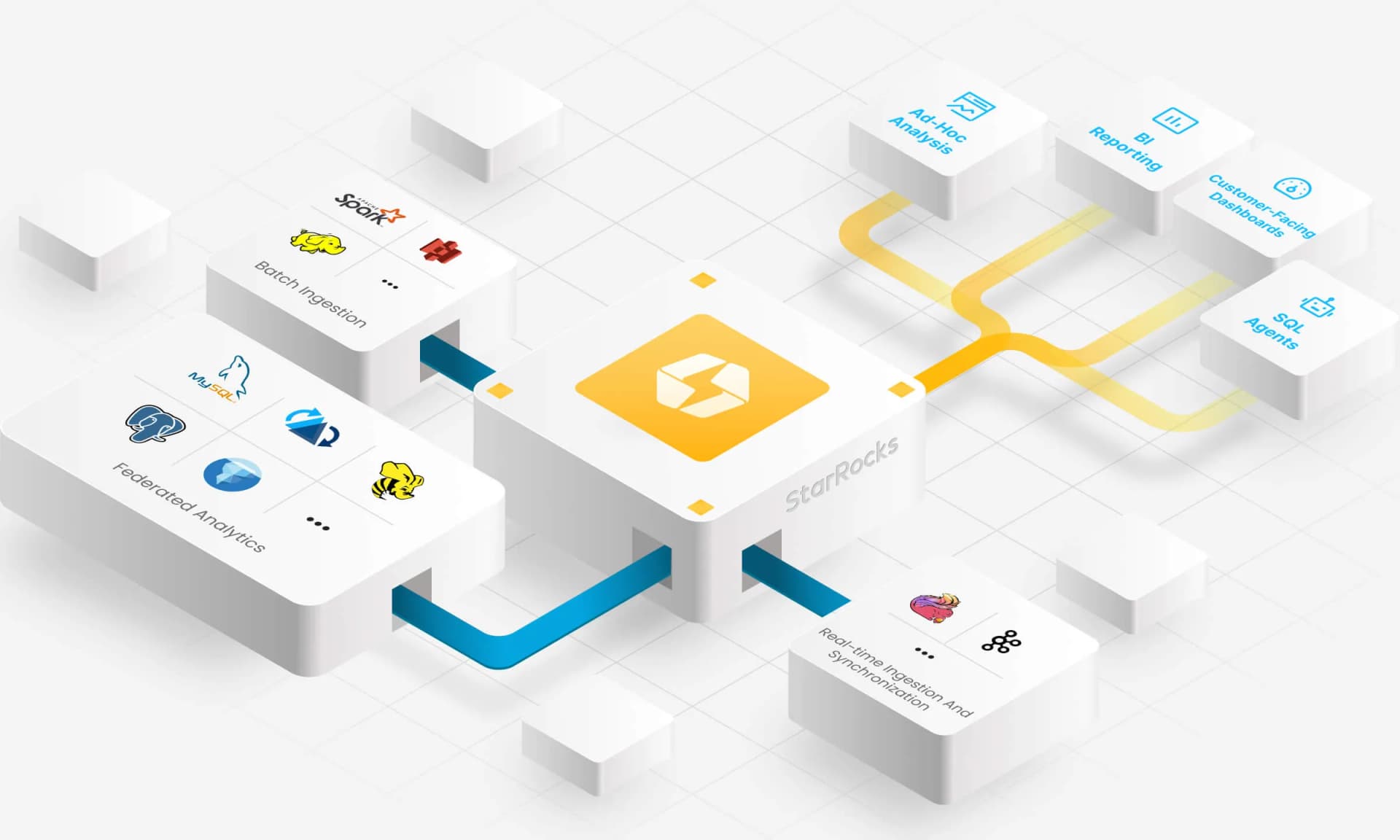
We recommend StarRocks for data engineering teams that need sub-second analytics on rapidly changing data and are comfortable operating open-source infrastructure. StarRocks delivers unmatched real-time query performance through its SIMD-optimized vectorized engine, primary key tables for mutable data, and native streaming ingestion from Kafka and Flink. It queries Apache Iceberg, Delta Lake, and Hudi directly without data copying, which simplifies lakehouse architectures. The Apache-2.0 license means zero licensing cost for self-hosted deployments, and CelerData provides a managed cloud option for teams that want StarRocks performance without the operational burden. With 11,500+ GitHub stars, active Slack community, and backing as a Linux Foundation project, StarRocks is a strong choice for real-time dashboards, ad-hoc OLAP, and high-concurrency agent-serving use cases.
These scenarios reflect the available product evidence. Your requirements, existing stack, and team expertise should guide the final decision.
Frequently Asked Questions
Is StarRocks a replacement for Snowflake?
StarRocks is not a direct replacement for Snowflake. They optimize for different workload profiles. Snowflake provides a fully managed cloud data warehouse with deep governance, multi-cloud support, and broad enterprise features like Time Travel and Snowflake Intelligence. StarRocks focuses on sub-second OLAP query performance on mutable, real-time data. Some organizations use both: Snowflake as the enterprise data warehouse for batch analytics and governed reporting, and StarRocks as the real-time analytics layer for dashboards and agent-serving workloads that demand low latency.
How does pricing compare between Snowflake and StarRocks?
Snowflake uses consumption-based pricing with credits that scale by edition (Standard, Enterprise, Business Critical, or VPS), plus separate per-TB storage fees that vary by region and payment model. Annual capacity commitments offer discounted rates compared to on-demand pricing. StarRocks is open-source under the Apache-2.0 license and free to self-host, so the primary costs are compute infrastructure and engineering time to operate the cluster. CelerData offers a managed cloud version with custom pricing. For teams with strong DevOps capabilities, StarRocks can be significantly cheaper at scale since there are no per-credit or edition-based charges.
Which platform is better for real-time analytics?
StarRocks is purpose-built for real-time analytics. Its primary key tables resolve data changes during ingestion, delivering sub-second freshness on mutable data without impacting query performance. Native streaming ingestion from Flink and Kafka applies updates in real time. Snowflake supports near-real-time loading through Snowpipe, but it is architecturally optimized for batch and scheduled workloads rather than sub-second mutable data scenarios. If your primary use case is real-time dashboards or serving AI agents with fresh data, StarRocks has a clear performance advantage.
Can StarRocks query data stored in a data lake?
Yes. StarRocks queries Apache Iceberg, Delta Lake, and Apache Hudi tables directly without requiring data copying or separate ingestion pipelines. Its shared-data architecture can persist data on object storage like S3 while scaling compute independently. This makes StarRocks a strong fit for lakehouse architectures where you want to keep data in open formats but need sub-second analytical query performance on top of that data.