Decision comparison
ClearML vs Vertex AI
ClearML and Vertex AI approach MLOps from opposite ends. ClearML is open source and runs anywhere, with agents scheduling work onto whatever hardware you own, and it costs engineering time rather than licence fees. Vertex AI is a managed Google Cloud service covering the full lifecycle plus AutoML and foundation models, with nothing to operate and no option to run it elsewhere.
Architecture choice. These take different approaches to the same problem. Read the table as a fit question rather than a feature race.
Applies to: self-hosted MLOps workloads requiring integrated experiment, dataset, and compute orchestration
All 2 are ML platforms.
Quick Comparison
| Decision factor | ClearML | Vertex AI |
|---|---|---|
| What it is | An open-source MLOps suite covering experiment tracking, orchestration, data versioning and serving | Google Cloud's managed machine learning platform, covering training, pipelines, feature store, model registry and serving |
| Licensing | Open source, self-hosted at no licence cost, with a hosted service and paid enterprise tiers | A commercial managed service, billed on the compute and features you use |
| Where it runs | Your own servers, any cloud, or ClearML's hosted service | Google Cloud only |
| Compute | Agents run on whatever machines you give them, including on-premise GPUs and spot instances across clouds | Google-managed CPU, GPU and TPU capacity |
| Integration | Two lines added to a Python script capture runs; works with PyTorch, TensorFlow and scikit-learn | Native integration with BigQuery, Cloud Storage, Dataflow and IAM |
| Self-hosting | Docker Compose for a single server or Kubernetes via Helm, with artefacts stored on S3 or compatible object storage | Not available; the service is operated by Google |
| Scope | Tracking, orchestration, data and model versioning, hyperparameter optimisation and serving | Full lifecycle plus AutoML, Model Garden and Gemini foundation models |
| Best fit | Teams wanting control, portability and low licence cost with engineering capacity to match | Teams on Google Cloud wanting a managed platform with nothing to operate |
ClearML
- What it is:
- An open-source MLOps suite covering experiment tracking, orchestration, data versioning and serving
- Licensing:
- Open source, self-hosted at no licence cost, with a hosted service and paid enterprise tiers
- Where it runs:
- Your own servers, any cloud, or ClearML's hosted service
- Compute:
- Agents run on whatever machines you give them, including on-premise GPUs and spot instances across clouds
- Integration:
- Two lines added to a Python script capture runs; works with PyTorch, TensorFlow and scikit-learn
- Self-hosting:
- Docker Compose for a single server or Kubernetes via Helm, with artefacts stored on S3 or compatible object storage
- Scope:
- Tracking, orchestration, data and model versioning, hyperparameter optimisation and serving
- Best fit:
- Teams wanting control, portability and low licence cost with engineering capacity to match
Vertex AI
- What it is:
- Google Cloud's managed machine learning platform, covering training, pipelines, feature store, model registry and serving
- Licensing:
- A commercial managed service, billed on the compute and features you use
- Where it runs:
- Google Cloud only
- Compute:
- Google-managed CPU, GPU and TPU capacity
- Integration:
- Native integration with BigQuery, Cloud Storage, Dataflow and IAM
- Self-hosting:
- Not available; the service is operated by Google
- Scope:
- Full lifecycle plus AutoML, Model Garden and Gemini foundation models
- Best fit:
- Teams on Google Cloud wanting a managed platform with nothing to operate
Public signals
Verified factual signals only. Bars appear only for like-for-like metrics with five weekly assessments for every tool; missing evidence stays explicit. These signals do not establish enterprise adoption, product quality, or total cost.
| Metric | ClearML | Vertex AI |
|---|---|---|
| Docker Hub pulls(Product adoption) | 87.0k | Not available |
| GitHub commits, 90d(Product adoption) | 79 | Not available |
| GitHub stars(Product adoption) | 6,500+ | Not available |
| Search interest(Market interest) | 0 | 7 |
| PyPI weekly downloads(Product adoption) | 160.3k | Not available |
| Stack Overflow questions(Community interest) | 54 | 989 |
| GitHub commits, 90d(Developer adoption) | Not available | 187 |
| GitHub stars(Developer adoption) | Not available | 904 |
| Hacker News mentions, 90d(Community interest) | Not available | 1 |
| npm weekly downloads(Developer adoption) | Not available | 297.6k |
| PyPI weekly downloads(Developer adoption) | Not available | 20.7M |
As of September 14, 2026 — updated weekly.
Health & risk evidence
Observed public-source checks for mapped package versions and repositories.
ClearML
September 14, 2026Package vulnerabilities
PyPI · clearml@2.1.12
0 vulnerabilities
across 1 package
Repository security score
Not available
Vertex AI
September 14, 2026Package vulnerabilities
npm · @google-cloud/aiplatform@7.4.0 · PyPI · google-cloud-aiplatform@2.1.0
0 vulnerabilities
across 2 packages
Repository security score
Not available
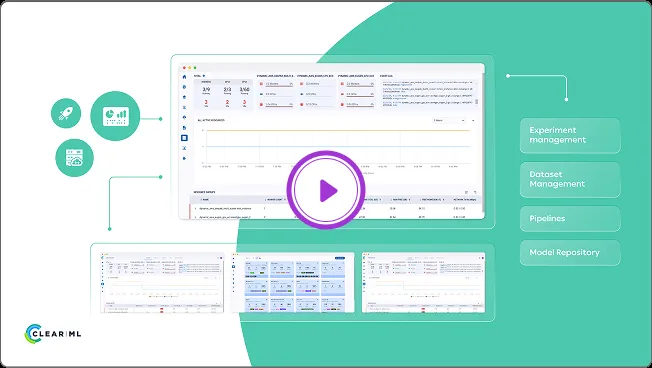
Interface Preview
ClearML
Vertex AI

Feature Comparison
| Feature | ClearML | Vertex AI |
|---|---|---|
| Tracking | ||
| Experiment tracking | Full support | Full support |
| Data and artefact versioning | Full support | Full support |
| Hyperparameter optimisation | Full support | Full support |
| Model registry | Full support | Full support |
| Compute | ||
| Managed training jobs | Partial support | Full support |
| Use your own hardware | Full support | Not verified |
| GPU orchestration across clouds | Full support | Not verified |
| TPU access | Not verified | Full support |
| Serving | ||
| Model serving | Full support | Full support |
| Batch inference | Full support | Full support |
| Autoscaling endpoints | Partial support | Full support |
| Drift monitoring | Partial support | Full support |
| Platform | ||
| Open source and self-hostable | Full support | Not verified |
| Fully managed option | Full support | Full support |
| AutoML | Partial support | Full support |
| Foundation model catalogue | Not verified | Full support |
Tracking
Experiment tracking
Data and artefact versioning
Hyperparameter optimisation
Model registry
Compute
Managed training jobs
Use your own hardware
GPU orchestration across clouds
TPU access
Serving
Model serving
Batch inference
Autoscaling endpoints
Drift monitoring
Platform
Open source and self-hostable
Fully managed option
AutoML
Foundation model catalogue
Which approach fits
ClearML and Vertex AI approach MLOps from opposite ends. ClearML is open source and runs anywhere, with agents scheduling work onto whatever hardware you own, and it costs engineering time rather than licence fees. Vertex AI is a managed Google Cloud service covering the full lifecycle plus AutoML and foundation models, with nothing to operate and no option to run it elsewhere.
When each approach fits
Choose ClearML if:
Choose ClearML when control and portability matter and you have the engineering capacity to run a platform. A few lines added to a Python script capture runs, agents schedule work onto on-premise GPUs or spot instances in any cloud, and data and model versioning come with it. Self-hosting removes licence cost and keeps everything inside your own infrastructure.
Choose Vertex AI if:
Choose Vertex AI when you are on Google Cloud and want the lifecycle covered without operating anything. Training reads directly from BigQuery, pipelines build on Kubeflow, TPUs are available for large jobs, endpoints autoscale with drift monitoring included, and Model Garden with Gemini sits beside your own models.
These scenarios reflect the available product evidence. Your requirements, existing stack, and team expertise should guide the final decision.
Frequently Asked Questions
Is self-hosting ClearML actually free?
The licence is. The server, the storage for artefacts, the agents and the person who keeps them running are not. For a team that already operates infrastructure, that total is often well below a managed platform bill, especially with on-premise GPUs already bought. For a team without that capacity, the staff time exceeds what the licence would have cost. ClearML's hosted service exists for the second case.
What does running agents on our own hardware buy?
Use of capacity you have already paid for, and freedom to schedule across clouds. A GPU server sitting in a rack, spot instances on three providers, and a workstation under someone's desk can all take jobs from the same queue. On a managed cloud platform the compute is the provider's, at the provider's rates, in the provider's region.
How portable is the work we do on these platforms?
Model code in Python with scikit-learn, PyTorch or TensorFlow is portable anywhere. What ties you to a platform is everything around it: pipeline definitions, feature store schemas, endpoint configuration, monitoring rules and the identity model. Teams that keep training code in plain Python and treat the platform as an execution environment migrate with moderate effort. Teams that build deeply into proprietary pipeline and feature services do not.
How much of the lifecycle does each cover?
ClearML covers tracking, data and artefact versioning, orchestration, hyperparameter optimisation and serving — the engineering spine of an ML workflow. Vertex AI covers that plus AutoML, a feature store, managed endpoints with drift monitoring, and a foundation model catalogue. If those extras would be used, they are real; if your work is custom models trained by engineers, the overlap is larger than it looks.
Which suits a small team better?
It depends on what the team is short of. A small team short of engineering time benefits from a managed service, because operating a platform is work nobody has spare. A small team short of budget but with infrastructure skills benefits from self-hosting, because the licence line disappears. Be honest about which constraint actually binds before deciding.
What does a ClearML deployment look like?
The server runs from Docker Compose on a single machine for small teams, or on Kubernetes through a Helm chart for larger ones, with artefacts and datasets stored on S3 or any compatible object storage. Agents are Python processes installed on each machine that runs jobs, pulling from named queues. Everything is reachable over a REST API, so scheduling and reporting can be automated from your own tooling.
Can we start with one and move later?
Moving from ClearML to a managed platform is usually straightforward, because training code stays plain Python and the platform is an execution environment. Moving off a managed platform is harder in proportion to how much you built into its pipelines, feature store and endpoints. If you expect to re-evaluate in two years, keeping training code framework-native protects that option on either side.