Decision comparison
ClickHouse vs StarRocks
ClickHouse and StarRocks are both open-source columnar analytical databases, compared directly in 2026 OLAP round-ups. ClickHouse is built around raw scan and aggregation throughput over tables you shape yourself, with a very large ecosystem behind it. StarRocks joins tables at query time and speaks the MySQL protocol, so normalised schemas and existing clients work without flattening or new connectors.
Direct comparison. These are reviewed substitutes bought for the same job, so the differences below are the ones that decide between them.
All 2 are OLAP databases.
Quick Comparison
| Decision factor | ClickHouse | StarRocks |
|---|---|---|
| What it is | An open-source columnar database built for high-throughput analytical queries | An open-source MPP analytical database with fast joins and a MySQL-compatible interface |
| Query shape | Optimised for scans and aggregations over wide, largely denormalised tables | Optimised for joins at query time as well as aggregation, so normalised schemas work directly |
| Interface | Its own SQL dialect, with HTTP and native protocols | MySQL wire protocol, so existing MySQL clients and BI tools connect |
| Lakehouse access | External tables over object storage and open formats | Queries Iceberg, Hudi, Delta Lake and Hive tables in place alongside its own storage |
| Tuning | Table engines, ordering keys and materialised views chosen explicitly | Materialised views and a cost-based optimiser, with less physical design to choose |
| Ecosystem | Very large community, ClickHouse Cloud, and wide third-party tooling | Growing community, with managed offerings from several providers |
| Best fit | Raw scan throughput over event data you control the shape of | Analytics where dimensions change and tables must be joined rather than flattened |
ClickHouse
- What it is:
- An open-source columnar database built for high-throughput analytical queries
- Query shape:
- Optimised for scans and aggregations over wide, largely denormalised tables
- Interface:
- Its own SQL dialect, with HTTP and native protocols
- Lakehouse access:
- External tables over object storage and open formats
- Tuning:
- Table engines, ordering keys and materialised views chosen explicitly
- Ecosystem:
- Very large community, ClickHouse Cloud, and wide third-party tooling
- Best fit:
- Raw scan throughput over event data you control the shape of
StarRocks
- What it is:
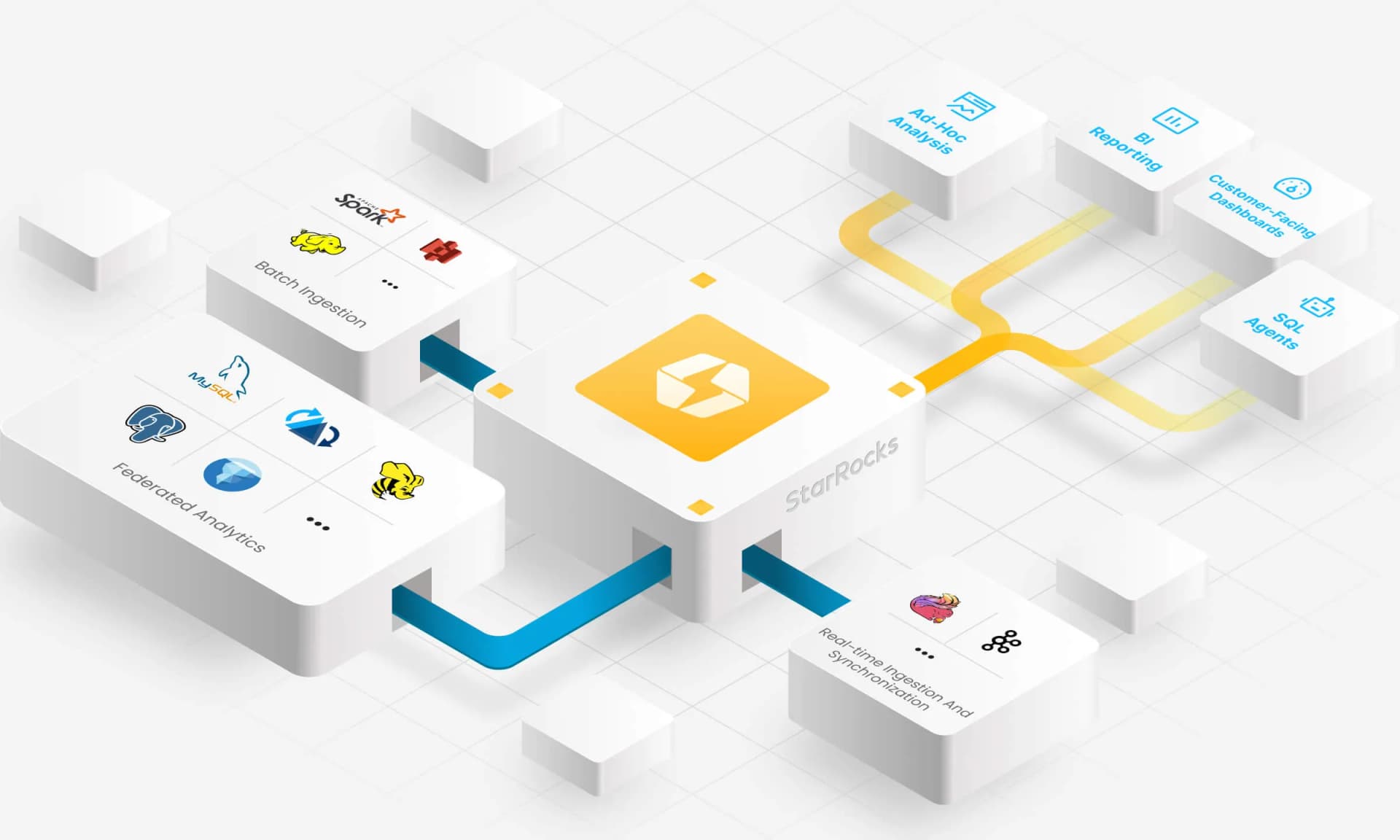
- An open-source MPP analytical database with fast joins and a MySQL-compatible interface
- Query shape:
- Optimised for joins at query time as well as aggregation, so normalised schemas work directly
- Interface:
- MySQL wire protocol, so existing MySQL clients and BI tools connect
- Lakehouse access:
- Queries Iceberg, Hudi, Delta Lake and Hive tables in place alongside its own storage
- Tuning:
- Materialised views and a cost-based optimiser, with less physical design to choose
- Ecosystem:
- Growing community, with managed offerings from several providers
- Best fit:
- Analytics where dimensions change and tables must be joined rather than flattened
Public signals
Verified factual signals only. Bars appear only for like-for-like metrics with five weekly assessments for every tool; missing evidence stays explicit. These signals do not establish enterprise adoption, product quality, or total cost.
| Metric | ClickHouse | StarRocks |
|---|---|---|
| Docker Hub pulls(Product adoption) | 301.2M | 906.6k |
| GitHub commits, 90d(Product adoption) | 38.7k | 1.3k |
| GitHub stars(Product adoption) | 50,000+ | 12,000+ |
| Search interest(Market interest) | 8 | 1 |
| Hacker News mentions, 90d(Community interest) | 156 | 0 |
| npm weekly downloads(Developer adoption) | 2.5M | Not available |
| Product Hunt comments(Community interest) | 0 | 0 |
| Product Hunt rating(Community interest) | 5.0/5 | Unavailable |
| Product Hunt reviews(Community interest) | 28 | 0 |
| Product Hunt votes(Community interest) | 12 | 2 |
| PyPI weekly downloads(Developer adoption) | 6.5M | 131.3k |
| Stack Overflow questions(Community interest) | 2.2k | 11 |
As of September 21, 2026 — updated weekly.
Health & risk evidence
Observed public-source checks for mapped package versions and repositories.
ClickHouse
September 21, 2026Package vulnerabilities
npm · @clickhouse/client@1.23.1 · PyPI · clickhouse-connect@1.8.0
0 vulnerabilities
across 2 packages
Repository security score
github.com/ClickHouse/ClickHouse
4.4/10
StarRocks
September 21, 2026Package vulnerabilities
PyPI · starrocks@1.3.4
0 vulnerabilities
across 1 package
Repository security score
Not available
Interface Preview
StarRocks
Feature Comparison
| Feature | ClickHouse | StarRocks |
|---|---|---|
| Query | ||
| Sub-second aggregation over large datasets | Full support | Full support |
| Fast multi-table joins | Partial support | Full support |
| Materialised views | Full support | Full support |
| High concurrency | Full support | Full support |
| Access | ||
| MySQL protocol compatibility | Not verified | Full support |
| Query Iceberg and Delta Lake in place | Partial support | Full support |
| Real-time ingestion from Kafka | Full support | Full support |
| Record-level updates | Partial support | Full support |
| Operations | ||
| Self-hosted deployment | Full support | Full support |
| Managed service available | Full support | Full support |
| Tiered storage to object storage | Full support | Full support |
| Open source | Full support | Full support |
| Ecosystem | ||
| Large community and third-party tooling | Full support | Partial support |
| Standard BI connectivity | Full support | Full support |
| Cloud service from the project's own vendor | Full support | Partial support |
| Broad language client coverage | Full support | Full support |
Query
Sub-second aggregation over large datasets
Fast multi-table joins
Materialised views
High concurrency
Access
MySQL protocol compatibility
Query Iceberg and Delta Lake in place
Real-time ingestion from Kafka
Record-level updates
Operations
Self-hosted deployment
Managed service available
Tiered storage to object storage
Open source
Ecosystem
Large community and third-party tooling
Standard BI connectivity
Cloud service from the project's own vendor
Broad language client coverage
Which to choose
ClickHouse and StarRocks are both open-source columnar analytical databases, compared directly in 2026 OLAP round-ups. ClickHouse is built around raw scan and aggregation throughput over tables you shape yourself, with a very large ecosystem behind it. StarRocks joins tables at query time and speaks the MySQL protocol, so normalised schemas and existing clients work without flattening or new connectors.
Best-fit scenarios
Choose ClickHouse if:
Choose ClickHouse when the workload is scans and aggregations over event data and you control the table shape. Explicit table engines, ordering keys and materialised views give direct influence over performance, the ecosystem and community are large enough that most problems have been solved publicly, and ClickHouse Cloud is available if you would rather not operate it.
Choose StarRocks if:
Choose StarRocks when your data is not naturally one wide table. Joining dimensions at query time means they stay in their own tables and can change independently, MySQL protocol compatibility removes an integration step for existing clients and BI tools, and querying Iceberg, Hudi and Delta Lake in place avoids copying lake data into another store.
These scenarios reflect the available product evidence. Your requirements, existing stack, and team expertise should guide the final decision.
Frequently Asked Questions
What kind of workload are these built for?
Aggregation over large volumes of event data, answered in milliseconds for many concurrent users — the shape of user-facing analytics, operational dashboards and real-time monitoring. None of them is a general-purpose warehouse and none is built for long batch transformations. If your queries are overnight joins across years of history, compare warehouses instead; these systems answer a different question.
Why does join performance decide the data model?
A system optimised for denormalised tables expects dimension attributes flattened in at ingestion. That is fast to query and painful when a dimension changes, because history has to be rewritten or old rows carry stale attributes. A system with fast joins lets dimensions stay in their own tables and change once. Look at which of your attributes change and how often; that answers this faster than a benchmark.
How much does MySQL compatibility help?
It removes an integration step. Existing MySQL clients, drivers and many BI tools connect without a new connector, and engineers who know MySQL syntax are productive quickly. It does not make the engine transactional — both are columnar and analytical — but a familiar wire protocol lowers the cost of adoption more than feature lists suggest.
What does querying the lake in place give us?
One less copy. If data already sits in Iceberg or Delta Lake on object storage, querying it directly means the analytical database serves recent hot data while history stays where it is. That removes both the storage duplication and the pipeline keeping a second copy current, which is a common source of quiet inconsistency between two systems that should agree.
What does running one of these involve?
Several node roles with different scaling behaviour, a metadata layer, object storage underneath, ingestion supervision from Kafka and capacity planning as volume grows. These are distributed databases and operating one is a specialism. Budget a meaningful fraction of an engineer's time indefinitely, concentrated unpredictably around incidents, or buy a managed service and pay for that time instead.
How do we control cost?
Keep recent data on fast storage and older data on object storage, and reduce what is scanned through materialised views or pre-aggregation. Ingestion method matters too: real-time ingestion from Kafka costs more in resources than batch loading the same volume, so anything that does not need second-level freshness should arrive in batches.