Decision comparison
Dagster vs Airbyte
Dagster excels as a full-lifecycle data orchestrator with asset-centric lineage, built-in observability, and transformation support, while Airbyte dominates data integration with 600+ connectors and turnkey ELT replication. They serve complementary roles in a modern data stack.
Used together. These are normally used together rather than chosen between. The comparison explains what each one does in the stack.
These are different kinds of product — Workflow Orchestrator and ELT Platform.
Quick Comparison
| Decision factor | Dagster | Airbyte |
|---|---|---|
| Primary Focus | Asset-centric data orchestration with built-in lineage, observability, and declarative pipeline management for ETL/ELT and ML workflows | ELT data integration platform with 600+ pre-built connectors focused on extracting and loading data from sources to warehouses |
| Connector Ecosystem | Native integrations for Snowflake, BigQuery, dbt, Databricks, Fivetran, Spark, and Great Expectations via Dagster Pipes | Industry-leading 600+ connectors for databases, SaaS apps, APIs, warehouses, lakes, and vector stores with CDK for custom builds |
| Pricing Model | Open-source self-hosted free (Apache-2.0), Solo Plan $10/mo, Starter Plan $100/mo, Starter $1200/mo, Pro and Enterprise Plan contact sales | Airbyte Open Source is free and self-hosted. Standard starts at $10/month on volume-based pricing, with a free trial at signup. Pro and Enterprise Flex are capacity-based on Data Workers and are quote-based. |
| Deployment Options | Self-hosted single server or Kubernetes, Dagster Cloud managed service, hybrid bring-your-own-infrastructure with NA and EU regions | Self-hosted OSS via Docker or Kubernetes, Airbyte Cloud managed SaaS, Enterprise self-hosted with PrivateLink and multi-region support |
| Community & Adoption | 16,000+ GitHub stars with Apache-2.0 license, active Python-based community, latest release 1.13.14 (core) / 0.29.14 (libraries) on Jul 16, 2026 | 22,000+ GitHub stars with 600+ community contributors, 25,000+ Slack community members, latest release Airbyte 2.0 in October 2025 |
| Enterprise Security | SOC 2 Type II and HIPAA certified, SSO with Google/GitHub/SAML, RBAC, SCIM provisioning, audit logs and retention policies | SOC 2 Type II certified with GDPR and HIPAA support, SSO, SCIM provisioning, fine-grained RBAC, audit logs, 99.9% uptime SLA |
Dagster
- Primary Focus:
- Asset-centric data orchestration with built-in lineage, observability, and declarative pipeline management for ETL/ELT and ML workflows
- Connector Ecosystem:
- Native integrations for Snowflake, BigQuery, dbt, Databricks, Fivetran, Spark, and Great Expectations via Dagster Pipes
- Pricing Model:
- Open-source self-hosted free (Apache-2.0), Solo Plan $10/mo, Starter Plan $100/mo, Starter $1200/mo, Pro and Enterprise Plan contact sales
- Deployment Options:
- Self-hosted single server or Kubernetes, Dagster Cloud managed service, hybrid bring-your-own-infrastructure with NA and EU regions
- Community & Adoption:
- 16,000+ GitHub stars with Apache-2.0 license, active Python-based community, latest release 1.13.14 (core) / 0.29.14 (libraries) on Jul 16, 2026
- Enterprise Security:
- SOC 2 Type II and HIPAA certified, SSO with Google/GitHub/SAML, RBAC, SCIM provisioning, audit logs and retention policies
Airbyte
- Primary Focus:
- ELT data integration platform with 600+ pre-built connectors focused on extracting and loading data from sources to warehouses
- Connector Ecosystem:
- Industry-leading 600+ connectors for databases, SaaS apps, APIs, warehouses, lakes, and vector stores with CDK for custom builds
- Pricing Model:
- Airbyte Open Source is free and self-hosted. Standard starts at $10/month on volume-based pricing, with a free trial at signup. Pro and Enterprise Flex are capacity-based on Data Workers and are quote-based.
- Deployment Options:
- Self-hosted OSS via Docker or Kubernetes, Airbyte Cloud managed SaaS, Enterprise self-hosted with PrivateLink and multi-region support
- Community & Adoption:
- 22,000+ GitHub stars with 600+ community contributors, 25,000+ Slack community members, latest release Airbyte 2.0 in October 2025
- Enterprise Security:
- SOC 2 Type II certified with GDPR and HIPAA support, SSO, SCIM provisioning, fine-grained RBAC, audit logs, 99.9% uptime SLA
Public signals
Verified factual signals only. Bars appear only for like-for-like metrics with five weekly assessments for every tool; missing evidence stays explicit. These signals do not establish enterprise adoption, product quality, or total cost.
| Metric | Dagster | Airbyte |
|---|---|---|
| Docker Hub pulls(Developer adoption) | 6.2M | 9.7M |
| GitHub commits, 90d(Product adoption) | 265 | 4.1k |
| GitHub stars(Product adoption) | 16,000+ | 22,000+ |
| Search interest(Market interest) | 1 | 0 |
| Hacker News mentions, 90d(Community interest) | 3 | 0 |
| Product Hunt comments(Community interest) | 11 | 22 |
| Product Hunt rating(Community interest) | 5.0/5 | 4.4/5 |
| Product Hunt reviews(Community interest) | 1 | 5 |
| Product Hunt votes(Community interest) | 112 | 132 |
| PyPI weekly downloads(Product adoption) | 1.8M | Not available |
| Stack Overflow questions(Community interest) | 171 | 45 |
| PyPI weekly downloads(Developer adoption) | Not available | 115.2k |
As of September 21, 2026 — updated weekly.
Health & risk evidence
Observed public-source checks for mapped package versions and repositories.
Dagster
September 21, 2026Package vulnerabilities
PyPI · dagster@1.13.23
0 vulnerabilities
across 1 package
Repository security score
github.com/dagster-io/dagster
5.1/10
Airbyte
September 21, 2026Package vulnerabilities
PyPI · airbyte@0.68.0
0 vulnerabilities
across 1 package
Repository security score
github.com/airbytehq/airbyte
4.8/10
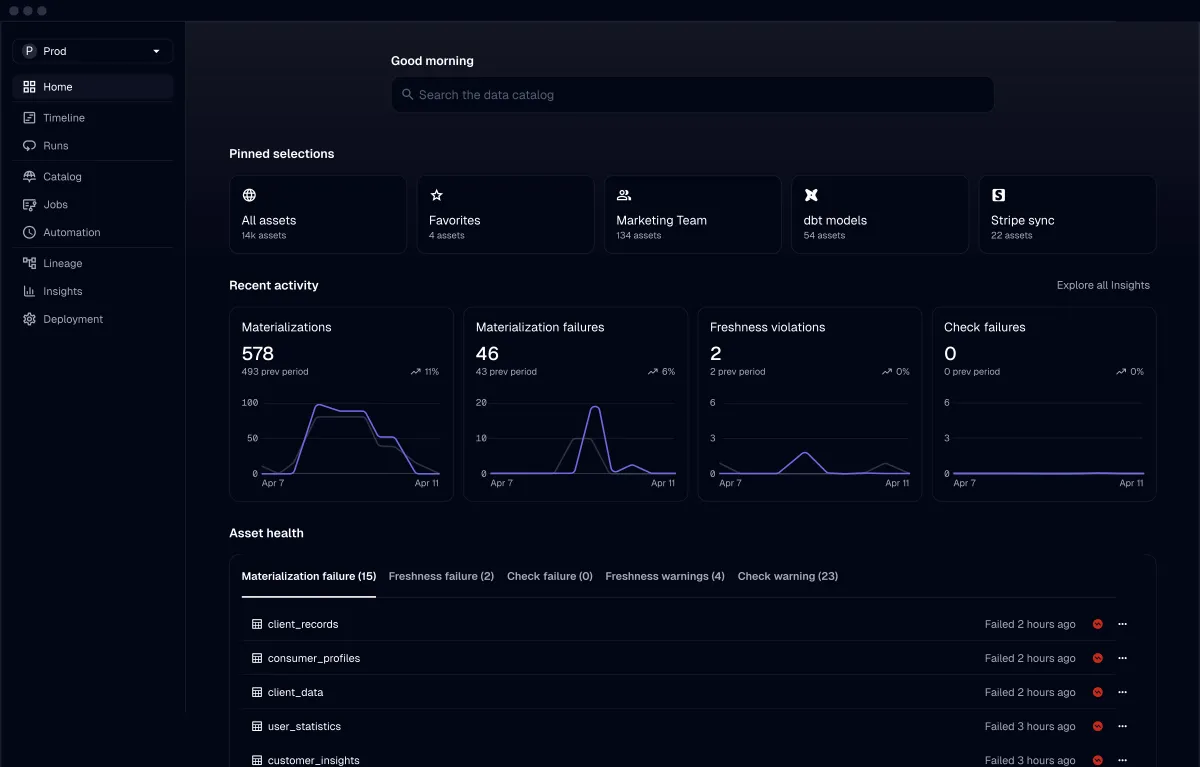
Interface Preview
Dagster
Feature Comparison
| Feature | Dagster | Airbyte |
|---|---|---|
| Data Orchestration | ||
| Pipeline Paradigm | Declarative asset-centric orchestration that models data assets with dependency tracking, partitioning, and versioning as first-class concepts | Connection-based ELT replication using source-destination pairs with batch and CDC sync modes for data movement |
| Scheduling & Automation | Built-in scheduler with cron-based, sensor-driven, and asset-materialization triggers plus branch deployments for CI/CD | Configurable sync scheduling with full-refresh, incremental, and log-based CDC replication modes across all connections |
| Workflow Management | DAG-based asset graph with intelligent dependency handling, fault-tolerance, and incremental materialization of partitioned assets | Parallel connection execution where each sync runs in isolated Docker containers for process-level fault isolation |
| Data Integration | ||
| Connector Coverage | Native integrations with Snowflake, BigQuery, dbt, Databricks, Fivetran, Spark, and Great Expectations through dedicated libraries | 600+ pre-built connectors for databases, SaaS apps, APIs, warehouses, data lakes, and vector stores with regular additions |
| Custom Integration Development | Python-based asset definitions and Dagster Pipes for observability of jobs running in external systems like Databricks or Spark | Connector Development Kit (CDK) enables building custom connectors in 30 minutes using Docker containers in any programming language |
| Transformation Support | Orchestrates dbt, Databricks, and Python transformations natively with built-in data quality validation and freshness checks | Minimal in-transit transformations with dbt integration for post-load transformation; focuses on extract and load phases |
| Observability & Monitoring | ||
| Data Lineage | Built-in data catalog with auto-generated documentation, full asset lineage graphs, and clear ownership tracking across teams | Connection-level monitoring with sync status tracking and error logging; lineage limited to source-destination mapping |
| Alerting & Debugging | Intelligent alerts in Slack with AI-powered debugging, impact analysis, and streamlined resolution workflows for data incidents | Real-time sync monitoring with detailed error logs, automatic retries on failure, and schema change detection notifications |
| Health Metrics | Real-time freshness, performance, cost tracking, and reliability dashboards with built-in data quality checks at every pipeline stage | Sync duration and record count tracking with 800,000+ daily pipeline jobs processed; 96/100 average customer satisfaction score |
| Security & Compliance | ||
| Authentication & Access Control | SSO via Google, GitHub, and SAML identity providers with RBAC and SCIM provisioning for automated user management | Single Sign-On with SCIM provisioning, fine-grained RBAC, and enterprise-grade encryption standards for data protection |
| Compliance Certifications | SOC 2 Type II and HIPAA certified with independent audits; multi-tenant code deployments for data isolation | SOC 2 Type II certified with GDPR and HIPAA support; PrivateLink deployment and multiple data region options |
| Enterprise Governance | Comprehensive audit logs with retention policies, unified view of all user actions, and multi-tenant instance isolation | Contractual 99.9% uptime SLA with 24/7 dedicated support, named customer success managers, and proactive pipeline monitoring |
| Developer Experience | ||
| Local Development | Emphasis on unit testing with local development support, CI integration, and branch deployments for safe iteration | Docker-based local deployment via docker-compose with web UI at localhost:8000 for testing and development |
| Programming Model | Python-first declarative framework with modular, reusable components and asset definitions that model real data dependencies | Configuration-driven no-code UI with Python CDK for custom connectors; API-driven setup for programmatic pipeline management |
| Open Source Model | Fully open-source under Apache-2.0 license with 16,000+ GitHub stars; active community contributions and Dagster University courses | Open-source core with MIT/Elastic licensing and 22,000+ GitHub stars; 600+ community contributors and 12,000+ Slack members |
Data Orchestration
Pipeline Paradigm
Scheduling & Automation
Workflow Management
Data Integration
Connector Coverage
Custom Integration Development
Transformation Support
Observability & Monitoring
Data Lineage
Alerting & Debugging
Health Metrics
Security & Compliance
Authentication & Access Control
Compliance Certifications
Enterprise Governance
Developer Experience
Local Development
Programming Model
Open Source Model
How they fit together
Dagster excels as a full-lifecycle data orchestrator with asset-centric lineage, built-in observability, and transformation support, while Airbyte dominates data integration with 600+ connectors and turnkey ELT replication. They serve complementary roles in a modern data stack.
What each one handles
Use Dagster for:
Choose Dagster when you need a unified control plane for orchestrating complex data workflows across ETL/ELT pipelines, dbt transformations, and ML/AI operations. Dagster is the stronger choice for teams that want asset-centric orchestration with built-in lineage graphs, data quality checks, freshness monitoring, and cost tracking. Its declarative Python framework makes pipelines testable and CI/CD-native, and Dagster Cloud supports hybrid deployments in North American and European regions. Teams already using dbt, Databricks, or Spark will benefit from Dagster's native integrations and the ability to orchestrate end-to-end workflows from a single platform with comprehensive observability.
Use Airbyte for:
Choose Airbyte when your primary need is replicating data from many sources into warehouses, lakes, or databases with minimal engineering effort. Airbyte's 600+ pre-built connectors and Connector Development Kit make it the fastest path to consolidating data from SaaS apps, databases, APIs, and files. The open-source self-hosted option gives engineering teams full control at zero per-usage cost, while Cloud Standard starts at $10/mo for managed pipelines. Airbyte is particularly strong for teams migrating away from expensive proprietary solutions like Fivetran, with typical 50-70% cost savings on equivalent data movement. The new Agent Engine extends Airbyte into AI-powered real-time data access.
These roles reflect the available product evidence. Most teams run both; which one owns a given job depends on your stack and team.
Frequently Asked Questions
Can Dagster and Airbyte be used together in the same data stack?
Dagster and Airbyte integrate directly and complement each other well in a modern data stack. Dagster has a native Airbyte integration that lets you orchestrate Airbyte syncs as assets within your Dagster pipeline graph. This means Dagster handles the scheduling, dependency management, and observability layer while Airbyte handles the actual data extraction and loading through its 600+ connectors. Many data teams use this combination: Airbyte replicates data from sources into a warehouse, Dagster orchestrates the entire workflow including dbt transformations downstream, and the built-in lineage graph shows the complete data flow from source to final analytics tables.
How do the open-source licensing models differ between Dagster and Airbyte?
Dagster uses the Apache-2.0 license, one of the most permissive open-source licenses available, which allows unrestricted commercial use, modification, and distribution. Airbyte uses a combination of MIT and Elastic licensing for its open-source core. Both tools offer their self-hosted open-source editions completely free with unlimited usage. The key difference is that Dagster's Apache-2.0 license has no restrictions on how you use or distribute the software, while Airbyte's Elastic license includes some limitations on offering Airbyte as a managed service. For most data teams running pipelines internally, both licenses work without restrictions. The commercial cloud offerings from both vendors add enterprise features like SSO, RBAC, and dedicated support on top of the open-source core.
Which tool handles data transformations better?
Dagster provides significantly deeper transformation capabilities. It natively orchestrates dbt, Databricks, and Python transformations as first-class assets with built-in data quality validation, freshness checks, and automated testing at every pipeline stage. Dagster treats transformations as part of the asset graph, giving you full lineage visibility from raw source data through to final analytics tables. Airbyte intentionally focuses on the extract and load phases of ELT, offering only minimal in-transit transformations like schema normalization and column selection. Airbyte integrates with dbt for post-load transformations but does not orchestrate them. If transformation orchestration is critical to your workflow, Dagster is the clear choice; if you only need data movement, Airbyte handles that with minimal configuration.
How do the pricing models compare for a growing data team?
Dagster+ uses monthly plans plus usage credits and compute charges, while Airbyte offers a free self-hosted edition and credit- or capacity-based cloud plans. The better fit depends on whether the growing cost centre is orchestration and data-platform work (Dagster) or moving data from many sources (Airbyte).