Decision comparison
Datadog vs SigNoz
Datadog and SigNoz answer the same operational need with opposite cost structures. Datadog is the broader platform by a wide margin — hundreds of integrations, real user monitoring, security products — and it bills on hosts, ingested GB, custom metrics and indexed spans, so the invoice grows with how enthusiastically your engineers instrument. SigNoz is OpenTelemetry-native and open source, built on ClickHouse, so the cost moves to infrastructure and the engineer who runs it. Neither is cheaper in the abstract; they are cheap in different circumstances.
Architecture choice. These take different approaches to the same problem. Read the table as a fit question rather than a feature race.
Applies to: cloud-scale Dev and Ops monitoring workloads spanning infrastructure, applications, and logs
All 2 are observability platforms.
Quick Comparison
| Decision factor | Datadog | SigNoz |
|---|---|---|
| What it is | A commercial SaaS observability platform covering infrastructure, applications, logs and much else | An open-source OpenTelemetry-native platform built on ClickHouse, self-hosted or managed |
| Breadth | Several hundred integrations spanning cloud services, databases, CI, security and real user monitoring | Metrics, traces and logs from OpenTelemetry, with the exporters OTel itself provides |
| Instrumentation | Datadog agents and libraries, with OpenTelemetry ingestion supported alongside them | OpenTelemetry throughout; there is no proprietary agent to adopt |
| Where data lives | Datadog's cloud, in the region you select | Your infrastructure if self-hosted, on ClickHouse storage you control, or SigNoz Cloud |
| Cost model | Per host, per ingested GB, per custom metric and per indexed span, with retention tiers on top | Free to self-host; you pay for the ClickHouse cluster and the engineering time to run it |
| Operational burden | None beyond agent rollout and configuration | A ClickHouse-backed service on Docker or Kubernetes that someone has to run and upgrade |
| Best fit | Teams that want breadth immediately and can absorb usage-based pricing | Teams with a Kubernetes practice that want cost control and no instrumentation lock-in |
Datadog
- What it is:
- A commercial SaaS observability platform covering infrastructure, applications, logs and much else
- Breadth:
- Several hundred integrations spanning cloud services, databases, CI, security and real user monitoring
- Instrumentation:
- Datadog agents and libraries, with OpenTelemetry ingestion supported alongside them
- Where data lives:
- Datadog's cloud, in the region you select
- Cost model:
- Per host, per ingested GB, per custom metric and per indexed span, with retention tiers on top
- Operational burden:
- None beyond agent rollout and configuration
- Best fit:
- Teams that want breadth immediately and can absorb usage-based pricing
SigNoz
- What it is:
- An open-source OpenTelemetry-native platform built on ClickHouse, self-hosted or managed
- Breadth:
- Metrics, traces and logs from OpenTelemetry, with the exporters OTel itself provides
- Instrumentation:
- OpenTelemetry throughout; there is no proprietary agent to adopt
- Where data lives:
- Your infrastructure if self-hosted, on ClickHouse storage you control, or SigNoz Cloud
- Cost model:
- Free to self-host; you pay for the ClickHouse cluster and the engineering time to run it
- Operational burden:
- A ClickHouse-backed service on Docker or Kubernetes that someone has to run and upgrade
- Best fit:
- Teams with a Kubernetes practice that want cost control and no instrumentation lock-in
Public signals
Verified factual signals only. Bars appear only for like-for-like metrics with five weekly assessments for every tool; missing evidence stays explicit. These signals do not establish enterprise adoption, product quality, or total cost.
| Metric | Datadog | SigNoz |
|---|---|---|
| GitHub commits, 90d(Developer adoption) | 2.4k | Not available |
| GitHub stars(Developer adoption) | 3,500+ | Not available |
| Search interest(Market interest) | 14 | 1 |
| Hacker News mentions, 90d(Community interest) | 16 | 3 |
| Hugging Face downloads(Product adoption) | 96.6k | Not available |
| Hugging Face likes(Product adoption) | 220 | Not available |
| npm weekly downloads(Developer adoption) | 7.3M | Not available |
| Product Hunt comments(Community interest) | 1 | Not available |
| Product Hunt rating(Community interest) | 5.0/5 | Not available |
| Product Hunt reviews(Community interest) | 13 | Not available |
| Product Hunt votes(Community interest) | 75 | Not available |
| PyPI weekly downloads(Developer adoption) | 11.0M | Not available |
| Stack Overflow questions(Community interest) | 1.1k | 9 |
| Docker Hub pulls(Product adoption) | Not available | 1.0M |
| GitHub commits, 90d(Product adoption) | Not available | 609 |
| GitHub stars(Product adoption) | Not available | 32,000+ |
As of September 14, 2026 — updated weekly.
Health & risk evidence
Observed public-source checks for mapped package versions and repositories.
Datadog
September 14, 2026Package vulnerabilities
PyPI · datadog@0.53.0 · npm · dd-trace@6.16.0
0 vulnerabilities
across 2 packages
Repository security score
github.com/DataDog/datadog-agent
5.9/10
SigNoz
Package vulnerabilities
Not available
Repository security score
Not available
Interface Preview
SigNoz
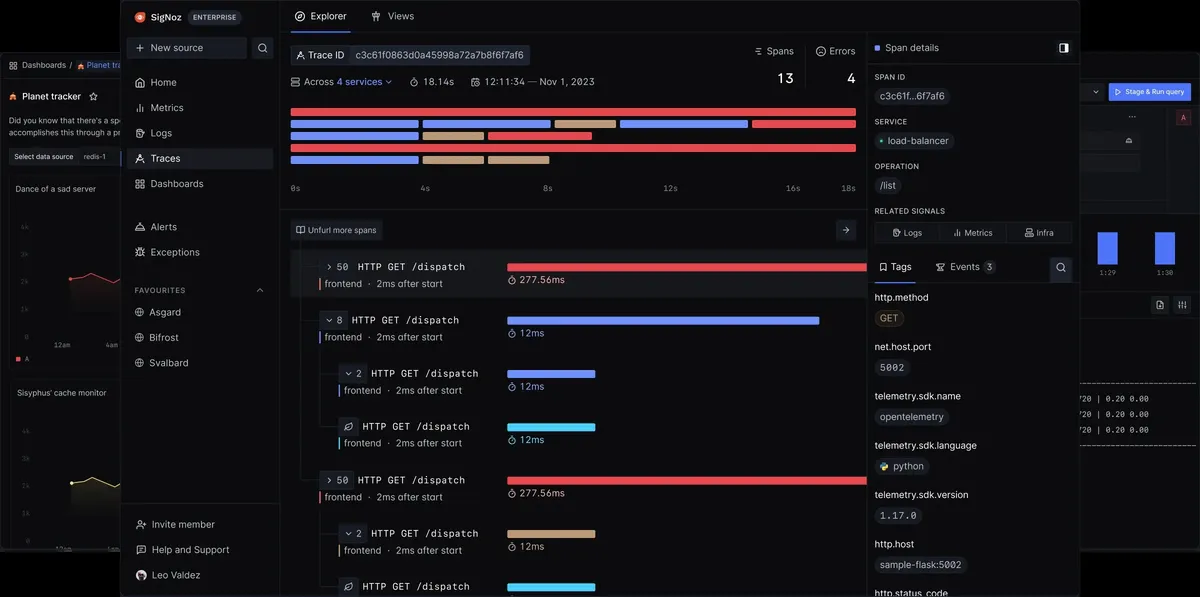
Feature Comparison
| Feature | Datadog | SigNoz |
|---|---|---|
| Telemetry | ||
| Distributed tracing | Full support | Full support |
| Metrics and dashboards | Full support | Full support |
| Log management | Full support | Full support |
| Real user monitoring | Full support | Partial support |
| Integration | ||
| OpenTelemetry ingestion | Full support | Full support |
| Vendor-neutral instrumentation | Partial support | Full support |
| Breadth of prebuilt integrations | Full support | Partial support |
| Cloud provider integrations for AWS, GCP and Azure | Full support | Partial support |
| Operations | ||
| Fully managed option | Full support | Full support |
| Self-hosted deployment | Not verified | Full support |
| Data residency under your control | Partial support | Full support |
| Predictable cost at growing volume | Partial support | Full support |
| Platform | ||
| Alerting and on-call workflows | Full support | Full support |
| Long retention without indexing charges | Partial support | Full support |
| Open-source licence | Not verified | Full support |
| Security and compliance products | Full support | Not verified |
Telemetry
Distributed tracing
Metrics and dashboards
Log management
Real user monitoring
Integration
OpenTelemetry ingestion
Vendor-neutral instrumentation
Breadth of prebuilt integrations
Cloud provider integrations for AWS, GCP and Azure
Operations
Fully managed option
Self-hosted deployment
Data residency under your control
Predictable cost at growing volume
Platform
Alerting and on-call workflows
Long retention without indexing charges
Open-source licence
Security and compliance products
Which approach fits
Datadog and SigNoz answer the same operational need with opposite cost structures. Datadog is the broader platform by a wide margin — hundreds of integrations, real user monitoring, security products — and it bills on hosts, ingested GB, custom metrics and indexed spans, so the invoice grows with how enthusiastically your engineers instrument. SigNoz is OpenTelemetry-native and open source, built on ClickHouse, so the cost moves to infrastructure and the engineer who runs it. Neither is cheaper in the abstract; they are cheap in different circumstances.
When each approach fits
Choose Datadog if:
Choose Datadog when breadth and immediacy matter more than the bill. Agents roll out quickly, several hundred integrations cover cloud services, databases and CI without custom work, and the platform extends into real user monitoring and security products that SigNoz does not attempt. For a team without spare platform engineering capacity, buying observability outright is usually faster than building the capability to run it.
Choose SigNoz if:
Choose SigNoz when telemetry volume is growing faster than your budget and you have a Kubernetes practice to lean on. It is OpenTelemetry-native, so instrumentation is not vendor-specific and moving backends later is a configuration change rather than a rewrite. ClickHouse underneath makes long retention affordable, because storage cost does not carry per-indexed-span charges.
These scenarios reflect the available product evidence. Your requirements, existing stack, and team expertise should guide the final decision.
Frequently Asked Questions
Does OpenTelemetry really remove lock-in?
It removes instrumentation lock-in, which is the expensive kind. Applications emit OTLP, and the backend becomes a routing decision rather than a code change — you can point a slice of traffic at a second backend and compare without touching services. What it does not remove is everything built around the data: dashboards, monitors, saved queries, on-call routing and the habits of the team. Those are rebuilt on migration, and they are the real switching cost.
Where does Datadog's cost actually come from?
Usually not the host count that dominates the first quote. It is custom metrics, indexed spans and log ingestion, all of which grow as engineers add instrumentation — which is the behaviour you wanted when you bought it. A single high-cardinality tag can multiply custom metric counts dramatically. The controls exist, but they require someone to own them, and the usual failure is that nobody does until the renewal.
What does self-hosting SigNoz actually involve?
Running a ClickHouse-backed service, typically on Kubernetes: sizing storage and memory, planning retention, handling upgrades, and monitoring the monitoring. For a team already operating stateful workloads this is a known quantity. For a team without that practice it is a new responsibility, and the honest comparison prices the engineering time alongside the infrastructure rather than treating open source as free. SigNoz Cloud exists if you want the software without the operations.
Can we run both during a migration?
Yes, and with OpenTelemetry it is straightforward — the collector can fan out to two backends, so you run them side by side on real traffic and compare dashboards, alert quality and cost on your own volume. That trial is the single most useful thing you can do before committing, and it is much cheaper than a pricing-page comparison, which cannot know your cardinality.
What does Datadog do that SigNoz does not?
Breadth. Several hundred prebuilt integrations, real user monitoring, synthetic testing, and a range of security products sit beside the core telemetry. If you need those and would otherwise buy them separately, the consolidated bill can be the better deal. If you need metrics, traces and logs and nothing else, you are paying for a catalogue you do not use.