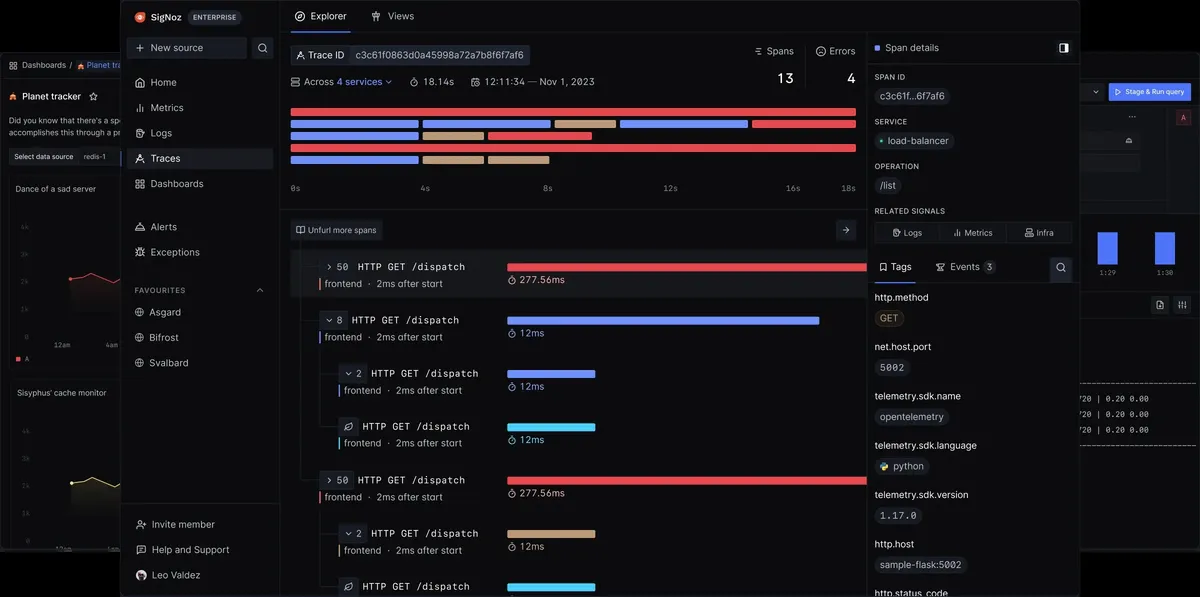
SigNoz: product and architecture
This SigNoz review covers the open-source observability platform that's emerged as the leading OpenTelemetry-native alternative to Datadog, New Relic, and other proprietary SaaS tools. SigNoz offers APM, logs, traces, metrics, exceptions, and alerts in a single application — self-hosted free under Apache 2.0 or available via SigNoz Cloud with usage-based pricing. It's gained traction among teams wanting observability without vendor lock-in. We evaluated it against Datadog, Grafana Cloud, and Honeycomb to answer the real question: is SigNoz good enough to replace your current observability stack, or is it the tool you pair with it?
Overview
SigNoz is a full-stack observability platform sitting at the OpenTelemetry-native end of the Observability & Monitoring category. Unlike metrics-only tools or proprietary agent-based platforms, SigNoz is built from the ground up on OpenTelemetry (OTel) — the CNCF standard for telemetry data. All data (metrics, logs, traces) flows through OTel SDKs and the OTel Collector into ClickHouse, the columnar database that powers SigNoz's storage and query layer.
The platform matters because it's one of the few observability tools offering genuine feature parity with commercial APMs while remaining fully open source. The self-hosted Community Edition is not a crippled teaser — it's the same product SigNoz Cloud runs, minus the managed infrastructure. Target audience includes engineering teams with data-residency constraints, cost-conscious mid-size organizations that have outgrown free tiers but can't justify Datadog Enterprise pricing, and teams already invested in OpenTelemetry who want a backend that treats OTel as first-class rather than converting it to a proprietary format.
Key Features and Architecture
SigNoz's core is the OpenTelemetry-native unified datastore backed by ClickHouse. You send telemetry via the OTel Collector (running as a sidecar, DaemonSet, or gateway), and SigNoz stores metrics, logs, and traces in a columnar format optimized for observability queries. ClickHouse is the same database used by other modern observability platforms for the same reason: it handles billions of events per day on modest hardware.
Correlated logs, metrics, and traces are the signature workflow. From a trace span, you can jump directly to related logs and metrics filtered by the same tags — the kind of cross-signal investigation that requires multiple tools in metrics-and-logs architectures. Flexible deployment means you can run SigNoz entirely self-hosted (Docker Compose, Kubernetes via Helm, or on-prem VMs) with no cloud dependency, or use SigNoz Cloud for managed hosting. End-to-end debugging with Kubernetes, Git, and Jira integration links incidents to code and tickets.
OpenTelemetry semantic conventions support means SigNoz understands the standard OTel attributes (service.name, deployment.environment, http.status_code) without custom mapping — this simplifies SDK migration from other tools. Natural language query interface for dashboard creation is a newer AI-powered feature for building dashboards by describing what you want rather than picking widgets manually. Exceptions tracking handles error grouping similar to Sentry, though with less mature grouping UX.
Ideal Use Cases
Best for:
- Cost-conscious engineering teams that have outgrown free tiers of Datadog, New Relic, or Honeycomb but can't justify the $500-$5,000/month enterprise pricing. Self-hosted SigNoz is free; SigNoz Cloud is meaningfully cheaper than commercial alternatives.
- Teams with data-residency or compliance requirements that rule out SaaS observability. Self-hosted SigNoz on your infrastructure keeps all telemetry on-prem.
- OpenTelemetry-first organizations that want a backend treating OTel as first-class rather than converting to vendor-specific formats. Migration from other OTel-compatible backends is straightforward.
- Mid-size SRE teams (20-200 engineers) where the engineering culture values open-source tools and you have the ops capacity to run self-hosted observability.
- Kubernetes-heavy environments where the SigNoz K8s integration plus OTel Collector as DaemonSet captures container telemetry cleanly.
Not suitable for:
- Small teams without ops capacity — self-hosted SigNoz requires running ClickHouse, the OTel Collector, and SigNoz services. Realistically needs someone who knows Kubernetes or Docker Compose well. SigNoz Cloud removes this friction but costs more.
- Teams needing best-in-category error tracking — Sentry's stack-trace grouping UX is sharper than SigNoz's exceptions feature for error-tracking-specific workflows.
- Organizations valuing polished UX above all — SigNoz's dashboards are functional and improving, but don't match Datadog's visual polish or Grafana's widget ecosystem.
- Teams without OpenTelemetry adoption — without OTel instrumentation, SigNoz's advantage shrinks and you're competing on general-purpose observability UX against established tools.
Pros and Cons
Pros:
- Full feature parity between Community and Cloud — self-hosting doesn't cost you features.
- OpenTelemetry-native architecture means no vendor-specific SDK lock-in.
- Correlated logs, metrics, traces in a single application — the workflow most teams want.
- ClickHouse-backed storage handles high volumes on modest hardware.
- Transparent published pricing for Cloud — $0.30/GB is rare clarity in the category.
- Flexible deployment covers self-hosted, private cloud, and managed options.
Cons:
- Self-hosting is operationally non-trivial — running ClickHouse at scale requires expertise.
- Less polished UX than Datadog or Grafana — dashboards are functional but not inspiring.
- An integration ecosystem that trails commercial alternatives.
- Error tracking UX is weaker than Sentry for error-grouping-specific workflows.
- Community documentation is uneven — deep operational topics (scaling, upgrades) sometimes require reading Slack archives.