Decision comparison
mosec vs Seldon
Choose mosec when efficient single-service inference, Python ergonomics, dynamic batching, and unrestricted Apache-2.0 self-hosting matter most. Choose Seldon when the organization needs Kubernetes-native deployment at enterprise scale, controlled rollout experiments, multi-model capacity management, and auditable production operations, and can procure its commercial production license.
Seldon is now sold under new ownership
TrueFoundry acquired Seldon's business and customers, announced on 15 October 2026. seldon.io now says "Seldon is now TrueFoundry": Seldon's Kubernetes MLOps stack is combined with TrueFoundry's enterprise AI platform, and TrueFoundry sets its commercial terms. Seldon Core keeps its name.
Direct comparison. These are reviewed substitutes bought for the same job, so the differences below are the ones that decide between them.
All 2 are model serving.
Quick Comparison
| Decision factor | mosec | Seldon |
|---|---|---|
| Best For | Python teams serving individual ML models or compact multi-model services that need low-latency, GPU-efficient inference without Kubernetes operations. | Enterprises operating many production ML, GenAI, or composite AI workloads needing Kubernetes governance, traffic experiments, observability, and commercial support. |
| Architecture | Rust asynchronous web and coordination layer driving Python Workers through shared-memory, CPU/GPU/IO pipeline stages and dynamic batching. | Kubernetes-native MLOps and LLMOps framework orchestrating model components as REST/gRPC microservices and Kafka-powered real-time pipelines. |
| Pricing Model | Open source under the Apache-2.0 license; source code at https://github.com/mosecorg/mosec. | Seldon Core 2 is distributed under the Business Source License 1.1, which is not an open source license: it allows copying, modifying, redistributing and non-production use, and non-profit educational institutions may also use it in production. Other production use requires buying a commercial license from Seldon, and each version moves to the Apache License 2.0 four years after its release. Seldon publishes no prices on its website. Verified 2026-10-26 against https://seldon.io/ and https://github.com/SeldonIO/seldon-core, and 2026-11-02 against https://raw.githubusercontent.com/SeldonIO/seldon-core/v2/LICENSE. |
| Ease of Use | Framework-agnostic Python interface, type-annotation validation, generated OpenAPI docs, warmup, and multiple routes reduce model-service implementation work. | Standardizes Kubernetes deployment pipelines, but requires cluster, routing, and operational expertise; enterprise customers receive a migration path through TrueFoundry. |
| Scalability | Improves per-machine throughput through dynamic batching, asynchronous I/O, shared-memory IPC, and separate CPU/GPU pipeline stages; infrastructure scaling is self-managed. | Built for Kubernetes deployment at enterprise scale, with multi-model serving, LRU memory swapping, REST/gRPC endpoints, and cloud-agnostic cluster support. |
| Community/Support | Community-driven Apache-2.0 GitHub project with 904 stars, documentation, Prometheus metrics, and a latest 0.9.8 release dated 2026-10-12. | Enterprise MLOps offering now associated with TrueFoundry; repository has 4,785 stars and published v2.10.2, released 2025-12-19. |
mosec
- Best For:
- Python teams serving individual ML models or compact multi-model services that need low-latency, GPU-efficient inference without Kubernetes operations.
- Architecture:
- Rust asynchronous web and coordination layer driving Python Workers through shared-memory, CPU/GPU/IO pipeline stages and dynamic batching.
- Pricing Model:
- Open source under the Apache-2.0 license; source code at https://github.com/mosecorg/mosec.
- Ease of Use:
- Framework-agnostic Python interface, type-annotation validation, generated OpenAPI docs, warmup, and multiple routes reduce model-service implementation work.
- Scalability:
- Improves per-machine throughput through dynamic batching, asynchronous I/O, shared-memory IPC, and separate CPU/GPU pipeline stages; infrastructure scaling is self-managed.
- Community/Support:
- Community-driven Apache-2.0 GitHub project with 904 stars, documentation, Prometheus metrics, and a latest 0.9.8 release dated 2026-10-12.
Seldon
- Best For:
- Enterprises operating many production ML, GenAI, or composite AI workloads needing Kubernetes governance, traffic experiments, observability, and commercial support.
- Architecture:
- Kubernetes-native MLOps and LLMOps framework orchestrating model components as REST/gRPC microservices and Kafka-powered real-time pipelines.
- Pricing Model:
- Seldon Core 2 is distributed under the Business Source License 1.1, which is not an open source license: it allows copying, modifying, redistributing and non-production use, and non-profit educational institutions may also use it in production. Other production use requires buying a commercial license from Seldon, and each version moves to the Apache License 2.0 four years after its release. Seldon publishes no prices on its website. Verified 2026-10-26 against https://seldon.io/ and https://github.com/SeldonIO/seldon-core, and 2026-11-02 against https://raw.githubusercontent.com/SeldonIO/seldon-core/v2/LICENSE.
- Ease of Use:
- Standardizes Kubernetes deployment pipelines, but requires cluster, routing, and operational expertise; enterprise customers receive a migration path through TrueFoundry.
- Scalability:
- Built for Kubernetes deployment at enterprise scale, with multi-model serving, LRU memory swapping, REST/gRPC endpoints, and cloud-agnostic cluster support.
- Community/Support:
- Enterprise MLOps offering now associated with TrueFoundry; repository has 4,785 stars and published v2.10.2, released 2025-12-19.
Public signals
Verified factual signals only. Bars appear only for like-for-like metrics with five weekly assessments for every tool; missing evidence stays explicit. These signals do not establish enterprise adoption, product quality, or total cost.
| Metric | mosec | Seldon |
|---|---|---|
| GitHub commits, 90d(Product adoption) | 18 | 0 |
| GitHub stars(Product adoption) | 904 | 4,500+ |
| PyPI weekly downloads(Developer adoption) | 478 | Not available |
| Search interest(Market interest) | Not available | 0 |
| Hacker News mentions, 90d(Community interest) | Not available | 0 |
| PyPI weekly downloads(Product adoption) | Not available | 1.4k |
| Stack Overflow questions(Community interest) | Not available | 17 |
As of November 16, 2026 — updated weekly.
Health & risk evidence
Observed public-source checks for mapped package versions and repositories.
mosec
November 16, 2026Package vulnerabilities
PyPI · mosec@0.9.8
0 vulnerabilities
across 1 package
Repository security score
Not available
Seldon
November 16, 2026Package vulnerabilities
PyPI · seldon-core@1.19.0
0 vulnerabilities
across 1 package
Repository security score
Not available
Interface Preview
mosec

Seldon
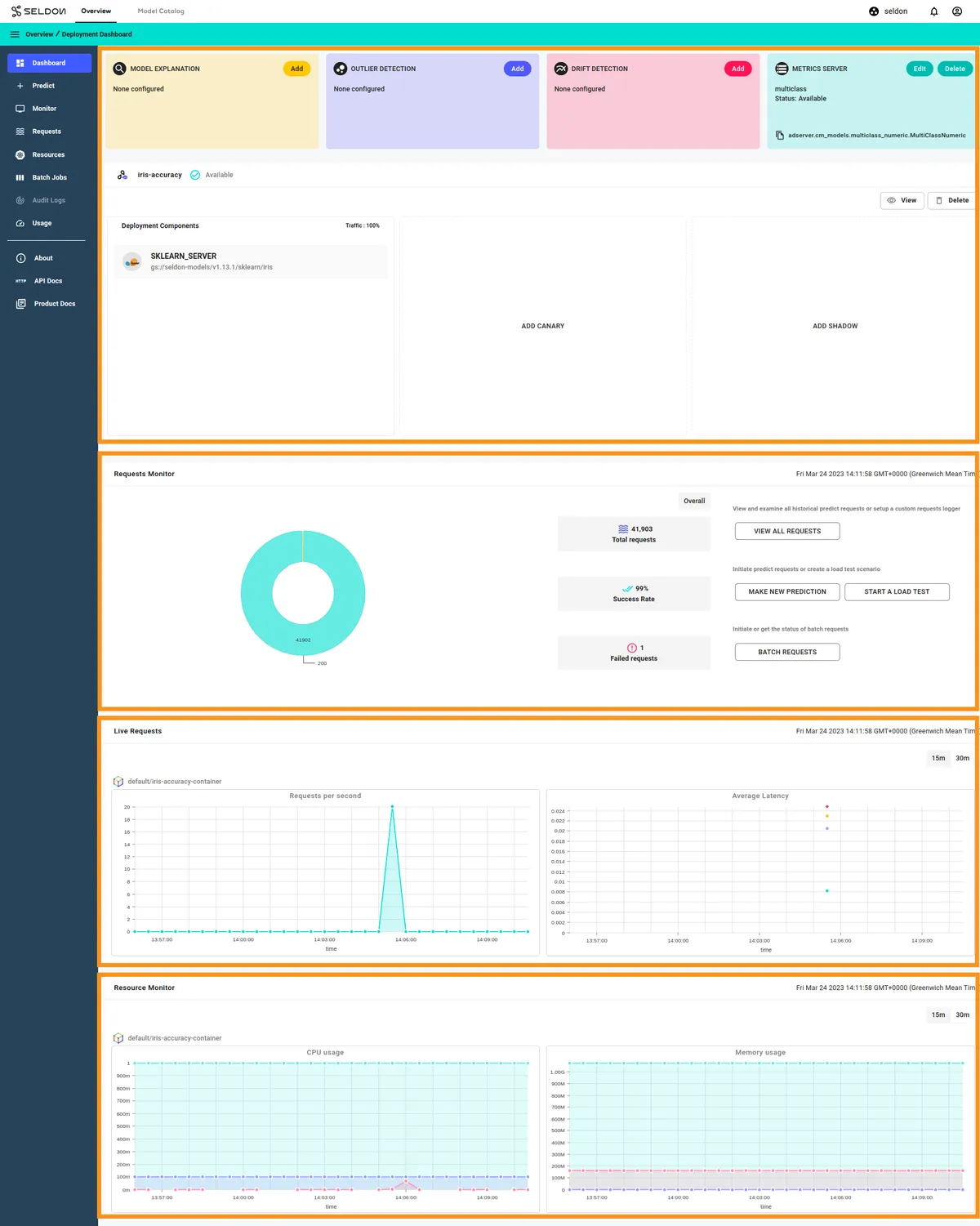
Feature Comparison
| Feature | mosec | Seldon |
|---|---|---|
| Inference execution model | ||
| Request batching | Dynamically aggregates independent requests into inference batches | Routes production traffic through Kubernetes deployment components |
| Compute pipeline design | Separates CPU, GPU, and IO work into pipelined stages | Composes model and processing components as Kubernetes microservices |
| Inter-process communication | Transfers pipeline-stage data through shared-memory IPC | Connects real-time components through Kafka-powered data pipelines |
| Deployment and platform | ||
| Primary deployment model | Runs a Rust web service with Python Workers | Deploys AI systems as Kubernetes-native services |
| Model endpoint protocols | Generates OpenAPI documentation for Worker service routes | Provides REST and gRPC support for model types |
| Infrastructure portability | Self-hosts on infrastructure chosen by the application team | Supports cloud-agnostic and on-premise Kubernetes deployments |
| Production traffic management | ||
| Multi-model serving | Exposes multiple model routes from one service | Consolidates models onto shared inference servers |
| Release experimentation | No A/B or canary routing described | Runs A/B, canary, and multi-armed-bandit traffic experiments |
| Capacity optimization | Uses dynamic batching to raise device utilization | Uses LRU memory swapping for model overcommit |
| Operations and observability | ||
| Metrics integration | Exports Prometheus metrics plus customized application metrics | Supports Prometheus, Grafana, and custom operational dashboards |
| Service readiness | Warms models before declaring the service ready | Standardizes production deployment through Kubernetes-native pipelines |
| Shutdown behavior | Handles SIGINT and SIGTERM with graceful shutdown | Manages deployed components through Kubernetes orchestration |
| Developer experience and governance | ||
| Model authoring interface | Uses framework-agnostic Python code matching offline model usage | Packages models and components for Kubernetes deployment workflows |
| Request validation | Validates requests using Python type annotations | No request type-annotation validation described |
| Explainability and monitoring | Provides metrics hooks but no explainability feature described | Supports outlier detection, explainability, and observable predictions |
Inference execution model
Request batching
Compute pipeline design
Inter-process communication
Deployment and platform
Primary deployment model
Model endpoint protocols
Infrastructure portability
Production traffic management
Multi-model serving
Release experimentation
Capacity optimization
Operations and observability
Metrics integration
Service readiness
Shutdown behavior
Developer experience and governance
Model authoring interface
Request validation
Explainability and monitoring
Which to choose
Choose mosec when efficient single-service inference, Python ergonomics, dynamic batching, and unrestricted Apache-2.0 self-hosting matter most. Choose Seldon when the organization needs Kubernetes-native deployment at enterprise scale, controlled rollout experiments, multi-model capacity management, and auditable production operations, and can procure its commercial production license.
Best-fit scenarios
Choose mosec if:
Choose mosec for a Python-owned inference API, especially when CPU/GPU pipeline utilization, dynamic batching, low operational overhead, and Apache-2.0 self-hosting are priorities. It is particularly suitable when the team can manage its own deployment and does not require built-in Kubernetes traffic experimentation or enterprise model-governance features.
Choose Seldon if:
Choose Seldon for enterprise Kubernetes estates serving many models or AI components across clouds or on-premise infrastructure. It fits teams that need REST/gRPC deployment, canary or A/B releases, Kafka-connected pipelines, prediction auditability, explainability, drift-oriented monitoring, and commercial licensing/support.
These scenarios reflect the available product evidence. Your requirements, existing stack, and team expertise should guide the final decision.
Frequently Asked Questions
What is the main difference between mosec and Seldon?
mosec is an application-level model-serving framework focused on extracting efficient inference from a machine: its Rust asynchronous web layer coordinates Python Workers, dynamic batching, shared-memory IPC, and CPU/GPU/IO pipeline stages. Seldon Core 2 is a Kubernetes-native MLOps and LLMOps platform for deploying and operating AI systems across infrastructure. The practical dividing line is that mosec optimizes a serving service, while Seldon adds enterprise deployment orchestration, traffic routing experiments, real-time observability, and multi-model operational controls.
Which is better for small teams?
For most small teams, mosec is the more direct fit when the goal is to expose one or several Python-backed models as performant APIs. Its framework-agnostic Python interface, model warmup, type-based request validation, generated OpenAPI documentation, and Prometheus metrics reduce service-building work without requiring a Kubernetes platform. Seldon is appropriate for a small team only when it already operates Kubernetes and specifically needs capabilities such as canary releases, A/B testing, Kafka-powered pipelines, or enterprise-grade governance from the beginning.
Can I migrate from mosec to Seldon?
Yes, but it is an architectural migration rather than an in-place configuration change. A mosec deployment centers on Python Workers behind its Rust service layer, with routes, serialization mixins, and pipeline stages defined in the application. Moving to Seldon means packaging the model and its surrounding processing logic as Kubernetes-deployed components, defining REST or gRPC exposure, and configuring the desired routing, observability, and pipeline integrations. Reuse model artifacts and inference logic where possible, but plan to redesign deployment, traffic, and operational configuration.
What are the pricing differences?
mosec is Apache-2.0 open-source software: teams may self-host, copy, modify, and distribute it under that license, and the supplied information identifies no paid edition or vendor rate card. Seldon Core 2 uses the Business Source License 1.1 rather than an open-source license. It permits copying, modification, redistribution, and non-production use; non-profit educational institutions may use it in production, while other production use requires purchasing a commercial Seldon license. Seldon publishes no public prices, and each version converts to Apache License 2.0 four years after release.