Decision comparison
BentoML vs mosec
Choose BentoML when the serving problem includes repeatable packaging, model lifecycle management, distributed LLM deployment, autoscaling, and a possible managed operating path through BentoCloud. Choose mosec when the decisive requirement is extracting efficient dynamic-batched inference from Python models using Rust-backed HTTP coordination and explicit CPU/GPU/I/O pipeline stages.
Direct comparison. These are reviewed substitutes bought for the same job, so the differences below are the ones that decide between them.
All 2 are model serving.
Quick Comparison
| Decision factor | BentoML | mosec |
|---|---|---|
| Best For | Teams packaging, deploying, monitoring, and operating diverse AI applications, LLM services, multi-model pipelines, or inference APIs. | Latency- and throughput-sensitive Python inference APIs needing dynamic batching and efficient mixed CPU, GPU, and I/O pipelines. |
| Architecture | Python unified serving framework with Services, Model Runners, model signatures, a local Model Store, and portable Bento archives. | Python worker interface over a Rust asynchronous web and task-coordination layer, using pipelined stages and shared-memory IPC. |
| Pricing Model | Free and open source | Open source under the Apache-2.0 license; source code at https://github.com/mosecorg/mosec. |
| Ease of Use | Structured Service APIs, model signatures, runners, and bentofile.yaml simplify repeatable packaging, though production configuration has broader platform surface area. | Framework-agnostic Python interface reuses offline model code; type annotations generate validation and OpenAPI documentation for Workers. |
| Scalability | Supports distributed LLM inference, inference-specific autoscaling, configurable per-Service workers and concurrency, plus managed BentoCloud operations. | Dynamic batching combines requests, while CPU/GPU/IO pipeline stages exploit a single machine's available compute resources. |
| Community/Support | Apache-2.0 Python project with 8,935 GitHub stars; BentoCloud provides a managed platform for operating AI applications. | Apache-2.0 Python project with 904 GitHub stars; documentation covers Workers, routes, metrics, and deployment behavior. |
BentoML
- Best For:
- Teams packaging, deploying, monitoring, and operating diverse AI applications, LLM services, multi-model pipelines, or inference APIs.
- Architecture:
- Python unified serving framework with Services, Model Runners, model signatures, a local Model Store, and portable Bento archives.
- Pricing Model:
- Free and open source
- Ease of Use:
- Structured Service APIs, model signatures, runners, and bentofile.yaml simplify repeatable packaging, though production configuration has broader platform surface area.
- Scalability:
- Supports distributed LLM inference, inference-specific autoscaling, configurable per-Service workers and concurrency, plus managed BentoCloud operations.
- Community/Support:
- Apache-2.0 Python project with 8,935 GitHub stars; BentoCloud provides a managed platform for operating AI applications.
mosec
- Best For:
- Latency- and throughput-sensitive Python inference APIs needing dynamic batching and efficient mixed CPU, GPU, and I/O pipelines.
- Architecture:
- Python worker interface over a Rust asynchronous web and task-coordination layer, using pipelined stages and shared-memory IPC.
- Pricing Model:
- Open source under the Apache-2.0 license; source code at https://github.com/mosecorg/mosec.
- Ease of Use:
- Framework-agnostic Python interface reuses offline model code; type annotations generate validation and OpenAPI documentation for Workers.
- Scalability:
- Dynamic batching combines requests, while CPU/GPU/IO pipeline stages exploit a single machine's available compute resources.
- Community/Support:
- Apache-2.0 Python project with 904 GitHub stars; documentation covers Workers, routes, metrics, and deployment behavior.
Public signals
Verified factual signals only. Bars appear only for like-for-like metrics with five weekly assessments for every tool; missing evidence stays explicit. These signals do not establish enterprise adoption, product quality, or total cost.
| Metric | BentoML | mosec |
|---|---|---|
| GitHub commits, 90d(Product adoption) | 13 | 18 |
| GitHub stars(Product adoption) | 8,500+ | 904 |
| PyPI weekly downloads(Product adoption) | 39.6k | Not available |
| Stack Overflow questions(Community interest) | 8 | Not available |
| PyPI weekly downloads(Developer adoption) | Not available | 478 |
As of November 16, 2026 — updated weekly.
Health & risk evidence
Observed public-source checks for mapped package versions and repositories.
BentoML
November 16, 2026Package vulnerabilities
PyPI · bentoml@1.4.40
0 vulnerabilities
across 1 package
Repository security score
Not available
mosec
November 16, 2026Package vulnerabilities
PyPI · mosec@0.9.8
0 vulnerabilities
across 1 package
Repository security score
Not available
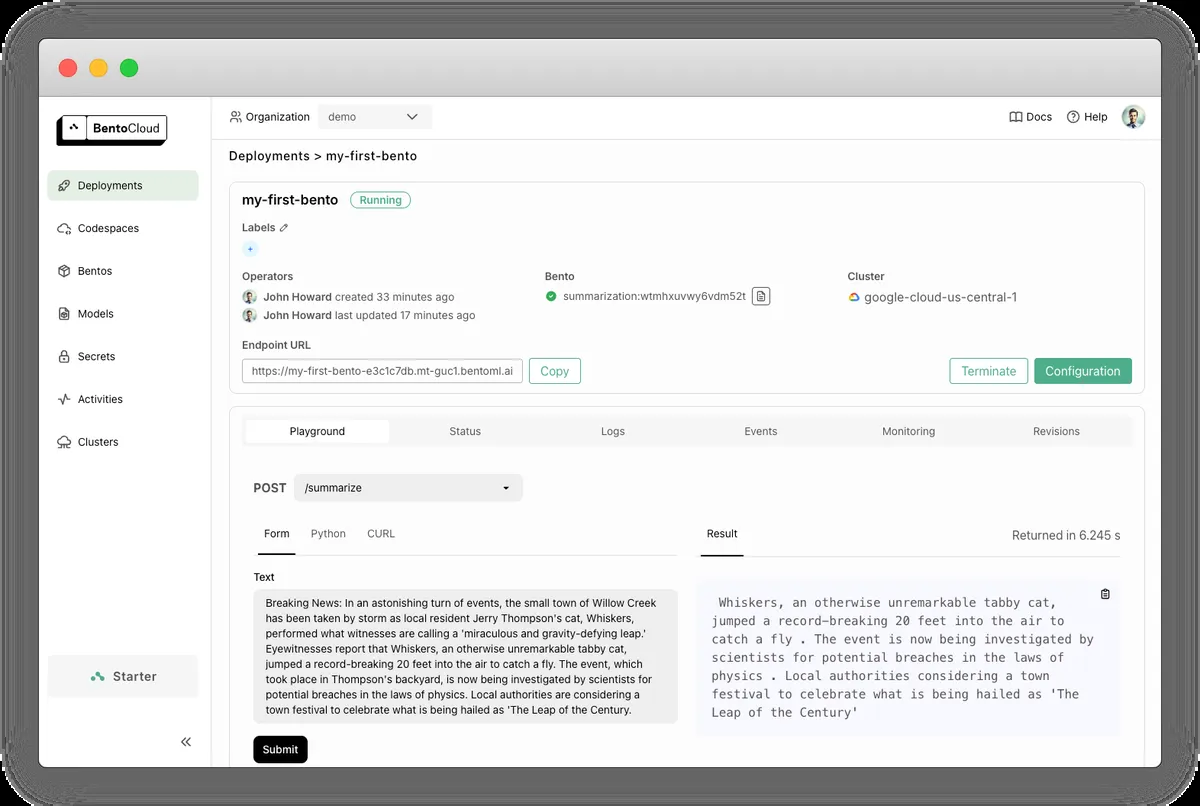
Interface Preview
BentoML
mosec

Feature Comparison
| Feature | BentoML | mosec |
|---|---|---|
| Serving architecture | ||
| Inference execution model | Model Runners encapsulate local model inference behind Services | Python Workers execute within Rust-coordinated serving pipelines |
| API contracts | Model signatures and Service APIs define inference inputs and outputs | Python type annotations validate requests and generate OpenAPI documentation |
| Multi-model service design | Services support AI applications and multi-model pipeline deployment | Multiple routes serve multiple models in one service |
| Performance and batching | ||
| Dynamic request batching | Optimization tooling targets latency, throughput, or cost requirements | Aggregates requests from different users into inference batches |
| Hardware utilization | Advanced tuning optimizes deployment components for available hardware | CPU, GPU, and I/O stages pipeline mixed workloads |
| Low-level serving layer | Python Services configure worker counts and concurrency per deployment | Rust web layer uses async I/O for efficient CPU utilization |
| Packaging and model management | ||
| Application packaging | Bento archives source, models, data, and runtime configuration | Worker-based services are defined through framework-agnostic Python code |
| Build configuration | bentofile.yaml specifies services, labels, included files, and packages | No Bento-style build manifest is described in provided data |
| Model repository | Local Model Store saves, loads, manages, and deletes models | No built-in model store is described in provided data |
| Scaling and operations | ||
| Autoscaling | Inference-specific scaling adapts to demand patterns and model metrics | No autoscaling mechanism is described in provided data |
| Large-model distribution | Distributed LLM inference runs large models across multiple GPUs | CPU/GPU pipeline stages maximize compute within serving machines |
| Lifecycle behavior | BentoCloud streamlines managed deployment and operational workflows | Warms models before readiness and gracefully handles termination signals |
| Observability and extensibility | ||
| Monitoring | Observability monitors inference performance and system health comprehensively | Prometheus metrics support standard and customized service measurements |
| Serialization and process communication | Service APIs specify remote calls with typed input and output formats | Shared-memory IPC and Msgpack or JSON mixins move pipeline data |
| Deployment control | Tailored optimization tunes deployment layers for speed, cost, and quality | Worker routes and pipeline stages tailor execution to application workloads |
Serving architecture
Inference execution model
API contracts
Multi-model service design
Performance and batching
Dynamic request batching
Hardware utilization
Low-level serving layer
Packaging and model management
Application packaging
Build configuration
Model repository
Scaling and operations
Autoscaling
Large-model distribution
Lifecycle behavior
Observability and extensibility
Monitoring
Serialization and process communication
Deployment control
Which to choose
Choose BentoML when the serving problem includes repeatable packaging, model lifecycle management, distributed LLM deployment, autoscaling, and a possible managed operating path through BentoCloud. Choose mosec when the decisive requirement is extracting efficient dynamic-batched inference from Python models using Rust-backed HTTP coordination and explicit CPU/GPU/I/O pipeline stages.
Best-fit scenarios
Choose BentoML if:
Choose BentoML for production AI teams that need portable Bento artifacts, a Model Store, explicit Service contracts, LLM or multi-model deployments, autoscaling, and an optional managed BentoCloud path.
Choose mosec if:
Choose mosec for focused Python model inference APIs where dynamic batching, warmup, Prometheus metrics, Rust async I/O, and CPU/GPU pipeline efficiency matter more than built-in packaging and model management.
These scenarios reflect the available product evidence. Your requirements, existing stack, and team expertise should guide the final decision.
Frequently Asked Questions
What is the main difference between BentoML and mosec?
BentoML is a broader inference application platform. It organizes inference around Services, model signatures, Model Runners, a local Model Store, and Bento archives that package code, models, data, and configuration. It also offers distributed LLM inference, inference-specific autoscaling, and BentoCloud for managed operations. mosec is a more focused high-performance serving framework: Python Workers are served through a Rust asynchronous web layer, with dynamic batching and pipelined CPU, GPU, and I/O stages designed to efficiently use machine resources.
Which is better for small teams?
For a small team shipping one or a few performance-sensitive Python APIs, mosec can be the more direct choice because its framework-agnostic Python interface, request validation, generated OpenAPI documentation, model warmup, and Prometheus metrics concentrate on the serving path. For a small team that must also package models reproducibly, retain deployable artifacts, manage models locally, and later operate multiple AI services, BentoML provides more built-in workflow structure. The deciding factor is whether operational packaging and model management are already needed.
Can I migrate from BentoML to mosec?
Yes, but it is an implementation migration rather than a drop-in deployment change. You would translate BentoML Service APIs and Model Runner logic into mosec Python Workers, recreate input validation with type annotations, and configure routes and pipeline stages for the target models. Bento artifacts, bentofile.yaml build definitions, and Model Store workflows do not have an equivalent described in mosec, so model loading, dependency packaging, and deployment procedures need replacement. Dynamic batching and CPU/GPU stage design should be explicitly benchmarked after migration.
What are the pricing differences?
Both projects ship under the Apache-2.0 license and are free to self-host, so the software license itself has no published dollar charge in the provided data. BentoML additionally offers BentoCloud, a fully managed platform for building and operating AI applications, but no public rate card, tiers, or dollar amounts are provided here. mosec's provided pricing information identifies only its Apache-2.0 open-source repository and does not describe a managed hosted offering. In either case, self-hosting still incurs your own infrastructure, GPU, storage, and operational costs.