Decision comparison
Prefect vs Sling
Prefect and Sling solve different problems in the data pipeline stack. Prefect orchestrates complex Python workflows across systems, while Sling moves data between databases, files, and storage with minimal configuration. Teams often benefit from running both: Sling for ELT data movement and Prefect for orchestrating the broader workflow.
Used together. These are normally used together rather than chosen between. The comparison explains what each one does in the stack.
These are different kinds of product — Workflow Orchestrator and ELT Platform.
Quick Comparison
| Decision factor | Prefect | Sling |
|---|---|---|
| Primary Purpose | Python-native workflow orchestration for data pipelines, ETL/ELT, and ML workflows | ELT data integration between databases, files, and storage systems with streaming architecture |
| Core Language | Python (flows and tasks defined with decorators) | Go core engine with YAML-based configuration for replication definitions |
| Pricing Model | Prefect is open source and self-hostable under Apache 2.0. Prefect Cloud Hobby is free forever, with 2 users, up to 5 deployments, 500 minutes of Prefect Serverless and 7-day run retention. Starter is $100/month for 3 users, up to 20 deployments and 75 hours of Serverless, on your own compute. Team is $100 per user per month for 4 to 8 users, up to 100 deployments and 225 hours of Serverless, with service accounts and a 24-hour audit log. Enterprise is custom. | Free for up to 30 users, Premium at $2.00 per user per month, Business at $4.00 per user per month. Open-source self-hosted available under GPL-3.0 license. |
| Learning Curve | Moderate; Python proficiency required but decorator-based API simplifies adoption | Low; YAML configs and CLI flags get replications running with minimal setup |
| GitHub Stars | 22,209 | 839 |
| User Rating | 8/10 (2 reviews) | 9.2/10 (14 reviews) |
| Latest Release | 3.6.27 (April 2026) | v1.5.15 (April 2026) |
| Best For | Orchestrating complex Python workflows with dynamic DAGs, retries, and cloud observability | Fast database replication, file loading, and ELT operations with minimal configuration |
Prefect
- Primary Purpose:
- Python-native workflow orchestration for data pipelines, ETL/ELT, and ML workflows
- Core Language:
- Python (flows and tasks defined with decorators)
- Pricing Model:
- Prefect is open source and self-hostable under Apache 2.0. Prefect Cloud Hobby is free forever, with 2 users, up to 5 deployments, 500 minutes of Prefect Serverless and 7-day run retention. Starter is $100/month for 3 users, up to 20 deployments and 75 hours of Serverless, on your own compute. Team is $100 per user per month for 4 to 8 users, up to 100 deployments and 225 hours of Serverless, with service accounts and a 24-hour audit log. Enterprise is custom.
- Learning Curve:
- Moderate; Python proficiency required but decorator-based API simplifies adoption
- GitHub Stars:
- 22,209
- User Rating:
- 8/10 (2 reviews)
- Latest Release:
- 3.6.27 (April 2026)
- Best For:
- Orchestrating complex Python workflows with dynamic DAGs, retries, and cloud observability
Sling
- Primary Purpose:
- ELT data integration between databases, files, and storage systems with streaming architecture
- Core Language:
- Go core engine with YAML-based configuration for replication definitions
- Pricing Model:
- Free for up to 30 users, Premium at $2.00 per user per month, Business at $4.00 per user per month. Open-source self-hosted available under GPL-3.0 license.
- Learning Curve:
- Low; YAML configs and CLI flags get replications running with minimal setup
- GitHub Stars:
- 839
- User Rating:
- 9.2/10 (14 reviews)
- Latest Release:
- v1.5.15 (April 2026)
- Best For:
- Fast database replication, file loading, and ELT operations with minimal configuration
Public signals
Verified factual signals only. Bars appear only for like-for-like metrics with five weekly assessments for every tool; missing evidence stays explicit. These signals do not establish enterprise adoption, product quality, or total cost.
| Metric | Prefect | Sling |
|---|---|---|
| Docker Hub pulls(Product adoption) | 224.6M | 17.2k |
| GitHub commits, 90d(Product adoption) | 394 | 180 |
| GitHub stars(Product adoption) | 23,000+ | 906 |
| Search interest(Market interest) | 0 | 1 |
| Hacker News mentions, 90d(Community interest) | 1 | Not available |
| Product Hunt comments(Community interest) | 0 | Not available |
| Product Hunt rating(Community interest) | 5.0/5 | Not available |
| Product Hunt reviews(Community interest) | 3 | Not available |
| Product Hunt votes(Community interest) | 5 | Not available |
| PyPI weekly downloads(Product adoption) | 1.6M | 40.3k |
| Stack Overflow questions(Community interest) | 212 | Not available |
As of September 21, 2026 — updated weekly.
Health & risk evidence
Observed public-source checks for mapped package versions and repositories.
Prefect
September 21, 2026Package vulnerabilities
PyPI · prefect@3.8.6
0 vulnerabilities
across 1 package
Repository security score
github.com/PrefectHQ/prefect
6.9/10
Sling
September 21, 2026Package vulnerabilities
PyPI · sling@1.6.3
0 vulnerabilities
across 1 package
Repository security score
github.com/slingdata-io/sling-cli
3.8/10
Interface Preview
Prefect

Sling
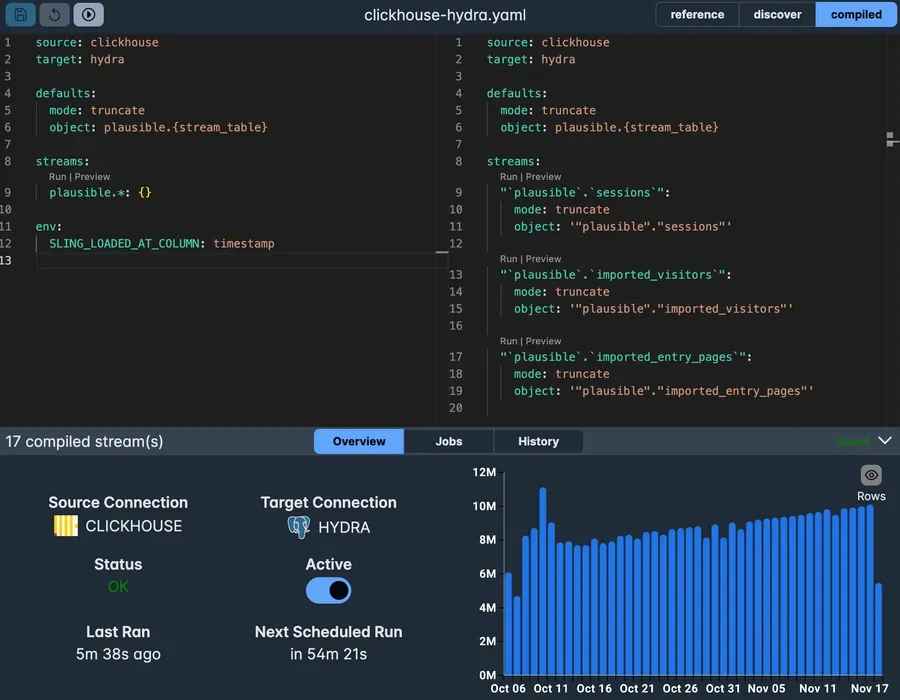
Feature Comparison
| Feature | Prefect | Sling |
|---|---|---|
| Core Capabilities | ||
| Workflow Orchestration | Full workflow orchestration with dynamic DAG engine, retries, scheduling, and dependency management across tasks and flows | Pipelines and hooks for creating workflows with HTTP requests, SQL queries, and file operations triggered before or after replications |
| Data Movement | Delegates data movement to external tools via integrations for dbt, Kubernetes, Docker, and custom Python tasks | Native data replication from source databases, files, or SaaS connections to destination databases or files using streaming architecture |
| Configuration Approach | Python-first design where flows and tasks are defined with decorators; one decorator turns any Python function into a workflow | YAML-based configuration for defining replications with default values, naming patterns, and runtime variables |
| Data Integration | ||
| Database Connectivity | Connects to databases through Python libraries and community integrations; no built-in database connectors | Native connectors for PostgreSQL, MySQL, Oracle, Snowflake, BigQuery, Redshift, Clickhouse, Databricks, DuckDB, and more |
| File and Storage Support | File operations handled through custom Python tasks or third-party library integrations within flows | Loads CSV, Parquet, JSON, and Excel files directly into warehouses; supports AWS S3, GCS, Azure Blob, SFTP, and FTP |
| API Data Extraction | API calls implemented as Python tasks within flows using any HTTP library; full programmatic control over pagination and auth | YAML-based API specifications with built-in pagination, authentication, and incremental sync for services like Stripe, HubSpot, and GitHub |
| Performance and Reliability | ||
| Execution Architecture | Hybrid execution model with autoscaling workers that run locally or on Kubernetes; cloud control plane manages scheduling | Go-based streaming engine that holds minimal data in memory for efficient processing without loading entire datasets |
| Parallelism | Concurrent task execution within flows using Python async or Prefect's built-in task runners for parallel processing | Parallel stream runs process multiple replication streams simultaneously with automatic retries for failed operations |
| Error Handling | Built-in retry mechanisms with configurable retry counts, delays, and exponential backoff on task and flow levels | Automatic retries for failed stream operations with stream chunking to break large datasets into manageable partitions |
| Observability and Monitoring | ||
| Monitoring Interface | Prefect Cloud dashboard with full observability for flow runs, task states, logs, and debugging across all deployments | Platform UI with historical logs showing rows and bytes transferred, duration, status, and execution details per job |
| Alerting | Cloud-based notifications and automations triggered by flow run state changes, failures, or custom conditions | Email, Slack, and MS Teams alerting on Standard plan and above for error, warning, or success conditions |
| Data Quality Checks | No built-in data quality framework; teams integrate external tools like Great Expectations within Python flows | Built-in quality checks with automatic alerts for schema or data deviations plus custom check definitions for consistency |
| Enterprise and Operations | ||
| Self-Hosting | Full self-hosted deployment under Apache-2.0 license with zero vendor lock-in; Prefect Cloud available for managed operations | CLI is free and open-source under GPL-3.0; Platform self-hosting available on the Advanced plan at $249/mo |
| Schema Management | No native schema management; schema handling delegated to downstream tools within orchestrated workflows | Schema evolution auto-detects changes and updates target schemas; schema migration handles PKs, FKs, indexes, and constraints on Advanced plan |
| Change Data Capture | CDC implemented through custom Python code or by orchestrating CDC tools like Debezium within flows | Native CDC replicates row-level inserts, updates, and deletes by reading the database transaction log on Advanced plan |
Core Capabilities
Workflow Orchestration
Data Movement
Configuration Approach
Data Integration
Database Connectivity
File and Storage Support
API Data Extraction
Performance and Reliability
Execution Architecture
Parallelism
Error Handling
Observability and Monitoring
Monitoring Interface
Alerting
Data Quality Checks
Enterprise and Operations
Self-Hosting
Schema Management
Change Data Capture
How they fit together
Prefect and Sling solve different problems in the data pipeline stack. Prefect orchestrates complex Python workflows across systems, while Sling moves data between databases, files, and storage with minimal configuration. Teams often benefit from running both: Sling for ELT data movement and Prefect for orchestrating the broader workflow.
What each one handles
Use Prefect for:
We recommend Prefect for teams that need to orchestrate complex, multi-step data pipelines that go beyond simple data movement. Prefect excels when your workflows involve coordinating tasks across multiple systems, running ML training jobs, triggering dbt transformations, deploying containers on Kubernetes, and managing dependencies between interdependent processes. Its Python-native design with decorator-based flows means any existing Python function can become an orchestrated task with retries, scheduling, and observability. Prefect Cloud provides enterprise-grade features including autoscaling workers, enterprise SSO, SOC 2 Type II compliance, and 99.99% uptime SLA without requiring you to manage orchestration infrastructure. With 22,209 GitHub stars and an active release cadence at version 3.6.27, Prefect has established itself as a mature orchestration platform for Python-centric data teams.
Use Sling for:
We recommend Sling for teams that need fast, reliable data movement between databases, files, and cloud storage systems without building custom ETL scripts. Sling's Go-based streaming engine processes data efficiently with minimal memory usage, handling database replication, file-to-warehouse loading, and cloud storage sync through simple YAML configurations or CLI commands. The tool supports a wide range of connectors including PostgreSQL, MySQL, Snowflake, BigQuery, Redshift, and cloud storage providers like S3, GCS, and Azure Blob. Built-in features like incremental loading, schema evolution, parallel streams, and automatic retries make it production-ready with minimal effort. The free CLI covers most use cases, while the Platform at $99 per month adds a web UI, parallel stream runs, alerting, and scheduled jobs. With a 9.2 out of 10 user rating across 14 reviews and endorsements from teams using it alongside Dagster, Sling delivers practical ELT results with remarkably low operational overhead.
These roles reflect the available product evidence. Most teams run both; which one owns a given job depends on your stack and team.
Frequently Asked Questions
Can Prefect and Sling be used together in a data pipeline?
Prefect and Sling complement each other well in production data pipelines. Prefect serves as the orchestration layer that schedules, monitors, and coordinates the overall workflow, while Sling handles the actual data movement between sources and destinations. In practice, a Prefect flow can trigger Sling CLI commands to replicate data from production databases to analytics warehouses, then proceed to run dbt transformations, quality checks, and downstream notifications. Prefect's retry mechanisms and observability wrap around Sling's data replication, giving teams full visibility into both the orchestration state and data movement results. Sling's integration with Dagster demonstrates this pattern, and the same approach works with Prefect by calling Sling CLI commands within Python tasks.
How do the open-source licenses differ between Prefect and Sling?
Prefect uses the Apache-2.0 license, which is highly permissive and allows commercial use, modification, and distribution without requiring derivative works to use the same license. This means teams can self-host Prefect, modify its source code, and incorporate it into proprietary systems without licensing restrictions. Sling CLI uses the GPL-3.0 license, which requires that any modifications to the source code be released under the same GPL-3.0 terms. The GPL-3.0 license does not restrict using Sling as a standalone tool in commercial environments, but it does impose copyleft obligations on modifications to Sling's own code. Both tools offer commercial managed platforms: Prefect Cloud and the Sling Platform, which provide additional features beyond what the open-source versions include.
What are the pricing differences between Prefect Cloud and the Sling Platform?
Prefect offers its open-source server under the Apache-2.0 license at no cost for self-hosted deployments, with Prefect Cloud and enterprise plans available by contacting sales for pricing. Sling provides a free CLI tool for all data movement operations, while the Sling Platform offers three tiers: Free at $0 with core features including incremental mode, wildcard selection, and a smart editor; Standard at $99 per month (or $91 per month billed yearly) adding alerting, API sources, parallel streams, transforms, pipelines, hooks, and one production agent; and Advanced at $249 per month (or $228 per month billed yearly) adding platform self-hosting, Git integration, CDC, schema migration, user roles, audit logs, observability, and three or more production agents. The pricing models differ fundamentally: Sling charges per platform subscription while Prefect Cloud pricing is based on infrastructure usage and deployment scale.
Which tool is better for teams without Python expertise?
Sling is the better choice for teams without Python expertise. Its configuration is entirely YAML-based, meaning teams define source connections, destination targets, load modes, and transformations in declarative YAML files without writing any code. The Sling CLI accepts simple command-line flags for one-off replications, and the Platform provides a web-based editor for building and testing configurations visually. Prefect, by contrast, is explicitly Python-native. Every flow and task is defined in Python using decorators, and leveraging Prefect's full capabilities requires understanding Python concepts like async functions, type annotations, and library integrations. While Prefect's decorator-based API lowers the barrier compared to other Python orchestrators, it still requires a development team comfortable writing and maintaining Python code in production.