Decision comparison
Qdrant vs Redis Vector Search
Qdrant is a database built to do vector search; Redis is a database you probably already run that can also do it. That difference decides most of this comparison. Qdrant gives retrieval its own system, its own memory and its own failure domain, with filtering applied inside the search. Redis gives you vector search for the cost of an index, with no new deployment to stand up — and with your retrieval index sharing memory and uptime with your cache.
Direct comparison. These are reviewed substitutes bought for the same job, so the differences below are the ones that decide between them.
All 2 are vector databases.
Quick Comparison
| Decision factor | Qdrant | Redis Vector Search |
|---|---|---|
| What it is | A purpose-built vector database written in Rust, with its own storage and index layer | Vector search inside Redis, indexing embeddings stored on hashes or JSON documents |
| Marginal cost of adoption | A new system to deploy, monitor and back up, even though a single binary makes that easy | Close to zero if Redis is already running: an index and a query pattern rather than a platform |
| Filtering | Payload filters applied inside the search, so narrow filters keep their recall | Redis query syntax combined with vector similarity, over fields on the same document |
| Memory profile | Quantisation and on-disk indexes let large collections exceed RAM | Memory-first by design; a large index competes with whatever else the instance holds |
| Deployment | Single binary, Docker, Kubernetes with a Helm chart, or Qdrant Cloud on AWS, GCP and Azure | Wherever Redis already runs — self-hosted, Docker, Kubernetes, or a managed Redis service |
| Non-vector workloads | None; it does one job | Sessions, caches, queues and rate limiters sit in the same instance |
| Pricing model | Free Tier free, $1 (no specific tier mentioned) | Vector search ships inside Redis itself, which from Redis 8 is licensed under your choice of RSALv2, SSPLv1 or AGPLv3, so self-hosting is free. The distributed build is sold as Redis Cloud and Redis Enterprise Software. |
Qdrant
- What it is:
- A purpose-built vector database written in Rust, with its own storage and index layer
- Marginal cost of adoption:
- A new system to deploy, monitor and back up, even though a single binary makes that easy
- Filtering:
- Payload filters applied inside the search, so narrow filters keep their recall
- Memory profile:
- Quantisation and on-disk indexes let large collections exceed RAM
- Deployment:
- Single binary, Docker, Kubernetes with a Helm chart, or Qdrant Cloud on AWS, GCP and Azure
- Non-vector workloads:
- None; it does one job
- Pricing model:
- Free Tier free, $1 (no specific tier mentioned)
Redis Vector Search
- What it is:
- Vector search inside Redis, indexing embeddings stored on hashes or JSON documents
- Marginal cost of adoption:
- Close to zero if Redis is already running: an index and a query pattern rather than a platform
- Filtering:
- Redis query syntax combined with vector similarity, over fields on the same document
- Memory profile:
- Memory-first by design; a large index competes with whatever else the instance holds
- Deployment:
- Wherever Redis already runs — self-hosted, Docker, Kubernetes, or a managed Redis service
- Non-vector workloads:
- Sessions, caches, queues and rate limiters sit in the same instance
- Pricing model:
- Vector search ships inside Redis itself, which from Redis 8 is licensed under your choice of RSALv2, SSPLv1 or AGPLv3, so self-hosting is free. The distributed build is sold as Redis Cloud and Redis Enterprise Software.
Public signals
Verified factual signals only. Bars appear only for like-for-like metrics with five weekly assessments for every tool; missing evidence stays explicit. These signals do not establish enterprise adoption, product quality, or total cost.
| Metric | Qdrant | Redis Vector Search |
|---|---|---|
| Docker Hub pulls(Product adoption) | 46.6M | Not available |
| GitHub commits, 90d(Product adoption) | 754 | 549 |
| GitHub stars(Product adoption) | 34,000+ | 6,000+ |
| Search interest(Market interest) | 3 | Unavailable |
| Hacker News mentions, 90d(Community interest) | 8 | 0 |
| Hugging Face downloads(Product adoption) | 3.9M | Not available |
| Hugging Face likes(Product adoption) | 69 | Not available |
| npm weekly downloads(Developer adoption) | 601.6k | Not available |
| PyPI weekly downloads(Developer adoption) | 2.7M | 384.3k |
| Stack Overflow questions(Community interest) | 60 | Not available |
As of September 21, 2026 — updated weekly.
Health & risk evidence
Observed public-source checks for mapped package versions and repositories.
Qdrant
September 21, 2026Package vulnerabilities
npm · @qdrant/js-client-rest@1.19.0 · PyPI · qdrant-client@1.19.1
0 vulnerabilities
across 2 packages
Repository security score
Not available
Redis Vector Search
September 21, 2026Package vulnerabilities
PyPI · redisvl@0.27.2
0 vulnerabilities
across 1 package
Repository security score
Not available
Interface Preview
Qdrant
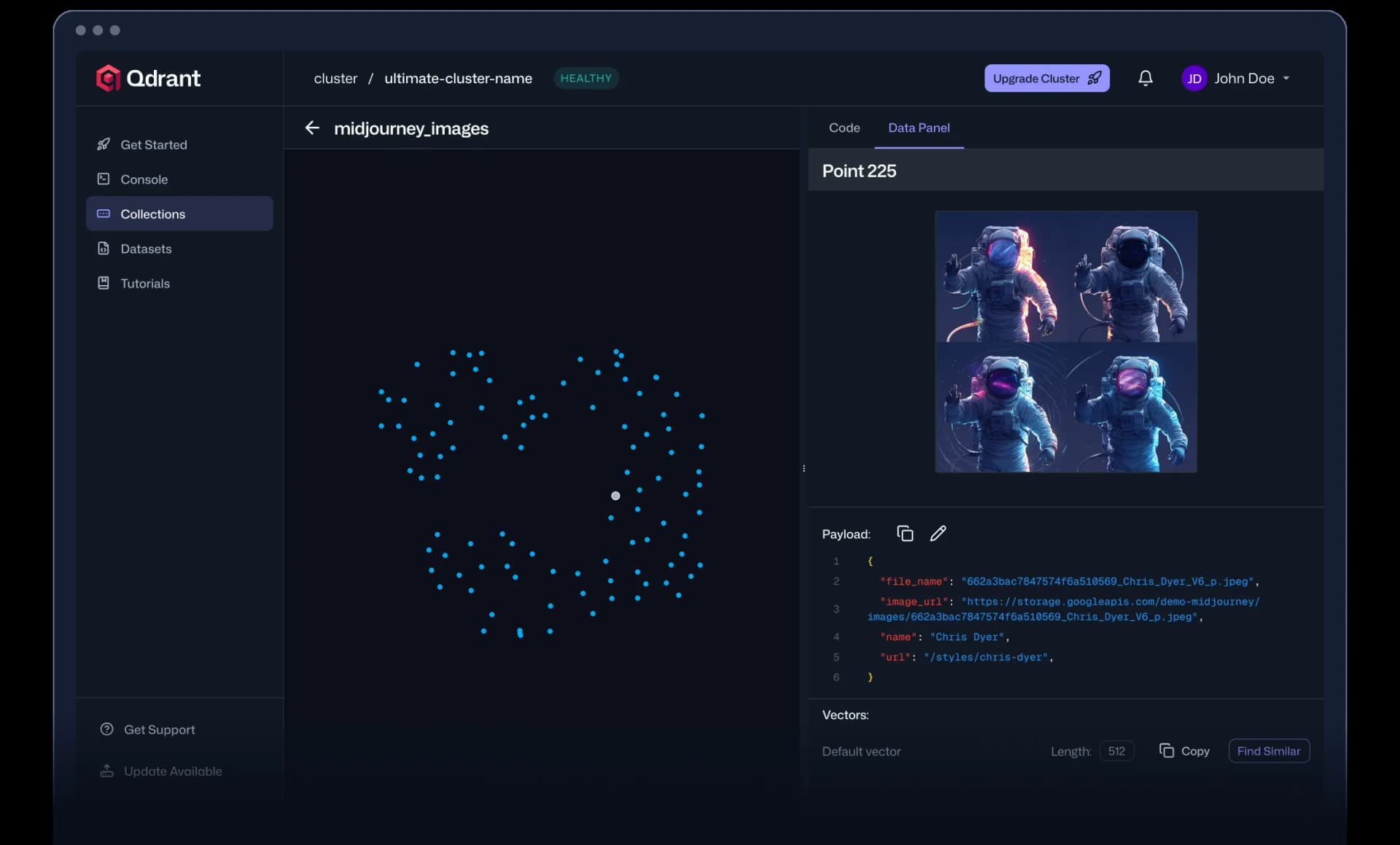
Feature Comparison
| Feature | Qdrant | Redis Vector Search |
|---|---|---|
| Search | ||
| Approximate nearest-neighbour search | Full support | Full support |
| Filtered vector search | Full support | Full support |
| Hybrid keyword and vector search | Full support | Partial support |
| Multi-vector records | Full support | Partial support |
| Scale | ||
| Quantisation to cut memory | Full support | Full support |
| On-disk index beyond RAM | Full support | Partial support |
| Horizontal sharding | Full support | Full support |
| Replication and failover | Full support | Full support |
| Operations | ||
| Runs without adding a system | Not verified | Full support |
| Isolated failure domain for retrieval | Full support | Not verified |
| First-party managed cloud | Full support | Full support |
| Kubernetes deployment | Full support | Full support |
| Ecosystem | ||
| Python and JavaScript clients | Full support | Full support |
| REST and gRPC APIs | Full support | Partial support |
| RAG framework integrations | Full support | Full support |
| Open-source licence | Full support | Full support |
Search
Approximate nearest-neighbour search
Filtered vector search
Hybrid keyword and vector search
Multi-vector records
Scale
Quantisation to cut memory
On-disk index beyond RAM
Horizontal sharding
Replication and failover
Operations
Runs without adding a system
Isolated failure domain for retrieval
First-party managed cloud
Kubernetes deployment
Ecosystem
Python and JavaScript clients
REST and gRPC APIs
RAG framework integrations
Open-source licence
Which to choose
Qdrant is a database built to do vector search; Redis is a database you probably already run that can also do it. That difference decides most of this comparison. Qdrant gives retrieval its own system, its own memory and its own failure domain, with filtering applied inside the search. Redis gives you vector search for the cost of an index, with no new deployment to stand up — and with your retrieval index sharing memory and uptime with your cache.
Best-fit scenarios
Choose Qdrant if:
Choose Qdrant when retrieval deserves its own system. A dedicated engine means the index does not compete with your cache for memory, a retrieval incident does not take sessions down with it, and filtering behaviour under narrow predicates is a design concern rather than a happy accident. It runs as a single binary for evaluation and on Kubernetes for production, so the operational cost is real but modest.
Choose Redis Vector Search if:
Choose Redis Vector when Redis is already in production and the corpus is modest. Adding an index to data you already store avoids a second system to deploy, monitor, secure, back up and carry a pager for, and the team already knows how to operate it. For retrieval that supports a product rather than constituting it, that saving usually outweighs the architectural tidiness of a dedicated store.
These scenarios reflect the available product evidence. Your requirements, existing stack, and team expertise should guide the final decision.
Frequently Asked Questions
Is a dedicated vector database worth the extra system?
It depends on what retrieval is for. If it powers a search box on a documentation site or a recommendation slot on a page, the marginal value over an index in Redis is small and the marginal cost of a second system is real — deployment, monitoring, backups, on-call. If retrieval quality is what your product competes on, or the corpus is large enough that index memory would squeeze your cache, a dedicated store starts paying for itself quickly.
What happens when the index outgrows memory?
Redis is memory-first, so a large vector index has a direct RAM cost and competes with everything else on the instance; quantisation helps and is worth enabling early. Qdrant supports quantisation as well as keeping indexes on disk, so a collection can exceed available RAM with a latency cost rather than a hard limit. If you expect to pass tens of millions of vectors, model that boundary before you pick.
Does sharing an instance with the cache actually cause problems?
It can, and the failure is usually gradual rather than dramatic. A growing retrieval index consumes memory that eviction would otherwise reclaim for cached values, so cache hit rates fall and unrelated latency rises before anyone connects it to the search feature. Separating them removes that coupling. Whether it is worth a second system depends on how much headroom your Redis instance has today.
How do the filtering models differ?
Qdrant applies payload filters during index traversal, so a query restricted to a small slice of the collection still finds good neighbours within it. Redis combines vector similarity with its own query syntax over fields on the same document, which covers a lot of ground. If your queries routinely filter to a narrow subset, write a few representative ones and measure recall rather than reasoning from the documentation.
Can we start in Redis and move later?
Yes, and it is a common and sensible sequence. Embeddings are portable, so a migration is an export, a re-upload and a rebuilt index, plus the query code around it. Starting in Redis costs you almost nothing and teaches you the real access pattern; moving when the pattern justifies it is cheaper than operating a dedicated store for a year before you needed one.