Decision comparison
Weaviate vs Qdrant
Both Weaviate and Qdrant are production-grade open-source vector databases with hybrid search, multi-tenancy, and enterprise compliance. Weaviate provides a more integrated AI application platform with built-in vectorizers and RAG, while Qdrant delivers superior raw search performance through its Rust engine and advanced quantization.
Direct comparison. These are reviewed substitutes bought for the same job, so the differences below are the ones that decide between them.
All 2 are vector databases.
Quick Comparison
| Decision factor | Weaviate | Qdrant |
|---|---|---|
| Search Capabilities | Built-in hybrid search combining vector and BM25 keyword search with configurable alpha weighting for result blending | Native hybrid search supporting dense and sparse vectors with BM25, SPLADE++, and miniCOIL for advanced retrieval |
| Pricing | Open source for self-hosting; Weaviate Cloud Free is always $0/month. Flex starts at $45/month (monthly pay-as-you-go); Premium starts at $400/month (prepaid). Flex and Premium minimums include the baseline cluster, vector dimensions, and storage; backups are additional. | Free Tier free, $1 (no specific tier mentioned) |
| Performance Architecture | Go-based engine with HNSW indexing and rotational quantization (RQ-8) achieving 4x memory reduction on vectors | Rust-based engine with SIMD optimization, custom Gridstore storage, and quantization reducing memory usage by up to 64x |
| Deployment Options | Managed cloud on GCP (AWS coming), self-hosted via Docker or Kubernetes, with RBAC, SOC 2, and HIPAA compliance | Managed cloud on AWS/GCP/Azure, Hybrid Cloud, Private Cloud, Edge (Beta), with SOC 2 and HIPAA compliance |
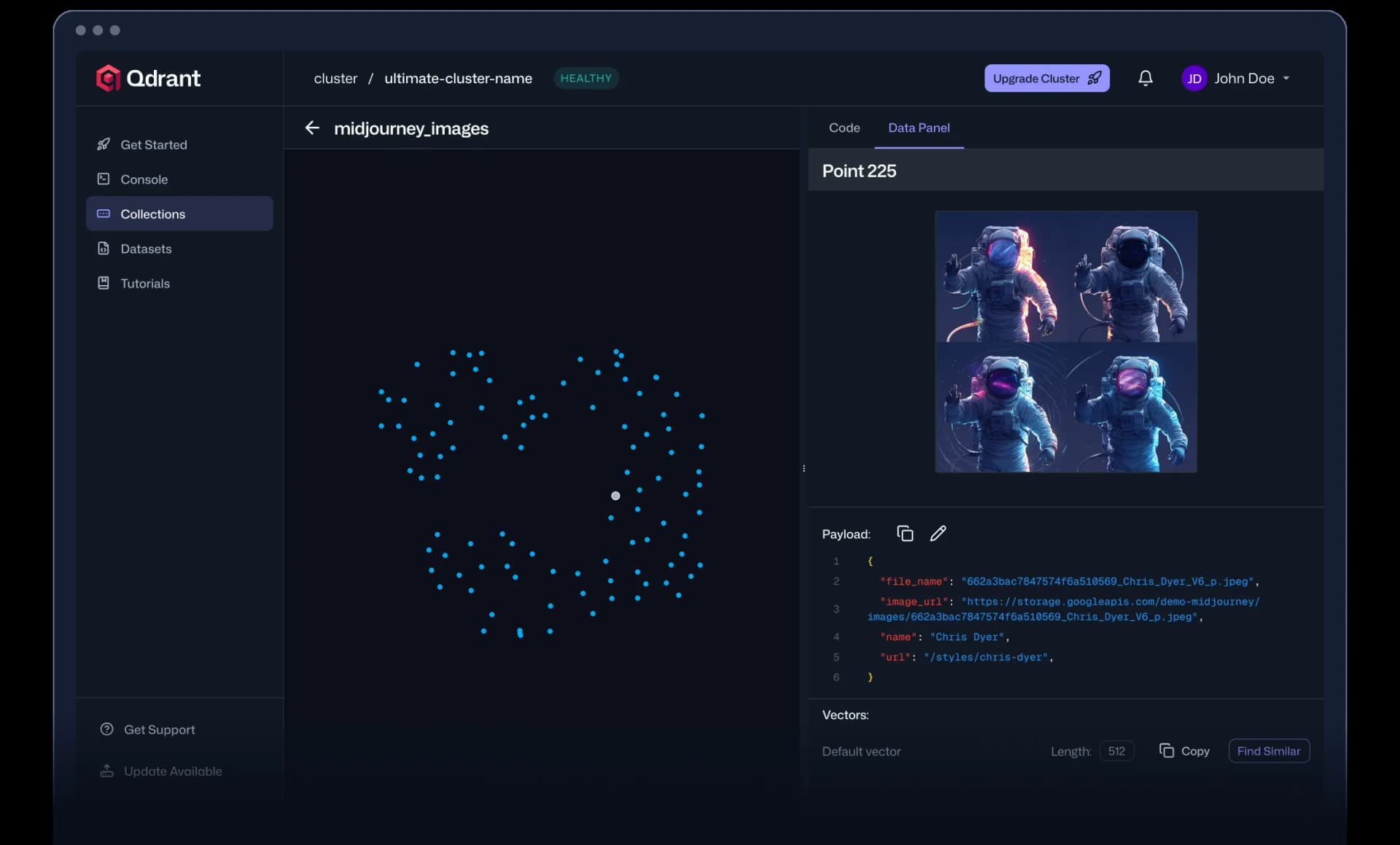
| Developer Experience | SDKs for Python, Go, TypeScript, JavaScript with GraphQL and REST APIs plus 20+ ML model ecosystem integrations | Official clients for Python, JavaScript, and more with REST and gRPC APIs plus built-in Web UI for visual exploration |
| Community & Ecosystem | Over 50,000 community members, 20+ ecosystem integrations for ML models, built-in vectorizer modules and Database Agents | Over 33,000 GitHub stars with 60,000+ community members, Apache-2.0 licensed, native Cloud Inference for embeddings |
Weaviate
- Search Capabilities:
- Built-in hybrid search combining vector and BM25 keyword search with configurable alpha weighting for result blending
- Pricing:
- Open source for self-hosting; Weaviate Cloud Free is always $0/month. Flex starts at $45/month (monthly pay-as-you-go); Premium starts at $400/month (prepaid). Flex and Premium minimums include the baseline cluster, vector dimensions, and storage; backups are additional.
- Performance Architecture:
- Go-based engine with HNSW indexing and rotational quantization (RQ-8) achieving 4x memory reduction on vectors
- Deployment Options:
- Managed cloud on GCP (AWS coming), self-hosted via Docker or Kubernetes, with RBAC, SOC 2, and HIPAA compliance
- Developer Experience:
- SDKs for Python, Go, TypeScript, JavaScript with GraphQL and REST APIs plus 20+ ML model ecosystem integrations
- Community & Ecosystem:
- Over 50,000 community members, 20+ ecosystem integrations for ML models, built-in vectorizer modules and Database Agents
Qdrant
- Search Capabilities:
- Native hybrid search supporting dense and sparse vectors with BM25, SPLADE++, and miniCOIL for advanced retrieval
- Pricing:
- Free Tier free, $1 (no specific tier mentioned)
- Performance Architecture:
- Rust-based engine with SIMD optimization, custom Gridstore storage, and quantization reducing memory usage by up to 64x
- Deployment Options:
- Managed cloud on AWS/GCP/Azure, Hybrid Cloud, Private Cloud, Edge (Beta), with SOC 2 and HIPAA compliance
- Developer Experience:
- Official clients for Python, JavaScript, and more with REST and gRPC APIs plus built-in Web UI for visual exploration
- Community & Ecosystem:
- Over 33,000 GitHub stars with 60,000+ community members, Apache-2.0 licensed, native Cloud Inference for embeddings
Public signals
Verified factual signals only. Bars appear only for like-for-like metrics with five weekly assessments for every tool; missing evidence stays explicit. These signals do not establish enterprise adoption, product quality, or total cost.
| Metric | Weaviate | Qdrant |
|---|---|---|
| Docker Hub pulls(Product adoption) | 22.1M | 46.6M |
| GitHub commits, 90d(Product adoption) | 3.6k | 754 |
| GitHub stars(Product adoption) | 16,000+ | 34,000+ |
| Search interest(Market interest) | 1 | 3 |
| Hacker News mentions, 90d(Community interest) | 3 | 8 |
| Hugging Face downloads(Product adoption) | 231 | 3.9M |
| Hugging Face likes(Product adoption) | 13 | 69 |
| npm weekly downloads(Developer adoption) | 264.5k | 601.6k |
| Product Hunt comments(Community interest) | 4 | Not available |
| Product Hunt rating(Community interest) | 4.9/5 | Not available |
| Product Hunt reviews(Community interest) | 13 | Not available |
| Product Hunt votes(Community interest) | 12 | Not available |
| PyPI weekly downloads(Developer adoption) | 3.2M | 2.7M |
| Stack Overflow questions(Community interest) | 160 | 60 |
As of September 21, 2026 — updated weekly.
Health & risk evidence
Observed public-source checks for mapped package versions and repositories.
Weaviate
September 21, 2026Package vulnerabilities
npm · weaviate-client@3.14.0 · PyPI · weaviate-client@4.23.1
0 vulnerabilities
across 2 packages
Repository security score
Not available
Qdrant
September 21, 2026Package vulnerabilities
npm · @qdrant/js-client-rest@1.19.0 · PyPI · qdrant-client@1.19.1
0 vulnerabilities
across 2 packages
Repository security score
Not available
Interface Preview
Weaviate
Qdrant
Feature Comparison
| Feature | Weaviate | Qdrant |
|---|---|---|
| Search & Retrieval | ||
| Hybrid Search | Merges vector and BM25 keyword search with configurable alpha parameter for blending | Combines dense and sparse vectors supporting BM25, SPLADE++, and miniCOIL retrieval methods |
| Filtering | Advanced filtering applied across large datasets in milliseconds with post-search filtering | One-stage filtering applied during HNSW traversal with no pre- or post-filtering overhead |
| Reranking | Built-in re-ranking of results from merged search algorithms within hybrid search pipeline | Full-spectrum reranking with score boosting, ColBERT late interaction, and MMR diversification |
| Data Management | ||
| Multi-tenancy | Native multi-tenancy with strict tenant isolation for horizontal scaling and resource efficiency | Multitenancy with granular RBAC and vector-scoped API keys for access control per tenant |
| Vector Storage | HNSW graph index with rotational quantization (RQ-8) providing 4x memory reduction | Custom Gridstore engine with asymmetric, scalar, and binary quantization for up to 64x memory reduction |
| Real-time Indexing | Dynamic indexing that adapts to workload with automated scaling and compression | Vectors become searchable the moment they are added without rebuilding the entire index |
| APIs & Integrations | ||
| API Protocols | GraphQL and REST APIs with language-agnostic SDKs for Python, Go, TypeScript, and JavaScript | REST and gRPC APIs with official client libraries for Python, JavaScript, and additional languages |
| ML Model Integration | 20+ built-in vectorizer modules for automatic embedding generation from popular ML models | Native Cloud Inference for text and image embeddings directly in Qdrant Cloud without separate pipelines |
| Framework Support | Built-in RAG capabilities and Database Agents that interact with and improve data automatically | LangChain integration with QdrantVectorStore class supporting dense, sparse, and hybrid retrieval |
| Deployment & Operations | ||
| Cloud Deployment | Managed cloud on shared or dedicated infrastructure with GCP available and AWS coming soon | Managed cloud on AWS, GCP, and Azure with auto-sharding and high availability built in |
| Self-Hosted | Open-source deployment via Docker, Kubernetes, or bare metal with no storage or query limits | Open-source Apache-2.0 licensed deployment via Docker or Kubernetes Helm chart with full features |
| Backup & Recovery | Configurable backups with zero downtime: 7-day retention on Flex, 45-day on Premium tier | Backups and point-in-time restore with zero-downtime upgrades across all deployment models |
| Security & Compliance | ||
| Authentication | RBAC on all tiers with SSO/SAML available on Premium plans for enterprise identity management | SSO via SAML/OIDC with granular RBAC and vector-scoped API keys for fine-grained access |
| Compliance | SOC 2 certified with HIPAA compliance available on Premium tier for healthcare workloads | SOC 2 and HIPAA compliant with GDPR-aligned options and private networking for data residency |
| Data Isolation | Tenant isolation with BYOC (Bring Your Own Cloud) on Premium for data residency requirements | Private Cloud with air-gapped deployments and Hybrid Cloud with decoupled control and data planes |
Search & Retrieval
Hybrid Search
Filtering
Reranking
Data Management
Multi-tenancy
Vector Storage
Real-time Indexing
APIs & Integrations
API Protocols
ML Model Integration
Framework Support
Deployment & Operations
Cloud Deployment
Self-Hosted
Backup & Recovery
Security & Compliance
Authentication
Compliance
Data Isolation
Which to choose
Both Weaviate and Qdrant are production-grade open-source vector databases with hybrid search, multi-tenancy, and enterprise compliance. Weaviate provides a more integrated AI application platform with built-in vectorizers and RAG, while Qdrant delivers superior raw search performance through its Rust engine and advanced quantization.
Best-fit scenarios
Choose Weaviate if:
Choose Weaviate if you want an all-in-one AI application platform that handles embedding generation, hybrid search, and RAG out of the box. Weaviate's 20+ built-in vectorizer modules eliminate the need for separate embedding pipelines, and its Database Agents automate data management tasks. The Flex plan at $45/mo provides a clear, predictable entry point for production workloads. Teams building RAG applications or semantic search features benefit from Weaviate's integrated approach, which reduces the number of moving parts in your AI infrastructure stack.
Choose Qdrant if:
Choose Qdrant if raw search performance and memory efficiency are your top priorities. Qdrant's Rust-based engine with SIMD optimization and custom Gridstore storage delivers high query throughput, while its quantization techniques reduce memory usage by up to 64x. The free forever 1GB cloud cluster provides a permanent development environment, and the broader cloud provider support (AWS, GCP, Azure) gives you more deployment flexibility. Teams handling billions of vectors or requiring edge deployment benefit from Qdrant's performance-first architecture and the Edge (Beta) deployment option.
These scenarios reflect the available product evidence. Your requirements, existing stack, and team expertise should guide the final decision.
Frequently Asked Questions
What are the main architectural differences between Weaviate and Qdrant?
Weaviate is built in Go and positions itself as an AI-native application platform with built-in vectorizer modules, RAG capabilities, and Database Agents. It uses HNSW graph indexing with rotational quantization (RQ-8) for 4x memory reduction and offers GraphQL alongside REST APIs. Qdrant is built entirely in Rust with SIMD optimization and a custom storage engine called Gridstore. It focuses on raw search performance with one-stage filtering during HNSW traversal and supports asymmetric, scalar, and binary quantization for up to 64x memory reduction. Qdrant provides gRPC and REST APIs; test the protocol and client behavior required by your application.
How do Weaviate and Qdrant pricing models compare for production use?
Weaviate's managed cloud starts at a $45/mo minimum on the Flex plan (pay-as-you-go) with usage-based billing for vector dimensions, storage, and backups. Premium starts at $400/mo with dedicated infrastructure and 99.95% SLA. Qdrant Cloud offers a free forever 1GB cluster for development and testing, with usage-based pricing for production workloads and enterprise plans available through sales contact. Both platforms offer free open-source self-hosted options with no licensing costs, though infrastructure and maintenance expenses apply.
Which vector database has better hybrid search capabilities?
Both databases support hybrid search, but their implementations differ. Weaviate combines vector search with BM25 keyword search using a configurable alpha parameter that lets you control the blend between semantic and keyword results. Qdrant supports hybrid search across dense and sparse vectors with support for BM25, SPLADE++, and miniCOIL retrieval methods, giving you more retrieval algorithm options. Qdrant also adds full-spectrum reranking with score boosting, ColBERT late interaction models, and Maximum Marginal Relevance (MMR) for result diversification, making its retrieval pipeline more configurable for advanced use cases.
Can both Weaviate and Qdrant handle enterprise-scale deployments with compliance requirements?
Both databases support enterprise-grade deployments with SOC 2 and HIPAA compliance. Weaviate offers RBAC on all tiers, SSO/SAML on Premium, and a BYOC (Bring Your Own Cloud) option for data residency. Its Premium plan provides 99.95% uptime SLA with phone and Slack support. Qdrant provides SSO via SAML/OIDC, granular RBAC with vector-scoped API keys, GDPR-aligned options, and private networking. Qdrant also offers a Private Cloud option with air-gapped deployments and Hybrid Cloud with decoupled control and data planes, giving organizations more flexible options for meeting strict data sovereignty and compliance requirements.