Buying snapshot
Scroll sideways to see all columns. With a keyboard, focus this table and use the arrow keys.
| Decision point | What digna states |
|---|---|
Where it runs | Inside your own infrastructure, on-premises or in a private cloud. digna's documentation says no module needs external services or SaaS. |
Where data is checked | In the source database by default. Per database connection you can choose the digna Engine instead, which exports the data and profiles it inside digna. |
Modules | Data Anomalies, Data Analytics, Data Validation, Timeliness and Schema Tracker. Release 2026.11 adds Data Reconciliation and digna Agentic, both beta. Each module is licensed separately. |
Server you provide | Linux (Ubuntu 22.04+, Debian 12+ or RHEL 9 family), x86_64 or arm64, 16 GB RAM and 10 GB disk at minimum, PostgreSQL 12+ for digna's metrics and a web server. 32 GB RAM and 50 GB disk if PostgreSQL shares the machine. Windows and macOS have their own guides. |
Databases | TimescaleDB, Teradata, Snowflake, SAP HANA, PostgreSQL, Oracle, Netezza, Apache Hive, Apache Impala, Databricks, MariaDB, MS SQL Server and MySQL. |
Alerts and sign-in | Alerts to Slack, Microsoft Teams, Jira Software, Zapier, webhooks and email. Single sign-on with Microsoft Entra ID, OpenID, SAML or Google. |
Scripting | An official Python SDK, digna-sdk, published on GitHub. |
Licence | A licence file from digna with your customer details and an expiry date. Release 2026.11 needs a new one. |
Our take
Shortlist digna if your data must stay in your own data center or private cloud and you have many warehouse tables to watch; digna lists finance, healthcare, telecom and the public sector among the sectors it serves. If you want a vendor-hosted service with nothing to install, it is the wrong fit.
Evaluate digna
Comparisons
Where it stands out
Data stays where it is. Checks run in your database by default and the platform runs on your hosts, so the data being checked does not go to a vendor service.
No rule for every table to start. Data Anomalies learns normal behaviour without manual setup, and Timeliness learns when each load usually arrives, so you can cover many tables before you write rules.
Checking more often costs nothing extra. There are no fees per scan, API call or alert, so the bill follows modules and tables, not how often checks run.
A public reference at scale. digna says ITSV uses it to check the timeliness and freshness of around 50 GB a day from 30 sources in 500 structures.
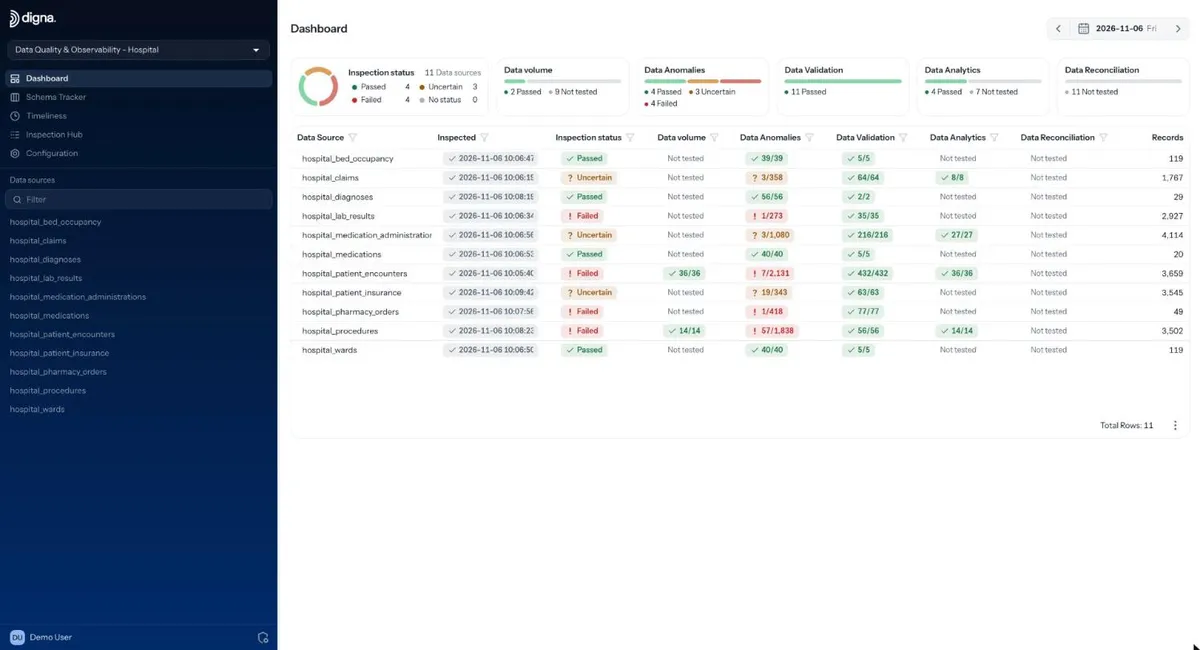
Product screenshot
Trade-offs to weigh
You run it. You provide and upgrade the server, the PostgreSQL database for digna's metrics and the web server, and install a new licence file when a release needs one, as 2026.11 does.
Two of the newest modules are beta. Data Reconciliation (exact or AI-learned source-to-target rules) and digna Agentic (an MCP server for Claude and other AI agents) are beta in 2026.11. Test them on your own data before you depend on them.
Each module adds to the bill. Every module has its own base fee and price per table, so size cost on the modules and table count you expect to reach, not only the first module.
Pricing and plan conditions
digna is priced by module: each module has a base fee plus a price per activated table, and you pay only for the tables you activate in that module. The first module unlocks the platform with no separate platform fee, and the scheduler, data catalog, all integrations and team collaboration come with it. There are no fees per API call, scan, inspection or alert.
Public signals
About these signals
Verified factual signals from public sources. They indicate observable activity or interest, not total adoption, product quality, or cost.
14 GitHub commits 90d0 GitHub stars0 vulnerabilities across 1 package
See all signals from 4 sources
PyPI · digna-sdk@1.0.1
Alternatives to digna
The reviewed substitutes for digna among the data observability, and what would make each one the better answer.
Direct alternatives
Reviewed substitutes: products bought for the same job, where a team picks one.
- Acceldata
- Acceldata and digna both run data quality checks, anomaly detection and reconciliation where the data lives: Acceldata's Pushdown engine delegates compute to the data source, and digna profiles in the source database by default. Acceldata adds pipeline, Hadoop and AI observability on its xLake platform with a customer-managed control plane; digna runs only on-premises or in a private cloud and is priced per module and per activated table.Applies to: Choosing a data quality and observability platform that runs checks where the data lives, in hybrid or on-premises estates.
- Anomalo
- Anomalo and digna both learn the normal behaviour of warehouse tables with machine learning and flag anomalies without a hand-written rule for each table. Anomalo runs in the customer's VPC or as SaaS; digna runs only on-premises or in the customer's private cloud and checks data in the source database by default.Applies to: Choosing a machine-learning data quality monitor for warehouse tables, including where it must run.
- Bigeye
- Bigeye and digna both monitor warehouse tables for anomalies and data quality issues. Bigeye is delivered as SaaS, with an optional agent in the customer's network, and adds lineage and AI governance modules; digna runs only on-premises or in a private cloud and is priced per module and per activated table.Applies to: Choosing a data observability platform for warehouse tables when deployment model and per-table pricing matter.
- Monte Carlo
- Monte Carlo and digna both detect freshness, volume and schema problems in warehouse data from learned baselines. Monte Carlo is a hosted platform bought as credits, with a data collector agent that can run in the customer's cloud; digna runs only on-premises or in a private cloud and charges a base fee plus a price per table for each module.Applies to: Choosing the data observability platform for a warehouse, hosted or self-hosted.