Decision comparison
Anomalo vs digna
Anomalo and digna both learn what normal data looks like and flag deviations without a hand-written rule for every table. The deciding question is where the product may run. Anomalo gives a choice between the customer's VPC and its SaaS, and it is moving towards AI agents and unstructured data. digna has one answer: your own hosts, with checks inside your database by default and a price set by modules and activated tables rather than by how often checks run.
Direct comparison. These are reviewed substitutes bought for the same job, so the differences below are the ones that decide between them.
All 2 are data observability.
Quick Comparison
| Decision factor | Anomalo | digna |
|---|---|---|
| Best for | Enterprises that want machine-learning checks on the content of their tables, including semi-structured and unstructured data, with a choice of running in their own VPC or as SaaS. Anomalo now presents itself as an autonomous data system for the agentic enterprise: five agents are live, among them Table Observability, Data Quality and the conversational analytics agent AIDA, and four more are listed as coming soon. | Teams whose data must stay in their own data center or private cloud and who have many warehouse tables to watch. digna lists finance, healthcare, telecommunications and the public sector among the sectors it serves. It runs only inside the customer's infrastructure and, by default, calculates its metrics inside the monitored database, so the data being checked stays where it is. |
| Where it runs | Fully in the customer's VPC or as SaaS. Anomalo says a customer can bring its own model or use Anomalo's, and that data never has to leave the customer's environment. It states SOC 2 Type II, GDPR and HIPAA compliance and includes dedicated customer success support for deployment. | Only on the customer's own hosts, on-premises or in a private cloud: digna's documentation says no module needs external services or SaaS. The server runs on Linux (Ubuntu 22.04+, Debian 12+ or the RHEL 9 family, x86_64 or arm64), Windows or macOS, needs at least 16 GB RAM and stores its metrics in PostgreSQL 12 or higher. digna supplies a licence file with an expiration date, and release 2026.11 needs a new one. |
| How it finds problems | Anomalo builds machine-learning models per dataset to find statistically significant deviations. Its Table Observability Agent watches data availability, freshness and schema consistency, and its Data Quality Agent lets a team describe good data in natural language, with no code and no SQL. The Data Insights Agent reports what changed, why it likely happened, which data is affected and what action to consider. | Data Anomalies learns the normal volume, distributions and value patterns of each table with no manual rule setup, and Timeliness combines learned arrival times with user-defined schedules to flag late, missing or early loads. Data Validation adds record-level rules (exact values, ranges, thresholds, reference lists) with an audit trail, and Schema Tracker reports added, removed or renamed columns and data type changes. |
| Data sources | Anomalo lists native integrations with cloud data lakes, warehouses and ETL tools, plus Unstructured Data Monitoring for documents. A chief data and analytics officer quoted on its site uses it across a petabyte-scale cloud warehouse. | TimescaleDB, Teradata, Snowflake, SAP HANA, PostgreSQL, Oracle, Netezza, Apache Hive, Apache Impala, Databricks, MariaDB, MS SQL Server and MySQL. Checks run inside the source database by default; per connection, the digna Engine can instead export the data and profile it on the digna host, which also allows referential integrity checks between different database technologies. |
| Alerts, sign-in and AI agents | Single sign-on through SAML with Okta, Google, Microsoft Entra ID and other identity providers. Findings arrive in an AI-curated feed, globally or on the table page, and optionally in Slack or email. A Data Issue First Responder Agent that follows runbooks and opens ServiceNow or Jira workflows is listed as coming soon. | Alerts go to Slack, Microsoft Teams, Jira Software, Zapier, webhooks and email, and single sign-on works with Microsoft Entra ID, OpenID, SAML or Google. Release 2026.11 adds digna Agentic (beta), an MCP server through which Claude and other AI agents can manage projects, rules and schedules and read inspection results down to a single check. |
| Pricing | Anomalo publishes no prices on its website. It runs fully in the customer's VPC or as SaaS, can use the customer's own model, and includes dedicated customer success support. Verified 2026-10-26 against https://www.anomalo.com/. | Quote-based modular subscription: each module has a base fee plus a price per activated table. The first module unlocks the platform, with no separate platform fee. No charges per API call, scan or alert. The pricing page lists no amounts; the vendor states there is no free tier or free trial and evaluation starts with a demo. Official pricing page checked November 11, 2026. |
Anomalo
- Best for:
- Enterprises that want machine-learning checks on the content of their tables, including semi-structured and unstructured data, with a choice of running in their own VPC or as SaaS. Anomalo now presents itself as an autonomous data system for the agentic enterprise: five agents are live, among them Table Observability, Data Quality and the conversational analytics agent AIDA, and four more are listed as coming soon.
- Where it runs:
- Fully in the customer's VPC or as SaaS. Anomalo says a customer can bring its own model or use Anomalo's, and that data never has to leave the customer's environment. It states SOC 2 Type II, GDPR and HIPAA compliance and includes dedicated customer success support for deployment.
- How it finds problems:
- Anomalo builds machine-learning models per dataset to find statistically significant deviations. Its Table Observability Agent watches data availability, freshness and schema consistency, and its Data Quality Agent lets a team describe good data in natural language, with no code and no SQL. The Data Insights Agent reports what changed, why it likely happened, which data is affected and what action to consider.
- Data sources:
- Anomalo lists native integrations with cloud data lakes, warehouses and ETL tools, plus Unstructured Data Monitoring for documents. A chief data and analytics officer quoted on its site uses it across a petabyte-scale cloud warehouse.
- Alerts, sign-in and AI agents:
- Single sign-on through SAML with Okta, Google, Microsoft Entra ID and other identity providers. Findings arrive in an AI-curated feed, globally or on the table page, and optionally in Slack or email. A Data Issue First Responder Agent that follows runbooks and opens ServiceNow or Jira workflows is listed as coming soon.
- Pricing:
- Anomalo publishes no prices on its website. It runs fully in the customer's VPC or as SaaS, can use the customer's own model, and includes dedicated customer success support. Verified 2026-10-26 against https://www.anomalo.com/.
digna
- Best for:
- Teams whose data must stay in their own data center or private cloud and who have many warehouse tables to watch. digna lists finance, healthcare, telecommunications and the public sector among the sectors it serves. It runs only inside the customer's infrastructure and, by default, calculates its metrics inside the monitored database, so the data being checked stays where it is.
- Where it runs:
- Only on the customer's own hosts, on-premises or in a private cloud: digna's documentation says no module needs external services or SaaS. The server runs on Linux (Ubuntu 22.04+, Debian 12+ or the RHEL 9 family, x86_64 or arm64), Windows or macOS, needs at least 16 GB RAM and stores its metrics in PostgreSQL 12 or higher. digna supplies a licence file with an expiration date, and release 2026.11 needs a new one.
- How it finds problems:
- Data Anomalies learns the normal volume, distributions and value patterns of each table with no manual rule setup, and Timeliness combines learned arrival times with user-defined schedules to flag late, missing or early loads. Data Validation adds record-level rules (exact values, ranges, thresholds, reference lists) with an audit trail, and Schema Tracker reports added, removed or renamed columns and data type changes.
- Data sources:
- TimescaleDB, Teradata, Snowflake, SAP HANA, PostgreSQL, Oracle, Netezza, Apache Hive, Apache Impala, Databricks, MariaDB, MS SQL Server and MySQL. Checks run inside the source database by default; per connection, the digna Engine can instead export the data and profile it on the digna host, which also allows referential integrity checks between different database technologies.
- Alerts, sign-in and AI agents:
- Alerts go to Slack, Microsoft Teams, Jira Software, Zapier, webhooks and email, and single sign-on works with Microsoft Entra ID, OpenID, SAML or Google. Release 2026.11 adds digna Agentic (beta), an MCP server through which Claude and other AI agents can manage projects, rules and schedules and read inspection results down to a single check.
- Pricing:
- Quote-based modular subscription: each module has a base fee plus a price per activated table. The first module unlocks the platform, with no separate platform fee. No charges per API call, scan or alert. The pricing page lists no amounts; the vendor states there is no free tier or free trial and evaluation starts with a demo. Official pricing page checked November 11, 2026.
Public signals
Verified factual signals only. Bars appear only for like-for-like metrics with five weekly assessments for every tool; missing evidence stays explicit. These signals do not establish enterprise adoption, product quality, or total cost.
| Metric | Anomalo | digna |
|---|---|---|
| Product Hunt comments(Community interest) | 19 | Not available |
| Product Hunt reviews(Community interest) | 0 | Not available |
| Product Hunt votes(Community interest) | 225 | Not available |
| PyPI weekly downloads(Developer adoption) | 24.5k | 23 |
| GitHub commits, 90d(Developer adoption) | Not available | 14 |
| GitHub stars(Developer adoption) | Not available | 0 |
| Hacker News mentions, 90d(Community interest) | Not available | 0 |
As of November 16, 2026 — updated weekly.
Health & risk evidence
Observed public-source checks for mapped package versions and repositories.
Anomalo
November 16, 2026Package vulnerabilities
PyPI · anomalo@0.57.3
0 vulnerabilities
across 1 package
Repository security score
Not available
digna
November 16, 2026Package vulnerabilities
PyPI · digna-sdk@1.0.1
0 vulnerabilities
across 1 package
Repository security score
Not available
Interface Preview
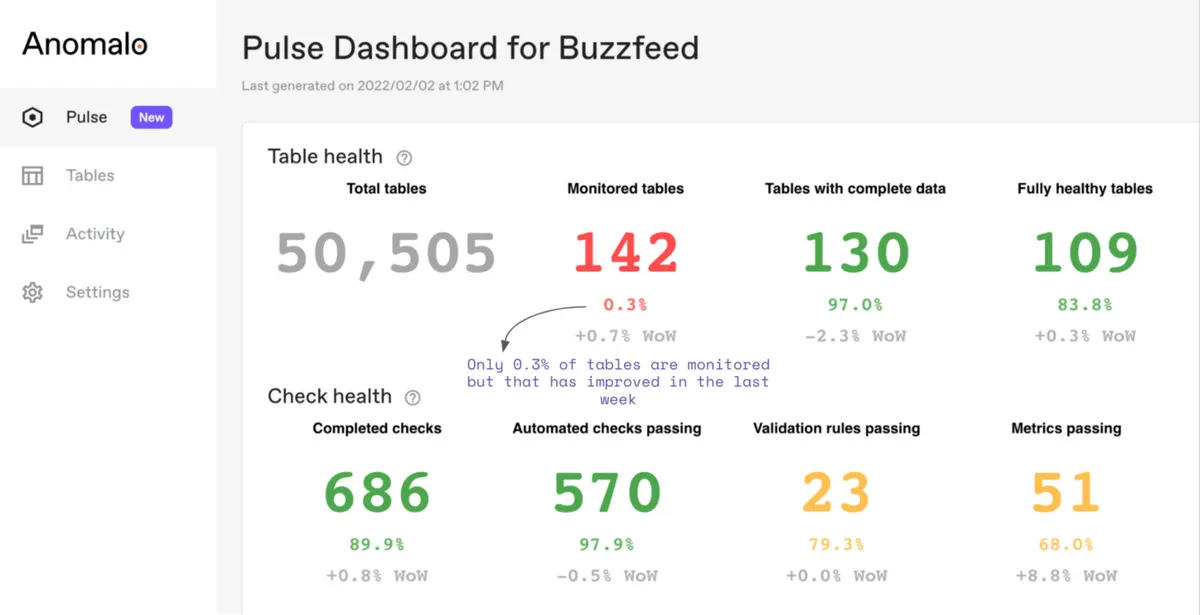
Anomalo
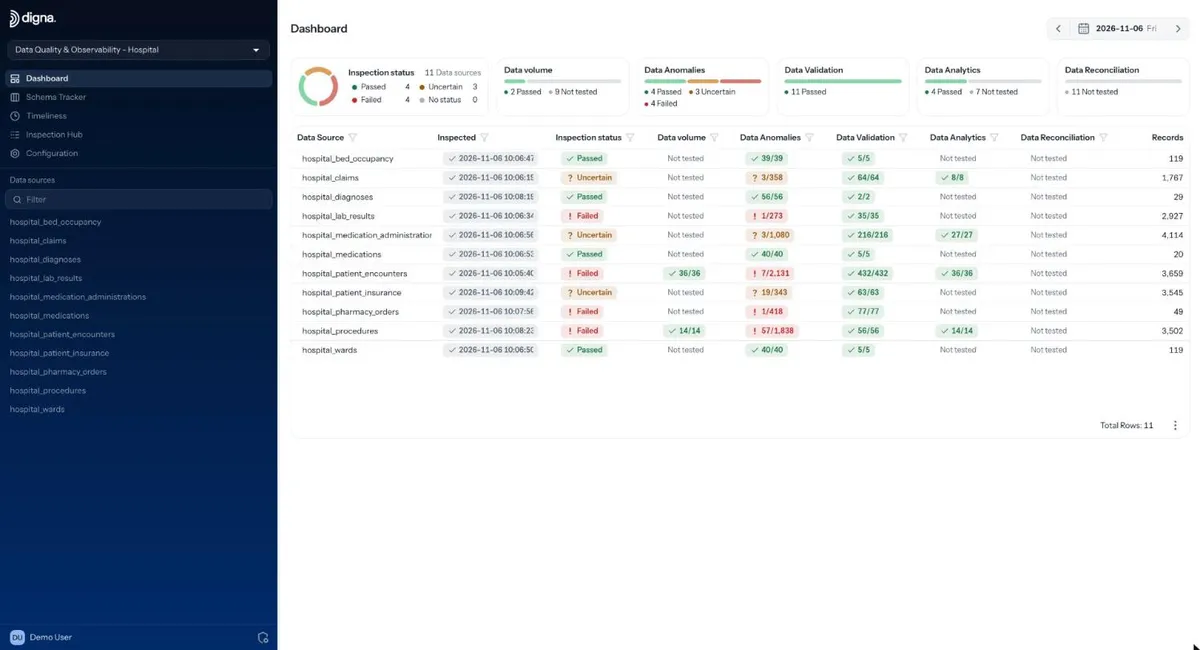
digna
Feature Comparison
| Feature | Anomalo | digna |
|---|---|---|
| Deployment and data handling | ||
| Deployment options | Customer VPC or SaaS | On-premises or customer private cloud; digna's documentation says no module needs SaaS |
| Where the data stays | Anomalo says data never has to leave the customer's environment | Checks run inside the source database by default; the optional digna Engine profiles exported data on the digna host |
| AI model | Bring your own model or use Anomalo's | Baselines learned per table inside the Data Anomalies and Timeliness modules |
| Stated compliance | SOC 2 Type II, GDPR and HIPAA | Runs inside your infrastructure; digna says it never accesses your data |
| Monitoring | ||
| Anomaly detection | Machine-learning models per dataset across structured, semi-structured and unstructured data | Data Anomalies learns each table's normal volume, distributions and value patterns with no manual rules |
| Freshness and late loads | Table Observability Agent watches availability and freshness | Timeliness combines learned arrival times with schedules to flag late, missing or early loads |
| Business rules | Data Quality Agent: describe good data in natural language, with no code or SQL | Data Validation: record-level rules (exact values, ranges, thresholds, reference lists) with an audit trail |
| Schema changes | Schema consistency checks in the Table Observability Agent | Schema Tracker reports added, removed or renamed columns and data type changes |
| Source-to-target checks | Automated lineage shows quality along the flow from source to destination | Data Reconciliation (beta in 2026.11) compares a target with its sources using exact or AI-learned rules |
| Workflow, access and buying | ||
| AI agents | Five live agents, including AIDA for conversational analytics; four more listed as coming soon | MCP server for Claude and other AI agents (beta in 2026.11) |
| Alert destinations | AI-curated insights feed, optionally Slack or email | Slack, Microsoft Teams, Jira Software, Zapier, webhooks and email |
| Single sign-on | Okta, Google, Microsoft Entra ID and others through SAML | Microsoft Entra ID, OpenID, SAML and Google |
| Time to first results | Anomalo states: connect your data in minutes, first insights in 24 hours | An ITSV manager is quoted: installed, connected to Netezza and inspecting data within two hours |
| Pricing basis | Prices given on request; dedicated customer success support included | Base fee plus a price per activated table, per module; no fees per scan, API call or alert |
Deployment and data handling
Deployment options
Where the data stays
AI model
Stated compliance
Monitoring
Anomaly detection
Freshness and late loads
Business rules
Schema changes
Source-to-target checks
Workflow, access and buying
AI agents
Alert destinations
Single sign-on
Time to first results
Pricing basis
Which to choose
Anomalo and digna both learn what normal data looks like and flag deviations without a hand-written rule for every table. The deciding question is where the product may run. Anomalo gives a choice between the customer's VPC and its SaaS, and it is moving towards AI agents and unstructured data. digna has one answer: your own hosts, with checks inside your database by default and a price set by modules and activated tables rather than by how often checks run.
Best-fit scenarios
Choose Anomalo if:
Choose Anomalo when you want the option of a managed service, or when the data you need to watch goes beyond database tables. Anomalo runs fully in your VPC or as SaaS, lets you bring your own model, and lists Unstructured Data Monitoring for documents. Its Data Quality Agent lets analysts describe good data in natural language, and its insights feed explains what changed and why. It states SOC 2 Type II, GDPR and HIPAA compliance, which matters when a security review asks for named attestations. The cost of that breadth is a price you only learn by asking, and four of its nine agents are still listed as coming soon, so check which agents your plan depends on.
Choose digna if:
Choose digna when policy says the platform itself must run on your own hosts, not only that data must stay in your environment. digna runs on-premises or in a private cloud, calculates its metrics inside the monitored database by default and supports older enterprise databases such as Teradata, Netezza and SAP HANA. Its pricing is easy to forecast: a base fee and a price per activated table for each module, with no fees per scan, API call or alert, so checking every hour costs the same as checking daily. In return you run the server, its PostgreSQL metrics store and its licence file, and the two newest modules, Data Reconciliation and the MCP server, are beta in release 2026.11.
These scenarios reflect the available product evidence. Your requirements, existing stack, and team expertise should guide the final decision.
Frequently Asked Questions
Can both run inside my own infrastructure?
Yes, in different ways. Anomalo runs fully in your VPC or as SaaS, and says your data never has to leave your environment. digna runs only on your own hosts, on-premises or in a private cloud, and its documentation says no module needs external services or SaaS.
Which one needs fewer hand-written rules to start?
Both are built to start without rules for each table. Anomalo builds machine-learning models per dataset, and digna's Data Anomalies and Timeliness modules learn normal behaviour and arrival times. Both also support rules: Anomalo through natural language in its Data Quality Agent, digna through record-level rules in Data Validation.
How is each one priced?
Anomalo publishes no prices on its website. digna prices each module as a base fee plus a price per activated table, with no fees per scan, API call or alert, but its pricing page lists no amounts either. With digna, also count the server and PostgreSQL database you run it on.
Do they work with AI assistants?
Anomalo has five live agents, including AIDA for conversational analytics, and lists four more as coming soon. digna's release 2026.11 adds an MCP server (beta) through which Claude and other AI agents can manage projects, rules and schedules and read inspection results.