Decision comparison
Anomalo vs Atlan
Anomalo and Atlan address fundamentally different problems in the modern data stack. Anomalo specializes in automated data quality monitoring, deploying unsupervised machine learning models that learn historical patterns and detect anomalies across structured, semi-structured, and unstructured data without manual rule configuration. Atlan operates as a comprehensive data catalog and AI context layer, unifying metadata from 80+ sources into an Enterprise Data Graph that serves every downstream AI agent and business user. These tools are complementary rather than competitive, and many organizations benefit from deploying both.
Architecture choice. These take different approaches to the same problem. Read the table as a fit question rather than a feature race.
These are different kinds of product — Data Observability and Data Catalog.
Quick Comparison
| Decision factor | Anomalo | Atlan |
|---|---|---|
| Primary Focus | Automated data quality monitoring across structured, semi-structured, and unstructured data | Data catalog, governance, and AI context layer with metadata management capabilities |
| Pricing Model | Contact for pricing | Atlan publishes no pricing. atlan.com/pricing resolves to a talk-to-sales contact form, and no plan or edition names are published, so both the tier structure and the figures come from a quote. |
| AI Approach | Unsupervised machine learning that automatically builds per-dataset models to detect statistically significant deviations | AI agents that read the Enterprise Data Graph to auto-generate asset descriptions, link business terms, and surface business questions |
| Data Scope | Monitors data at rest in cloud warehouses and data lakes including Snowflake, BigQuery, and Databricks | Indexes metadata across warehouses, BI tools, transformation layers, and business applications via 80+ connectors |
| Deployment Model | Cloud-hosted SaaS with in-VPC deployment option for enterprise security requirements | Cloud-hosted SaaS platform with subscription-based licensing per user or workspace |
| Integration Breadth | Native integrations with cloud data lakes, warehouses, orchestrators, and ETL tools | 80+ connectors spanning Snowflake, dbt, Databricks, Looker, Tableau, Postgres, Salesforce, and Fivetran |
| Target User | Data engineers, enterprise data architects, and AI/ML operations teams | Data engineers, analysts, data scientists, governance stewards, and business stakeholders |
| Company Size Fit | Large enterprises with mature data infrastructure and high table volumes | Mid-market to large enterprises across all data maturity levels |
Anomalo
- Primary Focus:
- Automated data quality monitoring across structured, semi-structured, and unstructured data
- Pricing Model:
- Contact for pricing
- AI Approach:
- Unsupervised machine learning that automatically builds per-dataset models to detect statistically significant deviations
- Data Scope:
- Monitors data at rest in cloud warehouses and data lakes including Snowflake, BigQuery, and Databricks
- Deployment Model:
- Cloud-hosted SaaS with in-VPC deployment option for enterprise security requirements
- Integration Breadth:
- Native integrations with cloud data lakes, warehouses, orchestrators, and ETL tools
- Target User:
- Data engineers, enterprise data architects, and AI/ML operations teams
- Company Size Fit:
- Large enterprises with mature data infrastructure and high table volumes
Atlan
- Primary Focus:
- Data catalog, governance, and AI context layer with metadata management capabilities
- Pricing Model:
- Atlan publishes no pricing. atlan.com/pricing resolves to a talk-to-sales contact form, and no plan or edition names are published, so both the tier structure and the figures come from a quote.
- AI Approach:
- AI agents that read the Enterprise Data Graph to auto-generate asset descriptions, link business terms, and surface business questions
- Data Scope:
- Indexes metadata across warehouses, BI tools, transformation layers, and business applications via 80+ connectors
- Deployment Model:
- Cloud-hosted SaaS platform with subscription-based licensing per user or workspace
- Integration Breadth:
- 80+ connectors spanning Snowflake, dbt, Databricks, Looker, Tableau, Postgres, Salesforce, and Fivetran
- Target User:
- Data engineers, analysts, data scientists, governance stewards, and business stakeholders
- Company Size Fit:
- Mid-market to large enterprises across all data maturity levels
Public signals
Verified factual signals only. Bars appear only for like-for-like metrics with five weekly assessments for every tool; missing evidence stays explicit. These signals do not establish enterprise adoption, product quality, or total cost.
| Metric | Anomalo | Atlan |
|---|---|---|
| Search interest(Market interest) | Unavailable | 2 |
| Product Hunt comments(Community interest) | 21 | Not available |
| Product Hunt reviews(Community interest) | 0 | Not available |
| Product Hunt votes(Community interest) | 292 | Not available |
| PyPI weekly downloads(Developer adoption) | 29.4k | 174.0k |
| GitHub commits, 90d(Developer adoption) | Not available | 153 |
| GitHub stars(Developer adoption) | Not available | 21 |
| Hacker News mentions, 90d(Community interest) | Not available | 0 |
As of October 19, 2026 — updated weekly.
Health & risk evidence
Observed public-source checks for mapped package versions and repositories.
Anomalo
October 19, 2026Package vulnerabilities
PyPI · anomalo@0.55.1
0 vulnerabilities
across 1 package
Repository security score
Not available
Atlan
October 19, 2026Package vulnerabilities
PyPI · pyatlan@11.4.1
0 vulnerabilities
across 1 package
Repository security score
Not available
Interface Preview
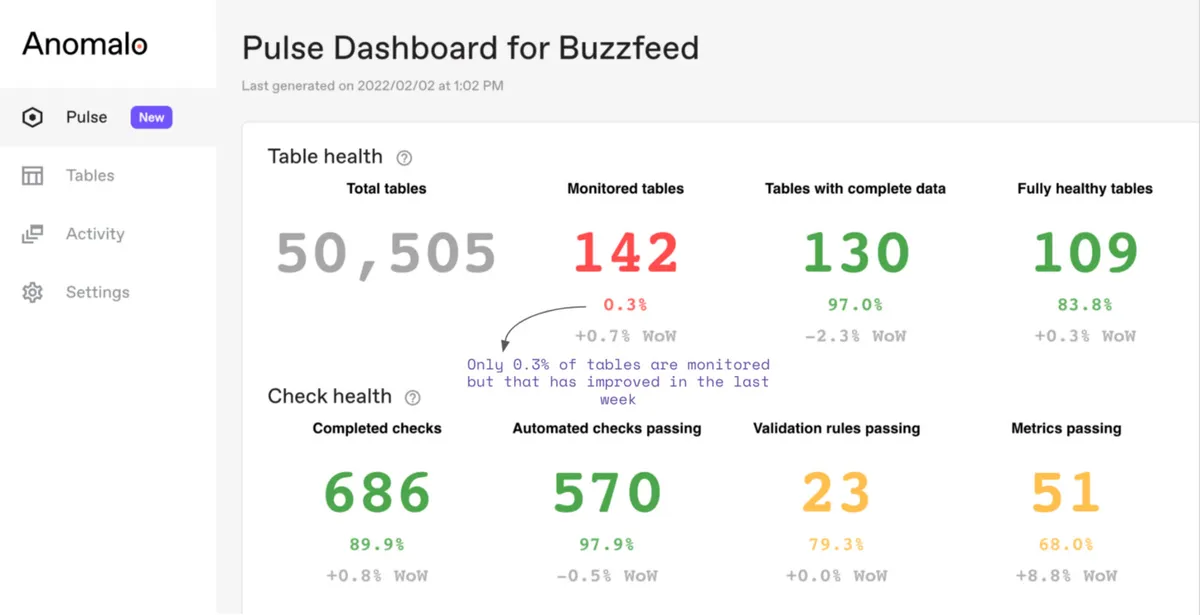
Anomalo
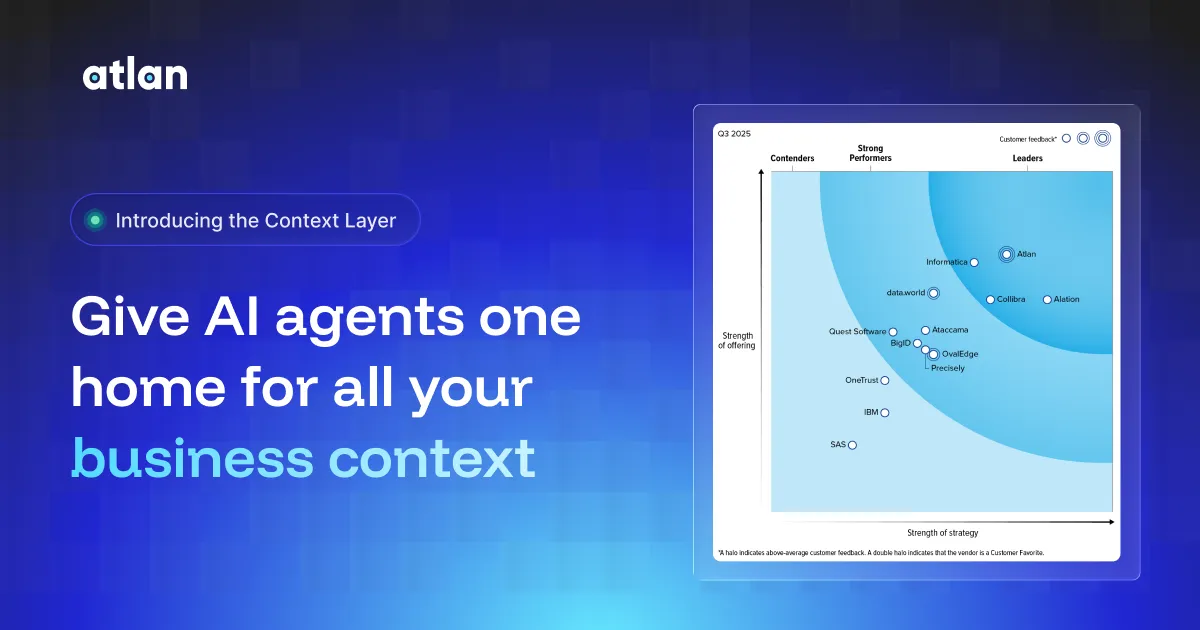
Atlan
Feature Comparison
| Feature | Anomalo | Atlan |
|---|---|---|
| Data Quality Monitoring | ||
| AI-powered anomaly detection | Unsupervised ML detects statistically significant deviations across data types. | Not verified |
| No-code rules | Create business rules and KPIs through UI or API. | Not verified |
| Root cause analysis | Automatically identifies data-issue sources for faster resolution. | Lineage root cause analysis traces a data quality issue in a report or dashboard back to its upstream source. |
| Metadata and Lineage | ||
| Data lineage | Visualizes upstream and downstream flows for impact analysis. | Provides highly visual end-to-end lineage across complex ecosystems. |
| Active Metadata | Not verified | Continuously updated, actionable metadata keeps insights current. |
| Business Glossary | Not verified | Centralized, linkable definitions include assigned ownership and accountability. |
| Integration and Openness | ||
| Platform integrations | Native integrations connect cloud lakes, warehouses, and ETL tools. | Over 80 connectors unify warehouse, BI, and business context. |
| Open APIs | Business rules and KPIs can be defined through API. | Open APIs support interoperability and avoid vendor lock-in. |
| Context delivery | Not verified | Certified context serves downstream tools through SQL, APIs, and MCP. |
| User Experience and Collaboration | ||
| Personalization | Not verified | Customized homepages and curated asset views support user needs. |
| Human context annotation | Not verified | Domain experts resolve conflicts, annotate edge cases, and certify context. |
| Rapid feature delivery | Not verified | Updates and enhancements are rolled out rapidly from customer feedback. |
Data Quality Monitoring
AI-powered anomaly detection
No-code rules
Root cause analysis
Metadata and Lineage
Data lineage
Active Metadata
Business Glossary
Integration and Openness
Platform integrations
Open APIs
Context delivery
User Experience and Collaboration
Personalization
Human context annotation
Rapid feature delivery
Which approach fits
Anomalo and Atlan address fundamentally different problems in the modern data stack. Anomalo specializes in automated data quality monitoring, deploying unsupervised machine learning models that learn historical patterns and detect anomalies across structured, semi-structured, and unstructured data without manual rule configuration. Atlan operates as a comprehensive data catalog and AI context layer, unifying metadata from 80+ sources into an Enterprise Data Graph that serves every downstream AI agent and business user. These tools are complementary rather than competitive, and many organizations benefit from deploying both.
When each approach fits
Choose Anomalo if:
We recommend Anomalo for large enterprises that need automated, AI-driven data quality monitoring across high-volume data warehouses and lakes. The platform excels when your team manages thousands of tables and needs to detect anomalies in data volume, schema, and distribution without writing manual rules or thresholds. Anomalo is the stronger choice if your primary concern is catching data issues before they cascade into broken dashboards, erratic ML models, or inaccurate reports. Its unsupervised machine learning approach automatically builds models per dataset, making it particularly valuable for organizations with stable pipelines and mature data infrastructure where the volume of data makes manual monitoring impractical.
Choose Atlan if:
We recommend Atlan for organizations that need a unified metadata platform to power data discovery, governance, and AI context delivery across their entire data estate. The platform excels when your team requires a centralized catalog with business glossary, end-to-end lineage, and collaborative workflows that bridge technical and business users. Atlan is the stronger choice if your primary challenge is enabling cross-functional teams to find, understand, and trust data assets while providing certified context to downstream AI agents. Its Enterprise Data Graph with 80+ connectors, MCP server integration, and open API architecture makes it particularly valuable for organizations building production AI systems that require rich business context to function effectively.
These scenarios reflect the available product evidence. Your requirements, existing stack, and team expertise should guide the final decision.
Frequently Asked Questions
Can Anomalo and Atlan be used together in the same data stack?
Anomalo and Atlan serve complementary roles and can be deployed together effectively. Anomalo handles automated data quality monitoring by running unsupervised ML models against your warehouse tables to detect anomalies in volume, schema, and distribution. Atlan functions as the metadata catalog and governance layer, ingesting data quality metrics from external systems and presenting them alongside lineage, business glossary terms, and asset documentation. Organizations that run both tools use Anomalo to detect and alert on data issues, while Atlan provides the collaborative context for understanding what went wrong and coordinating the response across teams.
Which platform is better for organizations just starting their data quality program?
Atlan publishes no pricing. Its pricing page resolves to a talk-to-sales contact form with no figures and no plan or edition names, so both the tier structure and the rates come from a quote. Ask for a quote scoped to your connector count and user roles, or the number will not be comparable with a competitor's published rate.
How do the AI capabilities differ between Anomalo and Atlan?
Anomalo and Atlan apply AI to fundamentally different problems. Anomalo deploys unsupervised machine learning models that are automatically built for each dataset based on its history, patterns, and structure. These models detect statistically significant deviations without requiring manual threshold configuration. Anomalo also runs an agentic platform with nine specialized AI agents covering table observability, data quality rules, proactive insights, and conversational analytics. Atlan applies AI to metadata enrichment and context generation. Its AI agents read the Enterprise Data Graph, which includes SQL query history, BI semantics, and pipeline code, and then generate asset descriptions, link business terms, and surface top business questions. Atlan estimates its AI can bootstrap approximately 80% of a context layer before human review begins.
What are the main limitations of each platform that buyers should know about?
Anomalo has several documented limitations. Its monitoring jobs can generate high compute costs when scanning large data volumes because it relies on full-table scans. Onboarding requires opting in each table individually, which becomes painful at scale beyond a few thousand tables. Alert routing lacks granular controls by owner, team, or domain. The platform operates on a closed documentation model where you cannot access docs without being a customer or in a trial. Atlan presents different trade-offs. Setup complexity is a recurring concern, with the Personas and Purposes permission model feeling unnecessarily complex to new users. Advanced workflows like mass-tagging introduce a steeper learning curve. List prices for connectors and member licenses are relatively high without negotiated volume discounts. Some users report that new features occasionally launch with minor bugs that require immediate patches.