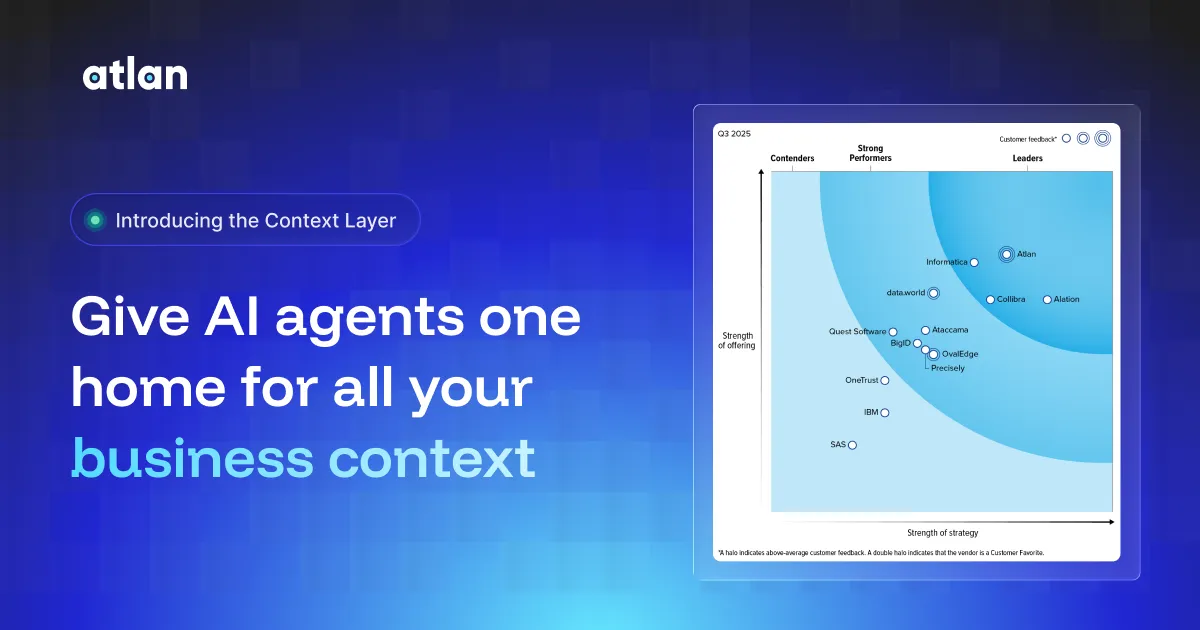
Atlan: product and architecture
This Atlan review concludes that Atlan is a strong fit for data teams that need a collaborative catalog and governance layer to make business context usable by people and AI tools. We recommend it for organizations willing to invest in metadata stewardship, lineage, and shared definitions; avoid it if you need a lightweight catalog with minimal onboarding, simple permissions, or mature mobile-first access.
Atlan positions itself as a modern data workspace combining data catalog, governance, and collaboration. Its current product message is more ambitious than a conventional catalog: it aims to build a shared understanding of data, business logic, and institutional knowledge, then make that context available to AI tools across the organization. That is valuable when data definitions are fragmented across warehouses, BI tools, and business applications, but it also means Atlan is not a casual add-on.
The practical decision is straightforward. Choose Atlan when trusted context, cross-functional participation, and AI-facing metadata matter enough to justify governance work. Look elsewhere when your immediate problem is narrow data observability, basic documentation, or a low-complexity internal directory of datasets.
Overview
Atlan is a freemium data-quality-category platform centered on metadata management, data discovery, governance, and collaboration. The company describes the product as a “Context Layer for AI,” based on the premise that enterprise AI projects fail in production when agents lack reliable understanding of business data, definitions, and workflows.
That positioning gives Atlan a clear strength: it treats metadata as organizational knowledge rather than as a passive inventory of tables. The platform is designed to help teams discover assets, understand their meaning, assign ownership, trace their relationships, and make that context available to downstream tools. In practical terms, this makes Atlan relevant to data engineers managing complex estates, analytics engineers maintaining semantic consistency, and data leaders trying to improve confidence in shared metrics.
Atlan’s stated architecture brings context from warehouse SQL, BI definitions, and business applications into an Enterprise Data Graph. It offers 80+ connectors, which is a meaningful coverage signal for organizations with a fragmented stack. Connector breadth is not the same as implementation simplicity, however: the value of a graph depends on teams resolving conflicts and maintaining the business context that enters it.
The platform’s emphasis on AI interoperability is also notable. Atlan says certified context can be delivered through SQL, APIs, and the Atlan MCP server, while evaluations, traces, and memory feed context back into the system. This is a compelling direction for AI-forward enterprises, but buyers should treat it as a governance program, not a shortcut around data ownership.
Key Features and Architecture
Atlan’s central architectural concept is the Enterprise Data Graph. More than 80 connectors collect context from across a data estate and bring warehouse SQL, BI definitions, and business applications into one living graph. That matters because a dataset name alone is rarely enough for trustworthy analytics or AI; teams need the surrounding definitions, ownership, dependencies, and business interpretation.
Key capabilities include:
-
Enterprise Data Graph: Atlan unifies context from 80+ connectors. The graph is intended to connect technical metadata from warehouse SQL with BI definitions and context from business applications, reducing the need to treat each system as an isolated documentation source.
-
Human-reviewed AI context: Atlan explicitly frames AI-generated context as a draft rather than a final answer. Domain experts resolve conflicts between sources, annotate edge cases, and certify context before it is distributed, which is the right design for organizations where definitions such as revenue, customer, or active user carry business consequences.
-
Certified context delivery: Production-ready context is made available to downstream tools through SQL, APIs, and the Atlan MCP server. Atlan also states that evaluations, traces, and memory feed back into the context layer, creating a feedback path between AI-tool behavior and the knowledge used to guide it.
-
Active Metadata: External reviews describe Atlan’s metadata as dynamic, continuously updated, and actionable rather than static catalog content. This is important for modern data stacks where SQL, dashboards, and operational data definitions change frequently.
-
End-to-end lineage: Atlan provides visual lineage intended to trace data flows across ecosystems including Snowflake, dbt, Tableau, and Salesforce. For analytics engineers, this can support impact analysis before changing models or business definitions; for leaders, it can make data dependencies more visible during governance reviews.
-
Business glossary: Atlan supports a centralized, linkable glossary in which every definition has assigned ownership. This is one of the more concrete governance mechanisms in the product: accountability is attached to definitions instead of leaving ambiguous terms as anonymous wiki entries.
-
Personalized workspaces: Customized homepages and curated asset views help different users focus on assets relevant to their role. That can reduce catalog noise for analysts and business users, although personalization also requires deliberate setup to remain useful.
-
Open integration approach: Atlan is described as built on open APIs and states that context should move across agents, models, and clouds rather than remain locked into one vendor representation. The trade-off is that portability does not eliminate the internal work of defining, reviewing, and governing context.
Atlan’s feature set is broad, and that breadth is both its appeal and its cost. Its architecture is best when teams need cataloging, collaboration, lineage, glossary management, and AI-facing context to work together. It is weak as a “turn it on and forget it” product because its own human-certification model depends on engaged domain experts.
Ideal Use Cases
Atlan is best for a centralized data organization with enough operating maturity to maintain shared definitions. A team of roughly 10 or more data engineers, analytics engineers, analysts, and governance stakeholders can justify the workflow because ownership, annotation, certification, and lineage review have clear participants. In this setting, Atlan can provide a common layer between warehouse SQL, BI definitions, and business applications rather than forcing every user to reconstruct context manually.
A strong scenario is a company operating a modern cloud data stack with Snowflake, dbt, Tableau, and Salesforce-related data flows. The end-to-end lineage capability is particularly useful when a dbt model change can affect downstream dashboards and business-facing definitions. Analytics engineers can use lineage and glossary ownership to identify who must review a change, while data leaders can establish an auditable process around trusted metrics.
A second good scenario is an AI-forward enterprise trying to make internal agents useful against governed business context. Atlan’s support for certified context flowing through SQL, APIs, and the Atlan MCP server is relevant when AI tools need more than raw records. We recommend Atlan for teams that have already identified missing business context as a production AI problem and can assign domain experts to resolve conflicts and certify the result.
A third scenario is a regulated or governance-heavy organization where different business units use the same words differently. A centralized, linkable business glossary with named ownership creates a practical way to manage definitions such as customer, revenue, or active status. The people-side requirement is substantial: frontline teams must participate, not merely engineers, because the platform is designed for business context as well as technical metadata.
Don’t use this if your team only needs monitoring of data quality incidents or a simple list of dashboards and tables. Atlan’s catalog, collaboration, graph, lineage, governance, and AI-context capabilities create more surface area than a small team may be able to maintain. Also avoid it if your users cannot tolerate a learning curve around advanced workflows, mass-tagging, and the Personas and Purposes permissions model.
Strengths & Trade-offs
Atlan has an 8.3/10 user rating from 11 reviews, which is positive but limited evidence. We treat that score as user sentiment, not proof of enterprise-wide outcomes. The feedback is useful because it aligns with the product’s technical positioning: reviewers repeatedly point to integrations, UI, data sources, BI tooling, cloud security, visualization, and support as strengths.
Pros
-
Broad context collection through 80+ connectors: Atlan’s Enterprise Data Graph is designed to pull warehouse SQL, BI definitions, and business-application context into one place. This is materially useful for teams whose metadata is split across several systems.
-
Human certification before AI distribution: The product does not position AI-drafted context as automatically authoritative. Experts can resolve conflicts, annotate exceptions, and certify context before it reaches SQL, APIs, or the Atlan MCP server.
-
Concrete governance structures: The centralized, linkable business glossary assigns ownership to definitions. That is more actionable than documentation without accountable owners, especially where business terms have contested meanings.
-
Visual lineage across named modern-stack tools: External reviews specifically identify lineage across Snowflake, dbt, Tableau, and Salesforce ecosystems. This helps teams understand downstream impact when changing data models or BI logic.
-
Positive user feedback on the interface and integrations: Reviewers cite the user interface, seamless integration, data sources, BI tools, information collected, cloud security, and data visualization. A clean interface matters in a catalog because adoption fails when analysts and business users avoid it.
Cons
-
The platform can be overwhelming: Users explicitly describe Atlan as overwhelming at times. That is credible given the range of catalog, governance, collaboration, lineage, personalization, permissions, and AI-context functions exposed in one product.
-
Advanced workflows have a learning curve: External review feedback identifies complexity in onboarding workflows such as mass-tagging. Teams should plan for enablement rather than assuming every user will immediately understand the operating model.
-
Permissions can feel unnecessarily complex: The Personas and Purposes permissions model has been called complex for new users. This is a real adoption concern because governance often requires broad participation, including users who are not metadata specialists.
-
API documentation is a reported weakness: User feedback specifically calls out API documentation. That can slow teams that want to use Atlan’s open APIs or automate metadata-related workflows.
-
Support and service feedback is mixed: While some users cite the technical support team as a strength, weaknesses also mention customer service, service staff, and technical service. Buyers should test support expectations during evaluation rather than treating marketing claims as sufficient evidence.
-
Mobile application is a reported weakness: Users identify the mobile application as a limitation. Teams requiring mobile-first catalog consumption should not rely on Atlan until they validate the workflows they need.
The main trade-off is clear: Atlan provides depth where shared context matters, but that depth requires design, training, governance participation, and commercial diligence. We recommend a pilot that includes an engineer, analytics engineer, business owner, and governance lead rather than a single technical evaluator.