Elementary: product and architecture
Our verdict in this Elementary review: Elementary is a strong choice for dbt-centered data teams that want data observability, testing visibility, lineage, and automated monitoring without leaving the dbt workflow. Its open-source foundation, Apache-2.0 license, and self-hosted option make it particularly compelling for teams that value control, while its cloud service adds premium capabilities for organizations that need a broader operating model. We recommend Elementary for analytics engineering organizations that already treat dbt as the center of their transformation practice; teams without dbt at the core should evaluate alternatives more closely.
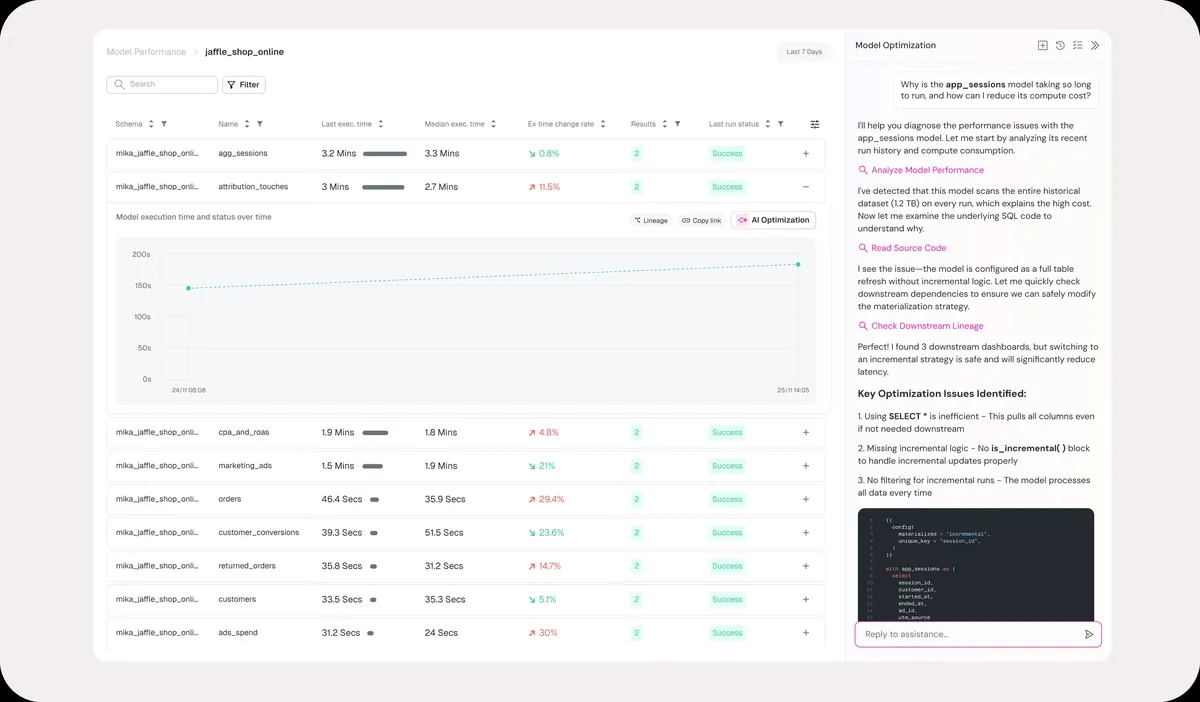
Elementary positions itself as a data and AI control plane rather than merely a standalone data-quality product. The product combines observability, quality, governance, discovery, and a shared context engine intended to connect engineers and business users around metadata, lineage, validations, logs, and health signals. That positioning is ambitious, and the practical value depends on whether a team can make Elementary’s dbt-native workflow part of its everyday operating process.
Public adoption indicators are meaningful but should not be mistaken for proof of enterprise deployment. The Elementary repository has 2,406 GitHub stars, its latest listed release is v0.25.1 from July 8, 2026, and the repository was last pushed on September 7, 2026. Those signals indicate an active open-source project, but buyers should still validate support expectations, implementation ownership, and the fit of premium capabilities for their own environment.
Overview
Elementary is an open-source, dbt-native data observability product for data and analytics engineers. It is designed to monitor data pipelines, surface anomalies, visualize test results, and provide lineage directly around a dbt project. The defining trade-off is clear: dbt-native design creates a cohesive experience for dbt teams, but it narrows the product’s natural fit for organizations whose transformation layer is not centered on dbt.
The product’s stated purpose is trusted data for the AI era, delivered through a unified control plane spanning observability, quality, governance, and discovery. Elementary says its context engine brings metadata, lineage, logs, validations, and health signals together so data workflows and AI agents operate with shared context. This is a useful framing for data leaders who are tired of fragmented point tools, but it is not evidence that Elementary will independently solve every governance or catalog requirement.
At its operational core, Elementary is built to make dbt artifacts and data health more visible. Rather than asking teams to rebuild their existing validation investment, it incorporates dbt tests into Elementary coverage and can also work with Elementary and custom tests. That approach matters because duplicate testing logic is one of the most common reasons data-quality programs become expensive to maintain.
Elementary is available as self-hosted software or as a cloud service with premium features. Its repository uses the Apache-2.0 license, which is a practical advantage for teams that require source access or want to operate the product themselves. Self-hosting is not free operationally, however: someone still owns deployment, upgrades, access controls, alert routing, and the ongoing administration of the observability platform.
Key Features and Architecture
Elementary’s architecture begins with automated monitors for production tables. These monitors cover freshness, volume, and schema changes, and the product states that they activate automatically without manual configuration. The monitors use metadata such as information schema and query history, which Elementary says enables monitoring with low compute cost; this is valuable for teams that need broad baseline coverage before they have time to author detailed tests for every model.
Its anomaly detection capability extends beyond simple pipeline failure reporting. Teams can add monitors for unexpected changes and add tests either in code during development or through the Elementary UI. The documented detection scope includes nullness, distribution, dimensions, and completeness, while configuration options include seasonality and where expressions. The benefit is more nuanced monitoring than a basic row-count check, although meaningful anomaly detection still requires teams to tune thresholds and investigate whether an alert represents a real business problem.
Testing is another central element of the product. Elementary is positioned as one solution for dbt, Elementary, and custom data tests, and it states that existing dbt tests become part of Elementary coverage without reconfiguration or duplicated logic. It also supports leveraging dbt ecosystem packages including dbt-expectations and dbt-utils. For teams with an established dbt test suite, this is a direct operational advantage: test outcomes can be treated as observability signals rather than isolated build logs.
End-to-end, column-level lineage is a more advanced architectural feature. Elementary documents lineage across code, the data warehouse, sources, and BI tools, and says that lineage is enriched with test results so teams can see incidents across the DAG. The practical outcome is faster impact analysis: an engineer can trace an issue toward its origin and identify downstream assets affected by a failing model or unhealthy table. The trade-off is that lineage quality depends on the metadata available across the stack; Elementary’s claims do not eliminate the need to validate lineage completeness during evaluation.
The alerting design is also operationally specific. Elementary can route actionable alerts to different systems, channels, recipients, and owners, with the stated goal of reducing alert fatigue. Alerts can be generated from failed Elementary monitors, dbt tests, and model-related signals. Routing flexibility is important because data incidents need ownership, but alert configuration is only valuable when teams have defined escalation paths and people responsible for responding.
Beyond monitoring, the product describes discovery as making data easier to find, governance as setting and enforcing compliance and security policies, and quality as ensuring trusted input for dashboards, models, and AI workflows. Its Context Engine is the connective layer: shared context on every dataset and event across the stack. These capabilities are relevant to a broader data-control-plane strategy, though the available product data does not specify detailed implementation mechanics, policy types, or external catalog behavior outside the Enterprise plan’s external catalog integrations.
Ideal Use Cases
Elementary is best suited to a data team of roughly 3 to 10 analytics engineers that already develops transformations and tests in dbt. In this scenario, the team can use automated freshness, volume, and schema monitoring across production tables while bringing existing dbt tests into the same coverage view. This reduces the overhead of adopting a separate quality product that requires engineers to recreate validation logic elsewhere.
A second strong use case is a growing marketplace, SaaS, or digital-product company where unreliable tables can affect dashboards, operational reporting, or machine-learning and AI workflows. Column-level lineage enriched with test results can help a team understand which downstream assets are exposed when a model incident occurs. The product’s ability to check nullness, distributions, dimensions, and completeness is especially relevant when changing source data can silently change the meaning of business metrics.
Elementary also fits a data leader building a shared reliability process across engineering and business stakeholders. Its stated control-plane design combines discovery, governance, quality, observability, and shared context, which can give different functions a common place to reason about data health. This is most useful when the organization has an established dbt practice and wants to connect technical failures to business-facing assets rather than merely collect more infrastructure telemetry.
Self-hosting makes Elementary worth considering for organizations with source-access requirements or deployment constraints that make SaaS-only tooling difficult. Apache-2.0 licensing supports that path, and the project’s repository describes both self-hosted and cloud-service availability. The cost is internal operational responsibility: self-hosted users should budget for platform ownership rather than treating open source as a zero-effort deployment.
Don’t use Elementary if your organization does not use dbt as a central part of its transformation workflow. Its strongest documented capabilities—existing dbt test coverage, dbt-native monitoring, and project-oriented observability—are tightly tied to dbt. Also avoid treating Elementary as a substitute for a fully specified governance program if your decision depends on detailed policy-management, enterprise security, or catalog requirements not documented in the available product information.
We recommend Elementary for dbt-heavy teams that need to move from reactive test failures to proactive monitoring and lineage-informed incident response. Choose a tool with a different primary integration model if your data engineering architecture is warehouse- and orchestration-centric but not dbt-centered.
Strengths & Trade-offs
Pros
- Elementary brings existing dbt tests into its coverage without requiring teams to reconfigure or duplicate their validation logic. That reduces migration friction for analytics engineering teams already using dbt tests and packages such as dbt-expectations and dbt-utils.
- Automated monitors cover freshness, volume, and schema changes for production tables and activate without manual configuration. Using information schema and query history for low-compute-cost monitoring is a practical way to establish baseline observability before custom checks are written.
- The product supports anomaly detection for nullness, distributions, dimensions, and completeness, with configuration for seasonality and where expressions. This is materially more useful than treating every quality issue as a binary test failure.
- Column-level lineage spans code, warehouse, sources, and BI tools, and is enriched with test results. That combination gives incident responders a more direct path from a failing condition to affected assets across a DAG.
- Apache-2.0 licensing and a self-hosted option provide control for teams that cannot rely exclusively on a SaaS deployment. The current public repository data also shows 2,406 GitHub stars and a v0.25.1 release, useful public signals of a maintained open-source product.
- Scale and Enterprise plan descriptions include increasingly explicit operational capabilities, including AI Agents and Automated Monitors in Scale, plus SSO, RBAC, and Advanced Deployment Options in Enterprise.
Cons
- Elementary is explicitly dbt-native, so its most distinctive workflow is a poor fit for teams that do not build around dbt. Adopting it outside that context risks introducing a product whose testing and project model do not align with the team’s development process.
- Official pricing is incomplete for larger deployments. Scale, Enterprise, and the unlimited-seat tier list table limits and “$ per extra 1K” language without dollar amounts, preventing a reliable cost forecast from the published data.
- The Free tier is limited to 1 user. That makes it suitable for individual evaluation but weak as a realistic collaboration environment for most data teams.
- Advanced enterprise requirements are gated above Scale: SSO, RBAC and advanced deployment options appear only from the Enterprise tier, and no tier carries a published price, so those controls cannot be budgeted without a quote.
- The available product data describes discovery, governance, and a context engine at a high level but does not document detailed policy mechanisms, supported external catalogs outside the Unlimited tier, or implementation specifics. Buyers with strict governance requirements should validate those points directly rather than purchasing based on broad control-plane language.