Decision comparison
Acceldata vs Elementary
Acceldata and Elementary serve fundamentally different segments of the data observability market. Acceldata is built for large enterprises managing complex, multi-cloud data environments who need a comprehensive platform spanning data quality, pipeline health, infrastructure monitoring, cost optimization, and AI-driven autonomous remediation. Elementary is purpose-built for dbt-centric data teams who want code-first, open-source observability that integrates directly into their existing development workflows. The right choice depends entirely on your team's architecture, scale, and approach to data operations.
Direct comparison. These are reviewed substitutes bought for the same job, so the differences below are the ones that decide between them.
All 2 are data observability.
Quick Comparison
| Decision factor | Acceldata | Elementary |
|---|---|---|
| Best For | Large enterprises with complex multi-cloud data environments | dbt-centric data teams seeking code-first observability |
| Deployment | SaaS cloud platform with on-prem and hybrid options | Self-hosted (open-source dbt package) or Elementary Cloud |
| Pricing Model | Acceldata publishes no prices. Its pricing page lists PRO and ENTERPRISE packages with a free trial, and directs buyers to a demo, so every figure comes from a quote. | Elementary publishes no amounts. Its open-source dbt package is free and self-hosted. Elementary Cloud is priced by seats and environments: Scale covers up to 10 editor seats and 1K tables, Enterprise up to 20 editor and 40 viewer seats and 3K tables, and Unlimited removes the seat caps; extra tables are charged per additional 1K. A free trial covers the Essentials feature set. Every paid tier is quote-only. |
| Open Source | No | Yes (Apache-2.0, 2,000+ GitHub stars) |
| Learning Curve | Moderate to steep; enterprise onboarding required | Low for dbt users; integrates directly into existing workflows |
Acceldata
- Best For:
- Large enterprises with complex multi-cloud data environments
- Deployment:
- SaaS cloud platform with on-prem and hybrid options
- Pricing Model:
- Acceldata publishes no prices. Its pricing page lists PRO and ENTERPRISE packages with a free trial, and directs buyers to a demo, so every figure comes from a quote.
- Open Source:
- No
- Learning Curve:
- Moderate to steep; enterprise onboarding required
Elementary
- Best For:
- dbt-centric data teams seeking code-first observability
- Deployment:
- Self-hosted (open-source dbt package) or Elementary Cloud
- Pricing Model:
- Elementary publishes no amounts. Its open-source dbt package is free and self-hosted. Elementary Cloud is priced by seats and environments: Scale covers up to 10 editor seats and 1K tables, Enterprise up to 20 editor and 40 viewer seats and 3K tables, and Unlimited removes the seat caps; extra tables are charged per additional 1K. A free trial covers the Essentials feature set. Every paid tier is quote-only.
- Open Source:
- Yes (Apache-2.0, 2,000+ GitHub stars)
- Learning Curve:
- Low for dbt users; integrates directly into existing workflows
Public signals
Verified factual signals only. Bars appear only for like-for-like metrics with five weekly assessments for every tool; missing evidence stays explicit. These signals do not establish enterprise adoption, product quality, or total cost.
| Metric | Acceldata | Elementary |
|---|---|---|
| Search interest(Market interest) | 0 | Unavailable |
| PyPI weekly downloads(Developer adoption) | 38.7k | Not available |
| GitHub commits, 90d(Product adoption) | Not available | 19 |
| GitHub stars(Product adoption) | Not available | 2,000+ |
| PyPI weekly downloads(Product adoption) | Not available | 215.3k |
As of September 21, 2026 — updated weekly.
Health & risk evidence
Observed public-source checks for mapped package versions and repositories.
Acceldata
September 21, 2026Package vulnerabilities
PyPI · acceldata-sdk@26.9.0
0 vulnerabilities
across 1 package
Repository security score
Not available
Elementary
September 21, 2026Package vulnerabilities
PyPI · elementary-data@0.26.0
0 vulnerabilities
across 1 package
Repository security score
github.com/elementary-data/elementary
7.4/10
Interface Preview
Elementary
Feature Comparison
| Feature | Acceldata | Elementary |
|---|---|---|
| Data Quality & Monitoring | ||
| Automated Anomaly Detection | AI-powered multi-variate anomaly detection across pipelines, infrastructure, and data quality | ML-based out-of-the-box monitors for freshness, volume, schema changes, nullness, and distribution |
| Data Profiling | Dedicated Data Profiling Agent analyzes datasets for distributions, anomalies, and structural insights | Anomaly detection covers distribution, completeness, and dimensions; no standalone profiling agent |
| Custom Data Quality Rules | 600+ inline data quality rules; customizable rules with domain-specific policies | Supports dbt tests, dbt-expectations, dbt-utils, plus custom SQL tests managed in code |
| Lineage & Observability | ||
| Data Lineage | End-to-end lineage with dedicated Data Lineage Agent; tracks data flow across systems for root cause analysis | Column-level lineage from code to BI tools; enriched with test results to show incidents across the DAG |
| Pipeline Monitoring | Full pipeline observability covering data quality, infrastructure health, cost, and user behavior | Monitors dbt model runs, source freshness, and test results; performance and cost tracking for models |
| Root Cause Analysis | AI agents trace root cause instantly using lineage and dependency analysis with automated remediation | Lineage-based incident tracking; groups related failures into managed incidents for triage |
| AI & Automation | ||
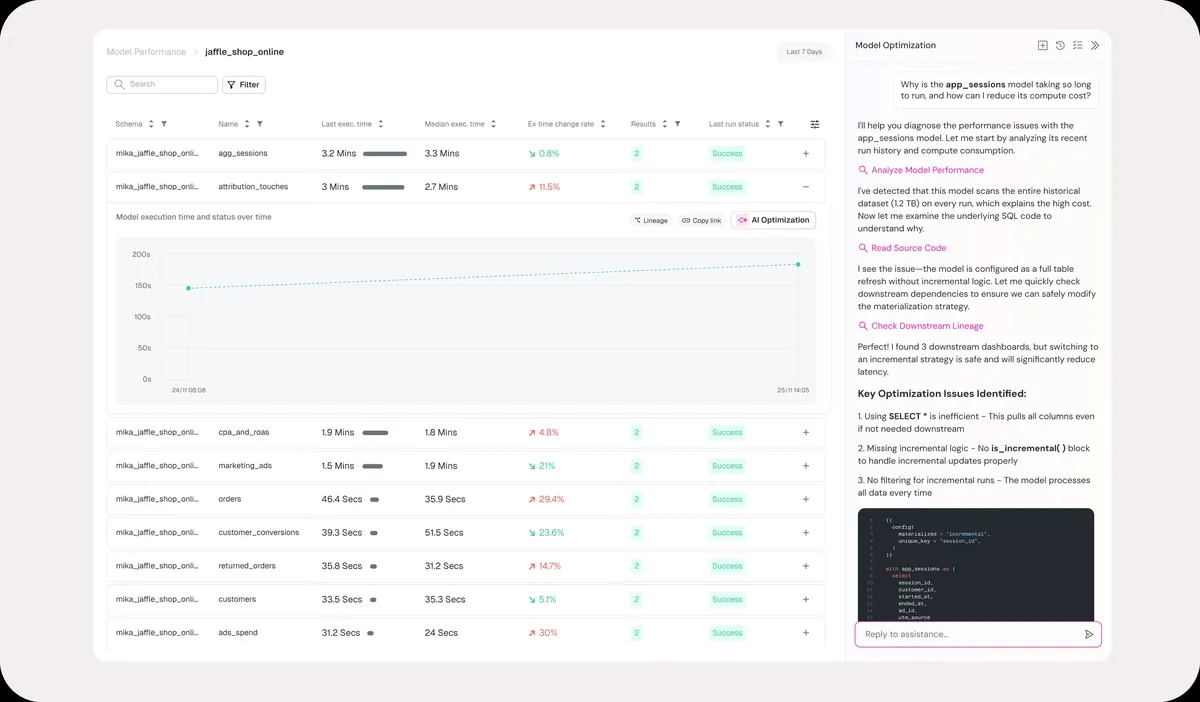
| AI Agents | Multiple specialized agents (Data Quality, Lineage, Profiling) coordinated by xLake Reasoning Engine | AI agents for validation, triage, metadata enrichment, test coverage analysis, and query optimization |
| Natural Language Interface | The Business Notebook: natural language interface with contextual memory and explainable AI reasoning | AI-first catalog with conversational format for querying assets, ownership, tags, and health |
| Automated Remediation | Closed-loop workflow orchestration with human-in-the-loop approvals and policy-governed autonomous actions | Automated monitor adjustments based on frequency, seasonality, and trends; incident routing by ownership |
| Integration & Deployment | ||
| dbt Integration | Supports dbt as one of many data pipeline integrations | dbt-native by design; open-source dbt package integrates tests and artifacts directly with data warehouse |
| BI Tool Integration | BI lineage tracking and data quality monitoring across visualization tools | Integrations with Tableau, Looker, and other BI tools; column-level lineage extends to BI layer |
| MCP Server Support | Not verified | MCP Server exposes context layer and agents through standard interface for use in any AI tool |
| Governance & Security | ||
| Access Control | Resource-Based Access Management (RBAM) with domain hierarchy; RBAC and MFA; SOC 2 Type 2 certified | SSO and RBAC available on Enterprise tier and above |
| Configuration as Code | Policy-driven governance with UI-based configuration and API access | All configurations managed in dbt code; version control, code review, and CI/CD built in |
| Data CI/CD | Not a primary focus; governance policies enforced via platform | Dedicated Data CI/CD feature prevents data quality issues at the pull request level |
Data Quality & Monitoring
Automated Anomaly Detection
Data Profiling
Custom Data Quality Rules
Lineage & Observability
Data Lineage
Pipeline Monitoring
Root Cause Analysis
AI & Automation
AI Agents
Natural Language Interface
Automated Remediation
Integration & Deployment
dbt Integration
BI Tool Integration
MCP Server Support
Governance & Security
Access Control
Configuration as Code
Data CI/CD
Which to choose
Acceldata and Elementary serve fundamentally different segments of the data observability market. Acceldata is built for large enterprises managing complex, multi-cloud data environments who need a comprehensive platform spanning data quality, pipeline health, infrastructure monitoring, cost optimization, and AI-driven autonomous remediation. Elementary is purpose-built for dbt-centric data teams who want code-first, open-source observability that integrates directly into their existing development workflows. The right choice depends entirely on your team's architecture, scale, and approach to data operations.
Best-fit scenarios
Choose Acceldata if:
Enterprise data teams with multi-cloud or hybrid deployments, high data volumes (billions of rows), and a need for unified observability across pipelines, infrastructure, cost, and governance with AI-powered autonomous remediation.
Choose Elementary if:
Data and analytics engineers working primarily with dbt who want open-source, code-first observability with column-level lineage, automated monitors, and a low-friction path from self-hosted to cloud as they scale.
These scenarios reflect the available product evidence. Your requirements, existing stack, and team expertise should guide the final decision.
Frequently Asked Questions
Is Elementary truly free to use?
Elementary offers an open-source dbt package under the Apache-2.0 license that is completely free to self-host. The Elementary Cloud service adds premium features like AI agents, BI integrations, and incident management across Scale, Enterprise, and Unlimited tiers, all of which require contacting the team for pricing.
Does Acceldata require a long implementation process?
Acceldata is designed for enterprise-scale deployments and typically requires onboarding with the vendor's team. The platform offers a 30-day free trial and sandbox environment to evaluate capabilities, but full enterprise rollouts involve connecting data sources, setting up monitoring rules, and configuring governance policies.
Can Elementary work without dbt?
Elementary is dbt-native by design, and its open-source package is tightly coupled to dbt projects. However, Elementary Cloud extends observability beyond dbt with integrations across ingestion, semantic layers, BI tools, and AI workflows through its context engine.
Which tool is better for multi-cloud environments?
Acceldata is specifically built for multi-cloud and hybrid environments, supporting hyperscalers, data clouds, and on-premises systems through its xLake Reasoning Engine. Elementary focuses primarily on the data warehouse layer and dbt pipelines, making Acceldata the stronger choice for organizations managing data across multiple cloud providers.
Do both tools support AI-powered features?
Yes. Acceldata offers specialized AI agents (Data Quality, Lineage, Profiling) coordinated by its xLake Reasoning Engine, plus a natural language Business Notebook interface. Elementary provides AI agents for data validation, triage, metadata enrichment, and test coverage analysis, along with an MCP Server that exposes its context layer to external AI tools.