Decision comparison
Alation vs Elementary
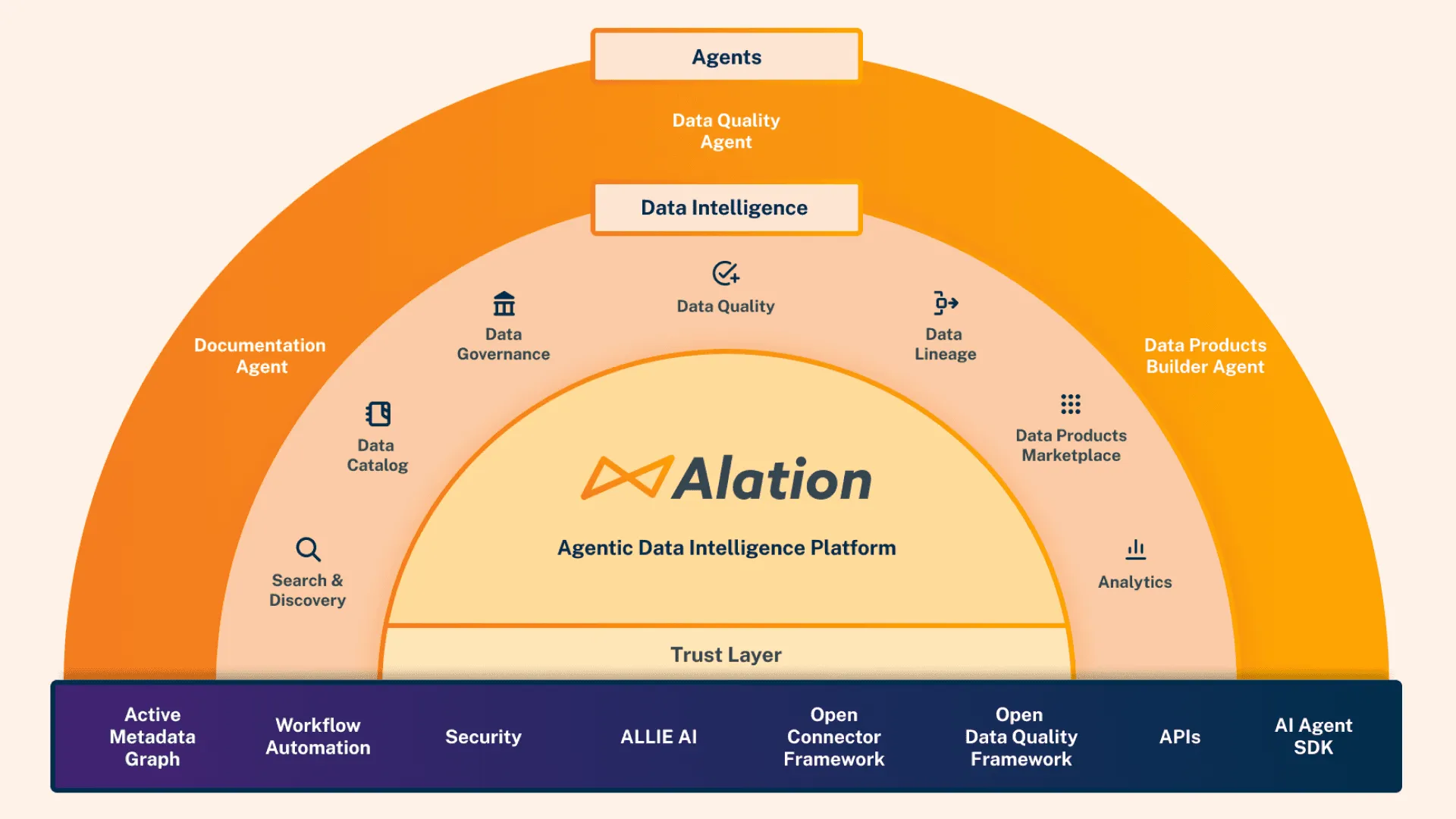
Alation and Elementary address fundamentally different layers of the data quality ecosystem. Alation is an enterprise data intelligence platform focused on cataloging, governance, and AI-ready data products for large organizations with complex data estates. Elementary is a dbt-native data observability tool built for engineering teams that need code-first monitoring, anomaly detection, and pipeline reliability. These tools complement each other more than they compete, but teams choosing between them should consider whether their primary need is enterprise data governance or pipeline-level data observability.
Architecture choice. These take different approaches to the same problem. Read the table as a fit question rather than a feature race.
These are different kinds of product — Data Catalog and Data Observability.
Quick Comparison
| Decision factor | Alation | Elementary |
|---|---|---|
| Best For | Large enterprises needing a unified data catalog with governance and AI-powered discovery | dbt-centric data teams seeking code-first data observability and quality monitoring |
| Core Strength | Data cataloging, governance, and metadata management with 120+ connectors | Automated data observability with anomaly detection, lineage, and alerting built into dbt workflows |
| Deployment | SaaS (Alation Cloud Service) or customer-managed on-premises | Self-hosted open-source dbt package or Elementary Cloud (SaaS) |
| Pricing Model | Alation publishes no pricing. alation.com/pricing resolves to a contact form, and no plan or edition names are published either, so every figure is set in a quote. | Elementary publishes no amounts. Its open-source dbt package is free and self-hosted. Elementary Cloud is priced by seats and environments: Scale covers up to 10 editor seats and 1K tables, Enterprise up to 20 editor and 40 viewer seats and 3K tables, and Unlimited removes the seat caps; extra tables are charged per additional 1K. A free trial covers the Essentials feature set. Every paid tier is quote-only. |
| Open Source | No | Yes (Apache-2.0 license, 2,000+ GitHub stars) |
| Learning Curve | Moderate to steep; 3-9 month implementation with professional services | Low for dbt users; integrates directly into existing dbt projects |
Alation
- Best For:
- Large enterprises needing a unified data catalog with governance and AI-powered discovery
- Core Strength:
- Data cataloging, governance, and metadata management with 120+ connectors
- Deployment:
- SaaS (Alation Cloud Service) or customer-managed on-premises
- Pricing Model:
- Alation publishes no pricing. alation.com/pricing resolves to a contact form, and no plan or edition names are published either, so every figure is set in a quote.
- Open Source:
- No
- Learning Curve:
- Moderate to steep; 3-9 month implementation with professional services
Elementary
- Best For:
- dbt-centric data teams seeking code-first data observability and quality monitoring
- Core Strength:
- Automated data observability with anomaly detection, lineage, and alerting built into dbt workflows
- Deployment:
- Self-hosted open-source dbt package or Elementary Cloud (SaaS)
- Pricing Model:
- Elementary publishes no amounts. Its open-source dbt package is free and self-hosted. Elementary Cloud is priced by seats and environments: Scale covers up to 10 editor seats and 1K tables, Enterprise up to 20 editor and 40 viewer seats and 3K tables, and Unlimited removes the seat caps; extra tables are charged per additional 1K. A free trial covers the Essentials feature set. Every paid tier is quote-only.
- Open Source:
- Yes (Apache-2.0 license, 2,000+ GitHub stars)
- Learning Curve:
- Low for dbt users; integrates directly into existing dbt projects
Public signals
Verified factual signals only. Bars appear only for like-for-like metrics with five weekly assessments for every tool; missing evidence stays explicit. These signals do not establish enterprise adoption, product quality, or total cost.
| Metric | Alation | Elementary |
|---|---|---|
| GitHub commits, 90d(Developer adoption) | 2 | Not available |
| GitHub stars(Developer adoption) | 19 | Not available |
| Product Hunt comments(Community interest) | 0 | Not available |
| Product Hunt reviews(Community interest) | 0 | Not available |
| Product Hunt votes(Community interest) | 2 | Not available |
| Stack Overflow questions(Community interest) | 12 | Not available |
| GitHub commits, 90d(Product adoption) | Not available | 19 |
| GitHub stars(Product adoption) | Not available | 2,000+ |
| PyPI weekly downloads(Product adoption) | Not available | 215.3k |
As of September 21, 2026 — updated weekly.
Health & risk evidence
Observed public-source checks for mapped package versions and repositories.
Alation
Package vulnerabilities
Not available
Repository security score
Not available
Elementary
September 21, 2026Package vulnerabilities
PyPI · elementary-data@0.26.0
0 vulnerabilities
across 1 package
Repository security score
github.com/elementary-data/elementary
7.4/10
Interface Preview
Alation
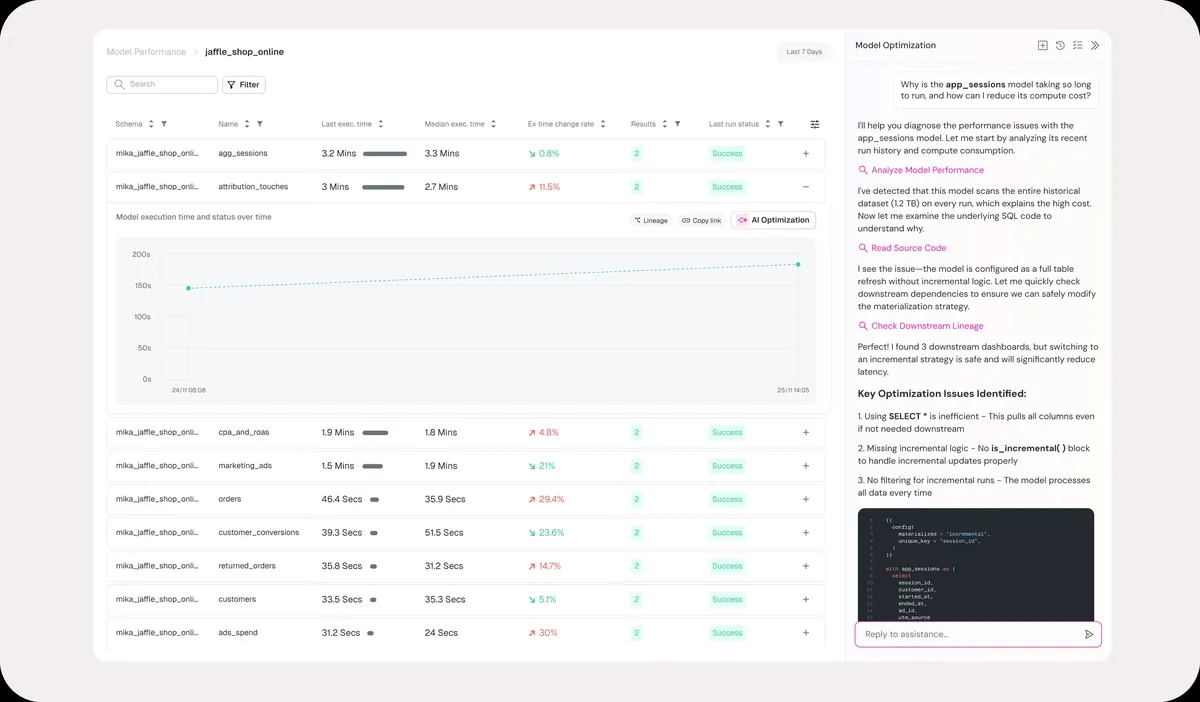
Elementary
Feature Comparison
| Feature | Alation | Elementary |
|---|---|---|
| Data Cataloging & Discovery | ||
| Data Catalog | Full-featured enterprise data catalog with natural-language search, wiki-like articles, trust markers, and 120+ pre-built connectors | Basic catalog for dbt assets with descriptions, ownership, tags, health status, and code-level documentation |
| Metadata Management | Active metadata engine with automated discovery, AI-powered curation (ALLIE AI), and behavioral analysis across the entire data estate | Code-as-source-of-truth approach where metadata is managed in dbt project files and version-controlled |
| Search & Discovery | Natural-language search powered by machine learning with usage-based ranking, trust signals, and cross-platform discovery | Conversational catalog interface where users ask about assets and get definitions, ownership, and health information |
| Data Quality & Observability | ||
| Automated Monitoring | Integrates with external data quality tools through the Open Data Quality Framework; no native monitoring | ML-based out-of-the-box monitors for freshness, volume, and schema changes with automated adjustments for seasonality and trends |
| Anomaly Detection | Not a native capability; relies on third-party integrations for anomaly detection | Built-in anomaly detection for nullness, distribution, dimensions, and completeness with configurable sensitivity |
| Alerting & Incident Management | Governance-focused notifications for policy violations and stewardship tasks | Actionable alerts routed to Slack, Teams, Opsgenie, and PagerDuty with incident grouping by related failures |
| Governance & Compliance | ||
| Data Governance | Enterprise-grade governance with centralized policies, automated stewardship, access control, data masking, and approval workflows | Policy enforcement through code-first configuration, data CI/CD to prevent breaking changes at the pull request level |
| Business Glossary | Full business glossary with standardized terms, definitions, and linkage to data assets across the organization | No dedicated business glossary; relies on dbt descriptions and tags for business context |
| Access Control | Role-based access control with data masking, approval workflows, and policy-driven permissions tied to lineage | SSO and RBAC available on Enterprise and Unlimited plans; access managed through dbt project permissions |
| Lineage & Integration | ||
| Data Lineage | End-to-end lineage visualization from source to destination with integration across BI tools and data platforms | Column-level lineage across the full stack from code to BI tools, enriched with test results and incident context |
| dbt Integration | Connector-based integration with dbt; not natively embedded in dbt workflows | dbt-native by design; the Elementary dbt package integrates directly into dbt projects for seamless workflow embedding |
| BI Tool Connectors | 120+ pre-built connectors including Tableau, Power BI, Looker, Snowflake, Redshift, and BigQuery | Integrations with Tableau, Looker, Snowflake, BigQuery, Redshift, Databricks, and BI tools through the context engine |
| AI & Automation | ||
| AI-Powered Features | Agentic workflows for automated documentation, policy enforcement, and natural-language querying of data products with metadata-aware agents | AI agents for validating data quality, triaging issues, enriching metadata, analyzing test coverage, and optimizing query performance |
| Automation Capabilities | Automated metadata extraction, pipeline code generation, workflow automation for catalog maintenance and governance | Automated monitor adjustments based on update frequency, seasonality, and trends; code-first CI/CD integration |
| MCP Server | Not verified | MCP Server exposes context layer and agents through a standard interface, making lineage and metadata available in any AI tool |
Data Cataloging & Discovery
Data Catalog
Metadata Management
Search & Discovery
Data Quality & Observability
Automated Monitoring
Anomaly Detection
Alerting & Incident Management
Governance & Compliance
Data Governance
Business Glossary
Access Control
Lineage & Integration
Data Lineage
dbt Integration
BI Tool Connectors
AI & Automation
AI-Powered Features
Automation Capabilities
MCP Server
Which approach fits
Alation and Elementary address fundamentally different layers of the data quality ecosystem. Alation is an enterprise data intelligence platform focused on cataloging, governance, and AI-ready data products for large organizations with complex data estates. Elementary is a dbt-native data observability tool built for engineering teams that need code-first monitoring, anomaly detection, and pipeline reliability. These tools complement each other more than they compete, but teams choosing between them should consider whether their primary need is enterprise data governance or pipeline-level data observability.
When each approach fits
Choose Alation if:
Choose Alation if your organization needs a comprehensive data catalog and governance platform to unify metadata across a large, complex data estate. Alation excels when you have 50 or more data contributors, regulatory compliance requirements that demand enterprise-grade lineage and access controls, and budget capacity for $200K+ annually. The platform is particularly strong for organizations that need natural-language search across hundreds of data sources, centralized policy management with automated stewardship, and AI-powered data products that enable business users to query data directly. Alation is the right choice when your primary challenge is helping people find, understand, and trust data across the organization rather than monitoring pipeline health.
Choose Elementary if:
Choose Elementary if your team runs dbt-based data pipelines and needs automated observability without the overhead of an enterprise platform. Elementary is the stronger choice for data and analytics engineers who want code-first configuration, ML-based anomaly detection, and actionable alerts routed directly to Slack or PagerDuty. The open-source dbt package lets you start monitoring in minutes with zero cost, and the cloud plans scale affordably based on seats and table count. Elementary stands out for teams that value version-controlled observability configuration, column-level lineage enriched with test results, and the ability to prevent data quality issues at the pull request stage through data CI/CD workflows.
These scenarios reflect the available product evidence. Your requirements, existing stack, and team expertise should guide the final decision.
Frequently Asked Questions
Can Alation and Elementary be used together?
Yes, Alation and Elementary serve complementary purposes and can work side by side in the same data stack. Alation handles enterprise-wide data cataloging, governance, and discovery while Elementary monitors data pipeline health, detects anomalies, and enforces quality checks within dbt workflows. Organizations often use Elementary for operational observability and Alation for strategic data governance and business user access.
Which tool is better for dbt-based data pipelines?
Elementary is purpose-built for dbt and integrates directly as a dbt package, making it the clear choice for dbt-centric teams. It leverages dbt artifacts, integrates with dbt tests from packages like dbt-expectations and dbt-utils, and manages all configuration in dbt code. Alation can connect to dbt through its connector framework but is not natively embedded in dbt workflows.
How do pricing models compare between Alation and Elementary?
Alation uses enterprise contract pricing starting at $60,000 to $198,000 per year for 25 Creator seats, with connectors, governance modules, and professional services adding to the total cost. Elementary offers a free open-source dbt package and cloud plans priced by editor seats and table count across Scale, Enterprise, and Unlimited tiers. Elementary is significantly more accessible for smaller teams and budget-conscious organizations.
Which tool has better data lineage capabilities?
Both tools offer data lineage but with different strengths. Elementary provides automated column-level lineage across the full stack from code to BI tools, enriched with test results and incident context. Alation offers end-to-end lineage visualization across its 120+ connected data sources. Elementary excels at operational lineage for debugging pipeline issues, while Alation provides broader enterprise lineage for compliance and impact analysis.
What are the deployment and implementation differences?
Elementary can be deployed in minutes as an open-source dbt package or through Elementary Cloud. Alation requires 3 to 9 months of implementation with professional services involvement, including architecture design, connector setup, and workflow customization. Teams that need fast time-to-value will find Elementary significantly quicker to operationalize.