Decision comparison
Alation vs Soda
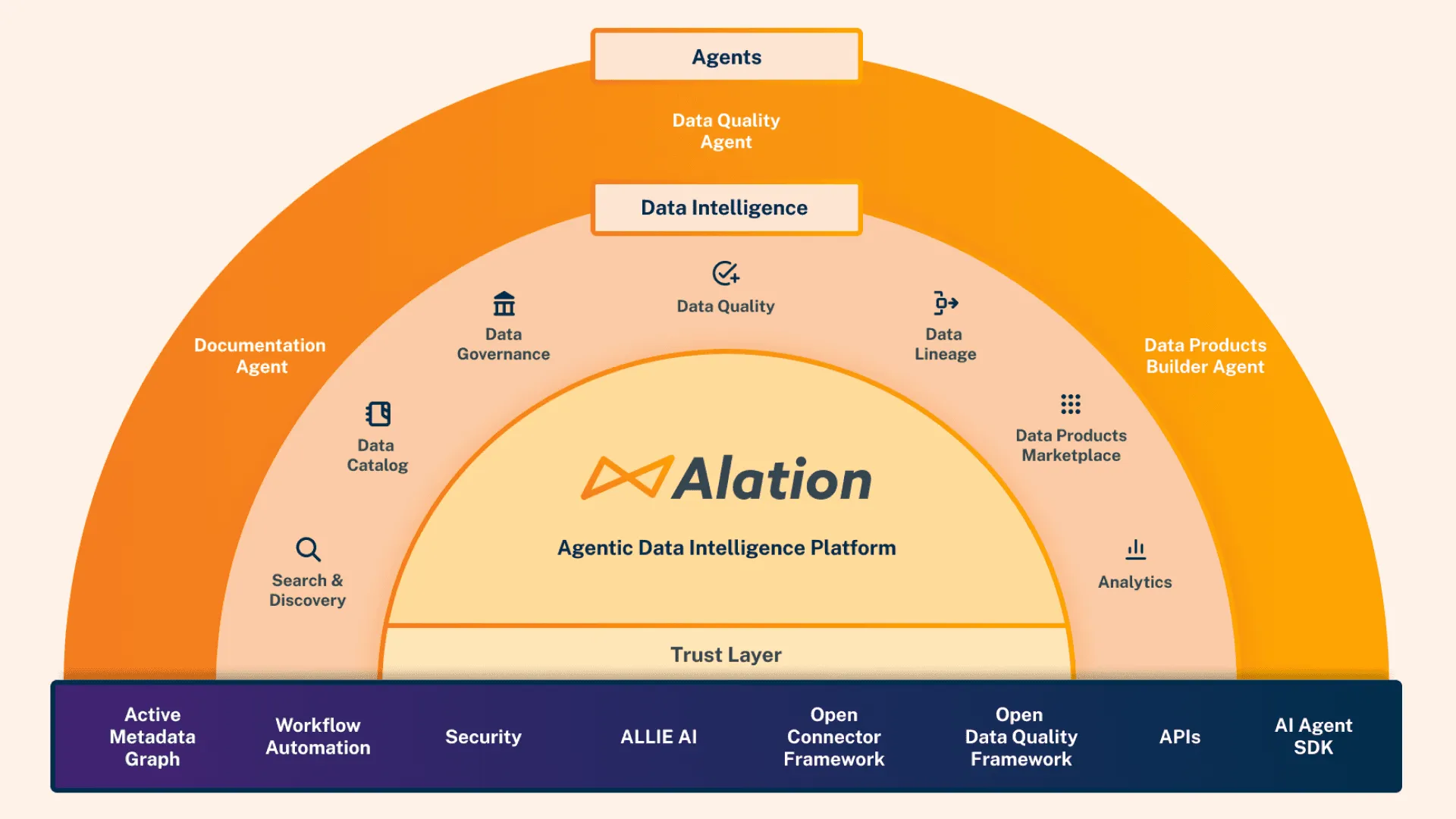
Alation and Soda serve fundamentally different roles in the modern data stack. Alation is an enterprise data intelligence platform built for cataloging, governance, and data discovery, while Soda is an AI-native data quality platform designed to detect, explain, and resolve data issues automatically. These tools are complementary rather than direct substitutes, and many organizations deploy both together.
Used together. These are normally used together rather than chosen between. The comparison explains what each one does in the stack.
These are different kinds of product — Data Catalog and Data Validation Framework.
Quick Comparison
| Decision factor | Alation | Soda |
|---|---|---|
| Primary Focus | Enterprise data intelligence platform combining cataloging, governance, lineage, and AI-powered discovery | AI-native data quality platform focused on automated detection, data contracts, and root cause analytics |
| Pricing Model | Alation publishes no pricing. alation.com/pricing resolves to a contact form, and no plan or edition names are published either, so every figure is set in a quote. | Free tier at $0 per month, Team tier at $750 per month, with enterprise features available |
| Target User | Data stewards, governance teams, and business analysts at large enterprises needing a unified data catalog | Data engineers and data teams needing automated quality checks, observability, and data contracts |
| AI Capabilities | Agentic workflows for documentation, policy enforcement, and natural-language querying of data products | AI-powered data contracts, record-level anomaly detection, and metrics monitoring with peer-reviewed algorithms |
| Deployment | Cloud (SaaS) or customer-managed on-premises; typical implementation takes 3-9 months with professional services | Cloud-based SaaS with data staying in the customer's own warehouse; faster setup in days to weeks |
| Open Source | Proprietary, closed-source platform with no open-source component | Open-source core (soda-core on GitHub, 2,000+ stars, Python-based) with commercial SaaS layer on top |
Alation
- Primary Focus:
- Enterprise data intelligence platform combining cataloging, governance, lineage, and AI-powered discovery
- Pricing Model:
- Alation publishes no pricing. alation.com/pricing resolves to a contact form, and no plan or edition names are published either, so every figure is set in a quote.
- Target User:
- Data stewards, governance teams, and business analysts at large enterprises needing a unified data catalog
- AI Capabilities:
- Agentic workflows for documentation, policy enforcement, and natural-language querying of data products
- Deployment:
- Cloud (SaaS) or customer-managed on-premises; typical implementation takes 3-9 months with professional services
- Open Source:
- Proprietary, closed-source platform with no open-source component
Soda
- Primary Focus:
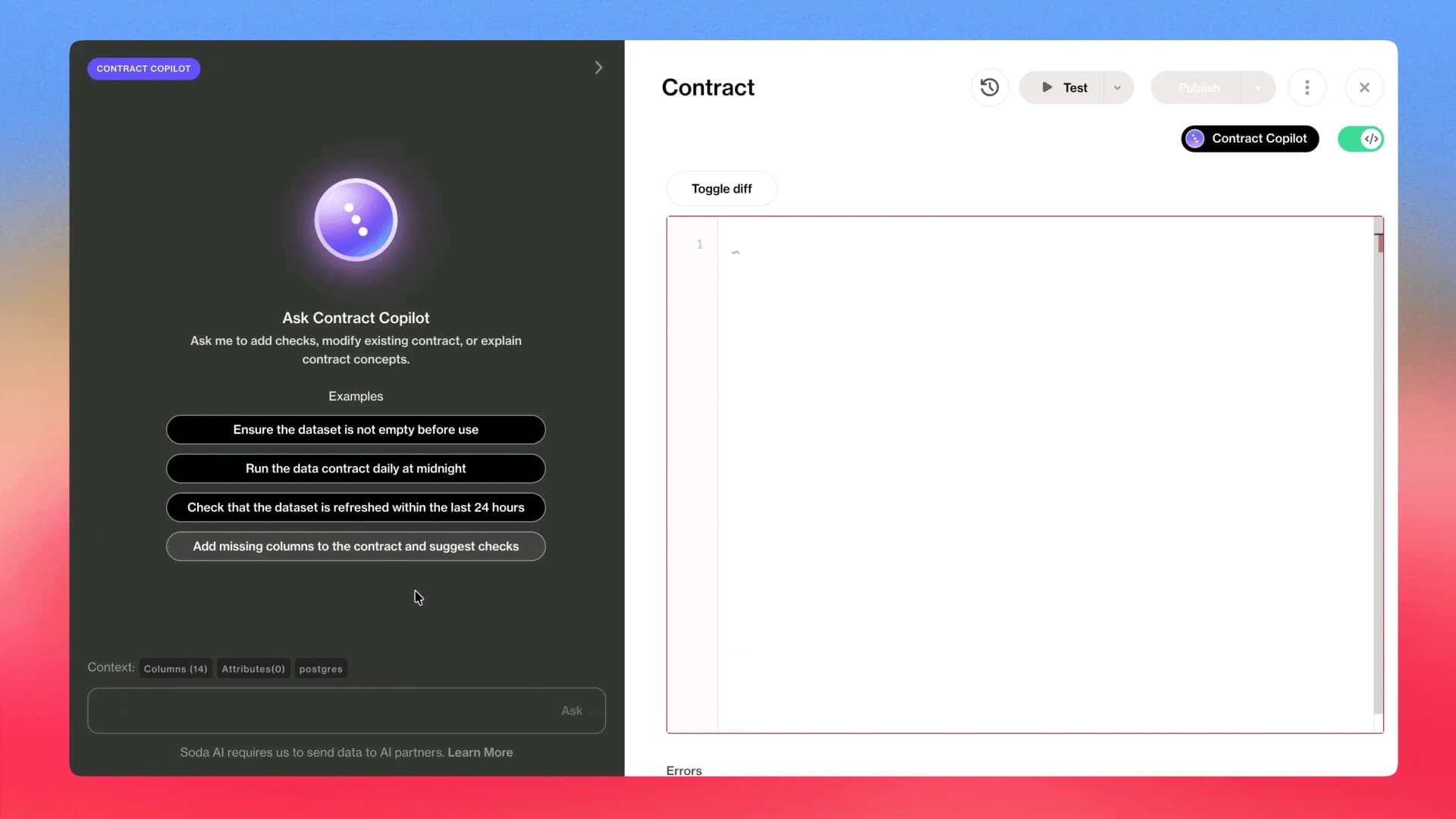
- AI-native data quality platform focused on automated detection, data contracts, and root cause analytics
- Pricing Model:
- Free tier at $0 per month, Team tier at $750 per month, with enterprise features available
- Target User:
- Data engineers and data teams needing automated quality checks, observability, and data contracts
- AI Capabilities:
- AI-powered data contracts, record-level anomaly detection, and metrics monitoring with peer-reviewed algorithms
- Deployment:
- Cloud-based SaaS with data staying in the customer's own warehouse; faster setup in days to weeks
- Open Source:
- Open-source core (soda-core on GitHub, 2,000+ stars, Python-based) with commercial SaaS layer on top
Public signals
Verified factual signals only. Bars appear only for like-for-like metrics with five weekly assessments for every tool; missing evidence stays explicit. These signals do not establish enterprise adoption, product quality, or total cost.
| Metric | Alation | Soda |
|---|---|---|
| GitHub commits, 90d(Developer adoption) | 2 | Not available |
| GitHub stars(Developer adoption) | 19 | Not available |
| Search interest(Market interest) | Unavailable | 0 |
| Product Hunt comments(Community interest) | 0 | Not available |
| Product Hunt reviews(Community interest) | 0 | Not available |
| Product Hunt votes(Community interest) | 2 | Not available |
| Stack Overflow questions(Community interest) | 12 | Not available |
| GitHub commits, 90d(Product adoption) | Not available | 96 |
| GitHub stars(Product adoption) | Not available | 2,000+ |
| PyPI weekly downloads(Product adoption) | Not available | 408.4k |
As of October 5, 2026 — updated weekly.
Health & risk evidence
Observed public-source checks for mapped package versions and repositories.
Alation
Package vulnerabilities
Not available
Repository security score
Not available
Soda
October 5, 2026Package vulnerabilities
PyPI · soda-core@4.25.0
0 vulnerabilities
across 1 package
Repository security score
Not available
Interface Preview
Alation
Soda
Feature Comparison
| Feature | Alation | Soda |
|---|---|---|
| Data Management & Discovery | ||
| Data Cataloging & Discovery | Full enterprise data catalog with natural-language search and 120+ connectors | Not available; Soda focuses on data quality, not cataloging |
| Data Lineage Tracking | End-to-end lineage from source to consumption layer | Not verified |
| Business Glossary & Collaboration | Wiki-like articles, trust markers, discussions, and a searchable business glossary | Collaboration scoped to data contracts only |
| Data Quality & Monitoring | ||
| Automated Data Quality Checks | Integrates with third-party quality tools via Open Data Quality Framework | Core strength: automated checks from table to record level |
| Record-Level Anomaly Detection | Not verified | Detects anomalies at the individual row level with high precision |
| Metrics Monitoring & Observability | Not available as built-in capability | Monitors thousands of tables with smart thresholds; claims 70% fewer false positives than Facebook Prophet |
| Backfilling & Backtesting Historical Data | Not verified | Built-in backfilling and backtesting to analyze up to one year of historical data |
| Root Cause Analytics & Diagnostics | Not verified | Automatically stores failed records in a diagnostics warehouse for root cause analysis |
| Governance & Contracts | ||
| Data Governance & Policy Management | Centralized policies, automated stewardship, access controls, and masking across the data estate | Governance scoped to data contracts; no broad policy management |
| Data Contracts Engine | Not available natively | Collaborative contracts with Git-based engineering workflow and no-code UI for business users |
| AI & Integration | ||
| AI-Powered Natural Language Querying | Users ask questions of data products in natural language; metadata-aware agents handle SQL | Not verified |
| BI Tool Integration (Slack, Teams, Excel) | Alation Anywhere brings data context into Excel, Slack, Teams, Tableau, and PowerBI | Integrates with alerting and ticketing tools but not BI tools directly |
| SQL Editor / Query Sharing | Compose: built-in SQL editor for writing, sharing, and reusing queries | Not verified |
| Accessibility & Openness | ||
| Free Tier Available | No free tier; enterprise contracts required | Free tier at $0/month for small projects with no credit card required |
| Open-Source Component | Fully proprietary; no open-source component | soda-core on GitHub (2,000+ stars, Python, actively maintained) |
Data Management & Discovery
Data Cataloging & Discovery
Data Lineage Tracking
Business Glossary & Collaboration
Data Quality & Monitoring
Automated Data Quality Checks
Record-Level Anomaly Detection
Metrics Monitoring & Observability
Backfilling & Backtesting Historical Data
Root Cause Analytics & Diagnostics
Governance & Contracts
Data Governance & Policy Management
Data Contracts Engine
AI & Integration
AI-Powered Natural Language Querying
BI Tool Integration (Slack, Teams, Excel)
SQL Editor / Query Sharing
Accessibility & Openness
Free Tier Available
Open-Source Component
How they fit together
Alation and Soda serve fundamentally different roles in the modern data stack. Alation is an enterprise data intelligence platform built for cataloging, governance, and data discovery, while Soda is an AI-native data quality platform designed to detect, explain, and resolve data issues automatically. These tools are complementary rather than direct substitutes, and many organizations deploy both together.
What each one handles
Use Alation for:
Choose Alation when your organization needs a centralized data catalog, enterprise-grade governance, and natural-language data discovery across a complex data estate. Alation excels at making data findable, understandable, and trustworthy for both technical and business users. The platform is best suited for large enterprises with 50+ data contributors, mature governance programs, and large governance budgets. With 120+ pre-built connectors, end-to-end lineage, and recognition as a 5X Leader in Gartner's Magic Quadrant for Metadata Management, Alation delivers comprehensive data intelligence. However, be prepared for a 3-9 month implementation timeline and significant total cost of ownership that includes connectors, add-on modules, and professional services.
Use Soda for:
Choose Soda when your primary challenge is ensuring data quality and reliability across your pipelines. Soda excels at automated data quality checks, data contracts, and record-level anomaly detection with AI that has been validated through peer-reviewed research published in NeurIPS, JAIR, and ACML. The freemium pricing model with a $0/month free tier and Team plan at $750/month makes Soda accessible to teams of all sizes. The open-source soda-core library (2,335 GitHub stars) allows engineers to run quality checks as code while business users work through the no-code interface. Soda deploys in days rather than months and keeps data in your own warehouse for security. It is the stronger choice for data engineering teams that need fast, automated quality enforcement without the overhead of a full data catalog.
These roles reflect the available product evidence. Most teams run both; which one owns a given job depends on your stack and team.
Frequently Asked Questions
Can Alation and Soda be used together?
Yes. Alation and Soda address different layers of the data stack and work well as complements. Alation provides the data catalog, governance, and discovery layer, while Soda handles automated data quality checks and monitoring. Alation even offers an Open Data Quality Framework that allows integration with third-party quality tools. Organizations often use Soda to enforce data quality standards and pipe those results into Alation for a unified view of data health alongside governance and lineage.
Which tool is more cost-effective for small to mid-sized data teams?
Soda is significantly more affordable for smaller teams. It offers a free tier at $0/month and a Team plan at $750/month, making it accessible without large upfront commitments. Alation publishes no prices and quotes every contract. For teams evaluating a lighter-weight data-quality workflow, compare the relevant plans and implementation scope directly with both vendors.
Does Soda offer data cataloging or governance features?
Soda does not provide a data catalog or broad governance capabilities. Its governance features are scoped to data contracts, which allow teams to define and enforce data quality expectations collaboratively. For full data cataloging, discovery, lineage, and enterprise governance, organizations pair Soda with a dedicated catalog platform like Alation or an alternative.
How do the implementation timelines compare?
Soda deploys much faster than Alation. Soda can be set up in days to weeks, with its open-source soda-core library available for immediate use by data engineers. Alation deployments typically require 3-9 months with professional services involvement, including architecture design, connector setup, workflow customization, and training. Organizations that need quick time-to-value will find Soda significantly faster to operationalize.
Which tool has stronger AI capabilities?
Both tools invest heavily in AI, but in different domains. Alation uses agentic AI workflows to automate documentation, enforce policies, and enable natural-language querying of data products. Soda applies AI to data quality specifically, with AI-powered data contracts, record-level anomaly detection, and metrics monitoring algorithms that claim 70% fewer false positives than Facebook Prophet. Soda's AI research has been published in peer-reviewed venues including NeurIPS, JAIR, and ACML.