Soda: product and architecture
Our decision: Soda is a strong choice for data engineering teams that want a shared, automation-oriented data quality workflow without forcing engineers and business users into separate tools. This Soda review finds the product most compelling where teams need to detect issues, investigate down to record level, and coordinate remediation through one platform; its $750-per-month Team plan makes it a deliberate investment rather than a casual add-on for tiny projects.
Overview
Soda positions Soda 4.0 as an AI-native, fully automated data quality platform focused on catching, explaining, and resolving quality issues as they appear. Its stated scope runs from table-level detection to record-level investigation, which matters because a useful quality program must move beyond alerting to identifying the affected data. The platform is built around a shared workflow: engineers run Soda as code, while business users work in an interface.
That split is one of Soda’s most practical differentiators. Data engineers can keep quality controls close to their development workflow, while business stakeholders can participate without being required to author code. We recommend Soda for organizations that need those groups to operate in the same quality process, particularly when quality ownership is distributed across technical and business teams.
Soda’s public repository reinforces its technical orientation. The repository uses Python as its primary language, carries 2,410 GitHub stars, and lists topics including data contracts, data engineering, data governance, data monitoring, data observability, data profiling, and data-quality checks. Those are useful public adoption signals, but they are not proof of enterprise deployment depth or operational fit.
The tool is not positioned as a generic dashboard layer. Soda’s own framing is explicit: it aims to stop incidents before they reach production, automate detection through resolution, and meet users in both code and an interface. That focus is valuable for teams with a real data-quality operating model; it is less compelling for a team that only wants occasional manual validation.
Key Features and Architecture
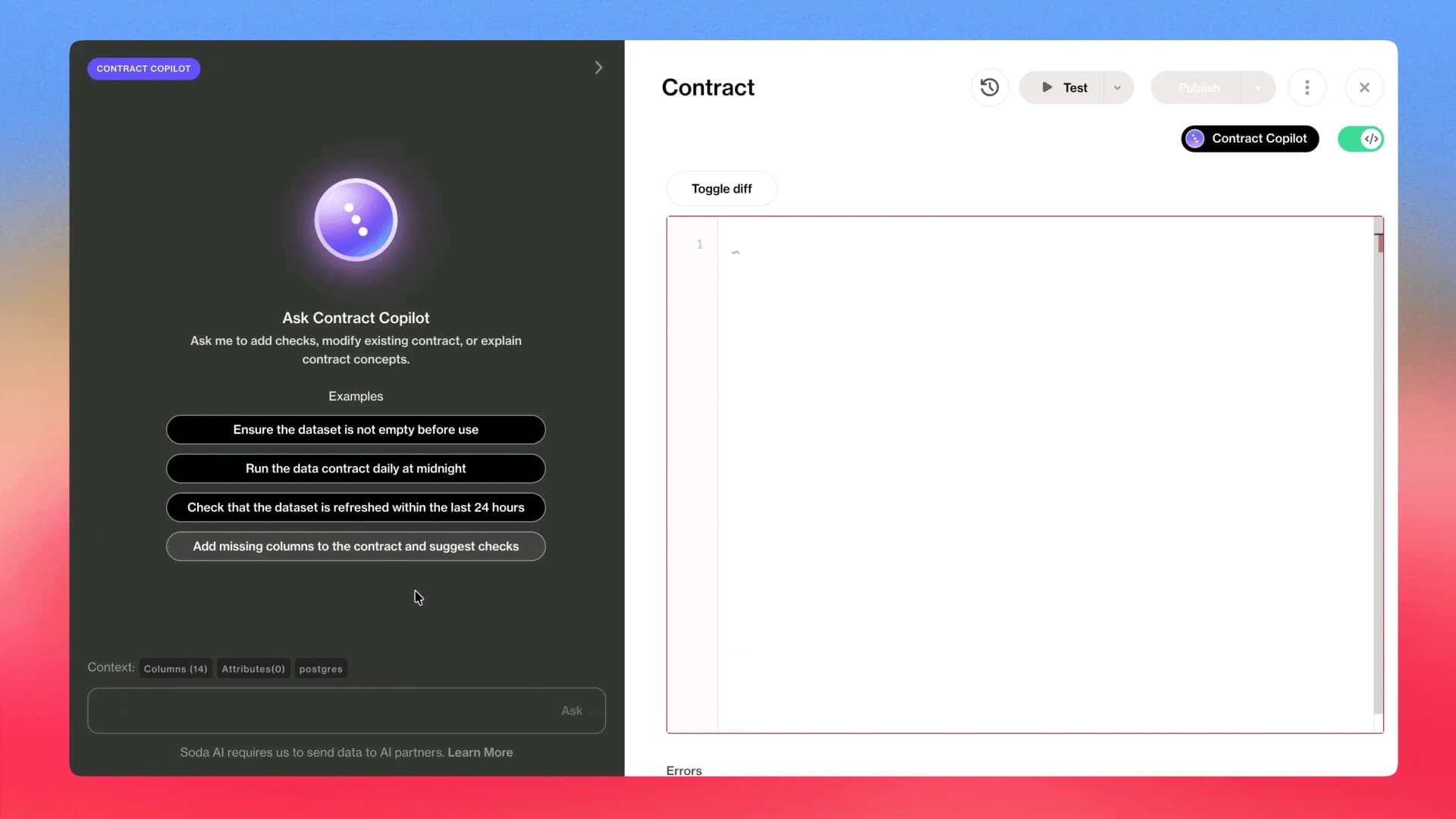
Soda’s core architecture combines a code-driven engine with an interface-driven collaboration model. Engineers can run quality work “as code,” giving technical teams a direct mechanism to express and operate checks in their engineering workflow. Meanwhile, business users can work through Soda’s interface, allowing the same quality process to include users who need visibility and participation but do not write code.
Key capabilities described for Soda include:
- Pipeline testing: Soda includes pipeline testing in its Free offering. This supports checking data quality as part of pipeline-oriented work rather than treating quality as a separate, retrospective activity.
- Metrics observability: The platform provides metrics observability, giving teams a mechanism to follow data-quality signals over time. The supplied product information does not specify retained metric history, sampling behavior, or threshold configuration, so those details should be validated in a technical evaluation.
- Alerting and ticketing integrations: Soda includes alerting and ticketing integrations on the Free plan. This is operationally important because quality findings need to reach the people responsible for investigation and remediation.
- Data contracts: The Team tier includes collaborative data contracts. This aligns Soda with teams that want quality expectations to be agreed across producers and consumers, not merely enforced by a central platform group.
- No-code interface: Soda’s Team plan provides a no-code interface, matching the product’s stated goal of uniting business and engineering in one workflow. The trade-off is that teams still need clear ownership: a collaborative interface does not decide which standards are correct.
- Advanced AI-powered data quality features: These are included in Team. Soda’s stated product direction is AI-powered automation from detection to resolution, but the supplied material does not define the model behavior, decision logic, or human-review controls.
- Record-level investigation: Soda states that it works from table to record level. That is a meaningful capability because a table-level signal alone is often insufficient for diagnosing an incident.
Soda’s repository describes itself as a “Data Contracts engine for the modern data stack,” which fits the product’s emphasis on contracts and engineering workflows. Its latest listed release is v4.21.0, dated 2026-08-13, and the last repository push is also dated 2026-08-13. These facts indicate recent public repository activity, though they do not establish support commitments or release quality.
Licensing is a material caveat. The repository’s license is listed as NOASSERTION, so teams considering direct repository use should not assume a conventional open-source license grant from that metadata alone. Avoid basing a production adoption decision on the repository’s availability without clarifying the applicable licensing and commercial terms.
Ideal Use Cases
Soda fits best when data quality must be operated as a cross-functional process rather than an isolated engineering script. A 5-to-15-person data engineering organization supporting several analytics consumers can use its code-based workflow to keep checks near technical delivery, while a no-code interface gives analysts or business data owners a way to engage with the same process. The practical benefit is shared visibility; the cost is that teams must establish who triages alerts and who approves data-contract expectations.
A second strong fit is a product-data environment where incidents must be caught before production impact and investigations need to reach record-level detail. For example, a data team responsible for pipelines that feed customer-facing reporting, operational workflows, or downstream products has a clear reason to connect pipeline testing, metrics observability, alerting, and ticketing integrations. Soda is particularly relevant when the operational goal is not simply “run checks,” but “detect, explain, and resolve” a quality issue through a documented workflow.
A third fit is a company formalizing data contracts across producer and consumer teams. Soda’s Team plan includes collaborative data contracts, audit logs, custom roles, role-based access control (RBAC), single sign-on (SSO), and private deployment. That combination is suited to a larger or more controlled organization where ownership, access boundaries, and auditability are part of the data-quality requirement rather than afterthoughts.
Soda also works for a small project starting with basic needs. The Free tier costs $0 per month, requires no credit card, includes unlimited users, and includes Free Soda Processing Units (SPUs), pipeline testing, metrics observability, and alerting and ticketing integrations. That makes it reasonable to evaluate Soda before adopting paid capabilities, though the supplied pricing information does not specify the number of included SPUs.
Don’t use Soda if your only requirement is a one-off validation script and your team has no need for alerting, observability, contracts, or collaborative remediation. Its value comes from operating data quality continuously across technical and business users. Also avoid treating its AI-powered positioning as a substitute for governance decisions: teams still need to define acceptable data, ownership, escalation paths, and release standards.
Strengths & Trade-offs
Soda’s strengths are concentrated in its ability to connect technical quality controls with a broader remediation workflow. That makes it more substantive than a tool that only surfaces metrics, but it also means the tool pays off most when an organization has people and processes ready to act on findings. In our evaluation, the clearest advantages are operational rather than cosmetic.
Pros
- One shared technical and business workflow: Engineers can run Soda as code while business users can work through an interface. This directly supports teams where data owners need to participate without becoming code authors.
- Detection through record-level investigation: Soda explicitly covers work from table level to record level. That is more useful than a high-level alert alone when responders need to locate affected records.
- Action-oriented Free plan: At $0 per month, Free includes pipeline testing, metrics observability, alerting and ticketing integrations, unlimited users, and no credit card requirement. It gives teams a practical way to evaluate an operating workflow before committing to $750 per month.
- Governance features in Team: Collaborative data contracts, audit logs, custom roles, RBAC, SSO, and private deployment give Soda a credible fit for teams that need controlled, auditable access rather than an informal quality tool.
- Recent public repository release: Soda’s listed latest release is v4.21.0 on 2026-08-13, with a repository push on the same date. That is a concrete public activity signal for the Python-based repository.
Cons
- The paid starting point is substantial for small teams: Team is $750 per month before any pay-as-you-go additional SPUs or add-ons. A team with simple validation needs may struggle to justify that spend.
- Free usage limits are not numerically disclosed: The Free tier includes Free SPUs, but the provided information does not state how many. Planning production coverage without a defined allowance is difficult.
- AI functionality is underspecified: Team includes advanced AI-powered data-quality features, but the supplied material does not define the automation’s boundaries, controls, or evaluation criteria. Teams with strict governance requirements need those answers before relying on automated resolution workflows.
- Repository licensing is unclear: The public repository’s
NOASSERTIONlicense metadata is a real limitation for direct code adoption. Teams cannot safely infer standard open-source rights from the repository listing. - Enterprise pricing is not published: Soda identifies enterprise availability but provides no named Enterprise plan or dollar amount. Organizations requiring a firm total-cost model will need a vendor conversation.