Decision comparison
Bigeye vs Soda
Bigeye and Soda represent two distinct approaches to data quality and trust. Bigeye is the stronger choice for large enterprises that need a unified AI trust platform combining data observability, end-to-end lineage, sensitive data discovery, and AI governance under one roof. Soda wins for data engineering teams that want collaborative data contracts, an open-source foundation, and accessible pricing starting at $0/mo. Bigeye excels when you need to trace data issues across complex legacy and modern pipelines with full lineage mapping, while Soda excels when your priority is developer-friendly, code-based data quality automation with AI-powered detection and remediation. Your decision comes down to whether you need enterprise-wide data trust governance or focused data quality engineering with a collaborative contract-based workflow.
Architecture choice. These take different approaches to the same problem. Read the table as a fit question rather than a feature race.
These are different kinds of product — Data Observability and Data Validation Framework.
Quick Comparison
| Decision factor | Bigeye | Soda |
|---|---|---|
| Best For | Large enterprises needing a unified AI trust platform combining data observability, end-to-end lineage, sensitive data discovery, and AI governance | Data engineering teams that want collaborative data contracts, open-source foundations, and AI-powered data quality automation from table to record level |
| Architecture | Closed-source SaaS platform with lineage-enabled data observability, metadata management, and AI Guardian runtime enforcement modules | Open-source core (Python) with commercial SaaS layer; engineers write checks as code while business users operate through a no-code interface |
| Pricing Model | Contact for pricing | Free tier at $0 per month, Team tier at $750 per month, with enterprise features available |
| Ease of Use | Intuitive UI for creating freshness and volume checks; SQL knowledge helpful for advanced configurations; some workspace management clutter reported | Dual interface approach with code-based checks for engineers and no-code interface for business users; collaborative data contracts unite both workflows |
| Scalability | Built for the world's largest enterprises with support for both modern and legacy data stacks across cloud and on-prem environments | Monitors thousands of tables in seconds; AI-powered detection to resolution; scales from small projects on the free tier to enterprise deployments |
| Community/Support | Highly rated customer support with responsive team; no open-source component; enterprise-focused documentation and onboarding | Open-source project with 2,335 GitHub stars; active Python community; peer-reviewed AI research published in NeurIPS, JAIR, and ACML |
Bigeye
- Best For:
- Large enterprises needing a unified AI trust platform combining data observability, end-to-end lineage, sensitive data discovery, and AI governance
- Architecture:
- Closed-source SaaS platform with lineage-enabled data observability, metadata management, and AI Guardian runtime enforcement modules
- Pricing Model:
- Contact for pricing
- Ease of Use:
- Intuitive UI for creating freshness and volume checks; SQL knowledge helpful for advanced configurations; some workspace management clutter reported
- Scalability:
- Built for the world's largest enterprises with support for both modern and legacy data stacks across cloud and on-prem environments
- Community/Support:
- Highly rated customer support with responsive team; no open-source component; enterprise-focused documentation and onboarding
Soda
- Best For:
- Data engineering teams that want collaborative data contracts, open-source foundations, and AI-powered data quality automation from table to record level
- Architecture:
- Open-source core (Python) with commercial SaaS layer; engineers write checks as code while business users operate through a no-code interface
- Pricing Model:
- Free tier at $0 per month, Team tier at $750 per month, with enterprise features available
- Ease of Use:
- Dual interface approach with code-based checks for engineers and no-code interface for business users; collaborative data contracts unite both workflows
- Scalability:
- Monitors thousands of tables in seconds; AI-powered detection to resolution; scales from small projects on the free tier to enterprise deployments
- Community/Support:
- Open-source project with 2,335 GitHub stars; active Python community; peer-reviewed AI research published in NeurIPS, JAIR, and ACML
Public signals
Verified factual signals only. Bars appear only for like-for-like metrics with five weekly assessments for every tool; missing evidence stays explicit. These signals do not establish enterprise adoption, product quality, or total cost.
| Metric | Bigeye | Soda |
|---|---|---|
| Search interest(Market interest) | Unavailable | 0 |
| Hacker News mentions, 90d(Community interest) | 0 | Not available |
| PyPI weekly downloads(Developer adoption) | 5.3k | Not available |
| GitHub commits, 90d(Product adoption) | Not available | 81 |
| GitHub stars(Product adoption) | Not available | 2,000+ |
| PyPI weekly downloads(Product adoption) | Not available | 405.8k |
As of September 21, 2026 — updated weekly.
Health & risk evidence
Observed public-source checks for mapped package versions and repositories.
Bigeye
September 21, 2026Package vulnerabilities
PyPI · bigeye-sdk@0.11.12
0 vulnerabilities
across 1 package
Repository security score
Not available
Soda
September 21, 2026Package vulnerabilities
PyPI · soda-core@4.24.0
0 vulnerabilities
across 1 package
Repository security score
Not available
Interface Preview
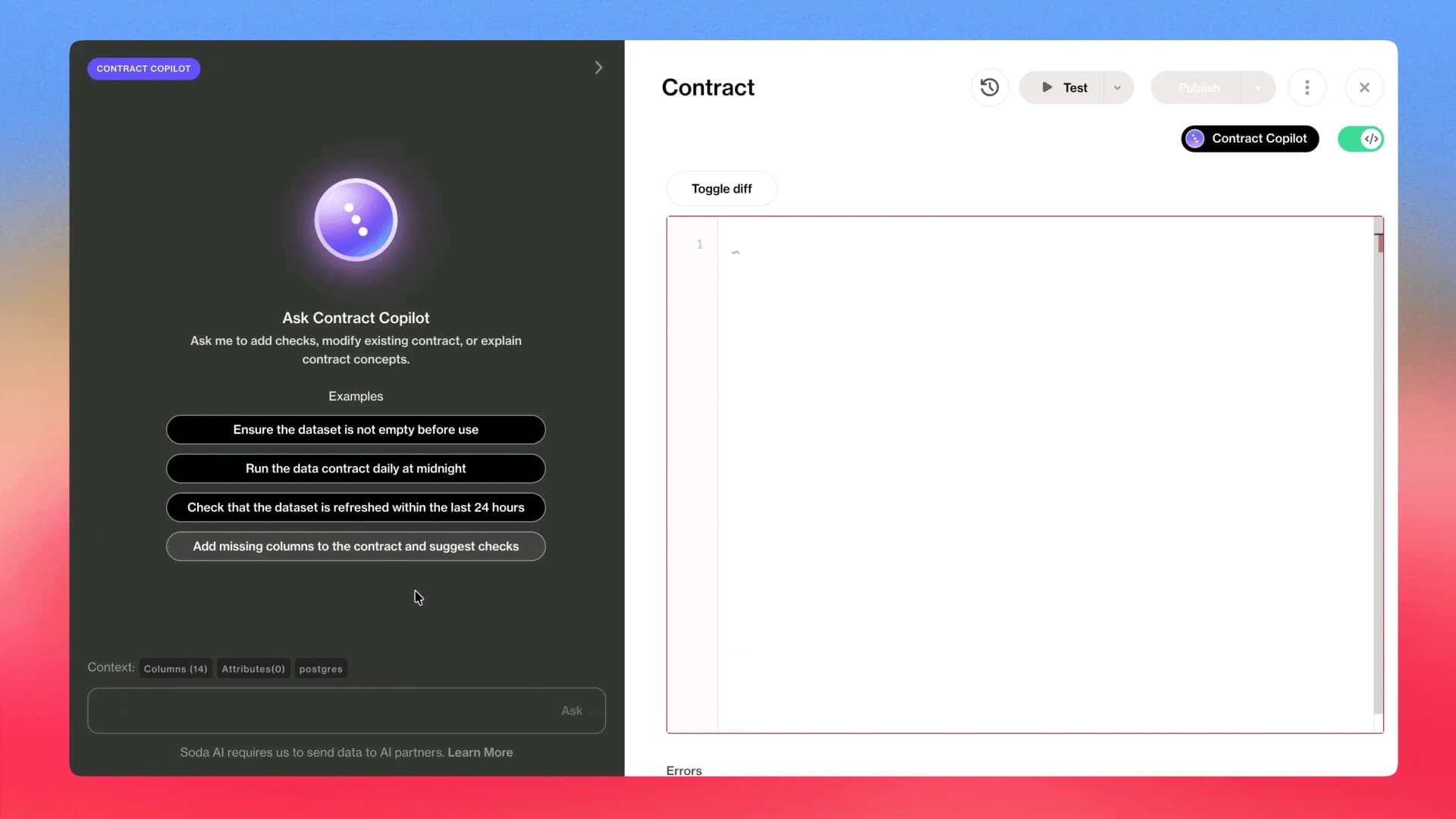
Soda
Feature Comparison
| Feature | Bigeye | Soda |
|---|---|---|
| Data Quality Monitoring | ||
| Anomaly Detection | Machine learning models monitor freshness, volume, and schema changes in real time; reinforcement learning fine-tunes alerts based on user feedback to reduce false alarms | Record-level anomaly detection powered by peer-reviewed AI algorithms published in NeurIPS and JAIR; detects issues the moment they appear |
| Data Contracts | Not a core feature; focuses on observability-driven quality monitoring and governance policies rather than contract-based workflows | Collaborative AI-powered data contracts with automated generation and refinement; engineers and business users share one contract workflow |
| Schema Monitoring | Automated schema change detection included in data observability module with lineage-aware impact analysis | Schema checks available as part of the data contract definition; validated alongside freshness and column-level checks |
| Data Observability | ||
| Data Lineage | End-to-end lineage for enterprise environments with the broadest range of connectivity for modern and legacy data stacks; visual lineage graphs trace errors to root causes | Not a core capability; focuses on data quality checks and contracts rather than full pipeline lineage mapping |
| Root Cause Analysis | Lineage-enabled root cause analysis that traces data issues across the full pipeline to identify upstream sources of failures | AI-powered detection to resolution workflow that explains and helps resolve data quality issues automatically |
| Pipeline Monitoring | Proactive alerts and monitoring across data pipelines with Slack integration for real-time notifications to data engineering teams | Pipeline testing with alerting and ticketing integrations; supports metrics observability in the free tier |
| Governance and Security | ||
| Sensitive Data Discovery | Automatically finds hidden PII, PHI, PCI, and other sensitive data in both structured and unstructured environments; reduces regulatory risk | Not a dedicated feature; focuses on data quality rather than sensitive data scanning and classification |
| AI Governance | AI Guardian provides runtime enforcement of data access policies, ensuring AI applications only access trustworthy data; supports EU AI Act and ISO 42001 | Not a dedicated AI governance module; AI capabilities focus on data quality automation and anomaly detection |
| Access Controls | Role-based access controls with auditable logging trail for governance and compliance in regulated industries like finance and healthcare | Audit logs, custom roles, and RBAC available in Enterprise tier; SSO and private deployment options included |
| Developer Experience | ||
| Open-Source Availability | Fully closed-source commercial platform; no open-source component available | Open-source core written in Python with 2,000+ GitHub stars; active development with latest release v4.7.0 in April 2026 |
| Code-Based Configuration | UI-driven configuration with SQL support for custom checks; no dedicated checks-as-code workflow | Engineers define checks as YAML code within data contracts; integrates with dbt, Snowflake, and modern data stack tools |
| Bad Data Remediation | Identifies issues through observability alerts; remediation handled through manual triage and resolution workflows | Automatically isolates, manages, and fixes bad data at the source within your environment; supports backfilling and backtesting for historical analysis |
| Platform and Integrations | ||
| Data Warehouse Support | Connectors to Snowflake, Databricks, and major cloud storage solutions; supports both modern cloud and legacy on-prem data stacks | Integrations with Snowflake, Unity Catalog, and the broader modern data stack; catalog integrations available as add-ons |
| Metadata Management | Full metadata management module with data cataloging, tags, owners, data domains, business glossary, and semantic layer creation | Focused on data quality metadata within contracts; does not include a standalone data catalog or metadata management module |
| Deployment Options | Cloud-hosted SaaS platform designed for enterprise deployment with support for hybrid environments | Cloud SaaS with private deployment option in Enterprise tier; open-source core can be self-hosted |
Data Quality Monitoring
Anomaly Detection
Data Contracts
Schema Monitoring
Data Observability
Data Lineage
Root Cause Analysis
Pipeline Monitoring
Governance and Security
Sensitive Data Discovery
AI Governance
Access Controls
Developer Experience
Open-Source Availability
Code-Based Configuration
Bad Data Remediation
Platform and Integrations
Data Warehouse Support
Metadata Management
Deployment Options
Which approach fits
Bigeye and Soda represent two distinct approaches to data quality and trust. Bigeye is the stronger choice for large enterprises that need a unified AI trust platform combining data observability, end-to-end lineage, sensitive data discovery, and AI governance under one roof. Soda wins for data engineering teams that want collaborative data contracts, an open-source foundation, and accessible pricing starting at $0/mo. Bigeye excels when you need to trace data issues across complex legacy and modern pipelines with full lineage mapping, while Soda excels when your priority is developer-friendly, code-based data quality automation with AI-powered detection and remediation. Your decision comes down to whether you need enterprise-wide data trust governance or focused data quality engineering with a collaborative contract-based workflow.
When each approach fits
Choose Bigeye if:
Choose Bigeye when your organization is a large enterprise with complex data environments spanning both modern cloud platforms and legacy on-prem systems. Bigeye is the right fit when you need a unified platform that goes beyond data quality monitoring to include end-to-end data lineage, sensitive data discovery for PII/PHI/PCI compliance, and AI governance with runtime policy enforcement. We recommend Bigeye for teams in regulated industries like finance and healthcare where auditable governance trails and compliance with frameworks like the EU AI Act and ISO 42001 are critical requirements. Bigeye also stands out when your organization is scaling AI initiatives and needs to ensure AI applications only access trustworthy, policy-compliant data through its AI Guardian module.
Choose Soda if:
Choose Soda when your data engineering team values an open-source foundation, collaborative data contracts, and a developer-friendly checks-as-code workflow. Soda is ideal for teams that want to start monitoring data quality without upfront cost on its free tier and scale to the $750/mo Team plan as needs grow. We recommend Soda for organizations where both engineers and business stakeholders need to participate in data quality workflows through its dual code and no-code interface. Soda is particularly strong when you need record-level anomaly detection backed by peer-reviewed AI research, automatic bad data isolation and remediation at the source, and native integration with modern data stack tools like dbt and Snowflake.
These scenarios reflect the available product evidence. Your requirements, existing stack, and team expertise should guide the final decision.
Frequently Asked Questions
What is the main difference between Bigeye and Soda?
Bigeye is an enterprise AI trust platform that combines data observability, end-to-end lineage, sensitive data discovery, and AI governance into a unified solution for large organizations. Soda is an AI-native data quality platform focused on collaborative data contracts, automated checks, and record-level anomaly detection with an open-source core. The fundamental difference is scope: Bigeye provides broad data trust and governance capabilities, while Soda focuses deeply on data quality automation with a developer-friendly approach.
How do Bigeye and Soda compare on pricing?
Soda offers a transparent pricing structure with a free tier at $0/mo that includes pipeline testing, metrics observability, and alerting integrations. Its Team tier costs $750/mo and adds collaborative data contracts, a no-code interface, and advanced AI features. Bigeye uses enterprise pricing with custom quotes and does not publish specific dollar amounts. Multiple reviews describe Bigeye as a premium service that may be cost-prohibitive for smaller organizations but delivers strong value for large enterprises with complex data environments.
Which tool is better for data engineering teams that work with code?
Soda is the stronger choice for code-oriented data engineering teams. Its open-source core is written in Python with 2,335 GitHub stars, and engineers define data quality checks as YAML code within data contracts. Soda integrates natively with dbt, Snowflake, and modern data stack tools. Bigeye is primarily UI-driven with SQL support for custom checks but does not offer a dedicated checks-as-code workflow or open-source component.
Does Bigeye or Soda offer better data lineage capabilities?
Bigeye has significantly stronger data lineage capabilities. It provides end-to-end lineage for enterprise environments with the broadest range of connectivity for both modern and legacy data stacks. Bigeye's visual lineage graphs allow you to trace errors back to their root causes across the full pipeline. Soda does not position data lineage as a core feature and instead focuses on data quality checks, contracts, and automated remediation workflows.
Can Soda and Bigeye handle AI governance requirements?
Bigeye offers dedicated AI governance through its AI Guardian module, which provides runtime enforcement of data access policies to ensure AI applications only access trustworthy data. It supports compliance with the EU AI Act and ISO 42001. Soda does not include a dedicated AI governance module; its AI capabilities focus on powering data quality automation, anomaly detection, and data contract generation rather than governing AI application data access.