Decision comparison
Bigeye vs Elementary
Bigeye and Elementary address data observability from opposite ends of the market. Bigeye is an enterprise AI trust platform that combines data observability with lineage, governance, sensitive data discovery, and AI policy enforcement in a single managed solution built for large organizations with complex, hybrid data stacks. Elementary is a dbt-native observability platform that starts with a free open-source package and scales through cloud tiers, built for data engineers who want code-first configuration, column-level lineage, and deep dbt integration. The right choice depends on whether you need enterprise-wide data governance and sensitivity scanning or a developer-centric observability tool that lives in your dbt codebase.
Direct comparison. These are reviewed substitutes bought for the same job, so the differences below are the ones that decide between them.
All 2 are data observability.
Quick Comparison
| Decision factor | Bigeye | Elementary |
|---|---|---|
| Best For | Large enterprises needing unified data observability, lineage, governance, and AI trust | dbt-centric data teams seeking code-first observability |
| Deployment | SaaS cloud platform with enterprise contracts | Self-hosted (open-source dbt package) or Elementary Cloud |
| Pricing Model | Contact for pricing | Elementary publishes no amounts. Its open-source dbt package is free and self-hosted. Elementary Cloud is priced by seats and environments: Scale covers up to 10 editor seats and 1K tables, Enterprise up to 20 editor and 40 viewer seats and 3K tables, and Unlimited removes the seat caps; extra tables are charged per additional 1K. A free trial covers the Essentials feature set. Every paid tier is quote-only. |
| Open Source | No | Yes (Apache-2.0, 2,000+ GitHub stars) |
| dbt Integration | Supports dbt as one of many pipeline integrations | dbt-native by design; open-source package integrates directly into dbt projects |
| Learning Curve | Moderate; intuitive core UI but advanced configurations require SQL knowledge | Low for dbt users; configurations live in existing dbt codebase |
Bigeye
- Best For:
- Large enterprises needing unified data observability, lineage, governance, and AI trust
- Deployment:
- SaaS cloud platform with enterprise contracts
- Pricing Model:
- Contact for pricing
- Open Source:
- No
- dbt Integration:
- Supports dbt as one of many pipeline integrations
- Learning Curve:
- Moderate; intuitive core UI but advanced configurations require SQL knowledge
Elementary
- Best For:
- dbt-centric data teams seeking code-first observability
- Deployment:
- Self-hosted (open-source dbt package) or Elementary Cloud
- Pricing Model:
- Elementary publishes no amounts. Its open-source dbt package is free and self-hosted. Elementary Cloud is priced by seats and environments: Scale covers up to 10 editor seats and 1K tables, Enterprise up to 20 editor and 40 viewer seats and 3K tables, and Unlimited removes the seat caps; extra tables are charged per additional 1K. A free trial covers the Essentials feature set. Every paid tier is quote-only.
- Open Source:
- Yes (Apache-2.0, 2,000+ GitHub stars)
- dbt Integration:
- dbt-native by design; open-source package integrates directly into dbt projects
- Learning Curve:
- Low for dbt users; configurations live in existing dbt codebase
Public signals
Verified factual signals only. Bars appear only for like-for-like metrics with five weekly assessments for every tool; missing evidence stays explicit. These signals do not establish enterprise adoption, product quality, or total cost.
| Metric | Bigeye | Elementary |
|---|---|---|
| Hacker News mentions, 90d(Community interest) | 0 | Not available |
| PyPI weekly downloads(Developer adoption) | 5.5k | Not available |
| GitHub commits, 90d(Product adoption) | Not available | 73 |
| GitHub stars(Product adoption) | Not available | 2,000+ |
| PyPI weekly downloads(Product adoption) | Not available | 214.3k |
As of October 19, 2026 — updated weekly.
Health & risk evidence
Observed public-source checks for mapped package versions and repositories.
Bigeye
October 19, 2026Package vulnerabilities
PyPI · bigeye-sdk@0.11.15
0 vulnerabilities
across 1 package
Repository security score
Not available
Elementary
October 19, 2026Package vulnerabilities
PyPI · elementary-data@0.26.1
0 vulnerabilities
across 1 package
Repository security score
github.com/elementary-data/elementary
7.5/10
Interface Preview
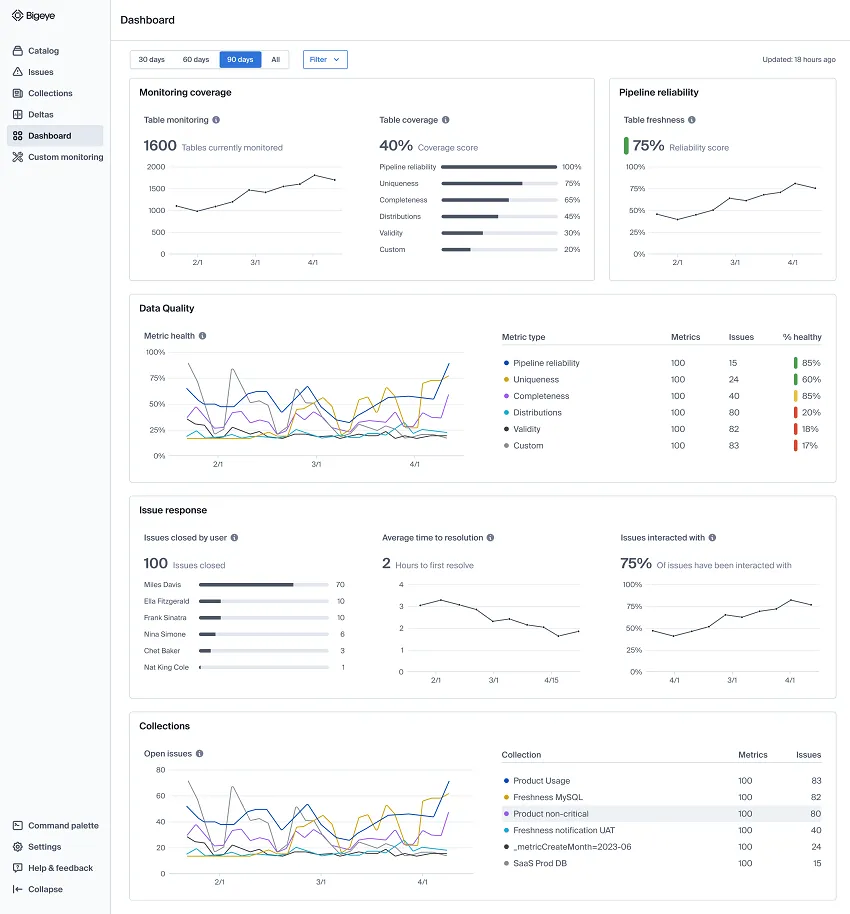
Bigeye
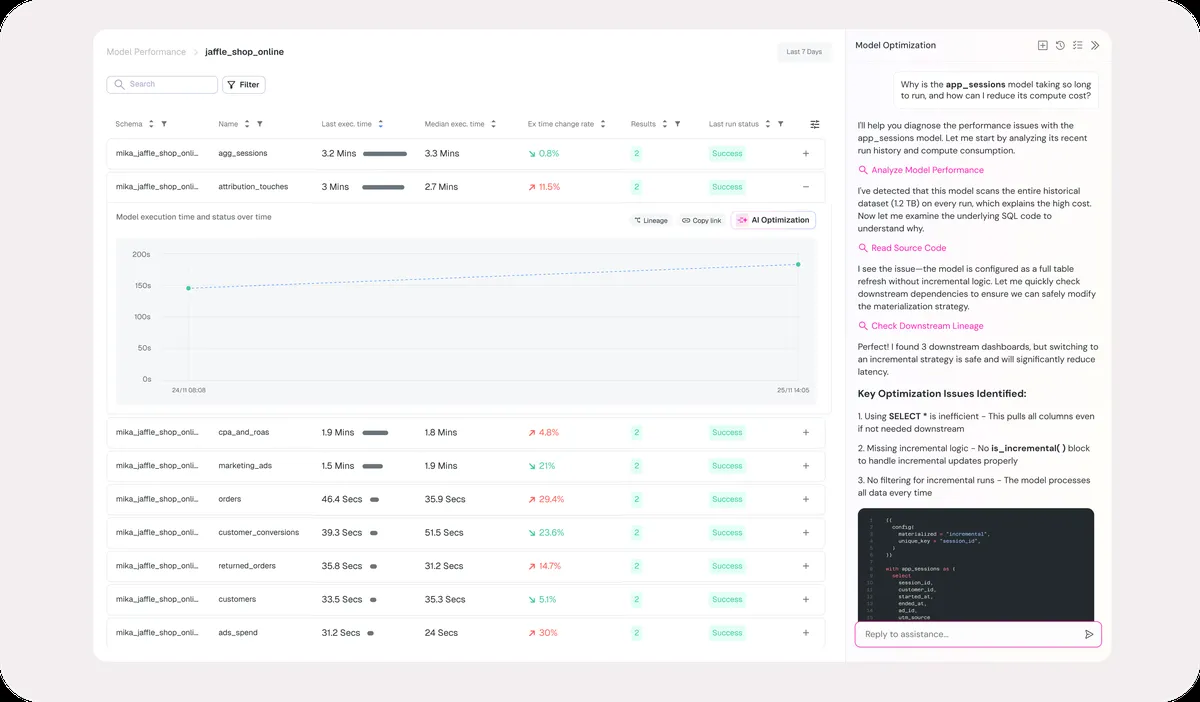
Elementary
Feature Comparison
| Feature | Bigeye | Elementary |
|---|---|---|
| Data Quality & Monitoring | ||
| Automated Anomaly Detection | ML-powered anomaly detection with reinforcement learning that fine-tunes alerts based on user feedback to reduce false positives | ML-based out-of-the-box monitors for freshness, volume, schema changes, nullness, distribution, and completeness with automated seasonal adjustments |
| Data Quality SLAs | Health scores for tables and dashboards with business-centric SLAs and reliability tracking over time | Data health scores across domains, teams, and assets measuring core data quality dimensions |
| Freshness & Volume Monitoring | Automated freshness and volume checks across warehouse tables with proactive alerting | Automated freshness, volume, and schema change monitors activated out-of-the-box using metadata and query history for low compute cost |
| Lineage & Observability | ||
| Data Lineage | End-to-end cross-source column-level lineage supporting both modern and legacy enterprise data stacks; acquired via Data Advantage Group in 2023 | Column-level lineage from code, data warehouse, sources, and BI tools; enriched with test results to show incidents across the DAG |
| Root Cause Analysis | Lineage-powered impact analysis and root cause identification; dependency-driven monitoring traces issues upstream automatically | Lineage-based incident tracking groups related failures into managed incidents for triage with ownership-based routing |
| Pipeline Monitoring | Monitors data pipelines across the full enterprise stack including modern, legacy, and hybrid environments | Monitors dbt model runs, source freshness, and test results; includes performance and cost tracking for models |
| Governance & Sensitivity | ||
| Sensitive Data Discovery | Automated scanning and classification of PII, PHI, PCI, and other sensitive data in structured and unstructured environments | Not a primary feature; governance focuses on policy enforcement, compliance, and security controls |
| Data Governance | Data certification, stewardship, business glossary, semantic layer creation, and metadata management with tags, owners, and domains | Set and enforce policies for compliance and security; catalog with definitions, ownership, tags, tests, usage, and health |
| AI Policy Enforcement | AI Guardian provides runtime enforcement of data access policies ensuring AI applications only access trustworthy data | No dedicated AI policy enforcement module; focuses on data reliability as a foundation for AI workflows |
| Integration & Deployment | ||
| dbt Integration | Supports dbt as one of many data pipeline integrations alongside Airflow and other orchestration tools | dbt-native by design; open-source dbt package integrates tests and artifacts directly with data warehouse |
| Warehouse Support | Snowflake, BigQuery, Redshift, Databricks, and cloud storage solutions with legacy system support | Snowflake, BigQuery, Redshift, Databricks, and Postgres |
| MCP Server Support | Not verified | MCP Server exposes context layer and agents through standard interface for use in any AI tool |
| Developer Experience | ||
| Configuration as Code | UI-based configuration with API access; no code-first configuration model | All configurations managed in dbt code with version control, code review, and CI/CD built in |
| Data CI/CD | Not a primary feature; focuses on operational monitoring and alerting workflows | Dedicated Data CI/CD prevents data quality issues at the pull request level; tests and previews PR impact before production |
| AI Agents | ML-driven monitoring with reinforcement learning feedback loop; no standalone AI agent layer | AI agents for data validation, triage, metadata enrichment, test coverage analysis, and query optimization |
Data Quality & Monitoring
Automated Anomaly Detection
Data Quality SLAs
Freshness & Volume Monitoring
Lineage & Observability
Data Lineage
Root Cause Analysis
Pipeline Monitoring
Governance & Sensitivity
Sensitive Data Discovery
Data Governance
AI Policy Enforcement
Integration & Deployment
dbt Integration
Warehouse Support
MCP Server Support
Developer Experience
Configuration as Code
Data CI/CD
AI Agents
Which to choose
Bigeye and Elementary address data observability from opposite ends of the market. Bigeye is an enterprise AI trust platform that combines data observability with lineage, governance, sensitive data discovery, and AI policy enforcement in a single managed solution built for large organizations with complex, hybrid data stacks. Elementary is a dbt-native observability platform that starts with a free open-source package and scales through cloud tiers, built for data engineers who want code-first configuration, column-level lineage, and deep dbt integration. The right choice depends on whether you need enterprise-wide data governance and sensitivity scanning or a developer-centric observability tool that lives in your dbt codebase.
Best-fit scenarios
Choose Bigeye if:
Large enterprises managing complex data environments across modern, legacy, and hybrid stacks who need unified data observability combined with sensitive data discovery, data governance, metadata management, and AI policy enforcement. Bigeye is particularly strong for organizations in regulated industries like finance, healthcare, and telecom that require automated PII/PHI/PCI detection, audit trails, and compliance support. Teams that value dependency-driven monitoring, cross-source column-level lineage, and a vendor-managed platform with enterprise SaaS contracts will find Bigeye delivers the breadth needed to serve multiple stakeholders from data engineers to privacy and security teams.
Choose Elementary if:
Data and analytics engineers working primarily with dbt who want observability that lives in version-controlled code alongside their transformation logic. Elementary is the stronger choice for teams that value open-source foundations (Apache-2.0, 2,312 GitHub stars), a zero-cost self-hosted starting point, and a clear upgrade path to managed cloud with AI agents, incident management, and BI integrations. Its code-first philosophy, Data CI/CD capabilities, and MCP Server support make it the natural fit for engineering teams that treat observability as part of the development lifecycle rather than an external monitoring layer.
These scenarios reflect the available product evidence. Your requirements, existing stack, and team expertise should guide the final decision.
Frequently Asked Questions
How much does Bigeye cost?
Bigeye does not publish pricing on its website. It operates as an enterprise SaaS platform with annual and multi-year contracts. Interested organizations need to request a demo to learn about pricing, which is tailored to deployment scale and organizational requirements. Multiple reviews note that smaller organizations may find the cost challenging, and pricing scales faster than some teams expect.
Is Elementary free to use?
Elementary offers a free open-source dbt package under the Apache-2.0 license that provides automated monitors, anomaly detection, lineage, alerts, and a data quality dashboard at no cost when self-hosted. Elementary Cloud adds premium features like AI agents, BI integrations, incident management, and MCP Server support across Scale, Enterprise, and Unlimited tiers, all of which require contacting the team for pricing. An AI Layer add-on uses credit-based pricing.
Can Bigeye work with dbt pipelines?
Bigeye supports dbt as one of its many pipeline integrations alongside tools like Airflow and various orchestration platforms. However, it is not dbt-native. Bigeye connects to your data warehouse and monitors tables and columns directly, rather than integrating into your dbt project code. If deep dbt integration is a priority, Elementary is purpose-built for that workflow.
Does Elementary support sensitive data discovery like Bigeye?
Elementary does not provide automated sensitive data scanning or PII/PHI/PCI classification. Its governance capabilities focus on policy enforcement, compliance controls, and metadata management within the data catalog. Bigeye offers a dedicated Data Sensitivity module that automatically scans and classifies sensitive data across structured and unstructured environments, making it the stronger choice for organizations with regulatory discovery requirements.
Which tool has better data lineage capabilities?
Both tools provide column-level lineage, but with different strengths. Bigeye offers end-to-end cross-source lineage that supports both modern and legacy enterprise data stacks, acquired through Data Advantage Group in 2023. Elementary provides column-level lineage from code through the data warehouse to BI tools, enriched with test results that show incidents across the directed acyclic graph. Bigeye covers a broader range of systems including legacy environments, while Elementary's lineage is tightly integrated with dbt workflows and enriched with quality signals.