Decision comparison
Anomalo vs Elementary
Anomalo and Elementary solve data quality from fundamentally different angles. Anomalo is an AI-native platform built for large enterprises that need automated, ML-driven anomaly detection across massive data estates including unstructured content. Elementary is a dbt-native observability solution designed for data and analytics engineers who want to manage data quality as code within their existing dbt workflows. The right choice depends on your team's technical profile, data stack maturity, and whether you prioritize hands-off ML automation or code-first developer control.
Architecture choice. These take different approaches to the same problem. Read the table as a fit question rather than a feature race.
All 2 are data observability.
Quick Comparison
| Decision factor | Anomalo | Elementary |
|---|---|---|
| Best For | Large enterprises needing automated ML-driven anomaly detection across structured and unstructured data | Data and analytics engineers running dbt who want code-first observability |
| Deployment Model | Fully managed SaaS with in-VPC deployment option | Open-source dbt package plus hosted cloud service |
| Pricing | Contact for pricing | Elementary publishes no amounts. Its open-source dbt package is free and self-hosted. Elementary Cloud is priced by seats and environments: Scale covers up to 10 editor seats and 1K tables, Enterprise up to 20 editor and 40 viewer seats and 3K tables, and Unlimited removes the seat caps; extra tables are charged per additional 1K. A free trial covers the Essentials feature set. Every paid tier is quote-only. |
| Core Approach | Unsupervised ML that learns data patterns and flags deviations without manual rules | Configuration-as-code with dbt-native monitors, anomaly detection, and data tests |
| Lineage | Upstream/downstream lineage pulled from the data warehouse | Column-level lineage across code, warehouse, sources, and BI tools |
| dbt Integration | Works alongside dbt but is not dbt-native | Deeply dbt-native with a dedicated dbt package that integrates tests and artifacts |
Anomalo
- Best For:
- Large enterprises needing automated ML-driven anomaly detection across structured and unstructured data
- Deployment Model:
- Fully managed SaaS with in-VPC deployment option
- Pricing:
- Contact for pricing
- Core Approach:
- Unsupervised ML that learns data patterns and flags deviations without manual rules
- Lineage:
- Upstream/downstream lineage pulled from the data warehouse
- dbt Integration:
- Works alongside dbt but is not dbt-native
Elementary
- Best For:
- Data and analytics engineers running dbt who want code-first observability
- Deployment Model:
- Open-source dbt package plus hosted cloud service
- Pricing:
- Elementary publishes no amounts. Its open-source dbt package is free and self-hosted. Elementary Cloud is priced by seats and environments: Scale covers up to 10 editor seats and 1K tables, Enterprise up to 20 editor and 40 viewer seats and 3K tables, and Unlimited removes the seat caps; extra tables are charged per additional 1K. A free trial covers the Essentials feature set. Every paid tier is quote-only.
- Core Approach:
- Configuration-as-code with dbt-native monitors, anomaly detection, and data tests
- Lineage:
- Column-level lineage across code, warehouse, sources, and BI tools
- dbt Integration:
- Deeply dbt-native with a dedicated dbt package that integrates tests and artifacts
Public signals
Verified factual signals only. Bars appear only for like-for-like metrics with five weekly assessments for every tool; missing evidence stays explicit. These signals do not establish enterprise adoption, product quality, or total cost.
| Metric | Anomalo | Elementary |
|---|---|---|
| PyPI weekly downloads(Developer adoption) | 32.6k | Not available |
| GitHub commits, 90d(Product adoption) | Not available | 19 |
| GitHub stars(Product adoption) | Not available | 2,000+ |
| PyPI weekly downloads(Product adoption) | Not available | 215.3k |
As of September 21, 2026 — updated weekly.
Health & risk evidence
Observed public-source checks for mapped package versions and repositories.
Anomalo
September 21, 2026Package vulnerabilities
PyPI · anomalo@0.52.0
0 vulnerabilities
across 1 package
Repository security score
Not available
Elementary
September 21, 2026Package vulnerabilities
PyPI · elementary-data@0.26.0
0 vulnerabilities
across 1 package
Repository security score
github.com/elementary-data/elementary
7.4/10
Interface Preview
Elementary
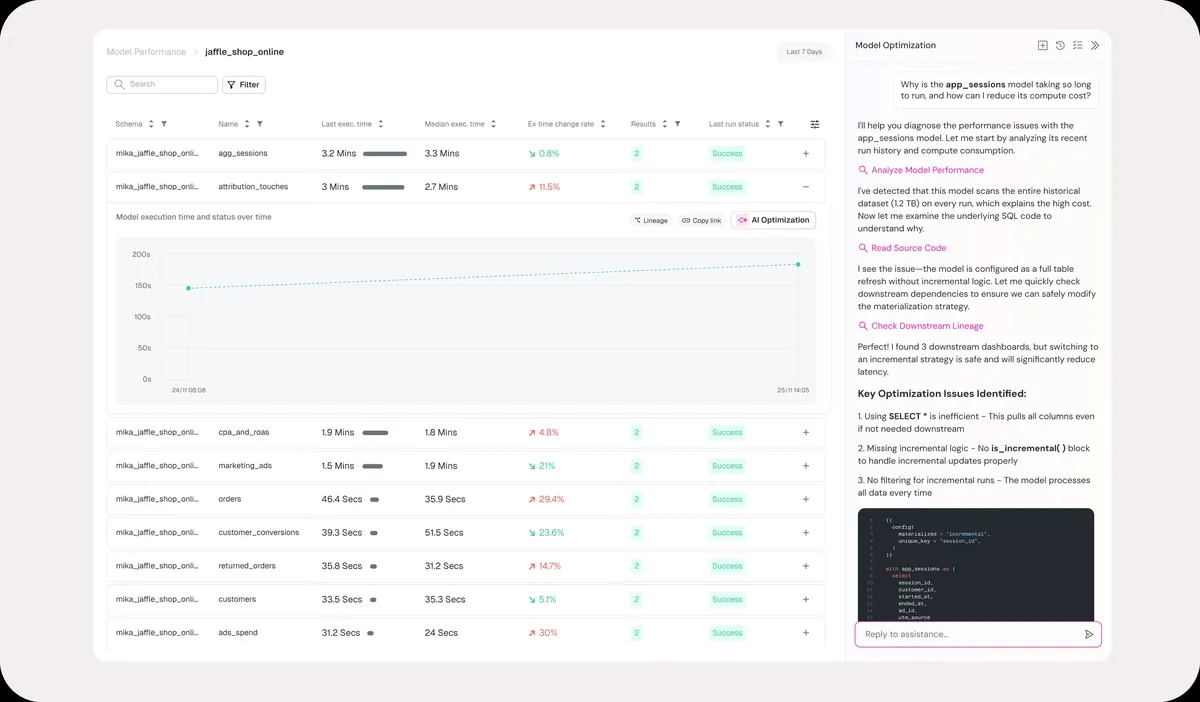
Feature Comparison
| Feature | Anomalo | Elementary |
|---|---|---|
| Data Quality Monitoring | ||
| Automated Anomaly Detection | Unsupervised ML learns historical patterns per table and flags statistically significant deviations automatically | ML-based monitors detect anomalies in freshness, volume, nullness, distribution, dimensions, and completeness |
| Custom Validation Rules | No-code UI for business rules and KPIs; SQL checks and API integration for advanced use cases | dbt tests, dbt-expectations, dbt-utils packages, plus custom tests defined in code or UI |
| Schema Change Detection | Monitors schema changes as part of automated data observability checks | Automated out-of-the-box monitors for schema changes across all production tables |
| Observability and Lineage | ||
| Data Lineage | Upstream/downstream lineage mapping pulled directly from the data warehouse or lakehouse | Column-level lineage from code, data warehouse, sources, and BI tools enriched with test results |
| Incident Management | Automated alerts with severity scoring, root cause analysis, and data lineage for triage | Groups related failures into managed incidents with context-aware alert routing based on ownership |
| Pipeline Monitoring | Monitors data after it lands in the warehouse; metadata-based observability for all tables | Monitors dbt model runs, source freshness, and pipeline execution with performance and cost tracking |
| Developer Experience | ||
| Configuration as Code | Configuration managed through UI and API; not code-first by default | All configurations managed in dbt code with version control, code review, and CI/CD integration |
| Data CI/CD | No built-in data CI/CD capabilities | Prevents breaking changes at the pull request level; runs tests and previews pipeline impact |
| Open Source Component | Closed source; no open-source component available | Open-source dbt package with 2,000+ GitHub stars under Apache-2.0 license |
| Platform and Integrations | ||
| Data Warehouse Support | Snowflake, BigQuery, Databricks, and other major cloud data warehouses and lakes | Snowflake, BigQuery, Redshift, Databricks, and PostgreSQL |
| BI Tool Integration | Limited direct BI tool integration; focuses on warehouse-level monitoring | Integrates with Tableau, Looker, and other BI tools for end-to-end lineage visibility |
| Alert Routing | Automated alerts with severity-based routing to configured channels | Alerts routed to Slack, Microsoft Teams, Opsgenie, and PagerDuty by owner and severity |
| Enterprise Features | ||
| Security and Compliance | SOC 2 compliance, role-based access controls, audit trails, and in-VPC deployment | SSO, RBAC, and advanced deployment options available on Enterprise and Unlimited plans |
| AI Agents | Agentic platform with nine AI agents including Data Insights, Conversational Analytics, and Documentation agents | AI agents for data quality validation, metadata enrichment, test coverage analysis, and triage |
| Unstructured Data Support | Monitors unstructured data quality for documents, text, and other non-tabular formats | Focused on structured data in data warehouses; no unstructured data support |
Data Quality Monitoring
Automated Anomaly Detection
Custom Validation Rules
Schema Change Detection
Observability and Lineage
Data Lineage
Incident Management
Pipeline Monitoring
Developer Experience
Configuration as Code
Data CI/CD
Open Source Component
Platform and Integrations
Data Warehouse Support
BI Tool Integration
Alert Routing
Enterprise Features
Security and Compliance
AI Agents
Unstructured Data Support
Which approach fits
Anomalo and Elementary solve data quality from fundamentally different angles. Anomalo is an AI-native platform built for large enterprises that need automated, ML-driven anomaly detection across massive data estates including unstructured content. Elementary is a dbt-native observability solution designed for data and analytics engineers who want to manage data quality as code within their existing dbt workflows. The right choice depends on your team's technical profile, data stack maturity, and whether you prioritize hands-off ML automation or code-first developer control.
When each approach fits
Choose Anomalo if:
We recommend Anomalo for large enterprises with thousands of tables across cloud data warehouses and lakes that need broad, automated data quality coverage without writing manual rules. Anomalo excels when your organization has a mature data infrastructure, stable pipelines, and a need to monitor both structured and unstructured data. Its unsupervised ML approach learns data patterns automatically, making it ideal for teams that want comprehensive anomaly detection with minimal configuration overhead. The agentic platform with nine specialized AI agents adds proactive insights, conversational analytics, and automated documentation capabilities that serve enterprise-scale operations.
Choose Elementary if:
We recommend Elementary for data and analytics engineering teams that run dbt and want observability tightly integrated into their development workflow. Elementary stands out with its configuration-as-code approach, column-level lineage across the full stack, and data CI/CD capabilities that catch breaking changes at the pull request level. The open-source dbt package provides a strong free starting point, and the cloud plans add AI agents, BI integrations, and incident management at predictable pricing tiers. Elementary is the stronger choice when your team values developer experience, version-controlled quality checks, and end-to-end visibility from ingestion through BI tools.
These scenarios reflect the available product evidence. Your requirements, existing stack, and team expertise should guide the final decision.
Frequently Asked Questions
Is Elementary open source?
Elementary offers an open-source dbt package with over 2,300 GitHub stars under the Apache-2.0 license. This package integrates directly with your dbt project to provide automated monitors, anomaly detection, and test results visualization at no cost. Elementary also offers a cloud service with premium features including AI agents, BI integrations, incident management, and advanced deployment options across Scale, Enterprise, and Unlimited plans.
Can Anomalo monitor unstructured data?
Yes. Anomalo supports data quality monitoring for unstructured data types including documents, text files, and other non-tabular content. The platform uses its ML engine to profile and validate unstructured data collections, which is particularly relevant for organizations building RAG pipelines or fine-tuning generative AI models. This capability distinguishes Anomalo from most data observability tools that focus exclusively on structured warehouse data.
Do I need dbt to use Elementary?
Elementary was designed as a dbt-native tool, and its open-source package requires dbt to function. The platform deeply integrates with dbt artifacts, tests, and project configurations. If your team does not use dbt, Elementary would not be a practical choice. Anomalo, by contrast, connects directly to cloud data warehouses and does not depend on any specific transformation framework.
How do Anomalo and Elementary handle alert routing?
Anomalo provides automated alerts with severity scoring and routes notifications to configured channels. Elementary offers more granular alert routing to Slack, Microsoft Teams, Opsgenie, and PagerDuty, with the ability to direct alerts to different recipients and owners based on ownership metadata and severity. Elementary also groups related failures into managed incidents to reduce alert fatigue.
Which tool is more cost-effective for smaller teams?
Elementary is accessible for focused teams thanks to its free open-source dbt package and tiered cloud pricing that starts with a Scale plan supporting up to 10 editor seats and 1K tables. Anomalo uses enterprise pricing that requires contacting sales, which typically puts it out of reach for smaller organizations. For teams already running dbt, Elementary provides meaningful data quality coverage at no initial cost.