Decision comparison
Anomalo vs Great Expectations
Anomalo and Great Expectations tackle data quality from opposite ends of the automation spectrum. Anomalo delivers a fully managed, AI-native enterprise platform that automatically detects anomalies using unsupervised machine learning across structured, semi-structured, and unstructured data with no code required. Great Expectations provides an open-source Python framework where teams codify precise validation rules as testable expectations and maintain full control over their data quality infrastructure. The right choice depends on whether your organization needs turnkey ML-driven monitoring with enterprise governance or fine-grained programmatic validation with open-source flexibility and zero vendor lock-in.
Architecture choice. These take different approaches to the same problem. Read the table as a fit question rather than a feature race.
These are different kinds of product — Data Observability and Data Validation Framework.
Quick Comparison
| Decision factor | Anomalo | Great Expectations |
|---|---|---|
| Deployment Model | Commercial SaaS platform with in-VPC deployment option for enterprise customers | Open-source Python framework (self-hosted) with optional GX Cloud managed service |
| Pricing Model | Contact for pricing | Free and Open-Source, Paid upgrades available |
| Core Architecture | AI-native platform using unsupervised machine learning models built per dataset automatically | Python-based Expectation Suites with pluggable execution backends for SQL, Pandas, and Spark |
| Primary Interface | No-code web UI for rule creation, monitoring dashboards, and root cause analysis; API available | Python API and CLI for developers; GX Cloud web UI for team collaboration and monitoring |
| Data Quality Approach | Automated ML-driven anomaly detection across structured, semi-structured, and unstructured data | Codified expectation suites with explicit validation rules, auto-generated Data Docs documentation |
| Community & Ecosystem | Backed by Databricks Ventures and Snowflake Ventures; ~19.8K monthly website visits | 11,000+ GitHub stars, Apache-2.0 license, active community with native orchestrator integrations |
Anomalo
- Deployment Model:
- Commercial SaaS platform with in-VPC deployment option for enterprise customers
- Pricing Model:
- Contact for pricing
- Core Architecture:
- AI-native platform using unsupervised machine learning models built per dataset automatically
- Primary Interface:
- No-code web UI for rule creation, monitoring dashboards, and root cause analysis; API available
- Data Quality Approach:
- Automated ML-driven anomaly detection across structured, semi-structured, and unstructured data
- Community & Ecosystem:
- Backed by Databricks Ventures and Snowflake Ventures; ~19.8K monthly website visits
Great Expectations
- Deployment Model:
- Open-source Python framework (self-hosted) with optional GX Cloud managed service
- Pricing Model:
- Free and Open-Source, Paid upgrades available
- Core Architecture:
- Python-based Expectation Suites with pluggable execution backends for SQL, Pandas, and Spark
- Primary Interface:
- Python API and CLI for developers; GX Cloud web UI for team collaboration and monitoring
- Data Quality Approach:
- Codified expectation suites with explicit validation rules, auto-generated Data Docs documentation
- Community & Ecosystem:
- 11,000+ GitHub stars, Apache-2.0 license, active community with native orchestrator integrations
Public signals
Verified factual signals only. Bars appear only for like-for-like metrics with five weekly assessments for every tool; missing evidence stays explicit. These signals do not establish enterprise adoption, product quality, or total cost.
| Metric | Anomalo | Great Expectations |
|---|---|---|
| Search interest(Market interest) | Unavailable | 0 |
| Product Hunt comments(Community interest) | 21 | Not available |
| Product Hunt reviews(Community interest) | 0 | Not available |
| Product Hunt votes(Community interest) | 292 | Not available |
| PyPI weekly downloads(Developer adoption) | 29.4k | Not available |
| GitHub commits, 90d(Product adoption) | Not available | 175 |
| GitHub stars(Product adoption) | Not available | 11,000+ |
| Hacker News mentions, 90d(Community interest) | Not available | 0 |
| PyPI weekly downloads(Product adoption) | Not available | 4.5M |
| Stack Overflow questions(Community interest) | Not available | 148 |
As of October 19, 2026 — updated weekly.
Health & risk evidence
Observed public-source checks for mapped package versions and repositories.
Anomalo
October 19, 2026Package vulnerabilities
PyPI · anomalo@0.55.1
0 vulnerabilities
across 1 package
Repository security score
Not available
Great Expectations
October 19, 2026Package vulnerabilities
PyPI · great-expectations@1.24.0
0 vulnerabilities
across 1 package
Repository security score
Not available
Interface Preview
Anomalo
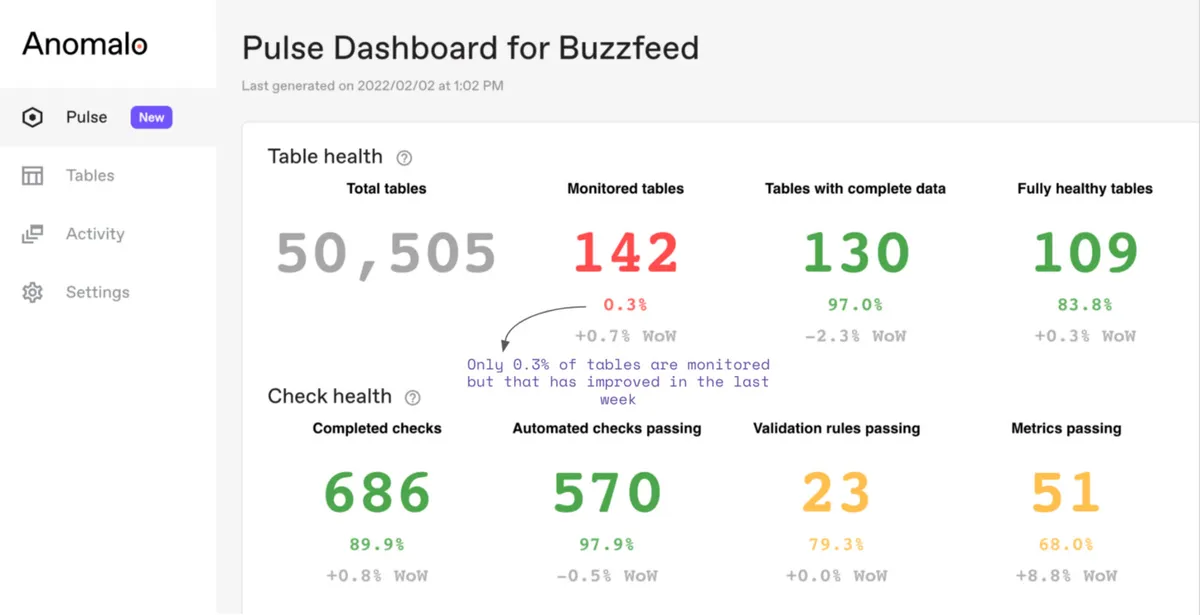
Great Expectations
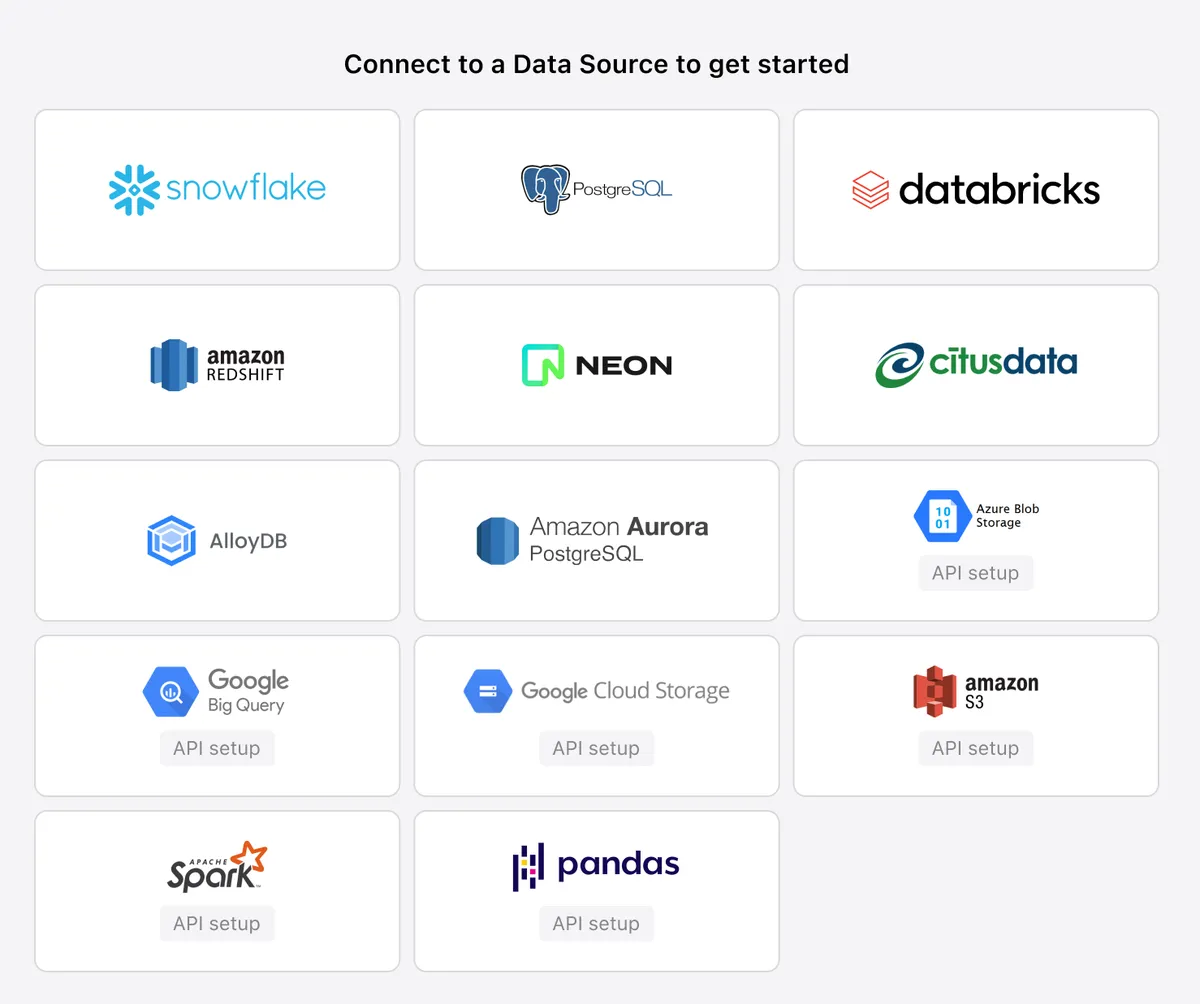
Feature Comparison
| Feature | Anomalo | Great Expectations |
|---|---|---|
| Data Quality Detection | ||
| Anomaly Detection | Unsupervised ML models automatically built per dataset to detect statistically significant deviations without manual rules | No built-in anomaly detection; teams implement threshold-based checks through custom Expectation classes |
| Schema Validation | Automated schema monitoring detects column additions, removals, and type changes across connected tables | Expectation Suites codify column presence, types, and ordering rules as testable Python assertions |
| Custom Business Rules | No-code UI for defining validation rules and KPIs; SQL-based custom checks and API integration supported | Parameterized Python Expectation classes encode arbitrarily complex business logic as version-controlled code |
| Monitoring and Observability | ||
| Automated Alerting | Smart alerts with severity scoring, automated routing, built-in triage, and root cause analysis for each incident | GX Cloud provides monitoring alerts; open-source users configure external alerting through webhook integrations |
| Data Lineage | Upstream and downstream lineage mapping pulled directly from connected data warehouses and lakehouses | No native lineage feature; teams rely on external catalog tools like DataHub or Atlan for lineage tracking |
| Root Cause Analysis | Automated root cause analysis identifies source of data issues with lineage-aware diagnostics and impact assessment | Validation results provide detailed failure information; root cause investigation handled manually or via external tools |
| Unstructured Data Support | ||
| Document Quality Monitoring | ML-based quality monitoring for unstructured data including documents, call transcripts, and text collections | Focused on structured and tabular data; no native support for unstructured document quality validation |
| AI/RAG Data Validation | Validates data collections used in RAG pipelines and generative AI workflows to prevent hallucination from poor data | Can validate structured inputs to ML pipelines; no specific tooling for RAG or generative AI data quality |
| Multi-Format Coverage | Single platform covers structured tables, semi-structured JSON/Parquet, and unstructured text data | Supports SQL databases, Pandas DataFrames, and Spark DataFrames for structured and semi-structured data |
| Integration and Deployment | ||
| Warehouse Connectivity | Native integrations with Snowflake, BigQuery, Databricks, and other cloud data warehouses and lakes | Pluggable data source connectors for SQL databases, cloud warehouses, Pandas, and Spark backends |
| Orchestrator Integration | Connects with orchestrators and ETL tools through API; no dedicated operator packages for specific orchestrators | Native integration packages for Airflow, Dagster, and Prefect with dedicated operator libraries |
| CI/CD Pipeline Support | API-driven integration for automated quality checks within deployment pipelines | Checkpoint-based validation runs integrate directly into CI/CD with structured JSON result outputs and exit codes |
| Governance and Collaboration | ||
| Access Controls | Enterprise-grade RBAC, audit trails, SOC 2 compliance, SSO, and in-VPC deployment options | GX Cloud Enterprise provides team-based access controls; open-source version has no built-in access management |
| Data Documentation | Monitoring dashboards with incident history, check results, and data profiling visualizations per table | Auto-generated Data Docs produce static HTML sites documenting all expectations, parameters, and validation results |
| Agentic AI Capabilities | Agentic platform with nine specialized AI agents covering observability, insights, analytics, and documentation | ExpectAI feature auto-generates test suites from data profiling; no autonomous agent capabilities |
Data Quality Detection
Anomaly Detection
Schema Validation
Custom Business Rules
Monitoring and Observability
Automated Alerting
Data Lineage
Root Cause Analysis
Unstructured Data Support
Document Quality Monitoring
AI/RAG Data Validation
Multi-Format Coverage
Integration and Deployment
Warehouse Connectivity
Orchestrator Integration
CI/CD Pipeline Support
Governance and Collaboration
Access Controls
Data Documentation
Agentic AI Capabilities
Which approach fits
Anomalo and Great Expectations tackle data quality from opposite ends of the automation spectrum. Anomalo delivers a fully managed, AI-native enterprise platform that automatically detects anomalies using unsupervised machine learning across structured, semi-structured, and unstructured data with no code required. Great Expectations provides an open-source Python framework where teams codify precise validation rules as testable expectations and maintain full control over their data quality infrastructure. The right choice depends on whether your organization needs turnkey ML-driven monitoring with enterprise governance or fine-grained programmatic validation with open-source flexibility and zero vendor lock-in.
When each approach fits
Choose Anomalo if:
Choose Anomalo when your organization operates a large-scale data environment with thousands of tables across cloud warehouses like Snowflake, BigQuery, or Databricks and needs automated data quality monitoring without writing manual rules. Anomalo's unsupervised machine learning models are built automatically for each dataset, learning historical patterns and detecting statistically significant deviations without manual threshold configuration. The platform stands out for enterprises that also work with unstructured data such as documents and text collections, particularly teams building RAG pipelines or generative AI workflows where data quality directly affects model outputs. The no-code interface allows business users and data governance teams to define validation rules and track KPIs alongside engineers, while enterprise features like SOC 2 compliance, in-VPC deployment, RBAC, and audit trails satisfy security and compliance requirements. Anomalo is backed by both Databricks Ventures and Snowflake Ventures, providing deep native integrations with these platforms. The trade-off is enterprise-only pricing with no public cost information, making it less accessible for smaller teams or organizations with limited budgets.
Choose Great Expectations if:
Choose Great Expectations when your data engineering team wants full programmatic control over validation logic and values open-source transparency with no vendor dependency. The Python-based Expectation Suite model lets you encode arbitrarily complex business rules as testable, version-controlled code that runs identically across SQL databases, Pandas DataFrames, and Spark backends. With 11,430 GitHub stars and an Apache-2.0 license, Great Expectations offers a sizable data quality community in the ecosystem, which means community-contributed expectations, extensive documentation, and proven production patterns from thousands of deployments. Native integration packages for Airflow, Dagster, and Prefect make it a natural fit for teams already invested in Python-based pipeline orchestration. The auto-generated Data Docs feature creates living HTML documentation that stays synchronized with your actual validation rules, eliminating documentation drift. GX Cloud provides an optional managed layer for teams that later need collaboration dashboards, centralized expectation management, and real-time monitoring without self-hosting. The trade-off is operational overhead: teams must manage their own infrastructure, build alerting workflows, and invest time authoring detailed expectations manually rather than relying on automated anomaly detection.
These scenarios reflect the available product evidence. Your requirements, existing stack, and team expertise should guide the final decision.
Frequently Asked Questions
Can Anomalo and Great Expectations be used together in the same data stack?
Yes, the two tools serve complementary roles and can operate side by side in a modern data stack. Anomalo provides broad, automated anomaly detection across your entire warehouse using unsupervised machine learning that requires no manual rule configuration, making it effective for catching unknown data quality issues at scale. Great Expectations handles precise, codified validation checks at specific pipeline checkpoints where you need explicit business rule enforcement. In practice, a team could deploy Great Expectations within Airflow or Dagster DAGs to validate data transformations against known business logic, while Anomalo monitors the full data estate for unexpected shifts in volume, distribution, or freshness. This layered approach combines the breadth of ML-driven detection with the precision of explicit expectation-based validation.
How do the two platforms compare for teams with limited engineering resources?
Anomalo is designed to minimize engineering effort through its no-code interface and automated ML model generation. Teams connect their data warehouse, and Anomalo automatically builds monitoring models for each dataset without requiring manual rule creation or threshold configuration. Business users can define additional validation rules and KPIs through the UI without writing code. Great Expectations requires Python development skills to author Expectation Suites, configure data sources, and integrate validation into pipelines. However, the ExpectAI feature now auto-generates test suites from data profiling to reduce initial setup time. GX Cloud further lowers the barrier by providing a web-based interface for managing expectations and viewing results. For teams without dedicated data engineers, Anomalo's turnkey approach typically delivers faster time to value, while Great Expectations offers more flexibility for teams willing to invest engineering time upfront.
What types of data does each tool support for quality monitoring?
Anomalo monitors structured data in cloud warehouses and data lakes, semi-structured data like JSON and Parquet files, and unstructured data including documents, call transcripts, and text collections. This multi-format coverage makes Anomalo particularly relevant for organizations building generative AI applications where unstructured data quality directly affects model outputs. Great Expectations focuses on structured and semi-structured data through its pluggable execution backends supporting SQL databases, Pandas DataFrames, and Spark DataFrames. It validates tabular data against codified expectations but does not include native tooling for unstructured document quality assessment. Teams needing unstructured data monitoring alongside structured data validation would find Anomalo's unified platform covers both use cases, while Great Expectations requires pairing with additional tools for document-level quality checks.
How do the pricing models differ between Anomalo and Great Expectations?
Anomalo operates on an enterprise pricing model where organizations must contact the sales team for pricing information. There are no publicly listed pricing tiers or self-serve options. This approach targets larger enterprises with substantial data quality budgets and typically involves annual contracts. Great Expectations takes an open-source-first approach where the core Python framework, GX Core, is completely free under the Apache-2.0 license with no usage limits or feature restrictions. GX Cloud provides optional managed services with a free Developer tier for getting started, plus Team and Enterprise tiers for organizations that need hosted collaboration, real-time monitoring, and centralized expectation management. The cost comparison depends on total cost of ownership: Anomalo bundles infrastructure, ML models, and support into its enterprise pricing, while Great Expectations shifts infrastructure and maintenance costs to the team running the self-hosted framework.