Decision comparison
Acceldata vs Great Expectations
Acceldata and Great Expectations serve fundamentally different roles in the data quality ecosystem. Acceldata is an enterprise-grade, AI-native observability platform that provides end-to-end visibility across pipelines, infrastructure, data quality, user activity, and costs. Great Expectations is a developer-focused, open-source framework for codified data validation that gives engineers precise control over data quality checks. Choose Acceldata when you need a unified command center for large-scale data operations with automated remediation. Choose Great Expectations when you want lightweight, code-first validation embedded directly in your data pipelines.
Architecture choice. These take different approaches to the same problem. Read the table as a fit question rather than a feature race.
These are different kinds of product — Data Observability and Data Validation Framework.
Quick Comparison
| Decision factor | Acceldata | Great Expectations |
|---|---|---|
| Best For | Enterprise teams needing unified observability across pipelines, infrastructure, and costs | Data engineers who want code-first, explicit data validation in their pipelines |
| Pricing Model | Acceldata publishes no prices. Its pricing page lists PRO and ENTERPRISE packages with a free trial and directs buyers to a demo, so every figure is set in a quote. | Free and Open-Source, Paid upgrades available |
| Deployment | SaaS with on-prem and hybrid options | Self-hosted (GX Core) or SaaS (GX Cloud) |
| Data Quality Approach | AI-powered anomaly detection with automated remediation agents | Expectation-based validation with codified rules and auto-generated documentation |
| Learning Curve | Moderate — managed platform with guided setup and dashboards | Steeper — requires Python proficiency and manual expectation definition |
Acceldata
- Best For:
- Enterprise teams needing unified observability across pipelines, infrastructure, and costs
- Pricing Model:
- Acceldata publishes no prices. Its pricing page lists PRO and ENTERPRISE packages with a free trial and directs buyers to a demo, so every figure is set in a quote.
- Deployment:
- SaaS with on-prem and hybrid options
- Data Quality Approach:
- AI-powered anomaly detection with automated remediation agents
- Learning Curve:
- Moderate — managed platform with guided setup and dashboards
Great Expectations
- Best For:
- Data engineers who want code-first, explicit data validation in their pipelines
- Pricing Model:
- Free and Open-Source, Paid upgrades available
- Deployment:
- Self-hosted (GX Core) or SaaS (GX Cloud)
- Data Quality Approach:
- Expectation-based validation with codified rules and auto-generated documentation
- Learning Curve:
- Steeper — requires Python proficiency and manual expectation definition
Public signals
Verified factual signals only. Bars appear only for like-for-like metrics with five weekly assessments for every tool; missing evidence stays explicit. These signals do not establish enterprise adoption, product quality, or total cost.
| Metric | Acceldata | Great Expectations |
|---|---|---|
| Search interest(Market interest) | 0 | 0 |
| PyPI weekly downloads(Developer adoption) | 63.6k | Not available |
| GitHub commits, 90d(Product adoption) | Not available | 181 |
| GitHub stars(Product adoption) | Not available | 11,000+ |
| Hacker News mentions, 90d(Community interest) | Not available | 0 |
| PyPI weekly downloads(Product adoption) | Not available | 4.5M |
| Stack Overflow questions(Community interest) | Not available | 148 |
As of October 12, 2026 — updated weekly.
Health & risk evidence
Observed public-source checks for mapped package versions and repositories.
Acceldata
October 12, 2026Package vulnerabilities
PyPI · acceldata-sdk@26.10.0
0 vulnerabilities
across 1 package
Repository security score
Not available
Great Expectations
October 12, 2026Package vulnerabilities
PyPI · great-expectations@1.24.0
0 vulnerabilities
across 1 package
Repository security score
Not available
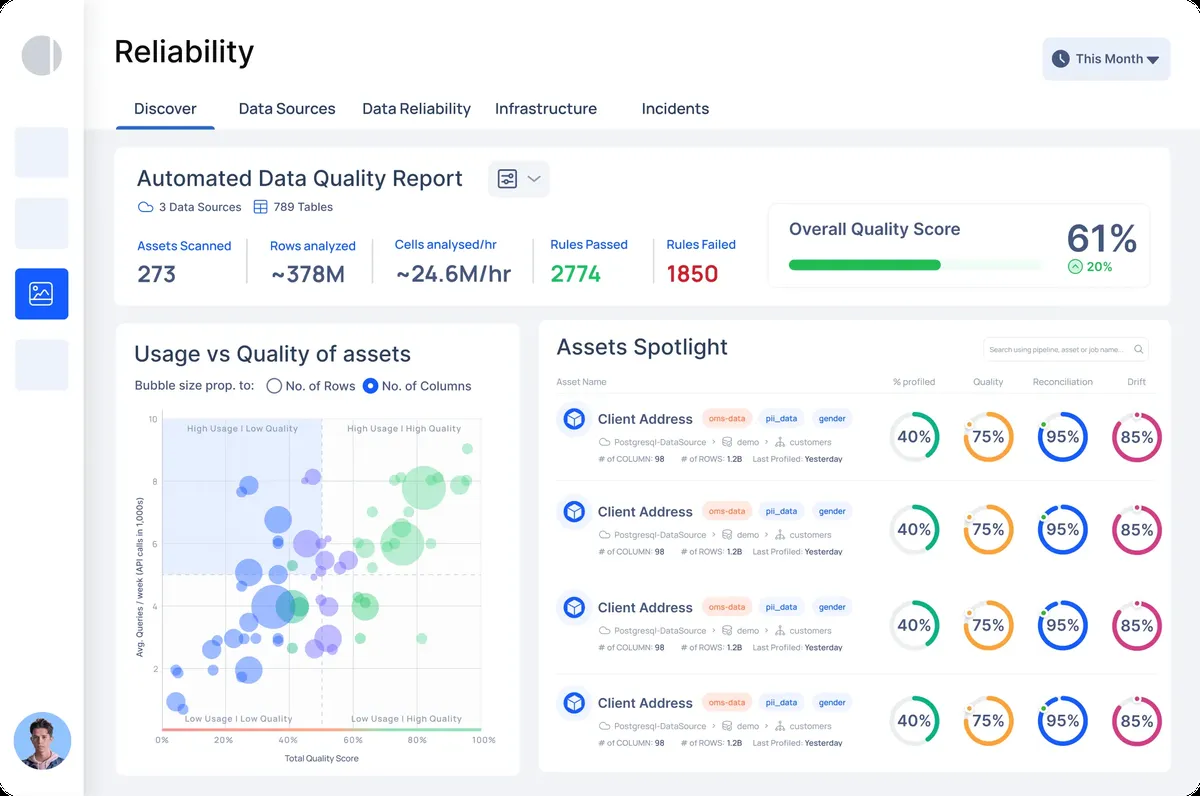
Interface Preview
Acceldata
Great Expectations
Feature Comparison
| Feature | Acceldata | Great Expectations |
|---|---|---|
| Data Quality | ||
| Anomaly Detection | AI-powered multi-variate anomaly detection with automated root cause tracing | Manual expectation-based checks; no built-in anomaly detection |
| Data Profiling | Dedicated Data Profiling Agent surfaces distributions, anomalies, and structural insights | Basic profiling via Expectation Suites and Data Docs |
| Schema Drift Detection | Built-in schema drift monitoring with alerts | Schema expectations must be manually defined per dataset |
| Pipeline & Observability | ||
| Pipeline Monitoring | End-to-end pipeline monitoring with SLA tracking and health dashboards | No native pipeline monitoring; relies on external orchestrators like Airflow or Dagster |
| Data Lineage | Column-level lineage tracking with a dedicated Data Lineage Agent | No built-in lineage; depends on integration with external catalog tools |
| Infrastructure Observability | Full infrastructure monitoring including workload health and bottleneck identification | Not available — focused on data validation only |
| Automation & AI | ||
| AI-Powered Agents | Specialized agents for quality, lineage, profiling, and pipeline health with autonomous remediation | ExpectAI auto-generates test expectations; no autonomous agents |
| Automated Remediation | Closed-loop remediation workflows with human-in-the-loop approvals | No automated remediation; validation results require manual action |
| Natural Language Interface | The Business Notebook allows natural language queries with contextual memory | Not verified |
| Integration & Extensibility | ||
| Backend Support | Snowflake, Databricks, AWS, GCP, Azure, Hadoop, Kafka, and hybrid environments | SQL databases, Pandas DataFrames, and Apache Spark |
| Orchestrator Integration | Integrates with enterprise data platforms and BI tools | Native integration with Airflow, Dagster, and Prefect |
| Open Source | Proprietary platform with free trial available | Fully open source under Apache-2.0 license with 11,000+ GitHub stars |
| Governance & Security | ||
| Access Control | RBAC plus Resource-Based Access Management (RBAM) with domain hierarchy | Basic access control via GX Cloud; no built-in RBAC in GX Core |
| Compliance Certifications | SOC 2 Type 2 certified with data encryption at rest and in transit | No enterprise compliance certifications for the open-source framework |
| Data Residency | Data never leaves premises; inline observation with geographic data center options | Self-hosted GX Core keeps data local; GX Cloud follows standard cloud policies |
Data Quality
Anomaly Detection
Data Profiling
Schema Drift Detection
Pipeline & Observability
Pipeline Monitoring
Data Lineage
Infrastructure Observability
Automation & AI
AI-Powered Agents
Automated Remediation
Natural Language Interface
Integration & Extensibility
Backend Support
Orchestrator Integration
Open Source
Governance & Security
Access Control
Compliance Certifications
Data Residency
Which approach fits
Acceldata and Great Expectations serve fundamentally different roles in the data quality ecosystem. Acceldata is an enterprise-grade, AI-native observability platform that provides end-to-end visibility across pipelines, infrastructure, data quality, user activity, and costs. Great Expectations is a developer-focused, open-source framework for codified data validation that gives engineers precise control over data quality checks. Choose Acceldata when you need a unified command center for large-scale data operations with automated remediation. Choose Great Expectations when you want lightweight, code-first validation embedded directly in your data pipelines.
When each approach fits
Choose Acceldata if:
Choose Acceldata if you run a large-scale enterprise data platform spanning multiple clouds or hybrid environments and need unified observability, AI-powered anomaly detection, automated remediation workflows, and cost optimization in a single managed platform.
Choose Great Expectations if:
Choose Great Expectations if you are a data engineer or small-to-mid-size team that wants free, open-source, code-first data validation with full control over expectation definitions, tight orchestrator integration, and no vendor lock-in.
These scenarios reflect the available product evidence. Your requirements, existing stack, and team expertise should guide the final decision.
Frequently Asked Questions
Is Great Expectations truly free to use?
Yes. GX Core is fully open source under the Apache-2.0 license and free to download, deploy, and extend. Great Expectations also offers GX Cloud, a managed platform with a free Developer tier and paid Team and Enterprise tiers for teams that want collaboration features, a hosted UI, and managed infrastructure without self-hosting overhead.
Can Acceldata replace Great Expectations for data validation?
Acceldata covers data quality validation as part of its broader observability platform, using AI-powered anomaly detection and 600+ inline data quality rules. However, it takes a different approach from Great Expectations' explicit, code-defined expectation suites. Teams that need fine-grained, developer-controlled validation logic may still prefer Great Expectations alongside or instead of Acceldata's automated approach.
Which tool is better for small data teams?
Great Expectations is typically the better fit for smaller teams. It is free, Python-native, and integrates directly into existing data pipelines without requiring a separate platform. Acceldata is built for enterprise-scale environments with complex multi-cloud deployments, and its pricing reflects that positioning with Pro and Enterprise tiers requiring sales engagement.
Does Acceldata support open-source data stacks?
Yes. Acceldata integrates with Snowflake, Databricks, AWS, GCP, Azure, Hadoop, and Kafka among others. It also provides an Open Data Platform product for Hadoop environments. However, Acceldata itself is a proprietary platform, unlike Great Expectations which is fully open source and community-driven with over 11,430 GitHub stars.
Can I use both Acceldata and Great Expectations together?
Yes, and many enterprise teams do. Great Expectations handles explicit, code-level data validation within pipelines, while Acceldata provides the broader observability layer covering infrastructure health, cost optimization, pipeline monitoring, and AI-powered anomaly detection. The two tools address different levels of the data quality stack and complement each other well.