Decision comparison
Acceldata vs Atlan
Acceldata and Atlan serve fundamentally different roles in the modern data stack. Acceldata is the operational nerve center for data observability, built for enterprises that need to monitor pipeline health, detect quality issues, and automate remediation at scale across complex multi-cloud environments. Atlan is the knowledge layer, designed to catalog metadata, build shared business context, and make that context available to every team and AI agent. Organizations running high-volume, mission-critical pipelines where downtime and data quality failures carry real cost will find Acceldata indispensable. Teams focused on data democratization, governance workflows, and enabling AI agents with trusted business context will get more value from Atlan.
Architecture choice. These take different approaches to the same problem. Read the table as a fit question rather than a feature race.
These are different kinds of product — Data Observability and Data Catalog.
Quick Comparison
| Decision factor | Acceldata | Atlan |
|---|---|---|
| Primary Focus | Data observability and pipeline monitoring across multi-cloud environments | Data catalog, governance, and context layer for AI agents |
| AI Capabilities | Autonomous AI agents for detection, root cause tracing, and automated remediation | AI agents that bootstrap context by generating descriptions, linking terms, and building semantic views |
| Data Catalog | Metadata-driven observability; not a standalone data catalog | Full-featured catalog with 80+ connectors, AI-powered search, and automated metadata cataloging |
| Governance Model | Resource-Based Access Management (RBAM) with domain hierarchy and policy-aware controls | Personas and Purposes access model with business glossary, annotation, and certification workflows |
| Pricing Model | Acceldata publishes no prices. Its pricing page lists PRO and ENTERPRISE packages with a free trial and directs buyers to a demo, so every figure is set in a quote. | Atlan publishes no pricing. atlan.com/pricing resolves to a talk-to-sales contact form, and no plan or edition names are published, so both the tier structure and the figures come from a quote. |
| Best For | Large enterprises needing pipeline reliability, data quality automation, and cost optimization | Data teams focused on discovery, governance, collaboration, and enabling AI with trusted context |
Acceldata
- Primary Focus:
- Data observability and pipeline monitoring across multi-cloud environments
- AI Capabilities:
- Autonomous AI agents for detection, root cause tracing, and automated remediation
- Data Catalog:
- Metadata-driven observability; not a standalone data catalog
- Governance Model:
- Resource-Based Access Management (RBAM) with domain hierarchy and policy-aware controls
- Pricing Model:
- Acceldata publishes no prices. Its pricing page lists PRO and ENTERPRISE packages with a free trial and directs buyers to a demo, so every figure is set in a quote.
- Best For:
- Large enterprises needing pipeline reliability, data quality automation, and cost optimization
Atlan
- Primary Focus:
- Data catalog, governance, and context layer for AI agents
- AI Capabilities:
- AI agents that bootstrap context by generating descriptions, linking terms, and building semantic views
- Data Catalog:
- Full-featured catalog with 80+ connectors, AI-powered search, and automated metadata cataloging
- Governance Model:
- Personas and Purposes access model with business glossary, annotation, and certification workflows
- Pricing Model:
- Atlan publishes no pricing. atlan.com/pricing resolves to a talk-to-sales contact form, and no plan or edition names are published, so both the tier structure and the figures come from a quote.
- Best For:
- Data teams focused on discovery, governance, collaboration, and enabling AI with trusted context
Public signals
Verified factual signals only. Bars appear only for like-for-like metrics with five weekly assessments for every tool; missing evidence stays explicit. These signals do not establish enterprise adoption, product quality, or total cost.
| Metric | Acceldata | Atlan |
|---|---|---|
| Search interest(Market interest) | 0 | 3 |
| PyPI weekly downloads(Developer adoption) | 2.8k | 124.7k |
| GitHub commits, 90d(Developer adoption) | Not available | 282 |
| GitHub stars(Developer adoption) | Not available | 22 |
| Hacker News mentions, 90d(Community interest) | Not available | 0 |
As of November 9, 2026 — updated weekly.
Health & risk evidence
Observed public-source checks for mapped package versions and repositories.
Acceldata
November 9, 2026Package vulnerabilities
PyPI · acceldata-sdk@26.10.0
0 vulnerabilities
across 1 package
Repository security score
Not available
Atlan
November 9, 2026Package vulnerabilities
PyPI · pyatlan@11.7.0
0 vulnerabilities
across 1 package
Repository security score
Not available
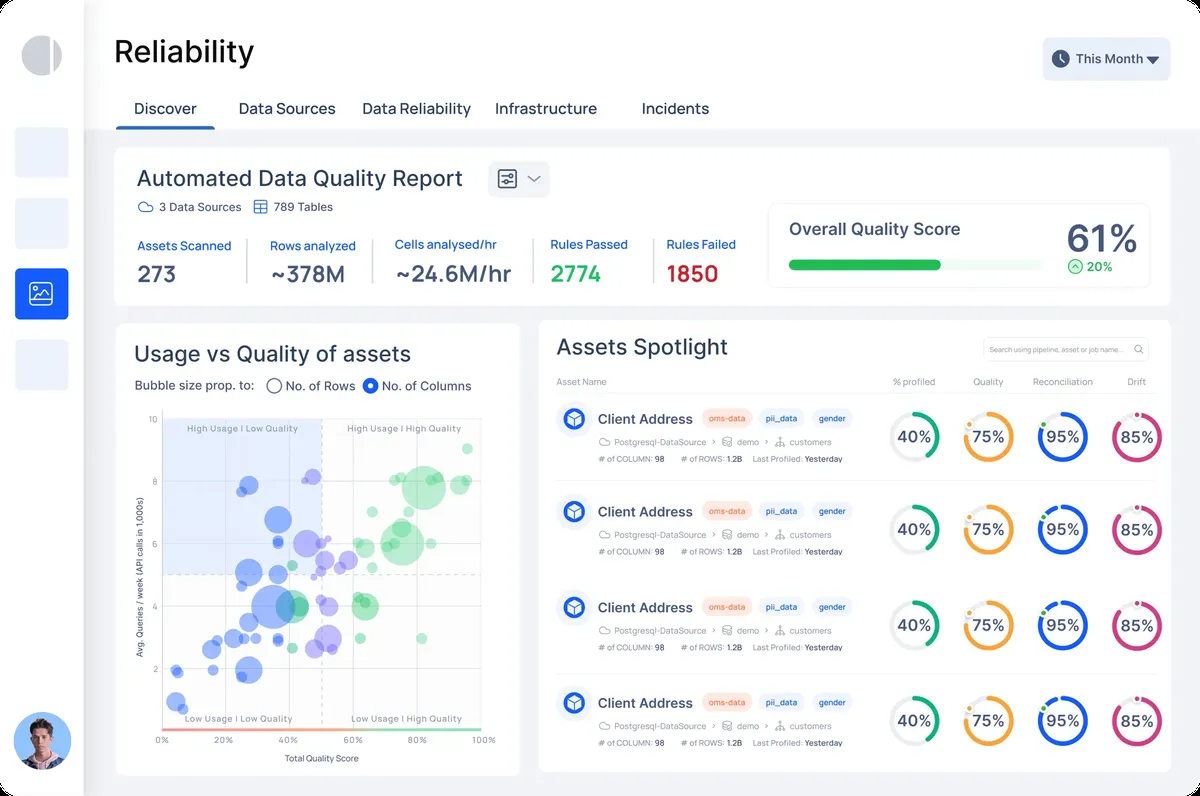
Interface Preview
Acceldata
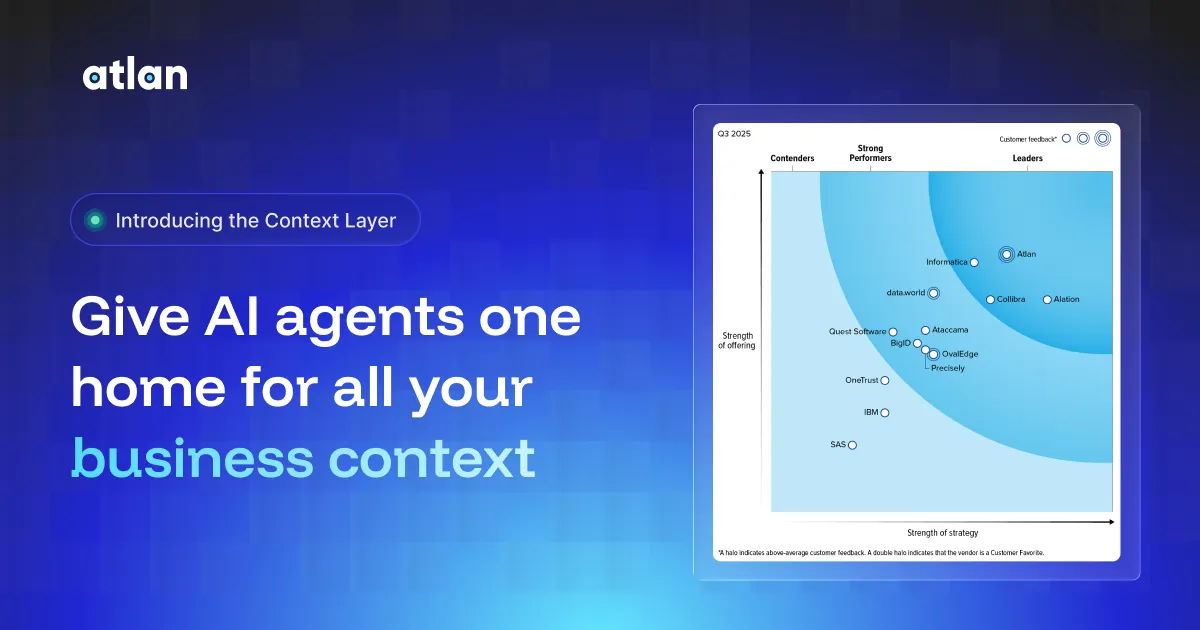
Atlan
Feature Comparison
| Feature | Acceldata | Atlan |
|---|---|---|
| Observability & Monitoring | ||
| Pipeline Health Monitoring | End-to-end pipeline observability with SLA tracking and anomaly detection | Metadata-level monitoring via integrations with external quality tools |
| Infrastructure Observability | Full infrastructure monitoring with bottleneck identification and resource management | Not a core capability; focuses on metadata rather than infrastructure |
| Cost Optimization | Dedicated cost pillar with visibility, chargeback, showback, and spend forecasting | Not offered as a standalone capability |
| Data Quality & Governance | ||
| Automated Data Quality | AI-powered agents with anomaly detection, profiling, and automated remediation | Quality profiling via marketplace integrations like Great Expectations and Soda |
| Data Lineage | Column-level lineage with root cause analysis across pipelines | End-to-end lineage across Snowflake, dbt, Tableau, Salesforce, and Fivetran |
| Business Glossary | Not a core feature; focused on operational metadata | Centralized, linkable glossary with ownership assignments and certification workflows |
| Access Control | Fine-grained RBAC with RBAM domain hierarchy and policy-aware controls | Personas and Purposes model with role-based access and data classification |
| Catalog & Discovery | ||
| Data Catalog | Metadata-driven observability dashboard; not a full data catalog | Full-featured catalog with AI-powered search and automated metadata cataloging |
| Data Discovery | Discovery focused on pipeline and quality issue investigation | Natural language search with personalized homepages and curated asset views |
| AI & Automation | ||
| AI Agent Framework | Specialized agents for quality, lineage, and profiling with xLake Reasoning Engine | Context pipeline agents that generate descriptions, link terms, and build semantic views |
| Natural Language Interface | The Business Notebook with contextual memory and explainable AI reasoning | AI-powered search across the Enterprise Data Graph |
| Custom Agent Building | Agent Studio for building and deploying custom AI agents | MCP server and open APIs for integrating context into external AI agents |
| Integration & Extensibility | ||
| Connector Ecosystem | Integrates with Snowflake, Databricks, AWS, GCP, Azure, Hadoop, and Kafka | 80+ connectors spanning warehouses, BI tools, transformation layers, and business apps |
| Open Architecture | API access to metadata available in Enterprise tier | Open by default with REST APIs, GraphQL, SDK, and MCP server |
Observability & Monitoring
Pipeline Health Monitoring
Infrastructure Observability
Cost Optimization
Data Quality & Governance
Automated Data Quality
Data Lineage
Business Glossary
Access Control
Catalog & Discovery
Data Catalog
Data Discovery
AI & Automation
AI Agent Framework
Natural Language Interface
Custom Agent Building
Integration & Extensibility
Connector Ecosystem
Open Architecture
Which approach fits
Acceldata and Atlan serve fundamentally different roles in the modern data stack. Acceldata is the operational nerve center for data observability, built for enterprises that need to monitor pipeline health, detect quality issues, and automate remediation at scale across complex multi-cloud environments. Atlan is the knowledge layer, designed to catalog metadata, build shared business context, and make that context available to every team and AI agent. Organizations running high-volume, mission-critical pipelines where downtime and data quality failures carry real cost will find Acceldata indispensable. Teams focused on data democratization, governance workflows, and enabling AI agents with trusted business context will get more value from Atlan.
When each approach fits
Choose Acceldata if:
Choose Acceldata if your top priority is operational data reliability. It delivers five-pillar observability across quality, pipelines, infrastructure, usage, and cost, with AI agents that autonomously detect and remediate issues. Enterprises in banking, telecom, and life sciences with complex hybrid environments will benefit most from its depth of monitoring and automated resolution capabilities.
Choose Atlan if:
Choose Atlan if you need a collaborative data catalog that unifies metadata and builds a shared context layer for your organization. Its 80+ connectors, AI-native bootstrapping, and MCP server make it the stronger platform for data discovery, governance, and enabling AI agents with certified business context. Teams prioritizing cross-functional collaboration and data democratization will find Atlan the better fit.
These scenarios reflect the available product evidence. Your requirements, existing stack, and team expertise should guide the final decision.
Frequently Asked Questions
What is the main difference between Acceldata and Atlan?
Acceldata is primarily a data observability and pipeline monitoring platform that detects, diagnoses, and remediates data issues across infrastructure and pipelines. Atlan is a data catalog and governance workspace that unifies metadata to help teams discover, understand, and trust their data assets. Acceldata excels at operational monitoring, while Atlan focuses on metadata management and collaboration.
Which platform is better for enterprise data quality?
Acceldata offers deeper data quality capabilities with AI-powered agents that continuously monitor pipelines, detect anomalies, trace root causes, and automate remediation workflows. Atlan supports data quality through marketplace integrations with tools like Great Expectations and Soda, but relies on external engines for the actual quality checks. For teams that need built-in, autonomous data quality monitoring, Acceldata is the stronger choice.
Can Atlan and Acceldata be used together?
Yes. Many enterprises use a data observability platform alongside a data catalog. Acceldata handles the operational monitoring, pipeline health, and automated remediation, while Atlan manages the metadata catalog, business glossary, and context layer. The two tools serve complementary roles in a modern data stack.
Which platform offers better pricing transparency?
Atlan publishes no pricing. Its pricing page resolves to a talk-to-sales contact form with no figures and no plan or edition names, so both the tier structure and the rates come from a quote. Ask for a quote scoped to your connector count and user roles, or the number will not be comparable with a competitor's published rate.
Which tool is better for supporting AI and LLM initiatives?
Both platforms position themselves as AI-ready but from different angles. Acceldata focuses on ensuring data reliability and governance for AI pipelines through its Agentic Data Management layer and BYOLLM support. Atlan provides the context layer that AI agents need to understand business logic, serving certified metadata through its MCP server and APIs. The right choice depends on whether your priority is data reliability or contextual understanding for AI.