Decision comparison
Acceldata vs Soda
Acceldata and Soda serve different segments of the data quality market. Acceldata is the stronger choice for large enterprises that need unified observability across pipelines, infrastructure, and cost alongside autonomous AI agents. Soda wins for data engineering teams that want collaborative data contracts, an open-source foundation, and peer-reviewed AI algorithms at a more accessible price point starting at $0/mo. Your decision depends on whether you need full-stack data platform observability or focused, developer-friendly data quality automation.
Architecture choice. These take different approaches to the same problem. Read the table as a fit question rather than a feature race.
These are different kinds of product — Data Observability and Data Validation Framework.
Quick Comparison
| Decision factor | Acceldata | Soda |
|---|---|---|
| Best For | Large enterprises needing unified data observability across pipelines, infrastructure, quality, usage, and cost with autonomous AI agents | Data engineering teams needing collaborative data contracts with AI-powered quality checks and record-level anomaly detection |
| Architecture | Closed-source SaaS platform with xLake Reasoning Engine for exabyte-scale processing across hyperscalers, data clouds, and on-prem environments | Open-source core (Python, 2,000+ GitHub stars) with SaaS cloud layer; data stays in your cloud for security-by-design compliance |
| Pricing Model | Acceldata publishes no prices. Its pricing page lists PRO and ENTERPRISE packages with a free trial, and directs buyers to a demo, so every figure comes from a quote. | Free tier at $0 per month, Team tier at $750 per month, with enterprise features available |
| Ease of Use | Natural language Business Notebook interface with contextual memory; rated 8.4/10 across 8 user reviews on external platforms | Engineers work in Git with YAML-based checks; business users use no-code UI; AI co-pilot generates data contracts with one click |
| Scalability | Exabyte-scale xLake Reasoning Engine processes 500B+ rows; verified 45 billion rows in under 2 hours for a top telco customer | Anomaly detection algorithms scale to 1 billion rows in 64 seconds with 70% fewer false positives than Facebook Prophet |
| Community/Support | Enterprise support with expert-led demos; recognized as G2 Leader in Data Observability and Gartner Market Guide representative vendor | Open-source community with 2,000+ GitHub stars; active development with v4.7.0 released April 2026; premium support on Team tier and above |
Acceldata
- Best For:
- Large enterprises needing unified data observability across pipelines, infrastructure, quality, usage, and cost with autonomous AI agents
- Architecture:
- Closed-source SaaS platform with xLake Reasoning Engine for exabyte-scale processing across hyperscalers, data clouds, and on-prem environments
- Pricing Model:
- Acceldata publishes no prices. Its pricing page lists PRO and ENTERPRISE packages with a free trial, and directs buyers to a demo, so every figure comes from a quote.
- Ease of Use:
- Natural language Business Notebook interface with contextual memory; rated 8.4/10 across 8 user reviews on external platforms
- Scalability:
- Exabyte-scale xLake Reasoning Engine processes 500B+ rows; verified 45 billion rows in under 2 hours for a top telco customer
- Community/Support:
- Enterprise support with expert-led demos; recognized as G2 Leader in Data Observability and Gartner Market Guide representative vendor
Soda
- Best For:
- Data engineering teams needing collaborative data contracts with AI-powered quality checks and record-level anomaly detection
- Architecture:
- Open-source core (Python, 2,000+ GitHub stars) with SaaS cloud layer; data stays in your cloud for security-by-design compliance
- Pricing Model:
- Free tier at $0 per month, Team tier at $750 per month, with enterprise features available
- Ease of Use:
- Engineers work in Git with YAML-based checks; business users use no-code UI; AI co-pilot generates data contracts with one click
- Scalability:
- Anomaly detection algorithms scale to 1 billion rows in 64 seconds with 70% fewer false positives than Facebook Prophet
- Community/Support:
- Open-source community with 2,000+ GitHub stars; active development with v4.7.0 released April 2026; premium support on Team tier and above
Public signals
Verified factual signals only. Bars appear only for like-for-like metrics with five weekly assessments for every tool; missing evidence stays explicit. These signals do not establish enterprise adoption, product quality, or total cost.
| Metric | Acceldata | Soda |
|---|---|---|
| Search interest(Market interest) | 0 | 0 |
| PyPI weekly downloads(Developer adoption) | 38.7k | Not available |
| GitHub commits, 90d(Product adoption) | Not available | 81 |
| GitHub stars(Product adoption) | Not available | 2,000+ |
| PyPI weekly downloads(Product adoption) | Not available | 405.8k |
As of September 21, 2026 — updated weekly.
Health & risk evidence
Observed public-source checks for mapped package versions and repositories.
Acceldata
September 21, 2026Package vulnerabilities
PyPI · acceldata-sdk@26.9.0
0 vulnerabilities
across 1 package
Repository security score
Not available
Soda
September 21, 2026Package vulnerabilities
PyPI · soda-core@4.24.0
0 vulnerabilities
across 1 package
Repository security score
Not available
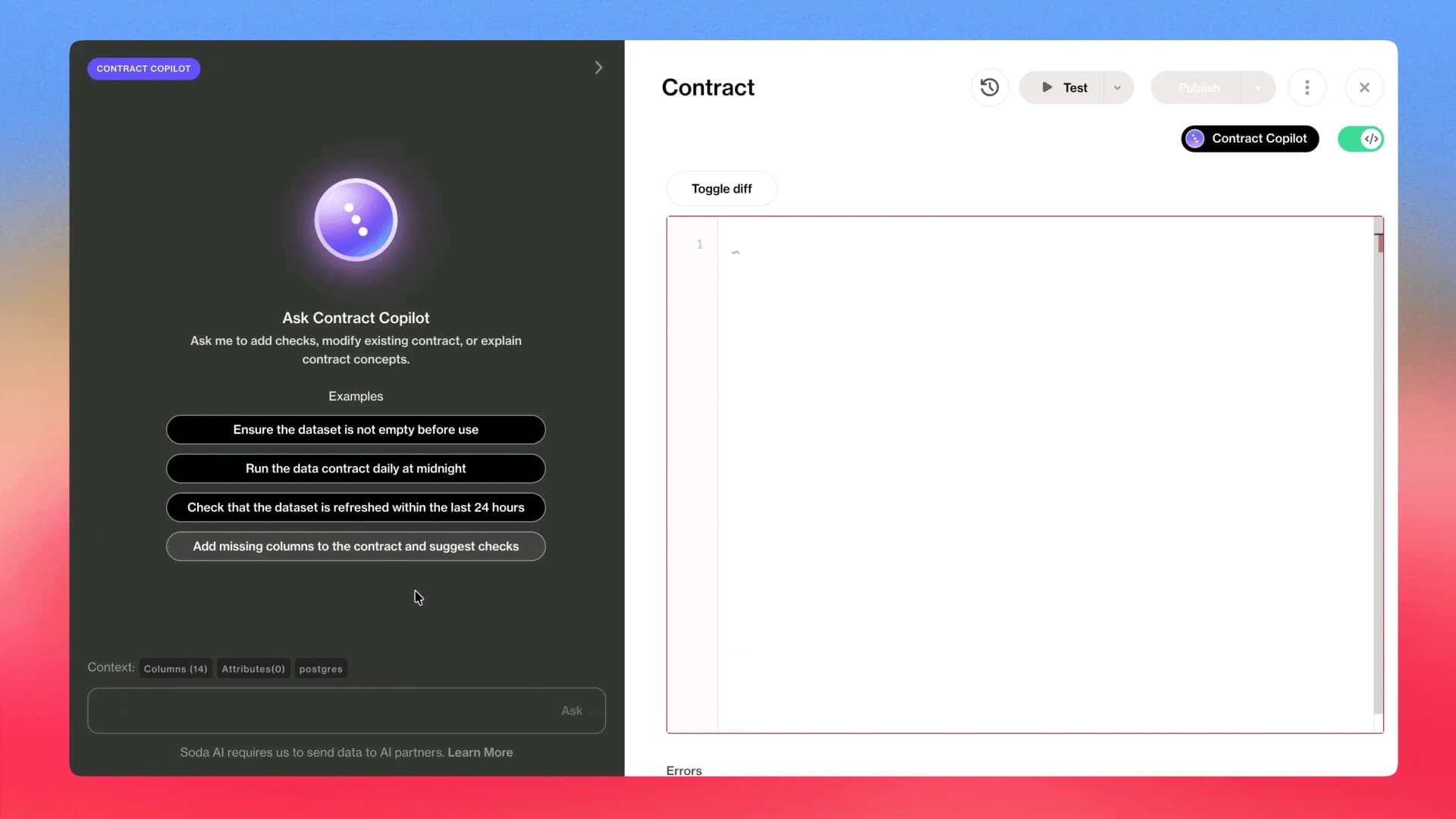
Interface Preview
Soda
Feature Comparison
| Feature | Acceldata | Soda |
|---|---|---|
| Data Quality Monitoring | ||
| Anomaly Detection | Multi-variate anomaly detection with AI agents that learn baseline behavior patterns | Record-level anomaly detection with peer-reviewed algorithms published in NeurIPS and JAIR |
| Schema Drift Detection | Automated schema drift monitoring included in Pro tier with real-time alerts | Schema checks enforced via YAML-based data contracts with versioned proposals and diffs |
| Data Freshness Monitoring | SLA tracking with reliability scoring and freshness monitoring across pipelines | Column-level freshness thresholds defined in data contracts with configurable time units |
| AI and Automation | ||
| AI-Powered Issue Resolution | Autonomous AI agents detect issues, trace root cause, and automate remediation workflows | AI co-pilot generates data contracts and checks from plain English descriptions |
| Natural Language Interface | Business Notebook with contextual memory for natural language queries and explainable reasoning | AI automations let users write checks in plain English with one-click contract generation |
| Automated Data Classification | Automated data classification included in Pro tier with advanced classification in Enterprise | AI-powered contract generation automatically identifies column types and validation rules |
| Governance and Compliance | ||
| Access Control | Resource-Based Access Management (RBAM) with domain hierarchy and policy-aware controls | Role-Based Access Control with audit logs, custom roles, and SSO on Team tier |
| Data Lineage | Column-level lineage with root cause tracing across pipelines and BI tools | Complete traceability with diagnostics warehouse storing all failed records and anomaly logs |
| Security Certifications | SOC 2 Type 2 certified with data encryption at rest and in transit | Security-by-design architecture where data stays in your cloud environment |
| Collaboration and Workflows | ||
| Data Contracts | Policy-governed workflows with human-in-the-loop approvals for autonomous agent actions | Dedicated data contracts engine with collaborative workflows between Git and UI interfaces |
| Business-Engineering Collaboration | Real-time collaboration platform to cut through organizational and technology silos | Engineers work in Git while business users use no-code UI with versioned proposals |
| Alerting and Integrations | Monitors and alerts with BI tool lineage and pipeline monitoring across cloud platforms | Alerting and ticketing integrations included in free tier with catalog integrations on paid |
| Infrastructure and Deployment | ||
| Deployment Options | SaaS with geographic data centers; supports on-prem and cloud data observation | SaaS with private deployment option on Team tier; open-source CLI for self-hosted use |
| Platform Coverage | Five observability pillars: data quality, pipeline, infrastructure, user, and cost | Focused on data quality with contracts, observability, root cause analytics, and remediation |
| Historical Data Analysis | Continuous monitoring with baseline learning from historical data patterns | Built-in backfilling and backtesting analyzes one year of historical data instantly |
Data Quality Monitoring
Anomaly Detection
Schema Drift Detection
Data Freshness Monitoring
AI and Automation
AI-Powered Issue Resolution
Natural Language Interface
Automated Data Classification
Governance and Compliance
Access Control
Data Lineage
Security Certifications
Collaboration and Workflows
Data Contracts
Business-Engineering Collaboration
Alerting and Integrations
Infrastructure and Deployment
Deployment Options
Platform Coverage
Historical Data Analysis
Which approach fits
Acceldata and Soda serve different segments of the data quality market. Acceldata is the stronger choice for large enterprises that need unified observability across pipelines, infrastructure, and cost alongside autonomous AI agents. Soda wins for data engineering teams that want collaborative data contracts, an open-source foundation, and peer-reviewed AI algorithms at a more accessible price point starting at $0/mo. Your decision depends on whether you need full-stack data platform observability or focused, developer-friendly data quality automation.
When each approach fits
Choose Acceldata if:
Choose Acceldata when your organization operates at enterprise scale with complex multi-cloud or hybrid data environments spanning lakehouses, warehouses, and streaming systems. Acceldata is the right fit if you need unified observability across five pillars -- data quality, pipeline health, infrastructure performance, user behavior, and cost optimization -- all managed through autonomous AI agents. It excels for Fortune 500 companies, financial institutions, and telecoms that process billions of rows and need autonomous remediation workflows with human-in-the-loop governance. The platform's xLake Reasoning Engine and Business Notebook interface make it suitable for organizations that want natural language access to their data operations.
Choose Soda if:
Choose Soda when your data engineering team needs a developer-friendly data quality platform with a strong open-source foundation and collaborative data contracts. Soda is ideal for teams that want engineers working in Git with YAML-based checks while business users contribute through a no-code interface. Its free tier makes it accessible for small projects, and the Team tier at $750/mo provides advanced AI-powered features, RBAC, and SSO. Soda stands out for organizations that value peer-reviewed AI research (published in NeurIPS, JAIR, ACML), need record-level anomaly detection scaling to 1 billion rows in 64 seconds, or want built-in backfilling to analyze historical data patterns instantly.
These scenarios reflect the available product evidence. Your requirements, existing stack, and team expertise should guide the final decision.
Frequently Asked Questions
What is the main difference between Acceldata and Soda?
Acceldata is a comprehensive enterprise data observability platform that covers five pillars: data quality, pipeline monitoring, infrastructure performance, user behavior, and cost optimization. It uses autonomous AI agents powered by the xLake Reasoning Engine to detect, diagnose, and remediate issues across complex multi-cloud environments. Soda focuses specifically on data quality with a developer-friendly approach built around data contracts. Engineers define checks in YAML via Git while business users collaborate through a no-code interface. Soda also offers an open-source core with 2,335 GitHub stars, making it accessible for focused teams and individual projects.
How do Acceldata and Soda compare on pricing?
Soda offers a free tier at $0/mo that includes pipeline testing, metrics observability, and alerting integrations. Its Team tier costs $750/mo and adds collaborative data contracts, no-code interface, advanced AI features, RBAC, and SSO. Enterprise pricing is custom. Acceldata provides a free tier for up to 1 TB of data and a Pro tier at $100/mo for up to 10 TB, with Enterprise pricing requiring a sales conversation. Acceldata also offers a 30-day free trial. Soda is generally more cost-effective for data engineering teams focused on data quality, while Acceldata's broader platform scope covering infrastructure, cost, and user observability justifies its enterprise pricing for larger organizations.
Which tool is better for data engineering teams that work with code?
Soda is the stronger choice for code-oriented data engineering teams. Its open-source core is written in Python with 2,335 GitHub stars, and engineers define data quality checks using YAML-based data contracts managed through Git workflows. Every change is versioned with proposals and diffs visible in both Git and the UI. Soda's CLI allows pipeline testing directly from development environments, and its AI co-pilot can generate full data contracts from plain English descriptions. Acceldata takes a more platform-centric approach with its Business Notebook natural language interface and Agent Studio for building custom AI agents, which suits organizations that prefer managed, low-code experiences over direct code integration.
How do Acceldata and Soda handle AI-powered data quality automation?
Both platforms leverage AI but with different approaches. Acceldata uses autonomous AI agents organized through its Agentic Data Management framework. These agents proactively monitor pipelines, detect anomalies using multi-variate analysis, trace root causes through lineage, and automate remediation with human-in-the-loop approvals. The xLake Reasoning Engine provides shared memory and context across agents. Soda has built proprietary AI algorithms that are peer-reviewed and published in NeurIPS, JAIR, and ACML. Their metrics monitoring beats Facebook Prophet with 70% fewer false positives and scales to 1 billion rows in 64 seconds. Soda's AI co-pilot generates data contracts and checks from natural language, focusing on quality automation rather than full-stack observability.