Decision comparison
Anomalo vs Soda
Anomalo and Soda both address data quality monitoring but take meaningfully different approaches. Anomalo leads with unsupervised machine learning that automatically detects anomalies across structured, semi-structured, and unstructured data at enterprise scale. Soda leads with a data contracts engine, record-level anomaly detection, and a collaborative workflow that unites engineers writing code with business users working in a UI. Anomalo's agentic architecture with nine AI agents delivers proactive insights without user prompts, while Soda's peer-reviewed AI research powers metrics monitoring that beats Facebook Prophet with 70% fewer false positives. The right choice depends on whether your team prioritizes zero-configuration ML-driven monitoring or a contracts-first approach with open source foundations and transparent pricing.
Architecture choice. These take different approaches to the same problem. Read the table as a fit question rather than a feature race.
These are different kinds of product — Data Observability and Data Validation Framework.
Quick Comparison
| Decision factor | Anomalo | Soda |
|---|---|---|
| Primary Focus | AI-powered data quality monitoring across structured, semi-structured, and unstructured data using unsupervised machine learning | AI-native data quality platform with data contracts, automated checks, and record-level anomaly detection across the full data lifecycle |
| Pricing Model | Contact for pricing | Free tier at $0 per month, Team tier at $750 per month, with enterprise features available |
| AI Approach | Unsupervised ML models automatically built per dataset to detect statistically significant deviations without manual thresholds | Peer-reviewed AI research published in NeurIPS, JAIR, and ACML powering metrics monitoring, record-level anomaly detection, and AI-generated data contracts |
| Data Scope | Monitors data at rest in cloud warehouses and data lakes including Snowflake, BigQuery, and Databricks | Monitors data across warehouses, pipelines, and source systems with data staying in the customer's cloud environment |
| Open Source Component | No open source component; fully proprietary closed-source platform with documentation accessible only to customers | Open source Python library (soda-core) with 2,000+ GitHub stars; latest release v4.7.0 in April 2026 |
| Target User | Data engineers, enterprise data architects, and AI/ML operations teams at large enterprises with mature data infrastructure | Data engineers working in code and business users working in the UI, united through collaborative data contracts |
Anomalo
- Primary Focus:
- AI-powered data quality monitoring across structured, semi-structured, and unstructured data using unsupervised machine learning
- Pricing Model:
- Contact for pricing
- AI Approach:
- Unsupervised ML models automatically built per dataset to detect statistically significant deviations without manual thresholds
- Data Scope:
- Monitors data at rest in cloud warehouses and data lakes including Snowflake, BigQuery, and Databricks
- Open Source Component:
- No open source component; fully proprietary closed-source platform with documentation accessible only to customers
- Target User:
- Data engineers, enterprise data architects, and AI/ML operations teams at large enterprises with mature data infrastructure
Soda
- Primary Focus:
- AI-native data quality platform with data contracts, automated checks, and record-level anomaly detection across the full data lifecycle
- Pricing Model:
- Free tier at $0 per month, Team tier at $750 per month, with enterprise features available
- AI Approach:
- Peer-reviewed AI research published in NeurIPS, JAIR, and ACML powering metrics monitoring, record-level anomaly detection, and AI-generated data contracts
- Data Scope:
- Monitors data across warehouses, pipelines, and source systems with data staying in the customer's cloud environment
- Open Source Component:
- Open source Python library (soda-core) with 2,000+ GitHub stars; latest release v4.7.0 in April 2026
- Target User:
- Data engineers working in code and business users working in the UI, united through collaborative data contracts
Public signals
Verified factual signals only. Bars appear only for like-for-like metrics with five weekly assessments for every tool; missing evidence stays explicit. These signals do not establish enterprise adoption, product quality, or total cost.
| Metric | Anomalo | Soda |
|---|---|---|
| Product Hunt comments(Community interest) | 21 | Not available |
| Product Hunt reviews(Community interest) | 0 | Not available |
| Product Hunt votes(Community interest) | 292 | Not available |
| PyPI weekly downloads(Developer adoption) | 29.4k | Not available |
| GitHub commits, 90d(Product adoption) | Not available | 105 |
| GitHub stars(Product adoption) | Not available | 2,000+ |
| PyPI weekly downloads(Product adoption) | Not available | 397.4k |
As of October 19, 2026 — updated weekly.
Health & risk evidence
Observed public-source checks for mapped package versions and repositories.
Anomalo
October 19, 2026Package vulnerabilities
PyPI · anomalo@0.55.1
0 vulnerabilities
across 1 package
Repository security score
Not available
Soda
October 19, 2026Package vulnerabilities
PyPI · soda-core@4.27.0
0 vulnerabilities
across 1 package
Repository security score
Not available
Interface Preview
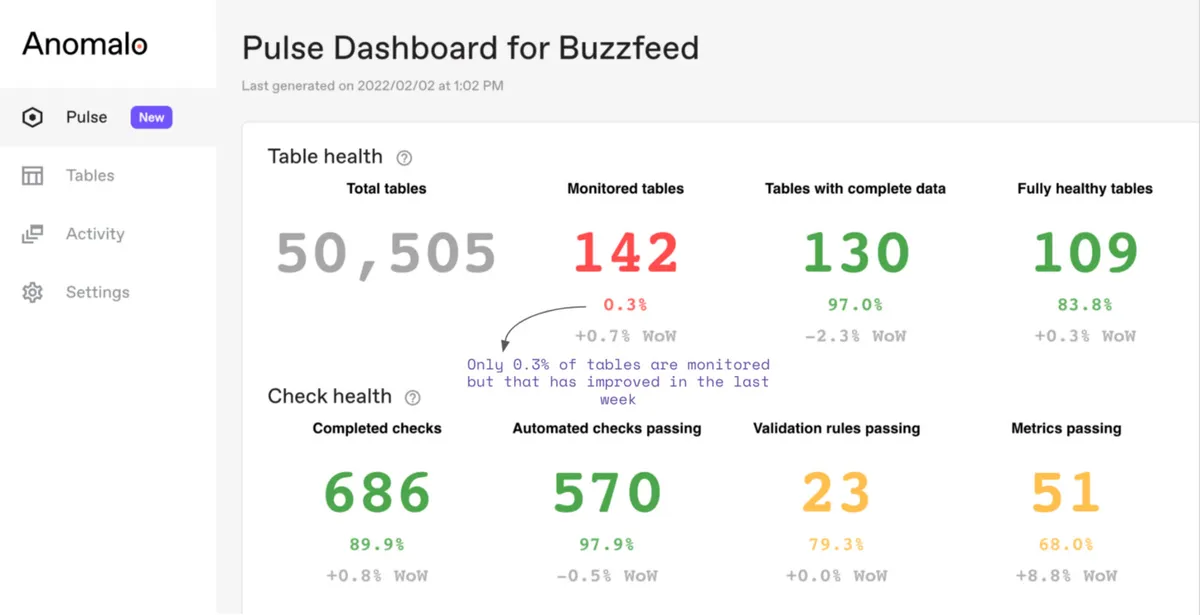
Anomalo
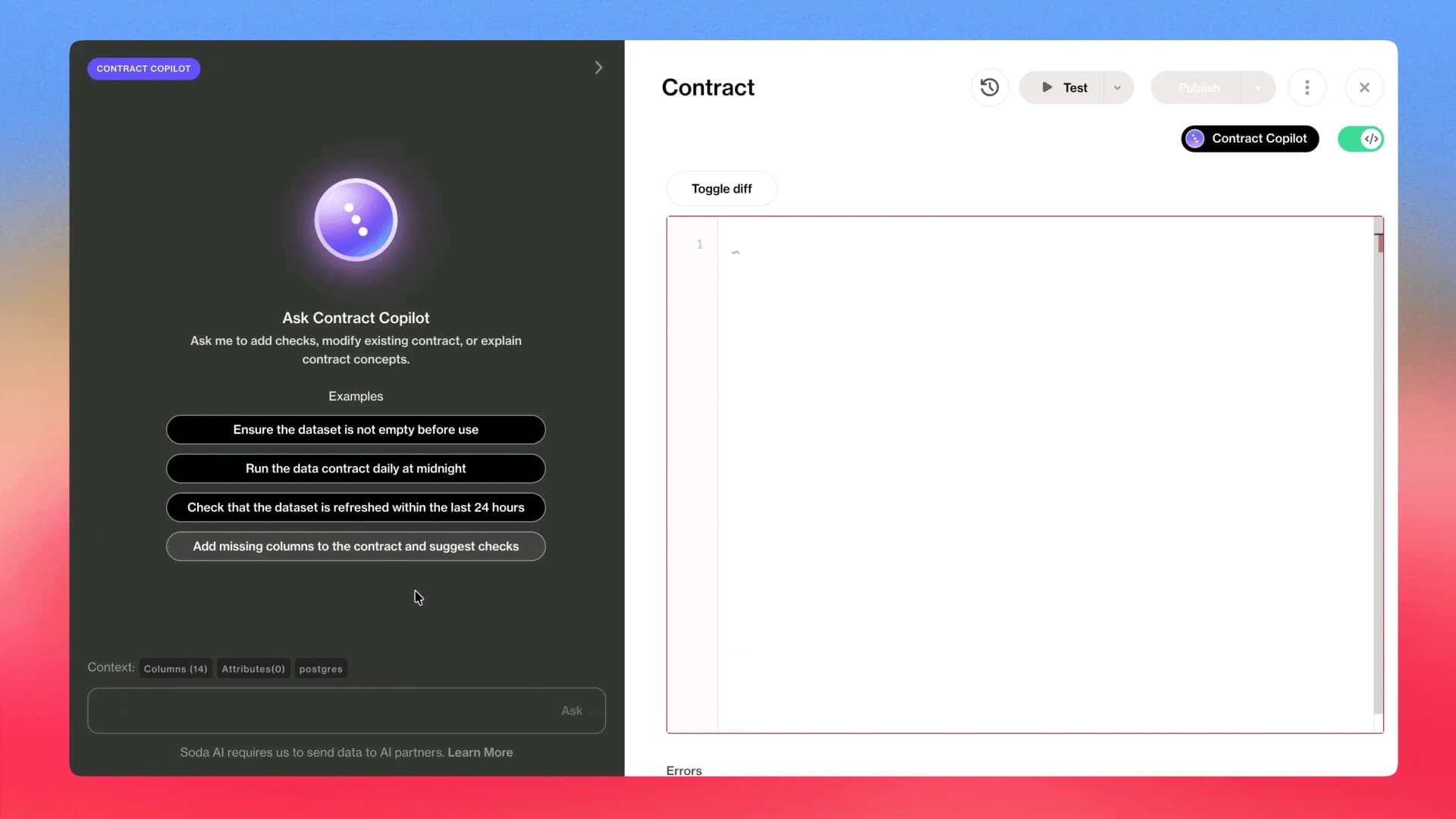
Soda
Feature Comparison
| Feature | Anomalo | Soda |
|---|---|---|
| Detection and Monitoring | ||
| AI-powered anomaly detection | Unsupervised ML detects statistically significant data deviations per dataset | Record-level anomaly detection is explicitly listed |
| Automated data quality checks | Automatically detects data issues as soon as they appear | Automated data quality checks are explicitly listed |
| Data type coverage | Monitors structured, semi-structured, and unstructured data | Not verified |
| Rules and Contracts | ||
| No-code interface | UI or API defines business rules and KPIs | No-code interface included in Team features |
| Data contracts | Not verified | Data Contracts Engine with collaborative data contracts |
| AI-powered contract generation | Not verified | Automated generation and refinement of AI-powered data contracts |
| Resolution and Analysis | ||
| Root cause analysis | Automated root cause analysis supports rapid issue resolution | Catches, explains, and resolves issues when they appear |
| Data lineage | Lineage tools visualize upstream and downstream impact | Not verified |
| Historical data analysis | Not verified | Backfilling and backtesting support historical data analysis |
| Integration and Pricing | ||
| Platform integrations | Native cloud lake, warehouse, and ETL integrations | Catalog integrations included with additional SPUs |
| Pricing model | Enterprise pricing; contact for pricing | Freemium usage-based pricing with enterprise options |
| Published starting price | Not verified | Free tier costs $0 per month |
Detection and Monitoring
AI-powered anomaly detection
Automated data quality checks
Data type coverage
Rules and Contracts
No-code interface
Data contracts
AI-powered contract generation
Resolution and Analysis
Root cause analysis
Data lineage
Historical data analysis
Integration and Pricing
Platform integrations
Pricing model
Published starting price
Which approach fits
Anomalo and Soda both address data quality monitoring but take meaningfully different approaches. Anomalo leads with unsupervised machine learning that automatically detects anomalies across structured, semi-structured, and unstructured data at enterprise scale. Soda leads with a data contracts engine, record-level anomaly detection, and a collaborative workflow that unites engineers writing code with business users working in a UI. Anomalo's agentic architecture with nine AI agents delivers proactive insights without user prompts, while Soda's peer-reviewed AI research powers metrics monitoring that beats Facebook Prophet with 70% fewer false positives. The right choice depends on whether your team prioritizes zero-configuration ML-driven monitoring or a contracts-first approach with open source foundations and transparent pricing.
When each approach fits
Choose Anomalo if:
We recommend Anomalo for large enterprises with mature data infrastructure that need automated, zero-configuration data quality monitoring across thousands of tables. The platform excels when your team manages high-volume data warehouses on Snowflake, BigQuery, or Databricks and needs to catch anomalies in data volume, schema, and distribution without writing manual rules or thresholds. Anomalo is the stronger choice if you require monitoring across structured, semi-structured, and unstructured data types, particularly for organizations investing heavily in generative AI where data quality for RAG pipelines and LLM training sets is critical. Its agentic platform with specialized AI agents for proactive insights, conversational analytics, and autonomous data quality rules delivers significant value for data teams that want continuous monitoring with minimal manual intervention. The trade-off is enterprise-only pricing with no public tiers, closed documentation, and compute costs that can grow with full-table scan workloads.
Choose Soda if:
We recommend Soda for data teams that need a contracts-first approach to data quality with transparent pricing and an open source foundation. The platform excels when your organization requires collaborative data contracts that bridge engineering and business teams, record-level anomaly detection that isolates individual bad rows, and a diagnostics warehouse that stores all failed records for root cause investigation. Soda is the stronger choice if you need a free tier to start, a code-first workflow for engineers alongside a no-code UI for business users, and AI-powered automation backed by peer-reviewed research published in NeurIPS, JAIR, and ACML. Its open source soda-core library with 2,335 GitHub stars provides transparency and extensibility that closed platforms cannot match. The Team tier at $750 per month gives growing data teams access to collaborative data contracts, advanced AI features, and private deployment without requiring enterprise-level commitment upfront.
These scenarios reflect the available product evidence. Your requirements, existing stack, and team expertise should guide the final decision.
Frequently Asked Questions
How do the pricing models compare between Anomalo and Soda?
Anomalo uses an enterprise-only pricing model where all pricing requires direct engagement with the sales team. There are no public pricing tiers, free trials, or self-service signup options. The platform targets large enterprises, and organizations should budget for both the Anomalo license and the additional warehouse compute credits generated by monitoring workloads that perform full-table scans. Soda offers a transparent tiered pricing structure. The Free tier costs $0 per month and includes pipeline testing, metrics observability, and alerting integrations. The Team tier costs $750 per month and adds collaborative data contracts, a no-code interface, advanced AI-powered data quality features, audit logs, custom roles, RBAC, private deployment, SSO, and premium support. Enterprise pricing is custom with annual billing and volume discounts available.
Which platform handles anomaly detection more effectively?
Anomalo and Soda take different approaches to anomaly detection. Anomalo uses unsupervised machine learning that automatically builds models for each dataset based on its history, patterns, and structure. These per-dataset models detect statistically significant differences from expected behavior without requiring manual threshold configuration. This approach works across structured, semi-structured, and unstructured data types. Soda applies record-level anomaly detection with algorithms that their team claims beat Facebook Prophet with 70% fewer false positives while scaling to 1 billion rows in 64 seconds. Soda's AI research has been published in peer-reviewed venues including NeurIPS, JAIR, and ACML. The key difference is granularity: Anomalo detects anomalies at the table and column level, while Soda provides record-level detection that identifies and isolates individual problematic rows in a diagnostics warehouse.
Can Soda replace Anomalo for unstructured data quality monitoring?
Soda focuses on structured data quality through data contracts, automated checks, and record-level anomaly detection across warehouses and pipelines. It does not currently provide monitoring capabilities for unstructured data such as documents, PDFs, or images. Anomalo explicitly supports unstructured data quality monitoring, using the same unsupervised ML approach it applies to structured data. Anomalo has published case studies and AWS partner documentation describing how it profiles, validates, and cleanses unstructured data collections for production AI initiatives. If your organization needs to monitor the quality of unstructured data assets alongside structured warehouse tables, Anomalo is the only option between these two platforms that addresses that requirement today.
What are the main limitations of each platform that buyers should know about?
Anomalo has several documented limitations. Its monitoring jobs can generate high compute costs when scanning large data volumes because it performs full-table scans. Onboarding requires opting in each table individually, which becomes painful beyond a few thousand tables. Alert routing lacks granular controls by owner, team, or domain. The platform does not provide native data contracts or record-level anomaly isolation. Documentation is accessible only to existing customers or trial users, creating friction during the evaluation process. Soda presents different trade-offs. The platform does not provide native data lineage visualization or dependency mapping across the data stack. It does not support unstructured data monitoring. The open source soda-core library covers basic checks, but advanced features like AI-powered data contracts, record-level anomaly detection, and the no-code interface require the paid Soda Cloud platform. The Team tier at $750 per month may be a significant jump for small teams moving off the free plan.