Decision comparison
Acceldata vs Monte Carlo
Acceldata and Monte Carlo are both enterprise data observability platforms, but they differ meaningfully in scope, deployment philosophy, and AI strategy. Acceldata takes a broader approach with five observability pillars covering quality, pipelines, infrastructure, usage, and cost, backed by autonomous AI agents that handle detection through remediation. Monte Carlo concentrates on data and AI observability with ML-driven monitoring, strong incident workflows, and a fast-deploy model that gets teams operational quickly. Acceldata is the deeper platform for organizations managing complex hybrid environments with on-prem, cloud, and multi-cloud data systems. Monte Carlo is the more focused platform for data teams that want fast deployment, battle-tested incident management, and dedicated AI agent observability.
Direct comparison. These are reviewed substitutes bought for the same job, so the differences below are the ones that decide between them.
All 2 are data observability.
Quick Comparison
| Decision factor | Acceldata | Monte Carlo |
|---|---|---|
| Primary Focus | Unified data management across quality, pipelines, infrastructure, usage, and cost | End-to-end data and AI observability from ingestion to consumption |
| AI Capabilities | Autonomous AI agents with xLake Reasoning Engine for detection, remediation, and governance | ML-driven anomaly detection, monitoring agents, and AI agent observability |
| Deployment Model | SaaS with support for on-prem, cloud, and hybrid environments; data never leaves premises | SaaS-first with self-hosted storage option available in Scale tier and above |
| Monitoring Approach | Five-pillar observability with inline data inspection at exabyte scale | Automated baseline monitors with ML-powered anomaly detection and agentic scaling |
| Pricing Model | Acceldata publishes no prices. Its pricing page lists PRO and ENTERPRISE packages with a free trial and directs buyers to a demo, so every figure is set in a quote. | Monte Carlo publishes no amounts. Its tiers are Start, Scale, Enterprise and Business Critical, purchased as credits, and all are quote-only. Every tier includes agent, ML and data observability. |
| Best For | Fortune 500 enterprises with complex multi-cloud pipelines needing broad infrastructure coverage | Data teams wanting fast deployment, strong incident workflows, and AI agent monitoring |
Acceldata
- Primary Focus:
- Unified data management across quality, pipelines, infrastructure, usage, and cost
- AI Capabilities:
- Autonomous AI agents with xLake Reasoning Engine for detection, remediation, and governance
- Deployment Model:
- SaaS with support for on-prem, cloud, and hybrid environments; data never leaves premises
- Monitoring Approach:
- Five-pillar observability with inline data inspection at exabyte scale
- Pricing Model:
- Acceldata publishes no prices. Its pricing page lists PRO and ENTERPRISE packages with a free trial and directs buyers to a demo, so every figure is set in a quote.
- Best For:
- Fortune 500 enterprises with complex multi-cloud pipelines needing broad infrastructure coverage
Monte Carlo
- Primary Focus:
- End-to-end data and AI observability from ingestion to consumption
- AI Capabilities:
- ML-driven anomaly detection, monitoring agents, and AI agent observability
- Deployment Model:
- SaaS-first with self-hosted storage option available in Scale tier and above
- Monitoring Approach:
- Automated baseline monitors with ML-powered anomaly detection and agentic scaling
- Pricing Model:
- Monte Carlo publishes no amounts. Its tiers are Start, Scale, Enterprise and Business Critical, purchased as credits, and all are quote-only. Every tier includes agent, ML and data observability.
- Best For:
- Data teams wanting fast deployment, strong incident workflows, and AI agent monitoring
Public signals
Verified factual signals only. Bars appear only for like-for-like metrics with five weekly assessments for every tool; missing evidence stays explicit. These signals do not establish enterprise adoption, product quality, or total cost.
| Metric | Acceldata | Monte Carlo |
|---|---|---|
| Search interest(Market interest) | 0 | 0 |
| PyPI weekly downloads(Developer adoption) | 112.9k | 46.0k |
| GitHub commits, 90d(Developer adoption) | Not available | 205 |
| GitHub stars(Developer adoption) | Not available | 2 |
| Hacker News mentions, 90d(Community interest) | Not available | 0 |
As of October 5, 2026 — updated weekly.
Health & risk evidence
Observed public-source checks for mapped package versions and repositories.
Acceldata
October 5, 2026Package vulnerabilities
PyPI · acceldata-sdk@26.9.0
0 vulnerabilities
across 1 package
Repository security score
Not available
Monte Carlo
October 5, 2026Package vulnerabilities
PyPI · montecarlodata@0.176.0
0 vulnerabilities
across 1 package
Repository security score
Not available
Interface Preview
Monte Carlo
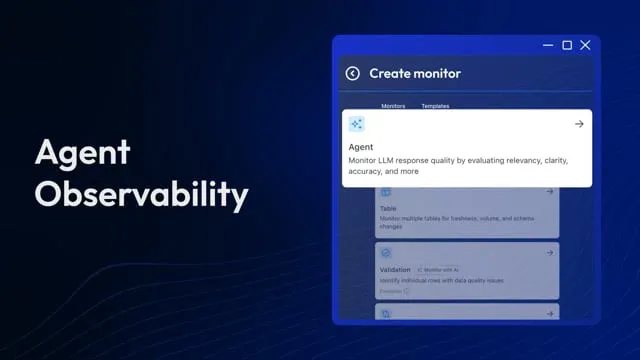
Feature Comparison
| Feature | Acceldata | Monte Carlo |
|---|---|---|
| Data Quality & Anomaly Detection | ||
| Anomaly Detection | AI-powered multi-variate anomaly detection with automated classification and inline inspection | ML-driven anomaly detection with automatic baseline coverage for freshness, volume, and schema |
| Data Profiling | Dedicated Data Profiling Agent that surfaces distributions, anomalies, and structural insights | Automatic data profiling with AI-powered quality rules and unstructured data monitoring |
| Schema Change Detection | Schema drift detection as part of the core observability platform | Automated schema change monitoring included in baseline coverage |
| Lineage & Root Cause Analysis | ||
| Data Lineage | Column-level lineage with root cause tracing across pipelines and platforms | End-to-end column-level lineage with visual tracking across the entire data ecosystem |
| Root Cause Analysis | AI agents trace root causes and automate remediation workflows with HITL approvals | Automated root cause analysis with enriched lineage context and impact assessment |
| Impact Analysis | Pipeline-level impact assessment through observability dashboard views | Downstream impact analysis for dashboards, reports, and business processes |
| Incident Management & Alerting | ||
| Alerting System | Real-time alerts and monitors across all five observability pillars | Granular alert routing with automated lineage grouping and root-cause context |
| Incident Triage | AI-driven triage with automated remediation and domain-specific policy enforcement | Built-in incident management workflow with triaging, communication, and resolution tracking |
| Monitor Deployment | Rule-based monitors with automated classification and AI Copilot assistance | Flexible deployment via CI/CD YAML, point-and-click UI, or AI-powered programmatic creation |
| AI & Agent Observability | ||
| AI Agent Framework | Agent Studio for building custom AI agents; xLake Reasoning Engine as shared intelligence layer | Monitoring agent for automated coverage recommendations; AI agent observability for production agents |
| AI Observability | BYOLLM support with enterprise-grade governance for AI inference within controlled environments | End-to-end AI observability monitoring inputs and outputs from data source to agent |
| Natural Language Interface | The Business Notebook with contextual memory, continuous learning, and explainable reasoning | Monitoring agent accepts natural language prompts to discover and deploy monitors |
| Platform & Integration | ||
| Integration Ecosystem | Snowflake, Databricks, AWS, GCP, Azure, Hadoop, Kafka, and on-prem systems | Deep integrations from ingestion to consumption including warehouses, lakes, BI, and ETL tools |
| Infrastructure Coverage | Dedicated infrastructure pillar with health monitoring, bottleneck identification, and resource management | Performance optimization with financial operations insights and cost management tools |
| Security & Compliance | SOC 2 Type 2, MFA, RBAC, RBAM, data encryption at rest and in transit | SSO, SCIM, self-hosted storage, PII filtering, and audit logging in Scale tier and above |
Data Quality & Anomaly Detection
Anomaly Detection
Data Profiling
Schema Change Detection
Lineage & Root Cause Analysis
Data Lineage
Root Cause Analysis
Impact Analysis
Incident Management & Alerting
Alerting System
Incident Triage
Monitor Deployment
AI & Agent Observability
AI Agent Framework
AI Observability
Natural Language Interface
Platform & Integration
Integration Ecosystem
Infrastructure Coverage
Security & Compliance
Which to choose
Acceldata and Monte Carlo are both enterprise data observability platforms, but they differ meaningfully in scope, deployment philosophy, and AI strategy. Acceldata takes a broader approach with five observability pillars covering quality, pipelines, infrastructure, usage, and cost, backed by autonomous AI agents that handle detection through remediation. Monte Carlo concentrates on data and AI observability with ML-driven monitoring, strong incident workflows, and a fast-deploy model that gets teams operational quickly. Acceldata is the deeper platform for organizations managing complex hybrid environments with on-prem, cloud, and multi-cloud data systems. Monte Carlo is the more focused platform for data teams that want fast deployment, battle-tested incident management, and dedicated AI agent observability.
Best-fit scenarios
Choose Acceldata if:
Choose Acceldata when your organization operates at enterprise scale across hybrid and multi-cloud environments and needs unified observability that goes beyond data quality into infrastructure health, pipeline monitoring, and cost optimization. Acceldata's five-pillar approach and AI-powered agents are built for Fortune 500 companies in banking, telecom, and life sciences where data downtime carries significant financial impact. Its xLake Reasoning Engine, Agent Studio for custom agent development, and RBAM governance model make it the stronger choice when you need breadth of coverage and autonomous remediation across the full data stack.
Choose Monte Carlo if:
Choose Monte Carlo when your team needs fast time-to-value, strong incident management workflows, and dedicated AI agent observability for production environments. Monte Carlo's ML-driven anomaly detection scales automatically, its monitoring agent deploys coverage in minutes, and its credit-based pricing model provides more structural transparency for budgeting. Enterprise customers like Nasdaq, JetBlue, and Axios validate its ability to handle large-scale environments. Monte Carlo is the better fit for data teams focused on data quality, lineage, and AI observability who want a platform that gets operational fast and scales with their environment.
These scenarios reflect the available product evidence. Your requirements, existing stack, and team expertise should guide the final decision.
Frequently Asked Questions
What is the main difference between Acceldata and Monte Carlo?
Acceldata is a unified data management platform that covers five observability pillars: data quality, pipelines, infrastructure, usage, and cost. It uses AI agents that autonomously detect, diagnose, and remediate issues across the entire data stack. Monte Carlo focuses specifically on data and AI observability with ML-driven anomaly detection, strong incident management workflows, and end-to-end lineage. Acceldata provides broader infrastructure coverage, while Monte Carlo emphasizes fast deployment and focused data quality monitoring.
Which platform is better for monitoring AI agents in production?
Monte Carlo has a dedicated AI Observability capability that monitors AI inputs and outputs from data source to agent, making it purpose-built for teams deploying agents in production. It also tracks agent context, performance, behavior, and outputs. Acceldata approaches AI readiness from the data reliability side, ensuring data feeding into AI models is governed, validated, and trustworthy through its BYOLLM framework. Teams focused on agent output monitoring should evaluate Monte Carlo; teams focused on ensuring AI-ready data pipelines should evaluate Acceldata.
How do the pricing models compare between Acceldata and Monte Carlo?
Acceldata uses a Contact Sales model for both its Pro and Enterprise tiers and offers a 30-day free trial. Monte Carlo uses a credit-based consumption model where teams buy credits and consume them based on published consumption rates, with four tiers: Start (up to 10 users, 1,000 monitors), Scale (unlimited users, pay per monitor), Enterprise, and Business Critical. Monte Carlo provides more pricing structure transparency through its tiered approach, while Acceldata requires direct engagement with sales for specific pricing.
Can Acceldata and Monte Carlo integrate with the same data stack?
Both platforms integrate with major data warehouses and lakes including Snowflake and Databricks. Acceldata also covers Hadoop, Kafka, and on-prem systems, making it stronger for hybrid environments. Monte Carlo offers deep integrations from ingestion to consumption with specific connectors for BI tools, ETL pipelines, and in its Enterprise tier, EDW systems like Oracle, SAP Hana, and Teradata. Both platforms can fit into a Snowflake or Databricks-centered stack, but Acceldata has an edge for on-prem and legacy system coverage.
Which platform deploys faster for a mid-size data team?
Monte Carlo emphasizes fast time-to-value with a connect-in-seconds setup, automatic baseline coverage out of the box, and self-guided onboarding in its Start tier. Its monitoring agent can discover and deploy the right monitors in minutes. Acceldata is built for larger-scale enterprise deployments that often involve expert-led onboarding and deeper platform configuration across multiple observability pillars. For teams that want to start monitoring quickly with minimal configuration, Monte Carlo typically offers a faster path to initial value.