Teradata: product and architecture
Our verdict: this Teradata review finds that Teradata Vantage is best suited to enterprises that need a data-warehouse platform across public cloud, hybrid multi-cloud, and on-premises environments—and are prepared to manage an enterprise-grade commercial relationship. Its central value is deployment flexibility and governed analytics at scale, not a simplified, self-serve experience. We recommend Teradata for established data organizations with demanding operational requirements; smaller teams seeking rapid setup, straightforward cloud integration, or predictable low-complexity adoption should evaluate alternatives carefully.
Overview
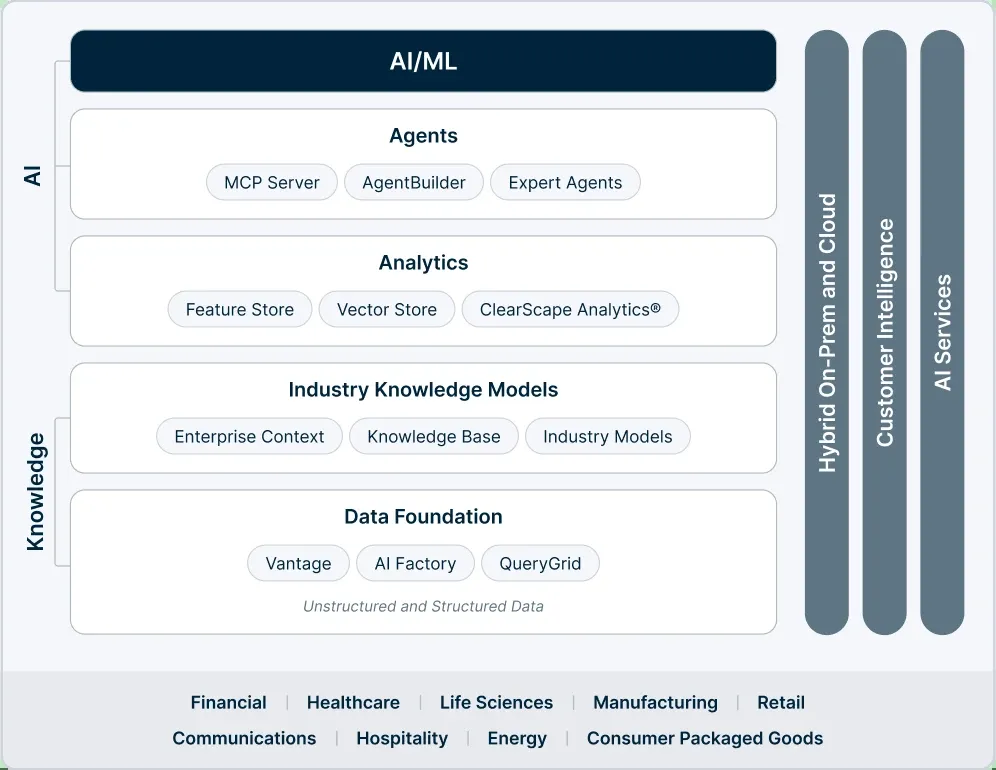
Teradata presents the Autonomous Knowledge Platform as an enterprise platform that connects data, AI, analytics, and agents so organizations can move from insight to action continuously. Its stated design joins a data foundation, knowledge context, AI, agent execution, and workspaces. The platform messaging focuses on trusted enterprise context, governed operation, and machine-driven workloads that can query, reason, and act at scale.
The deployment model is explicitly hybrid. Teradata states that the platform supports cloud, on-premises, and hybrid deployments, allowing organizations to select an operating model based on scale, cost, data-residency, and regulatory requirements. Its product portfolio also identifies Teradata Cloud as always-on, elastic, and autonomous; Teradata Factory as private AI and on-premises; and Teradata Fabric as unified access across locations.
The supplied platform evidence identifies several included capabilities: AI Studio, AgentStack as part of AI Studio, Enterprise Vector Store, Teradata Database, Connected Data Foundation, and Teradata Fabric. Teradata describes the platform as supporting AI, lakehouse, and data-engineering workloads, alongside retrieval-augmented generation (RAG), fraud detection and risk modeling, customer intelligence and personalization, operational decision automation, and multi-modal AI applications.
Teradata reports that 7 of the top 10 telecommunication companies use its technology. That is a vendor-reported industry measurement, not a substitute for workload validation. Buyers should evaluate the platform against their own data locations, governance requirements, operational processes, and planned AI use cases.
Key Features and Architecture
Teradata describes its architecture as a connected system in which the foundation, knowledge, AI, agents, and workspaces work together. The Connected Data Foundation is the data layer: it provides consistent access to data across environments, formats, and platforms, allowing organizations to work with data where it resides without duplication while maintaining governance, performance, and scalability. Teradata also describes a connected foundation that unifies structured and unstructured data across environments.
The platform’s autonomous operation has two stated levels. At the system level, it automatically optimizes compute, performance, cost, and data placement according to workload demand. At the knowledge level, it incorporates new data, context, and outcomes to update and refine enterprise knowledge. Teradata positions these feedback loops as a way to optimize performance, cost, governance, and execution over time.
For AI application context, Enterprise Vector Store manages, stores, and retrieves unstructured data through vector embeddings. It supports hybrid search, combining semantic vector search with lexical keyword search, and fusion search across structured tables and unstructured documents or content. Teradata lists text, PDFs, images, audio, and video as supported multi-modal unstructured formats. It also says integrations with NVIDIA and Unstructured automate preprocessing and embedding generation for unified ingestion.
Developers can access Enterprise Vector Store through APIs and integrations for embedding, indexing, retrieval, and RAG workflows. Teradata distinguishes this capability from a standalone vector database by connecting vectors with structured data, governance, and workflows. AI Studio, including AgentStack, is listed among the platform capabilities; the supplied evidence does not specify feature entitlements, APIs beyond the vector-store access described above, or technical limits for these products.
Teradata Fabric is named as a platform capability, while the portfolio describes it as unified access across locations. The supplied evidence does not provide a connector inventory, data-transfer mechanics, performance benchmarks, or service-level commitments. Those details should be established in an architecture review or proof-of-value using the buyer’s actual cloud, on-premises, and hybrid requirements.
Ideal Use Cases
Teradata is relevant for organizations that need to operate data, analytics, AI, and agents across cloud, on-premises, or hybrid environments. The platform explicitly connects structured and unstructured data across environments and supports requirements involving scale, cost, data residency, and regulatory constraints. This makes it appropriate to assess where an operating model cannot be reduced to a single deployment location.
The supplied evidence identifies AI and data use cases including RAG, fraud detection and risk modeling, customer intelligence and personalization, operational decision automation, multi-modal AI applications, lakehouse workloads, and data engineering. Enterprise Vector Store is particularly relevant for teams that need vector-embedding storage and retrieval, hybrid semantic and lexical search, or combined access to structured tables and unstructured content. Its stated format coverage includes text, PDFs, images, audio, and video.
Teradata also frames the platform for continuous, high-concurrency machine-driven workloads, where AI systems and agents query, reason, and act at scale. The vendor describes financial institutions monitoring and acting on risk signals in real time, healthcare organizations improving response times and operational efficiency, retailers optimizing pricing, promotions, and inventory dynamically, and manufacturers predicting and preventing failures across global operations. These are stated platform examples, rather than documented outcome commitments for a prospective buyer.
Existing Teradata customers can adopt new capabilities without fully re-architecting current data, applications, or workflows, according to Teradata. Organizations can evaluate cloud, on-premises, and hybrid scenarios through proof-of-value programs, real-world workloads, and architecture reviews. The supplied evidence does not state minimum data volumes, team-size thresholds, supported cloud-provider names, free-tier capacity, or implementation timelines. Buyers should therefore use an evaluation to confirm deployment fit, governance controls, integration requirements, and workload economics.
Strengths & Trade-offs
The following points reflect the supplied official platform and pricing material. They describe stated product design and commercial structure, not independent performance testing or customer-review findings.
Pros
- Hybrid deployment choice. Teradata states support for cloud, on-premises, and hybrid deployments, with selection based on requirements including scale, cost, data residency, and regulation.
- Connected data foundation. The Connected Data Foundation provides consistent access across environments, formats, and platforms, and Teradata says organizations can work with data where it resides without duplication.
- Structured and unstructured data support. Enterprise Vector Store combines vector embeddings with structured data, governance, and workflows, and supports text, PDFs, images, audio, and video.
- Search and RAG capabilities. The platform supports hybrid semantic-plus-lexical search, fusion search across tables and unstructured content, and API or integration access for embedding, indexing, retrieval, and RAG workflows.
- Autonomous optimization direction. Teradata states that the platform automatically optimizes compute, performance, cost, and data placement based on workload demand, while incorporating new data, context, and outcomes into enterprise knowledge.
- Defined commercial framework. Fixed + Flex combines a committed baseline for steady-state workloads with elastic capacity for changing demand, using Teradata Units across compute, storage, software, and AI.
Considerations
- No public monetary price is supplied. The official pricing evidence does not publish an amount, currency, package entitlement, unit rate, or term length.
- Commercial evaluation is required. Buyers need to confirm committed capacity, Flex rates, storage option, package terms, and renewal treatment with a Teradata pricing specialist.
- Technical limits are not stated. The supplied material does not provide benchmark results, connector inventories, capacity limits, latency characteristics, or service-level commitments.
- Deployment selection remains a buyer decision. Although cloud, on-premises, and hybrid models are supported, the evidence does not identify which deployment is best for a particular workload.
- Package changes have timing conditions. Teradata says upgrades can occur at any time, but downgrades take effect at the next contract renewal.
A proof-of-value with real-world workloads and an architecture review is the evidence-backed evaluation path Teradata describes.