Decision comparison
Snowflake vs Teradata
Snowflake is the stronger choice for cloud-native teams that prioritize ease of use, elastic scaling, and a broad data sharing ecosystem. Teradata is better suited for large enterprises that need hybrid or on-premises deployment, in-database analytics, and sophisticated mixed workload management. Both platforms deliver enterprise-grade data warehousing, but they serve different operational models and infrastructure strategies.
Direct comparison. These are reviewed substitutes bought for the same job, so the differences below are the ones that decide between them.
All 2 are cloud data warehouses.
Quick Comparison
| Decision factor | Snowflake | Teradata |
|---|---|---|
| Best For | Cloud-native analytics teams that want elastic scaling and data sharing without running infrastructure, on AWS, Azure or GCP | Large enterprises needing hybrid or on-premises deployment and mixed workload management, including regulated sectors that must keep some data in their own estate |
| Pricing Model | Snowflake prices on consumption, not a subscription: its pricing page states "We keep pricing simple with a consumption-based pricing model" and publishes no monthly or per-user price. Editions are Standard, Enterprise, Business Critical and Virtual Private Snowflake. Per-credit rates are scoped by edition, cloud and region: the Service Consumption Table effective 2026-09-09 lists on-demand AWS US East at $2.00 (Standard), $3.00 (Enterprise), $4.00 (Business Critical) and $6.00 (VPS), rising to $2.60/$3.90/$5.20 in AWS EU Dublin, so no single platform-wide credit price exists. Storage is billed separately at $23.00 per TB per month on demand in US East, less under capacity commitments. A 30-day free trial ends when the period or the included credit balance runs out; that is a trial, not a free tier. Verified 2026-09-16. | Usage-based pricing with options including $1.50, $4.80, $6.00, $7.20, $9,000/mo, and $10,500/mo. |
| Deployment | Multi-cloud across AWS, Azure and GCP, but cloud-only: there is no on-premises edition | Public cloud, hybrid cloud, and on-premises through IntelliFlex or VMware, managed together |
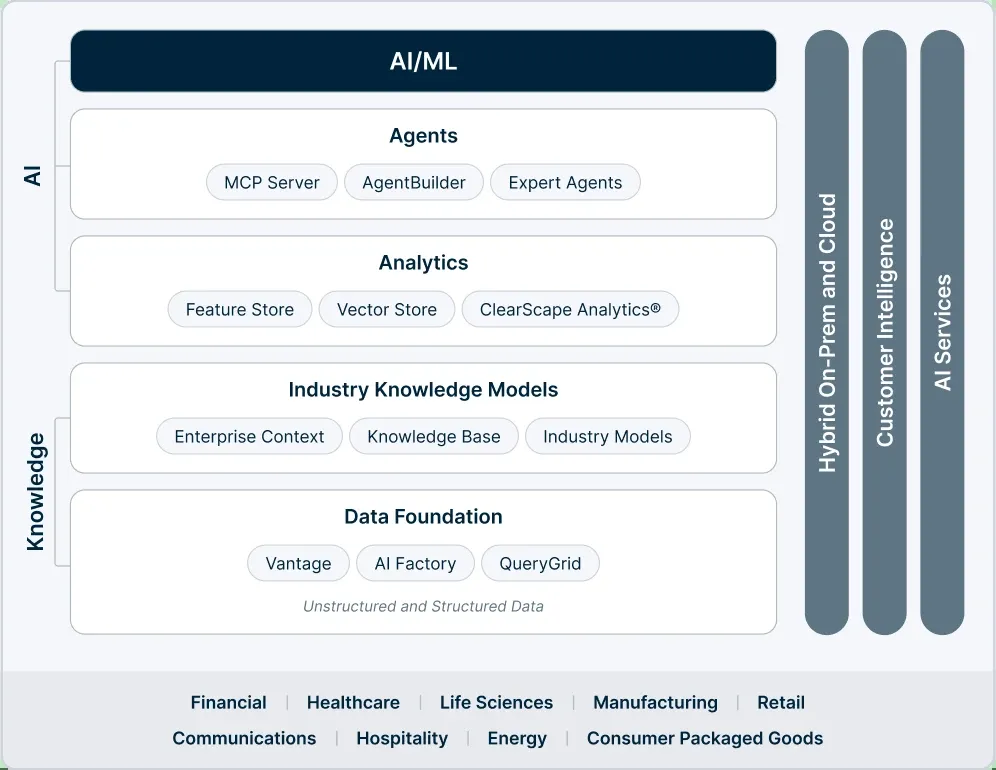
| AI/ML Capabilities | Snowpark for building pipelines and models, LLM deployment, and the Snowflake Intelligence agent for natural-language querying | ClearScape Analytics with ModelOps and Bring Your Own LLM, so models run in the database where the data already sits |
| User Rating | 8.7 out of 10 across 455 reviews | 8.1 out of 10 across 220 reviews |
Snowflake
- Best For:
- Cloud-native analytics teams that want elastic scaling and data sharing without running infrastructure, on AWS, Azure or GCP
- Pricing Model:
- Snowflake prices on consumption, not a subscription: its pricing page states "We keep pricing simple with a consumption-based pricing model" and publishes no monthly or per-user price. Editions are Standard, Enterprise, Business Critical and Virtual Private Snowflake. Per-credit rates are scoped by edition, cloud and region: the Service Consumption Table effective 2026-09-09 lists on-demand AWS US East at $2.00 (Standard), $3.00 (Enterprise), $4.00 (Business Critical) and $6.00 (VPS), rising to $2.60/$3.90/$5.20 in AWS EU Dublin, so no single platform-wide credit price exists. Storage is billed separately at $23.00 per TB per month on demand in US East, less under capacity commitments. A 30-day free trial ends when the period or the included credit balance runs out; that is a trial, not a free tier. Verified 2026-09-16.
- Deployment:
- Multi-cloud across AWS, Azure and GCP, but cloud-only: there is no on-premises edition
- AI/ML Capabilities:
- Snowpark for building pipelines and models, LLM deployment, and the Snowflake Intelligence agent for natural-language querying
- User Rating:
- 8.7 out of 10 across 455 reviews
Teradata
- Best For:
- Large enterprises needing hybrid or on-premises deployment and mixed workload management, including regulated sectors that must keep some data in their own estate
- Pricing Model:
- Usage-based pricing with options including $1.50, $4.80, $6.00, $7.20, $9,000/mo, and $10,500/mo.
- Deployment:
- Public cloud, hybrid cloud, and on-premises through IntelliFlex or VMware, managed together
- AI/ML Capabilities:
- ClearScape Analytics with ModelOps and Bring Your Own LLM, so models run in the database where the data already sits
- User Rating:
- 8.1 out of 10 across 220 reviews
Public signals
Verified factual signals only. Bars appear only for like-for-like metrics with five weekly assessments for every tool; missing evidence stays explicit. These signals do not establish enterprise adoption, product quality, or total cost.
| Metric | Snowflake | Teradata |
|---|---|---|
| GitHub commits, 90d(Developer adoption) | 68 | 7 |
| GitHub stars(Developer adoption) | 730 | 74 |
| Search interest(Market interest) | 2 | 2 |
| Hacker News mentions, 90d(Community interest) | 0 | Not available |
| npm weekly downloads(Developer adoption) | 1.7M | 9.2k |
| PyPI weekly downloads(Developer adoption) | 22.9M | 1.2M |
| Stack Overflow questions(Community interest) | 12.2k | 5.6k |
As of September 21, 2026 — updated weekly.
Health & risk evidence
Observed public-source checks for mapped package versions and repositories.
Snowflake
September 21, 2026Package vulnerabilities
PyPI · snowflake-connector-python@4.7.4 · npm · snowflake-sdk@3.3.0
0 vulnerabilities
across 2 packages
Repository security score
github.com/snowflakedb/snowflake-connector-python
5.0/10
Teradata
September 21, 2026Package vulnerabilities
npm · teradatasql@20.0.68 · PyPI · teradatasql@20.0.0.68
0 vulnerabilities
across 2 packages
Repository security score
Not available
Interface Preview
Teradata
Feature Comparison
| Feature | Snowflake | Teradata |
|---|---|---|
| Architecture & Deployment | ||
| Cloud-Native Architecture | Yes — built cloud-native from the ground up | Yes — VantageCloud is cloud-native |
| On-Premises Deployment | No — cloud-only | Yes — IntelliFlex and VMware options |
| Hybrid Cloud Support | No — multi-cloud but no on-prem component | Yes — full hybrid cloud with unified management |
| Compute-Storage Separation | Yes — fully independent scaling | Yes — in VantageCloud deployments |
| Multi-Cloud Support | AWS, Azure, and GCP | AWS, Azure, and GCP |
| Analytics & AI | ||
| In-Database Analytics | Limited — relies on Snowpark for advanced analytics | Yes — industry-leading in-database analytic functions |
| ML Model Deployment | Snowpark ML, custom LLM deployment | ClearScape Analytics, ModelOps, Bring Your Own LLM |
| Enterprise Vector Store | Cortex-based vector search | Native Enterprise Vector Store |
| Mixed Workload Management | Separate virtual warehouses per workload | Unified workload management across all query types |
| Natural Language Querying | Snowflake Intelligence agent | AI-powered autonomous agents via Loom |
| Data Management | ||
| Open Table Format Support | Apache Iceberg interoperability | Apache Iceberg and Delta Lake support |
| Data Sharing | Native live data sharing across accounts and clouds | Data fabric for distributed data access |
| Data Engineering Pipelines | Snowpipe, Streams, Tasks for pipeline orchestration | Native data engineering with extensive ETL capabilities |
| Security & Governance | ||
| Encryption | Automatic encryption; Tri-Secret Secure on Business Critical | Enterprise-grade encryption across all deployments |
| Governance Controls | Granular access controls on Enterprise tier and above | Unified governance and observability built-in |
| Ecosystem & Support | ||
| Partner Ecosystem | Large marketplace with 700+ partners and integrations | Partnerships with major cloud providers and system integrators |
| Community & Resources | Active developer community, open-source contributions | Enterprise-focused support, consulting, and managed services |
| Time Travel / Data Recovery | Up to 90 days on Enterprise; Fail-safe recovery | Point-in-time recovery with enterprise backup |
Architecture & Deployment
Cloud-Native Architecture
On-Premises Deployment
Hybrid Cloud Support
Compute-Storage Separation
Multi-Cloud Support
Analytics & AI
In-Database Analytics
ML Model Deployment
Enterprise Vector Store
Mixed Workload Management
Natural Language Querying
Data Management
Open Table Format Support
Data Sharing
Data Engineering Pipelines
Security & Governance
Encryption
Governance Controls
Ecosystem & Support
Partner Ecosystem
Community & Resources
Time Travel / Data Recovery
Which to choose
Snowflake is the stronger choice for cloud-native teams that prioritize ease of use, elastic scaling, and a broad data sharing ecosystem. Teradata is better suited for large enterprises that need hybrid or on-premises deployment, in-database analytics, and sophisticated mixed workload management. Both platforms deliver enterprise-grade data warehousing, but they serve different operational models and infrastructure strategies.
Best-fit scenarios
Choose Snowflake if:
Snowflake offers the simplest path to cloud data warehousing with consumption-based pricing, near-zero maintenance, and a massive partner ecosystem. Teams that run primarily on public cloud infrastructure and value fast onboarding will find Snowflake more accessible.
Choose Teradata if:
Teradata provides the deployment flexibility that heavily regulated industries require, including on-premises and hybrid cloud options. Its in-database analytics engine and mixed workload management handle complex enterprise analytics without moving data between systems.
These scenarios reflect the available product evidence. Your requirements, existing stack, and team expertise should guide the final decision.
Frequently Asked Questions
Is Snowflake or Teradata better for large-scale enterprise analytics?
It depends on your deployment model. Snowflake excels at cloud-native analytics with elastic scaling and near-zero maintenance. Teradata is purpose-built for large enterprise workloads with its in-database analytics and mixed workload management capabilities. Organizations already running hybrid infrastructure often find Teradata a better fit, while cloud-first companies typically prefer Snowflake.
How does Snowflake pricing compare to Teradata pricing?
Both use consumption-based pricing, but the unit differs. Snowflake charges per credit, priced by edition: its Service Consumption Table lists $2.00 for Standard, $3.00 for Enterprise and $4.00 for Business Critical per credit in AWS US regions, with storage billed separately at $23.00 per TB per month on demand, rising to about $40 in the costliest regions. Teradata prices by unit instead: VantageCloud Lake starts at $4.80 per hour for US regions and Lake+ at $7.20, while VantageCloud Enterprise starts at $9,000 per month and Enterprise+ at $10,500. The practical difference is that Snowflake's bill tracks query activity, while Teradata's packages set a monthly floor.
Can Teradata be deployed on-premises while Snowflake cannot?
Yes. Teradata offers full on-premises deployment through IntelliFlex and VMware options, plus hybrid cloud configurations. Snowflake is exclusively cloud-based and runs on AWS, Azure, and GCP. Organizations with strict data residency requirements or existing on-premises infrastructure investments may need Teradata's deployment flexibility.
Which platform has stronger AI and machine learning capabilities?
Teradata offers deeper in-database analytics through ClearScape Analytics, ModelOps, and its Bring Your Own LLM capability. Snowflake provides Snowpark for ML development, LLM deployment, and Snowflake Intelligence for natural language querying. Teradata's strength is running analytics where the data lives, while Snowflake focuses on making AI accessible through its cloud ecosystem.
What industries typically choose Teradata over Snowflake?
Teradata has strong adoption in heavily regulated industries. Ten of the top 10 banks, seven of the top 10 airlines, and seven of the top 10 telecom companies use Teradata. These organizations value hybrid deployment, enterprise-grade workload management, and decades of proven reliability at scale. Snowflake has extensive adoption across technology, retail, and media companies that operate cloud-first.