Decision comparison
Teradata vs Vertica
Choose Teradata for a governed enterprise data estate that must span AWS, Azure, GCP, hybrid environments, and on-premises systems while supporting data fabric and LLM-oriented capabilities. Choose Vertica for high-speed, large-scale SQL analytics where columnar storage, compression, fast loading, real-time analysis, and a $3.19-per-hour starting reference are central requirements.
Vertica is now sold under new ownership
Vertica is now sold by Rocket Software, which completed its acquisition of the product from OpenText on 11 May 2026. Pricing and packaging are set by Rocket Software; vertica.com redirects to their product page.
Direct comparison. These are reviewed substitutes bought for the same job, so the differences below are the ones that decide between them.
All 2 are cloud data warehouses.
Quick Comparison
| Decision factor | Teradata | Vertica |
|---|---|---|
| Best For | Large enterprises needing governed, hybrid multi-cloud warehousing, data fabric integration, in-database analytics, and AI initiatives across AWS, Azure, GCP, or on-premises. | Teams running large-scale, fast SQL analytics that value columnar storage, compression, real-time workloads, self-service analysis, and in-database machine learning. |
| Architecture | Vantage unifies data warehouses, lakes, analytics, and new data types across public cloud, hybrid multi-cloud, IntelliFlex appliances, and VMware commodity hardware. | Unified analytics database using columnar storage and advanced compression, with in-database machine learning, real-time analytics, and flexible deployment options. |
| Pricing Model | Usage-based pricing with options including $1.50, $4.80, $6.00, $7.20, $9,000/mo, and $10,500/mo. | Starts at $3.19 per hour, usage-based pricing |
| Ease of Use | Strong enterprise data ingestion and workload-management feedback, though users report cloud integration, tight integration, unstructured-data, and development-cycle challenges. | Users report easy use, fast loading, self-service access, and real-time analysis, while setup and limited options are recurring reported concerns. |
| Scalability | Built for massive enterprise workloads with flexible deployment, unified distributed-data access, workload management, and pricing intended to scale from small starts. | Designed for large-scale analytics, combining columnar storage, compression, fast loading, scale-up feedback, and real-time analytical processing. |
| Community/Support | Enterprise-oriented platform with consulting and managed services; the Teradata SQL Driver for Python repository has 74 stars and NOASSERTION licensing. | OpenText enterprise support and flexible licensing; the official Python client has 386 stars, Apache-2.0 licensing, and release 1.4.0. |
Teradata
- Best For:
- Large enterprises needing governed, hybrid multi-cloud warehousing, data fabric integration, in-database analytics, and AI initiatives across AWS, Azure, GCP, or on-premises.
- Architecture:
- Vantage unifies data warehouses, lakes, analytics, and new data types across public cloud, hybrid multi-cloud, IntelliFlex appliances, and VMware commodity hardware.
- Pricing Model:
- Usage-based pricing with options including $1.50, $4.80, $6.00, $7.20, $9,000/mo, and $10,500/mo.
- Ease of Use:
- Strong enterprise data ingestion and workload-management feedback, though users report cloud integration, tight integration, unstructured-data, and development-cycle challenges.
- Scalability:
- Built for massive enterprise workloads with flexible deployment, unified distributed-data access, workload management, and pricing intended to scale from small starts.
- Community/Support:
- Enterprise-oriented platform with consulting and managed services; the Teradata SQL Driver for Python repository has 74 stars and NOASSERTION licensing.
Vertica
- Best For:
- Teams running large-scale, fast SQL analytics that value columnar storage, compression, real-time workloads, self-service analysis, and in-database machine learning.
- Architecture:
- Unified analytics database using columnar storage and advanced compression, with in-database machine learning, real-time analytics, and flexible deployment options.
- Pricing Model:
- Starts at $3.19 per hour, usage-based pricing
- Ease of Use:
- Users report easy use, fast loading, self-service access, and real-time analysis, while setup and limited options are recurring reported concerns.
- Scalability:
- Designed for large-scale analytics, combining columnar storage, compression, fast loading, scale-up feedback, and real-time analytical processing.
- Community/Support:
- OpenText enterprise support and flexible licensing; the official Python client has 386 stars, Apache-2.0 licensing, and release 1.4.0.
Public signals
Verified factual signals only. Bars appear only for like-for-like metrics with five weekly assessments for every tool; missing evidence stays explicit. These signals do not establish enterprise adoption, product quality, or total cost.
| Metric | Teradata | Vertica |
|---|---|---|
| GitHub commits, 90d(Developer adoption) | 7 | 0 |
| GitHub stars(Developer adoption) | 74 | 386 |
| Search interest(Market interest) | 2 | 1 |
| npm weekly downloads(Developer adoption) | 9.2k | 5.7k |
| PyPI weekly downloads(Developer adoption) | 1.2M | 875.0k |
| Stack Overflow questions(Community interest) | 5.6k | 1.5k |
| Docker Hub pulls(Product adoption) | Not available | 127.1k |
As of September 21, 2026 — updated weekly.
Health & risk evidence
Observed public-source checks for mapped package versions and repositories.
Teradata
September 21, 2026Package vulnerabilities
npm · teradatasql@20.0.68 · PyPI · teradatasql@20.0.0.68
0 vulnerabilities
across 2 packages
Repository security score
Not available
Vertica
September 21, 2026Package vulnerabilities
npm · vertica-nodejs@1.1.4 · PyPI · vertica-python@1.4.0
0 vulnerabilities
across 2 packages
Repository security score
github.com/vertica/vertica-python
3.2/10
Interface Preview
Teradata
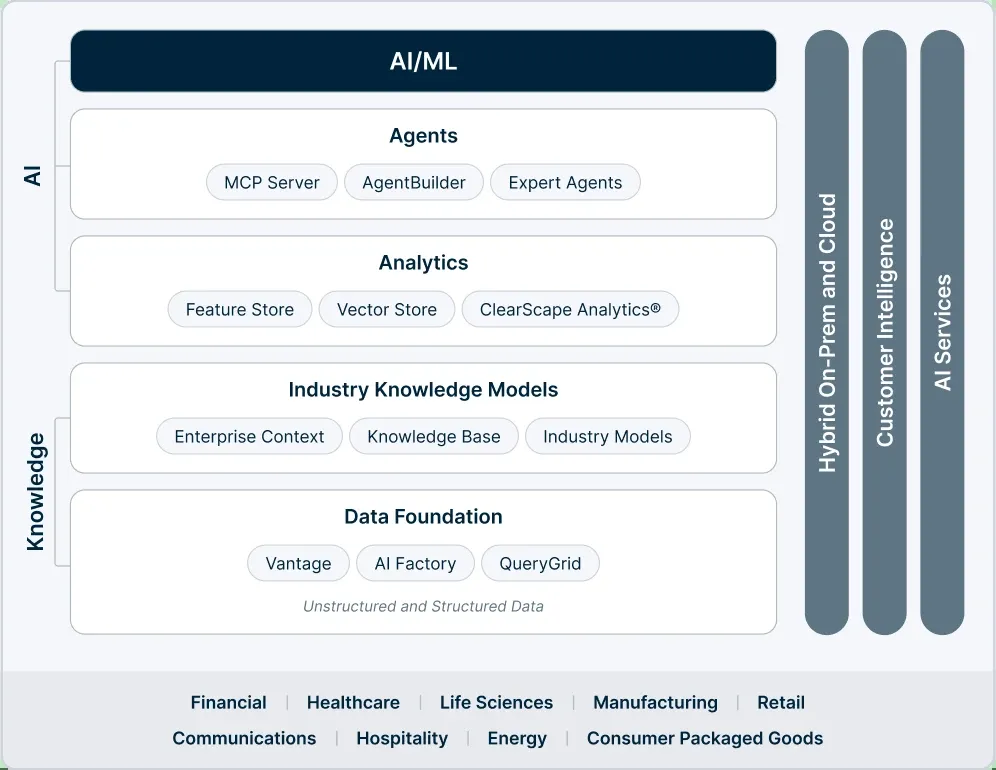
Feature Comparison
| Feature | Teradata | Vertica |
|---|---|---|
| Storage and data foundation | ||
| Primary data organization | Unified Vantage platform spans warehouses, lakes, analytics, and new data types | Columnar storage organizes analytical data for large-scale query workloads |
| Compression approach | Compression implementation is not specified in the provided product data | Advanced compression reduces disk-space requirements for analytical datasets |
| Distributed data access | Data fabric provides unified integration and management across distributed data | Unified analytics platform is designed for scalable centralized analytical workloads |
| Analytics and AI | ||
| In-database analytics | ClearScape Analytics delivers in-database analytics within the Vantage platform | Built-in machine learning runs alongside analytical data in the database |
| AI enablement | Supports Bring Your Own LLM, Enterprise Vector Store, and agent-based intelligence | Built-in machine learning supports data-driven analytical decision workloads |
| Real-time processing | Autonomous AI messaging emphasizes real-time decisions and business actions | Real-time analytics is a stated platform capability for fast data analysis |
| Deployment and cloud | ||
| Public cloud deployment | Deploys Vantage on AWS, Microsoft Azure, and Google Cloud | Flexible deployment is advertised, without named cloud providers in supplied data |
| Hybrid and on-premises options | Supports hybrid multi-cloud, IntelliFlex on-premises, and VMware commodity hardware | Flexible deployment is advertised; supplied data does not specify hybrid architecture |
| Cloud integration emphasis | Data fabric targets unified management across distributed cloud and enterprise data | Licensing can be tailored to compute, storage, or transfer requirements |
| Performance and operations | ||
| Workload handling | User feedback identifies workload management and high performance as strengths | Columnar design and compression target fast large-scale analytical query execution |
| Data ingestion and loading | Data ingestion is a listed feature and user-reported platform strength | Fast loading is a stated capability and user-reported strength |
| Self-service access | Enterprise reporting and analytics support governed organization-wide data access | Self-service analytics platform enables users to perform data analysis directly |
| Commercial and ecosystem | ||
| Commercial metering | Usage-based pricing lets customers control usage and spend at scale | Subscriptions may be tailored to compute, storage, or transfer requirements |
| Published pricing reference | Published amounts include $1.50 through $10,500 per month options | Third-party pricing data lists usage-based pricing starting at $3.19 hourly |
| Python ecosystem | Teradata SQL Driver for Python repository has 74 GitHub stars | Official native Python client is Apache-2.0 licensed with 386 GitHub stars |
Storage and data foundation
Primary data organization
Compression approach
Distributed data access
Analytics and AI
In-database analytics
AI enablement
Real-time processing
Deployment and cloud
Public cloud deployment
Hybrid and on-premises options
Cloud integration emphasis
Performance and operations
Workload handling
Data ingestion and loading
Self-service access
Commercial and ecosystem
Commercial metering
Published pricing reference
Python ecosystem
Which to choose
Choose Teradata for a governed enterprise data estate that must span AWS, Azure, GCP, hybrid environments, and on-premises systems while supporting data fabric and LLM-oriented capabilities. Choose Vertica for high-speed, large-scale SQL analytics where columnar storage, compression, fast loading, real-time analysis, and a $3.19-per-hour starting reference are central requirements.
Best-fit scenarios
Choose Teradata if:
Choose Teradata when you need Vantage across public cloud, hybrid multi-cloud, or on-premises infrastructure; enterprise workload management; data fabric; and governed AI capabilities such as BYO LLM and an Enterprise Vector Store.
Choose Vertica if:
Choose Vertica when analytical workloads benefit most from columnar storage, advanced compression, in-database machine learning, real-time queries, fast loading, and self-service access for data analysts.
These scenarios reflect the available product evidence. Your requirements, existing stack, and team expertise should guide the final decision.
Frequently Asked Questions
What is the main difference between Teradata and Vertica?
Teradata Vantage is positioned as a broad enterprise analytics cloud platform that unifies data warehouses, data lakes, analytics, and emerging data types. Its supplied capabilities emphasize data fabric, governed AI, ClearScape Analytics, BYO LLM, Enterprise Vector Store, and explicit AWS, Azure, GCP, hybrid, and on-premises deployment choices. Vertica is more specifically described as a unified analytics database built around columnar storage, advanced compression, real-time analytics, fast loading, self-service analytics, and in-database machine learning.
Which is better for small teams?
Vertica is generally the more direct fit for a small analytics-focused team when its columnar architecture, compression, fast loading, and self-service capabilities match the workload. The provided pricing reference starts at $3.19 per hour, which gives a concrete consumption entry point. Teradata can start small under its flexible usage model, but its strongest differentiation is enterprise-wide governed data, hybrid deployment, workload management, and AI-oriented platform capabilities; its supplied pricing includes enterprise monthly figures of $9,000 and $10,500.
Can I migrate from Teradata to Vertica?
Yes, but it should be treated as a database migration rather than a simple lift-and-shift. Both products support analytical SQL workloads, so schema, data, query, reporting, ingestion, security, and operational dependencies must be assessed. Teradata-specific dependencies may include Vantage deployment patterns, data fabric integrations, ClearScape in-database analytics, workload-management behavior, and AI or vector-store workflows. Validate Vertica equivalents using its columnar model, loading processes, real-time workload requirements, and in-database machine-learning capabilities before committing to cutover.
What are the pricing differences?
Both products use consumption-oriented commercial models, but the published references differ. Teradata states flexible usage-based enterprise pricing and provides amounts including $1.50, $4.80, $6.00, $7.20, $9,000 per month, and $10,500 per month; its pricing messaging emphasizes paying only for needed capacity and controlling spend. Vertica's supplied external pricing reference starts at $3.19 per hour, while its official licensing description says enterprise licenses and DBaaS subscriptions can be tailored to compute, storage, or transfer requirements. Compare the applicable meter and workload profile, not only headline rates.