Decision comparison
Alation vs Monte Carlo
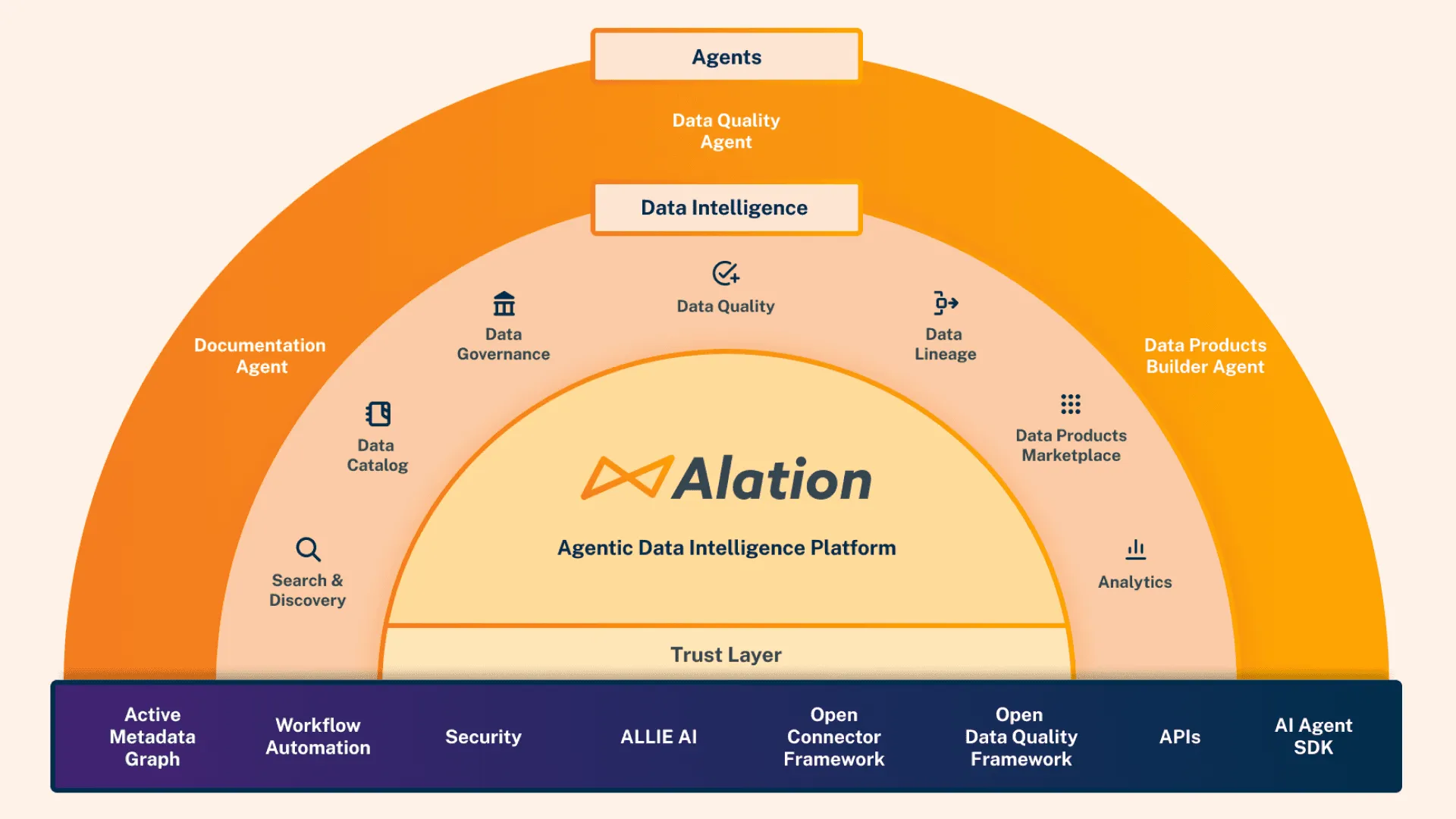
Alation and Monte Carlo address fundamentally different stages of the data lifecycle. Alation operates as a data intelligence platform where teams catalog, discover, govern, and query enterprise data assets through a unified hub with 120+ connectors. Monte Carlo operates as a data and AI observability platform where teams monitor pipeline health, detect anomalies, and resolve incidents before they affect downstream consumers. Most organizations with mature data operations deploy both tools together because cataloging without observability leaves data quality blind spots, while observability without cataloging leaves users unable to find or trust the data being monitored.
Architecture choice. These take different approaches to the same problem. Read the table as a fit question rather than a feature race.
These are different kinds of product — Data Catalog and Data Observability.
Quick Comparison
| Decision factor | Alation | Monte Carlo |
|---|---|---|
| Primary Function | Enterprise data intelligence platform combining cataloging, governance, and metadata management into a unified hub | Data and AI observability platform that monitors data pipelines, warehouses, and BI layers to detect data incidents |
| Data Lineage | End-to-end lineage tracking from source to destination with visual mapping across warehouses, BI tools, and pipelines | Column-level lineage across the entire data ecosystem with visual lineage tracking for understanding data flow and dependencies |
| Data Quality Approach | Integrates with external data quality tools through its Open Data Quality Framework, aggregating results into a single system of record | ML-driven anomaly detection with automated monitoring for freshness, volume, and schema; deploys monitors in seconds |
| Pricing Model | Alation publishes no pricing. alation.com/pricing resolves to a contact form, and no plan or edition names are published either, so every figure is set in a quote. | Monte Carlo publishes no amounts. Its tiers are Start, Scale, Enterprise and Business Critical, purchased as credits, and all are quote-only. Every tier includes agent, ML and data observability. |
| Deployment Time | 3 to 9 months with professional services involvement for full deployment | Fast setup with connection in seconds; start monitoring out of the box with automatic scaling |
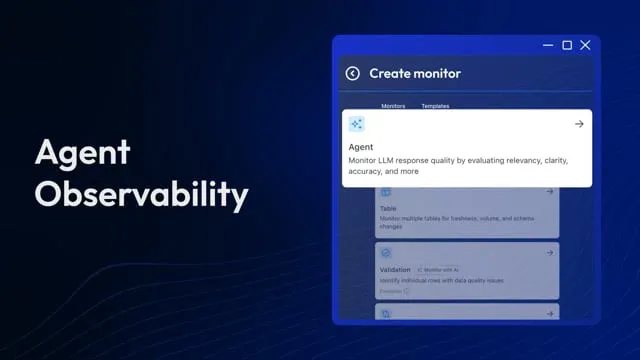
| AI Capabilities | Agentic workflows automate documentation and policy enforcement; ALLIE AI recommends metadata descriptions for intelligent curation | AI-powered monitoring agents automate monitor creation and deployment; agents handle troubleshooting and root cause analysis |
| User Rating | 9.3/10 based on 50 reviews | 9/10 based on 4 reviews |
| Best For | Large enterprises with mature data governance programs requiring a centralized data catalog with 120+ connectors | Data engineering teams needing automated pipeline monitoring, anomaly detection, and incident management across their data stack |
Alation
- Primary Function:
- Enterprise data intelligence platform combining cataloging, governance, and metadata management into a unified hub
- Data Lineage:
- End-to-end lineage tracking from source to destination with visual mapping across warehouses, BI tools, and pipelines
- Data Quality Approach:
- Integrates with external data quality tools through its Open Data Quality Framework, aggregating results into a single system of record
- Pricing Model:
- Alation publishes no pricing. alation.com/pricing resolves to a contact form, and no plan or edition names are published either, so every figure is set in a quote.
- Deployment Time:
- 3 to 9 months with professional services involvement for full deployment
- AI Capabilities:
- Agentic workflows automate documentation and policy enforcement; ALLIE AI recommends metadata descriptions for intelligent curation
- User Rating:
- 9.3/10 based on 50 reviews
- Best For:
- Large enterprises with mature data governance programs requiring a centralized data catalog with 120+ connectors
Monte Carlo
- Primary Function:
- Data and AI observability platform that monitors data pipelines, warehouses, and BI layers to detect data incidents
- Data Lineage:
- Column-level lineage across the entire data ecosystem with visual lineage tracking for understanding data flow and dependencies
- Data Quality Approach:
- ML-driven anomaly detection with automated monitoring for freshness, volume, and schema; deploys monitors in seconds
- Pricing Model:
- Monte Carlo publishes no amounts. Its tiers are Start, Scale, Enterprise and Business Critical, purchased as credits, and all are quote-only. Every tier includes agent, ML and data observability.
- Deployment Time:
- Fast setup with connection in seconds; start monitoring out of the box with automatic scaling
- AI Capabilities:
- AI-powered monitoring agents automate monitor creation and deployment; agents handle troubleshooting and root cause analysis
- User Rating:
- 9/10 based on 4 reviews
- Best For:
- Data engineering teams needing automated pipeline monitoring, anomaly detection, and incident management across their data stack
Public signals
Verified factual signals only. Bars appear only for like-for-like metrics with five weekly assessments for every tool; missing evidence stays explicit. These signals do not establish enterprise adoption, product quality, or total cost.
| Metric | Alation | Monte Carlo |
|---|---|---|
| GitHub commits, 90d(Developer adoption) | 2 | 231 |
| GitHub stars(Developer adoption) | 19 | 2 |
| Search interest(Market interest) | Unavailable | 0 |
| Product Hunt comments(Community interest) | 0 | Not available |
| Product Hunt reviews(Community interest) | 0 | Not available |
| Product Hunt votes(Community interest) | 2 | Not available |
| Stack Overflow questions(Community interest) | 12 | Not available |
| Hacker News mentions, 90d(Community interest) | Not available | 0 |
| PyPI weekly downloads(Developer adoption) | Not available | 41.2k |
As of September 21, 2026 — updated weekly.
Health & risk evidence
Observed public-source checks for mapped package versions and repositories.
Alation
Package vulnerabilities
Not available
Repository security score
Not available
Monte Carlo
September 21, 2026Package vulnerabilities
PyPI · montecarlodata@0.175.0
0 vulnerabilities
across 1 package
Repository security score
Not available
Interface Preview
Alation
Monte Carlo
Feature Comparison
| Feature | Alation | Monte Carlo |
|---|---|---|
| Data discovery and cataloging | ||
| Natural-language data discovery | Natural-language catalog search across definitions, lineage, policies, and trust signals | Not verified |
| Data catalog | Unified Data Catalog with 120+ connectors for enterprise discovery | Not verified |
| Governance and compliance | ||
| Centralized governance | Automated stewardship, access control, masking, approvals, lineage, and quality | Advanced security includes SSO, SCIM, PII filtering, and audit logging |
| AI governance | AI governance emphasizes quality, transparency, compliance, lineage, and collaboration | Not verified |
| Observability and reliability | ||
| Data and AI observability | Not verified | Monitors, traces, and troubleshoots enterprise agents in production |
| Anomaly detection | Not verified | ML-driven anomaly detection across pipelines, warehouses, and BI layers |
| Incident management | Not verified | Alert routing, lineage grouping, root-cause insights, and incident triaging |
| Lineage and delivery workflows | ||
| Data lineage | Clear lineage supports confident decisions, governance, policies, and quality | End-to-end column-level lineage supports root-cause analysis and impact analysis |
| Automation workflows | Agentic workflows automate documentation, policy enforcement, and data product delivery | Deploy monitors through CI/CD, UI, programmatically, or AI-powered workflows |
| Data products | Marketplace integrates governance into AI-driven, explainable, audit-ready data products | Not verified |
Data discovery and cataloging
Natural-language data discovery
Data catalog
Governance and compliance
Centralized governance
AI governance
Observability and reliability
Data and AI observability
Anomaly detection
Incident management
Lineage and delivery workflows
Data lineage
Automation workflows
Data products
Which approach fits
Alation and Monte Carlo address fundamentally different stages of the data lifecycle. Alation operates as a data intelligence platform where teams catalog, discover, govern, and query enterprise data assets through a unified hub with 120+ connectors. Monte Carlo operates as a data and AI observability platform where teams monitor pipeline health, detect anomalies, and resolve incidents before they affect downstream consumers. Most organizations with mature data operations deploy both tools together because cataloging without observability leaves data quality blind spots, while observability without cataloging leaves users unable to find or trust the data being monitored.
When each approach fits
Choose Alation if:
We recommend Alation for organizations that need a centralized data catalog to unify metadata discovery, governance, and self-service analytics across large enterprise data estates. Alation delivers the most value when your primary challenge is helping hundreds of business users find, understand, and trust data assets spread across multiple warehouses, BI tools, and applications. The platform's strength in policy management, stewardship workflows, and natural language querying makes it the stronger choice when regulatory compliance, data democratization, and AI-ready data products are the driving priorities for your data team.
Choose Monte Carlo if:
We recommend Monte Carlo for data engineering teams that need automated pipeline monitoring and anomaly detection to catch data quality issues before they reach dashboards and business decisions. Monte Carlo delivers the most value when your primary challenge is reducing data downtime, eliminating fire drills caused by silent pipeline failures, and scaling quality coverage across a growing data estate. The platform's ML-driven monitors, agent observability for AI systems, and near-instant setup make it the stronger choice when operational reliability, fast time to value, and proactive incident management are the driving priorities for your data team.
These scenarios reflect the available product evidence. Your requirements, existing stack, and team expertise should guide the final decision.
Frequently Asked Questions
Can Alation and Monte Carlo be used together?
Alation and Monte Carlo address complementary layers of the data stack and are frequently deployed together in enterprise environments. Alation handles the catalog, governance, and discovery layer where business users find and understand data assets, while Monte Carlo handles the observability layer where data engineers monitor pipeline health and detect anomalies. Monte Carlo integrates with data catalog tools to push quality signals into the catalog interface, giving users trust context alongside metadata. Organizations running both tools benefit from a closed loop where Monte Carlo detects data incidents, Alation surfaces the governance and lineage context needed to assess impact, and teams resolve issues with full visibility across the stack.
How do the pricing models compare between Alation and Monte Carlo?
Alation uses an enterprise licensing model with base subscriptions starting at $60,000 to $198,000 per year, user licenses sold in minimum packs of 25 Creator seats, and additional costs for connectors, governance modules, and professional services. Mid-sized deployments typically reach $413,660 annually when all costs are included. Monte Carlo uses a credit-based consumption model across four tiers: Start (up to 10 users, 1,000 monitors), Scale (unlimited users with advanced security), Enterprise (multi-workspace support), and Business Critical (maximum availability). Monte Carlo does not publicly list per-credit pricing and requires contacting sales for quotes. The key structural difference is that Alation costs scale primarily with the number of licensed users and connectors, while Monte Carlo costs scale with the number of monitors and API calls consumed.
Which tool provides better data lineage capabilities?
Both platforms implement data lineage but serve different purposes with their lineage implementations. Alation provides end-to-end lineage visualization that maps how data flows from source to report, capturing both technical lineage across tables, columns, and pipelines, and business lineage across dashboards, policies, and usage patterns. This lineage serves discovery and governance use cases, helping users understand data provenance and assess trustworthiness. Monte Carlo provides column-level lineage enriched with observability data that connects detected anomalies to their downstream impact on dashboards and business processes. This lineage serves incident management use cases, helping engineers quickly identify which downstream consumers are affected when an upstream issue occurs. Organizations that need lineage for both governance and operational troubleshooting benefit from having both perspectives available.
What are the key deployment differences between Alation and Monte Carlo?
Alation deployments typically require 3 to 9 months with professional services involvement, including architecture design, connector setup, workflow customization, and training. The platform offers both Alation Cloud Service (SaaS) and customer-managed on-premises deployment options. Industry analyses estimate approximately 21 months to realize ROI from an Alation deployment. Monte Carlo connects to data sources in seconds and provides automatic baseline monitoring out of the box for common issues like freshness, volume, and schema changes. The Start tier includes self-guided onboarding with a 24-hour support SLA, while Scale and Enterprise tiers offer expert-guided onboarding with 8-hour and 4-hour support SLAs respectively. The deployment difference reflects the fundamental scope difference: Alation requires extensive configuration of governance policies, stewardship workflows, and user roles across the organization, while Monte Carlo's ML-driven approach automatically learns baselines and surfaces anomalies with minimal manual configuration.