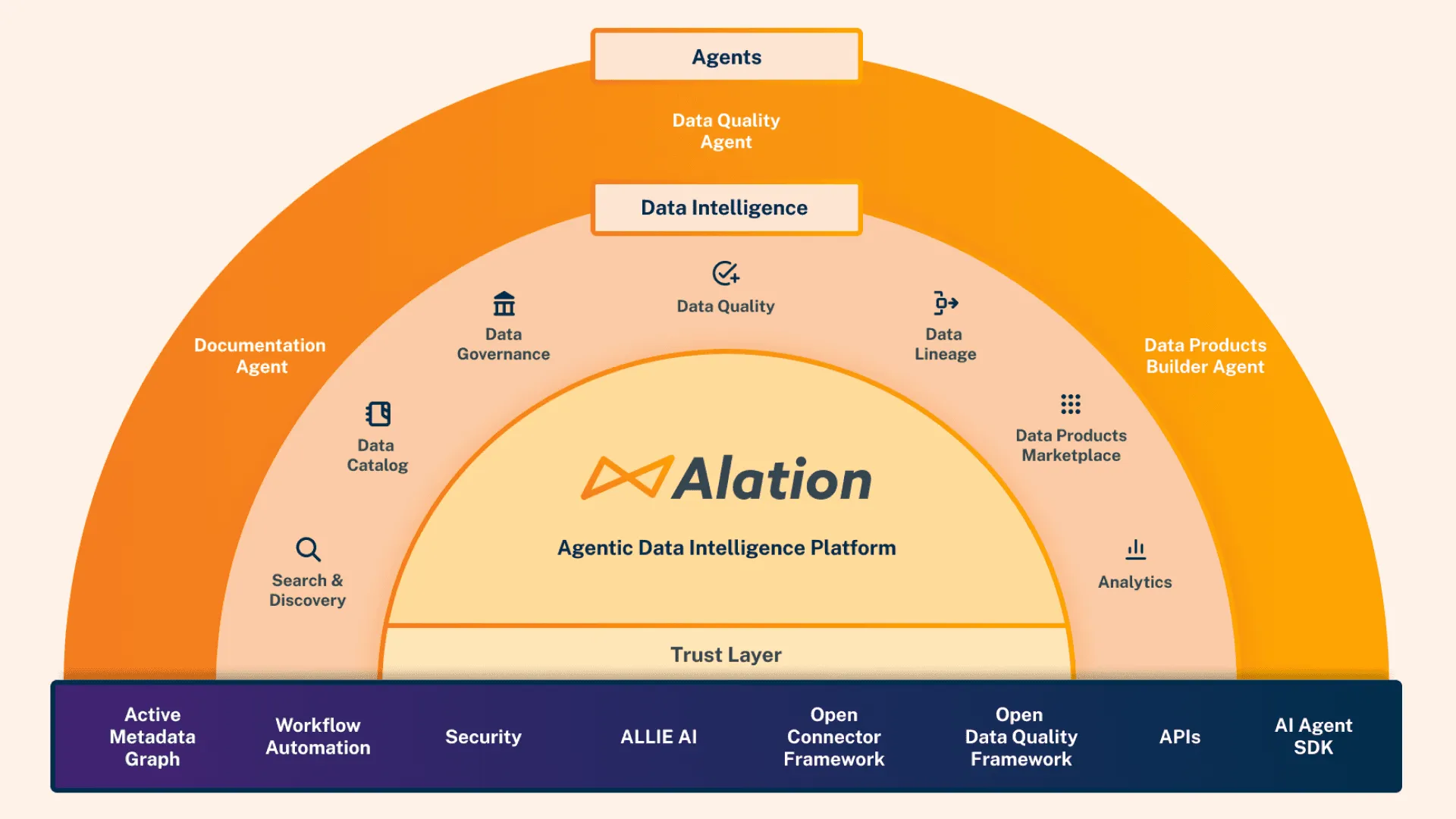
Alation: product and architecture
In this Alation review, we evaluate the enterprise data intelligence platform that pioneered the data catalog category and continues to lead in making enterprise data discoverable and trustworthy. Alation provides data cataloging, governance, lineage tracking, and AI-powered search capabilities that serve organizations with thousands of datasets where nobody knows what is where. Named a five-time Leader in Gartner's Magic Quadrant for Metadata Management Solutions and trusted by 40% of the Fortune 100, Alation brings order to data chaos at enterprise scale. We assess its features, real-world pricing, strengths, limitations, and how it compares to modern alternatives like Atlan, Collibra, and OpenMetadata to help data teams make an informed decision. With a 9.3 out of 10 user rating across 50 verified reviews, Alation has earned strong marks for data governance and catalog capabilities.
Overview
Alation is an agentic data intelligence platform founded to solve the fundamental problem of enterprise data discovery: teams waste days hunting for the right datasets across warehouses and BI tools. The platform combines machine learning with human insight through its Behavioral Analysis Engine to automate data discovery and cataloging. Alation supports over 120 pre-built connectors spanning relational databases, flat files, BI systems, applications, and AI models, providing unified access to metadata across an organization's entire data estate. The platform is trusted by 40% of the Fortune 100 for building trusted data products, scaling self-service analytics, and governing data and AI assets. A documented case study shows a national retailer saved 50,268 search hours, 100,537 comprehension hours, and 12,222 query writing hours. Alation was named a Leader in both the 2025 Gartner Magic Quadrant for Metadata Management Solutions and the 2025 Forrester Data Governance Solutions report, with customers highlighting its intuitive UX, flexible integration, and superior collaboration features.
Key Features and Architecture
Alation's architecture centers on the Agentic Data Intelligence Platform, a single hub where cataloging, governance, lineage, and data quality converge. Agentic workflows automate documentation, enforce policies, and streamline data product delivery through AI-driven processes.
The Data Catalog unifies discovery with natural-language search, surfacing frequently accessed data assets as users type. The catalog uses machine learning to interpret natural language and pinpoint the right data without requiring technical jargon or specific keywords. Each asset displays descriptions, terms, definitions, policies, documentation, lineage, tags, quality flags, endorsements, and comments from other users.
The Governance Engine centralizes policies, automates stewardship, and enforces access control, data masking, and approvals across the data estate. Policies are tied directly to lineage and quality signals, making compliance provable rather than aspirational. Workflow Automation improves metadata quality, consistency, and compliance by automatically adding new data assets to the catalog as they are created.
ALLIE AI recommends metadata descriptions and helps efficiently populate the data catalog with Intelligent Curation and AI assistance. The Compose SQL Editor allows teams to write, share, and reuse SQL queries across technical and non-technical users.
For AI-ready data delivery, Alation's Data Products Marketplace enables anyone to ask questions of enterprise data products in natural language and get trusted answers instantly. Behind the scenes, metadata-aware agents handle the SQL, cite sources, and display lineage, policies, and usage. The Chat with Your Data feature delivers answers with 60% more accuracy from these metadata-aware agents.
Alation supports end-to-end data lineage visualization from source to destination, integration with tools like Excel, Slack, Teams, Tableau, and Power BI through Alation Anywhere, and an Open Data Quality Framework for connecting to third-party data quality tools.
Ideal Use Cases
Alation is best suited for large enterprises with 50 or more data contributors and complex multi-cloud data estates spanning Snowflake, Redshift, BigQuery, and Databricks. Organizations where regulatory compliance demands enterprise-grade data lineage and governance documentation will find Alation's provable compliance capabilities essential.
We recommend Alation for data governance teams at Fortune 500 companies that need a single source of truth across hundreds of databases and BI systems. The platform excels when organizations need to break down data silos, enabling business users to find, understand, and trust data without waiting for IT.
Alation is a strong fit for organizations building AI and machine learning pipelines that require trusted, governed data products. The Data Products Marketplace and AI governance framework ensure data quality, transparency, and compliance for model training and inference.
Alation is best suited to data teams with at least 15 active catalog users and an enterprise budget, though Alation publishes no figure to size that against. The platform requires a 3-to-9-month implementation with professional services, and the 21-month average time to ROI makes it impractical for startups or teams needing quick time-to-value. Teams running a simple Snowflake-and-dbt stack should consider Atlan for faster deployment.
Strengths & Trade-offs
Pros:
- Natural-language search powered by machine learning makes data discovery intuitive for both technical and business users
- Over 120 pre-built connectors spanning warehouses, databases, BI tools, and applications, with an Open Connector Framework for custom sources
- Five-time Gartner Magic Quadrant Leader with a 9.3 out of 10 user rating across 50 reviews
- AI-powered catalog curation with ALLIE AI automates metadata descriptions and reduces manual stewardship burden Documented savings at a national retailer through search, comprehension, and query writing time reduction
- Data Products Marketplace with Chat with Your Data delivers natural-language answers with 60% more accuracy
Cons:
- Alation publishes no pricing at all, so there is no public figure to budget or benchmark against before entering a sales process
- Implementation requires 3 to 9 months with professional services, and ROI takes an average of 21 months to materialize
- User experience has been flagged as an area for improvement, with some users noting the interface could be more user-friendly
- No free tier or self-service trial, requiring a sales engagement to evaluate the platform